
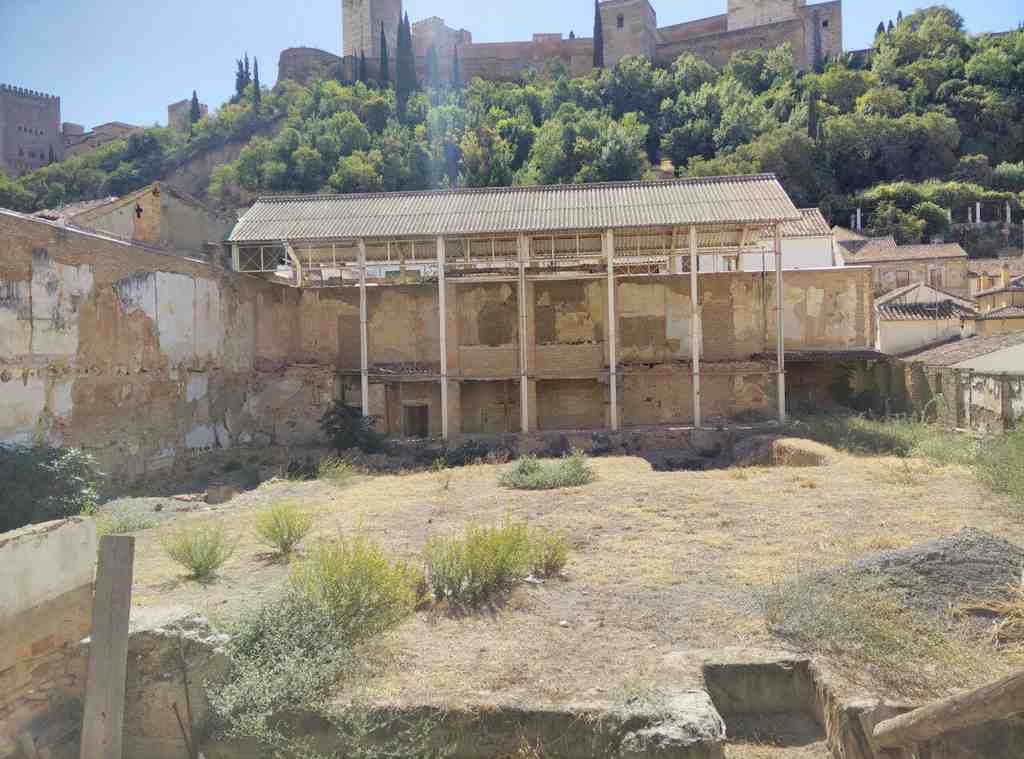
Right in front of you, you’ll spot the Maristán Nazarí as a large, partly open structure surrounded by crumbling yellow-brown walls with rough patches, sheltered by a roof held up by thin white columns-it faces you like an ancient, sleepy giant at the foot of the green hillside.
Now, let’s transport ourselves through time! Imagine standing here centuries ago. The year is 1365, and beneath your feet echo the bustling footsteps of Granada’s past. Sultans and servants, doctors and the destitute-all crossed this ground. If you listen carefully, you might even hear a distant murmur of voices and a soft splash from water as horses haul buckets from the river below.
The Maristán Nazarí was no average building; it was the very first hospital built for the poor and the sick in Muslim Granada. Sultan Muhammad V ordered it to rise quickly-perhaps he was a bit impatient, or maybe he just hated waiting rooms as much as we do! In just two years, the hospital opened as both a refuge for the ill and even as a home for those suffering in mind, not just body. Picture the clatter of wooden carts, the urgent voices calling for healers, and the quiet hope of those entering through the once-grand horseshoe gateway.
Back then, the building was shaped like a rectangle, wrapped around a sparkling central pool in an open courtyard. The rooms, or “crujías,” surrounded this patio, each one with smooth red floors and connected galleries where sunlight danced between archways. Just imagine: at the center, a grand stone pool flanked by two fearsome marble lions-those legendary lions now live in the Alhambra, but their memory lingers like silent guardians of forgotten tales.
But of course, if you think hospitals only have a single use, the Maristán would have a good laugh at you. Fast-forward just a little, and boom-the fifteenth century brings the clang of coins: the building transforms into Granada’s Royal Mint! Now instead of patients, you’d find treasurers, busy coining money in the newly created Sala del Tesoro, or Treasure Room. Two ancient shields, one of Charles V and another of Philip II, kept watch over the royal wealth like stern, metallic bouncers.
Then, as time trotted on (and it really does gallop here), the Maristán swapped coins for casks as it turned into a wine warehouse in the 1700s. Picture gigantic clay jars filling these rooms, with workers hauling barrels and the strong, sweet, earthy smell of wine drifting everywhere. Not quite the atmosphere for a hospital anymore-I doubt anyone ever tried to treat a headache in there!
But the Maristán wasn’t done shape-shifting. By the 1800s, it took on an even grimmer role: a lock-up and then a crowded boarding house. Prisoners’ voices might have echoed off these walls, and families living here would have turned every corner into a little world of its own. By now the hospital’s original elegant entrance, with its shining white marble and delicate Kufic script, was just a memory-a fragment of it survives in the Alhambra Museum, reminding us what glory once stood here.
Beneath your feet, archaeologists found the bones of a “qawraya”-two thick ancient walls that once let water be hauled right up from the river. Imagine the grind of carts and donkeys climbing this secret ramp carved into the hillside back when Granada’s fortifications pressed in right to the water’s edge. And if you squint, you might picture the battered medieval city wall, the city’s old gate of Bab al-Difaf, shutting out invaders, weather, and maybe even the odd stray goat!
After so much drama, the Maristán couldn’t keep up its glamour forever. In the nineteenth century, much of it was demolished, leaving only sturdy fragments-the very ones you see today. They’re patched and worn, yes, but don’t let that fool you: every stone is a survivor, a stubborn scrap of memory guarded with care by a blanket of protective fabric.
So as you look around, take a moment to feel the centuries pressing in. Hospitals and coins, wine and whispers, prisoners and families-the Maristán Nazarí has seen them all and is still standing, quietly waiting for someone to remember its story. And just think: the next time you’re stuck in a hospital waiting room, at least you’re not competing with a barrel of wine and a bag of old coins!




