
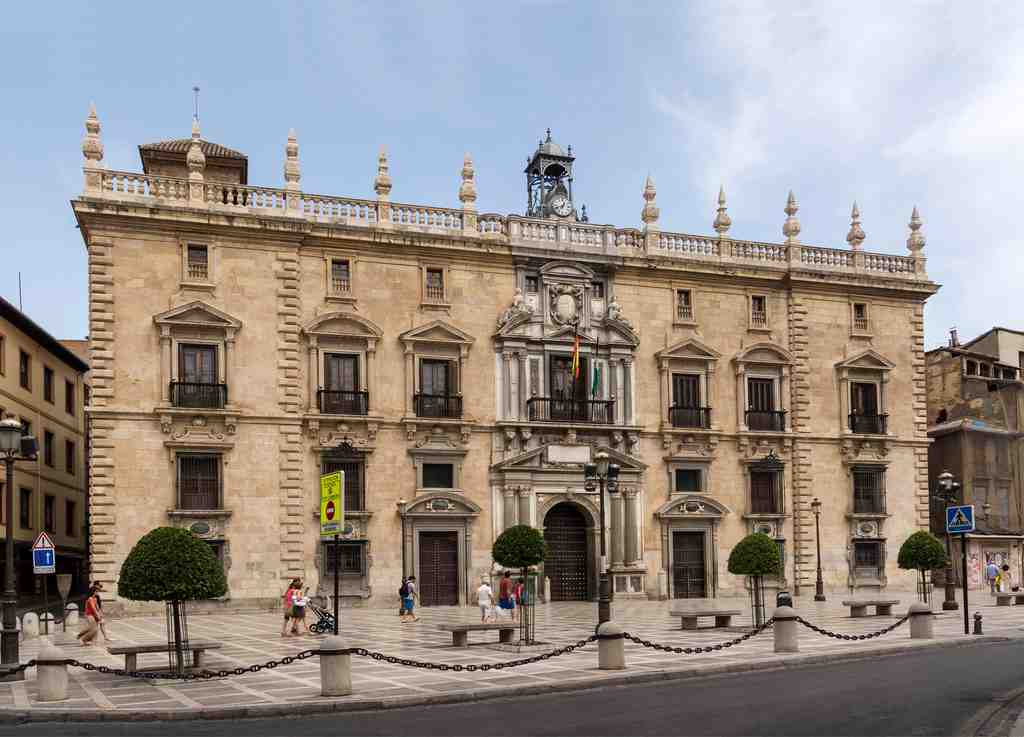
To spot the Royal Chancery of Granada, look straight ahead for a grand, sand-colored building that dominates Plaza Nueva. It’s got a strikingly symmetrical façade with rows of windows, each one topped by its own carved stone crown. The entrance stands out with its double columns, and there’s a balcony above where two flags flutter gently in the breeze. Look up for the clock tower perched in the center, and a row of stone pinnacles outlining the roof like chess pieces guarding a castle.
Okay, just imagine: It’s the early 1500s. The streets are buzzing with news-Granada is about to get its own royal courtroom, where the most serious matters will be judged. And you’re standing right in front of the building they built for it!
This isn’t just any courthouse. The Royal Chancery was the supreme court for the whole south of Spain, established by those legendary rulers, the Catholic Monarchs-Ferdinand and Isabella. Picture stern judges inside, cloaks sweeping as they pass, delivering justice on everything from farmland quarrels to royal disputes, and maybe pausing for the occasional siesta. Wouldn’t you, after all those cases?
Through its doors, you would have found bustling halls full of lawyers, clerks, and locals whispering stories and secrets. History tells us people came from areas south of the River Tagus, hoping for a fair hearing. During the 1500s, Spain was expanding, and so was its legal drama-there was competition with its northern rival, Valladolid, and even new courts springing up in places like Seville and the Canary Islands. Talk about courtroom drama, right?
King Carlos I wanted a courthouse that looked powerful-so he started building this mighty palace in 1531. Master builders and sculptors made sure everything, from the stone lions on the gates to that grand clock, was fit for royalty. Even the legendary architect Diego de Siloé left his mark in the courtyard inside.
But time changes everything. By the 1800s, the once-mighty court started losing power. The world was becoming more modern, and the echo of gavels slowly faded out. Finally, in 1834, the old court was dissolved with a rustle of paperwork as new laws swept in.
Today, this building is still about justice, serving as the home of the Higher Court of Andalusia. But if you listen carefully, maybe, just maybe, you’ll catch the whispers of ancient tales swirling around those stone hallways. Just don’t try to settle an argument with your friend here-I’m not sure the judges appreciate debate over who buys the next round of tapas!


