
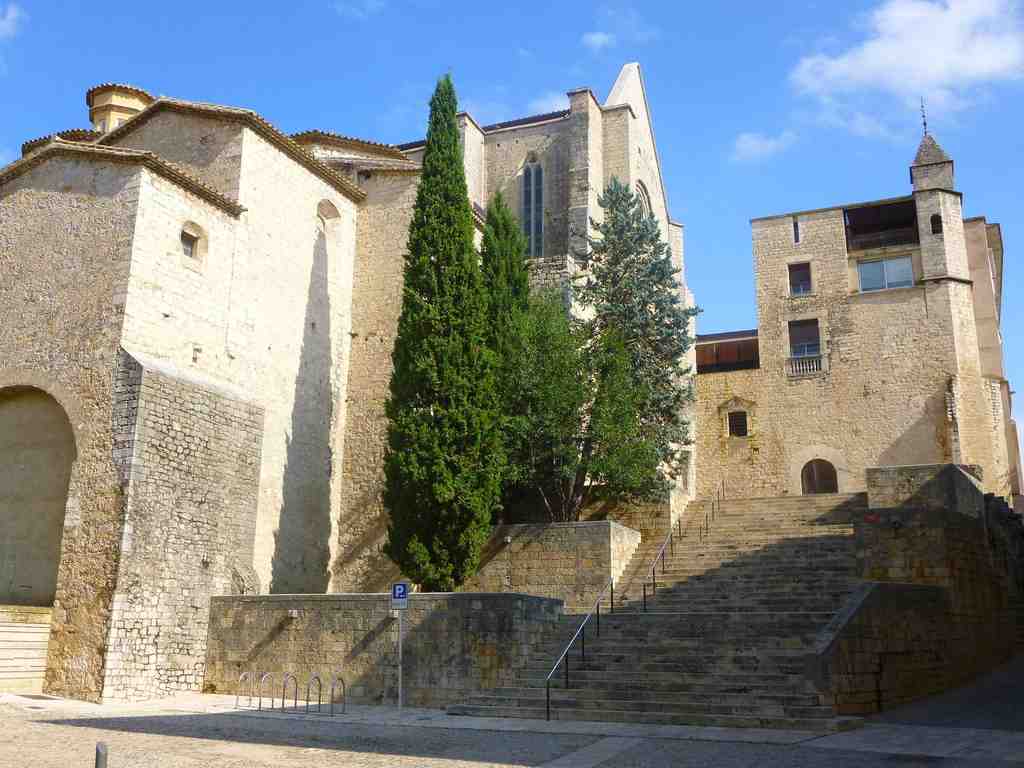
As you approach the Convent of Santo Domingo, take a look just ahead and to your right. You’ll notice an imposing, pale stone structure that almost glows in the sunlight. Its walls are solid and thick, like it was built to withstand centuries, and you’ll see a large set of stone steps leading up-like the invitation to a mystery. Two tall evergreen trees stand sentinel at the entrance, their shadows leaving sharp lines across the ancient stone. If you follow the steps with your eyes all the way up, you’ll see a small turret poking out to the right and a section of the church reaching skyward, topped by pointed Gothic windows.
Alright, time for a little time travel! Imagine you’re standing here in the 13th century. Instead of traffic and smartphones, you’d hear the distant murmur of monks in deep discussion, the clang of a bell ringing through the old city. This convent was born in 1253, dreamed up by Bishop Berenguer de Castellbisbal, who invited the Dominican order to set up right here.
The place is a bit of a medieval mash-up-a mix of a quiet convent, a church dedicated to the Annunciation of Mary, and not one but two stone courtyards called cloisters. The church, built in the primitive Catalan Gothic style, has just a single, grand nave. Picture yourself gliding inside on a beam of dusty sunlight, the tall, thin windows casting little rivers of light on the stone floor, while side chapels lie tucked between the thick walls-perfect for a secret prayer or maybe even a forbidden snack.
But don’t let the peaceful vibe fool you. In the 1600s, things got a bit dramatic: Baroque chapels popped up, and the church interiors were redecorated, turning up the wow-factor. And if you’re a fan of mysterious characters, you’ll love knowing this place was home to Nicolau Eimeric, a real-life inquisitor with quite the collection of secret manuscripts.
Over time, the convent has seen battles, sieges, and some wild events-imagine the echoes of marching boots during the siege of Girona in 1809, or monks packing up their things when the church was closed in the 1800s. Believe it or not, it even became a barracks for soldiers.
Today, though, the only thing you might hear is the sound of students rushing to class-the convent houses the Faculty of Arts for the University of Girona. Not a bad place to study, right? Who knows, maybe some of the old ghosts help out with the homework.
Alright, take your time gazing up at the stone and breathing in the centuries. When you’re ready, our next stop will take us even deeper into Girona’s fascinating history!




