
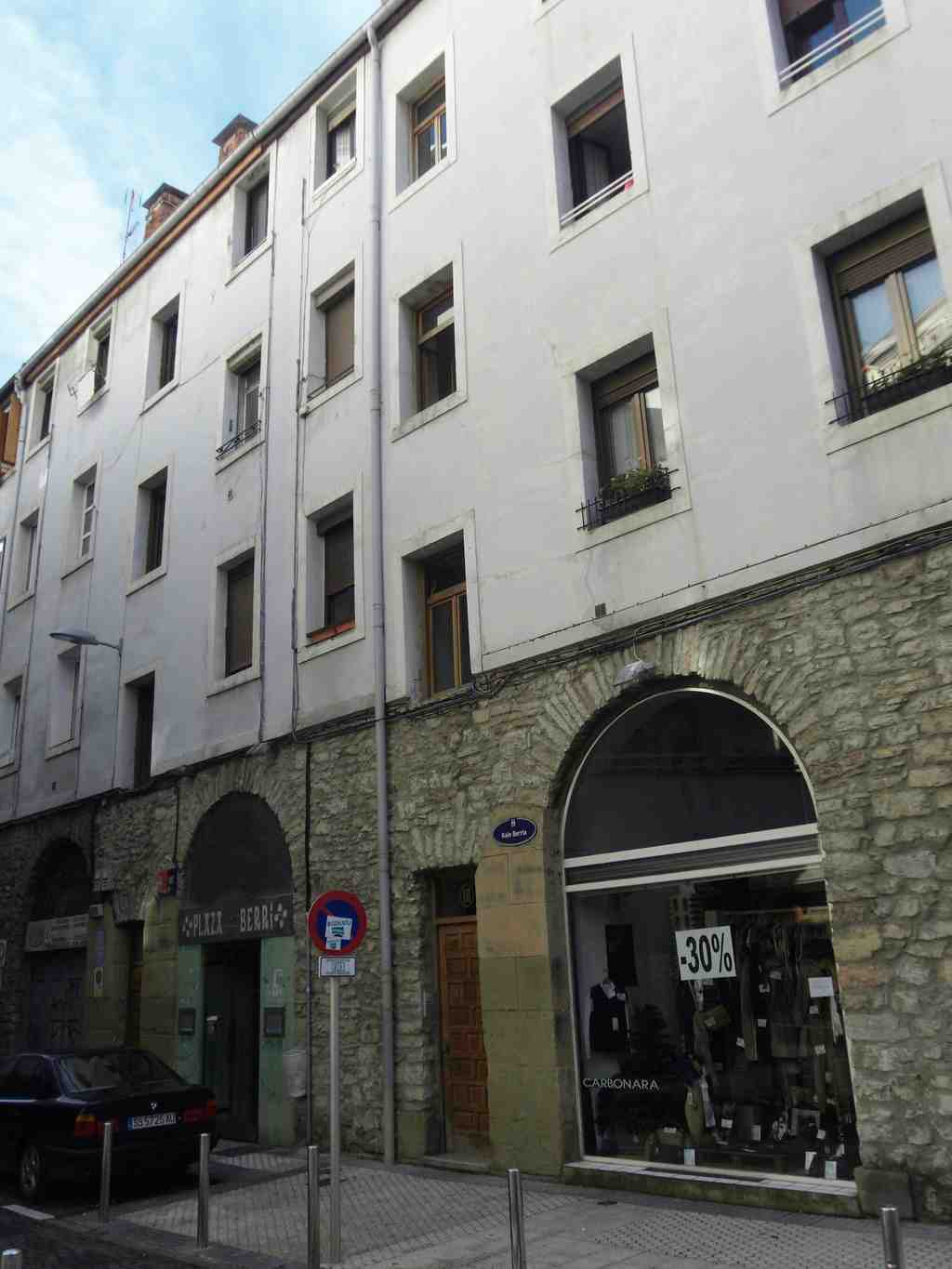
On your right, look for a plain plaster-and-stone street front with rectangular ground-floor openings and rows of residential windows above; behind that ordinary face sits the Trinquete de Gros.
Gros has a habit of hiding its older lives indoors. Behind everyday facades like this one, whole chapters of the neighbourhood survive out of sight, and this trinquet is one of the rare clues. A trinquet, by the way, is an enclosed court for pelota, the Basque ball game played against a main rebound wall called the frontis.
This is the oldest trinquet still standing in the Basque autonomous community, documented in eighteen eighty-four. On this side of the Bidasoa, only the one in Elizondo comes close in age, and that arrived later, in eighteen ninety-four. Yet from the street, you would never suspect such seniority. The building mixed uses in a rather clever, slightly unruly way: shops across the whole ground floor, flats above in a narrow strip along Calle Nueva and Iparragirre, and the court itself hidden behind them, raised to first-floor level over the premises below.
So while a stadium gathers a roaring public in the open, this place gathered a smaller world inside the block: players, neighbours, spectators leaning from timber balconies, and people climbing stairs that were never entirely meant for sport. The surviving layout suggests spectators even used the residents’ staircase at number sixteen, which connects to three levels of the court, including the side gallery and two long upper balconies.
Inside, the original playing space stretched roughly thirty-seven metres long and nine metres wide, rising about twelve metres to a gabled roof of wood trusses tied with iron, lit from above by a long skylight. The frontis still keeps its stone ashlar face. There was even a conical fraile, a jutting obstacle that sends the ball off at an awkward angle, showing that different forms of pelota were played here. Most visitors never realise the decisive twist came later: early in the twentieth century, someone inserted a wood-and-iron floor across the court and split the tall space into two workshop levels. That ended pelota here, yet it also preserved the shell by trapping it inside a new use.
The human trail is not all sporting. In eighteen eighty-five, Madrid’s official gazette circulated a warrant for Juan María Pacherón, known as Mar Sel, a French waiter who had lived in the Trinquete house here in Gros. Police wanted him over a homicide case and gunfire. Rather changes the atmosphere, does it not.
In two thousand and seventeen, Asier Elorriaga, Javier Prieto, and partners tried to revive the place as a restaurant, but neighbours protested over the works, a blocked emergency exit at number sixteen, and unauthorised chimneys at number twenty-two; by twenty eighteen, it had closed again, and a local paper called it the cursed trinquet.
San Sebastián often keeps its oldest stories behind doors and inner walls. When you are ready, continue about eight minutes to the Hotel María Cristina.




