
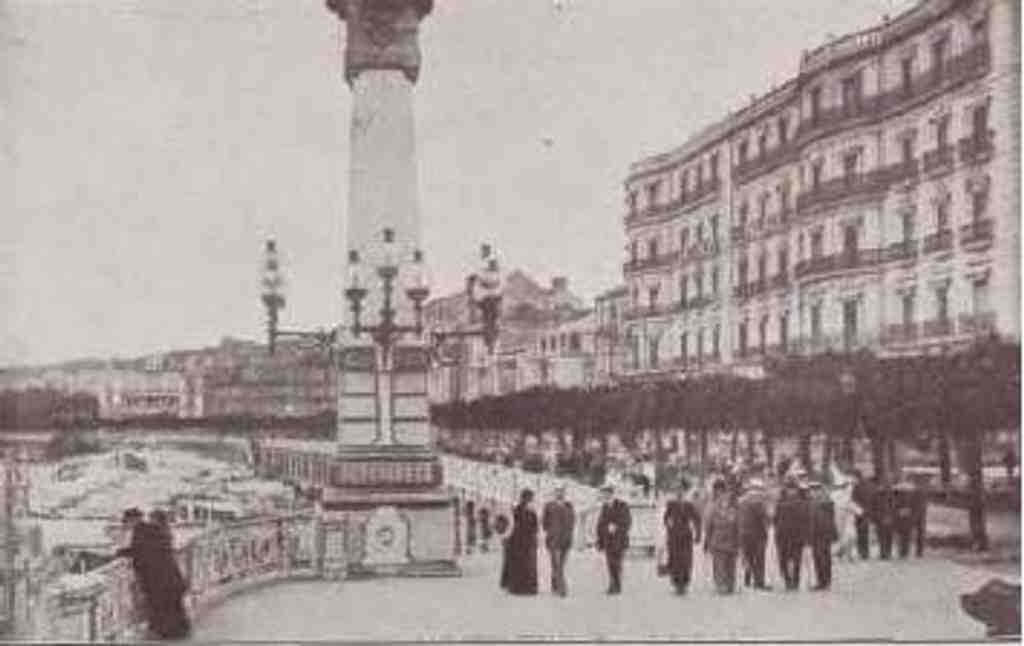
Look for the tall pale seafront building with its stacked wrought-iron balconies, rounded corner, and long façade facing the sweep of La Concha; this is the site where the Hotel Continental once stood.
The Continental told the world exactly what San Sebastián wanted to become. In eighteen eighty, a Basque banker named Agustín Galíndez, living in Madrid and thinking ambitiously, took his proposal to the city council. He asked architect José Goicoa to draw a new hotel here, first under the name Hotel La Concha. That name slipped away. By the time the doors opened on the fifteenth of May, eighteen eighty-four, the house had borrowed a grander identity from fashionable Biarritz and called itself the Continental.
That choice was not accidental. This city was learning how to present itself, and the beachfront was its stage. The Continental became only the second major hotel in San Sebastián, after the old Hotel de Londres y de Inglaterra, and it faced the bay as if it fully understood the value of being seen. It followed a French-influenced resort style, with a basement for the unseen machinery of luxury: kitchens, cold rooms, and wine cellars. Above that came the performance. A long dining room, family dining rooms, a restaurant, and a salon opened toward La Concha. Even the circulation of the building had social rank: one staircase for guests, another for staff.
And then there were the bragging rights. The Continental gave San Sebastián two novelties before most local rivals could dream of them: a lift and a winter garden, meaning a glassy indoor garden lounge beside the restaurant, where elegance could continue under cover without losing any of its display.
The human touch here belongs, for me, to François Estrade. He arrived as director in the eighteen nineties, after Emiliano Lestgarens and P. Hourcade, part of that distinctly French management culture that hotel owners trusted to signal polish and reliability. Estrade did not simply run the place; he sharpened its ambitions. In eighteen ninety-nine, dinner here appeared entirely in French, with dishes such as filet of sole Orly and savarin with rum. By the new century, Estrade pushed for larger windows toward the beach, an open central courtyard, and a more commanding silhouette. In nineteen eleven he bought the neighboring house from architect Luis Elizalde, expanded the building from four floors to seven plus a mezzanine, and rechristened it Palacio Continental. More rooms, more visibility, more bay.
That glittering address also connected to power. The hotel kept close ties with the San Sebastián Casino and later entered the Palace hotel group led by Georges Marquet, the same businessman linked to the Casino. So this was never just a place to sleep. It was part of a network of prestige, gaming, business, and carefully managed appearance.
Then history altered the mood. During the Civil War, militias used the hotel as a command post and barracks. Later, it hosted political banquets. In nineteen seventy-two, it closed for good, and developers demolished it for a more profitable residential block with sea views. That, too, says something rather sharp about this promenade: glamour always answered to real estate in the end.
Still, the real luxury remains where it always was - out there, along the curve of the bay. Walk on to La Concha beach in about two minutes. And, as a practical note, this stop sits on a street that never really sleeps: access here is available at all hours.




