
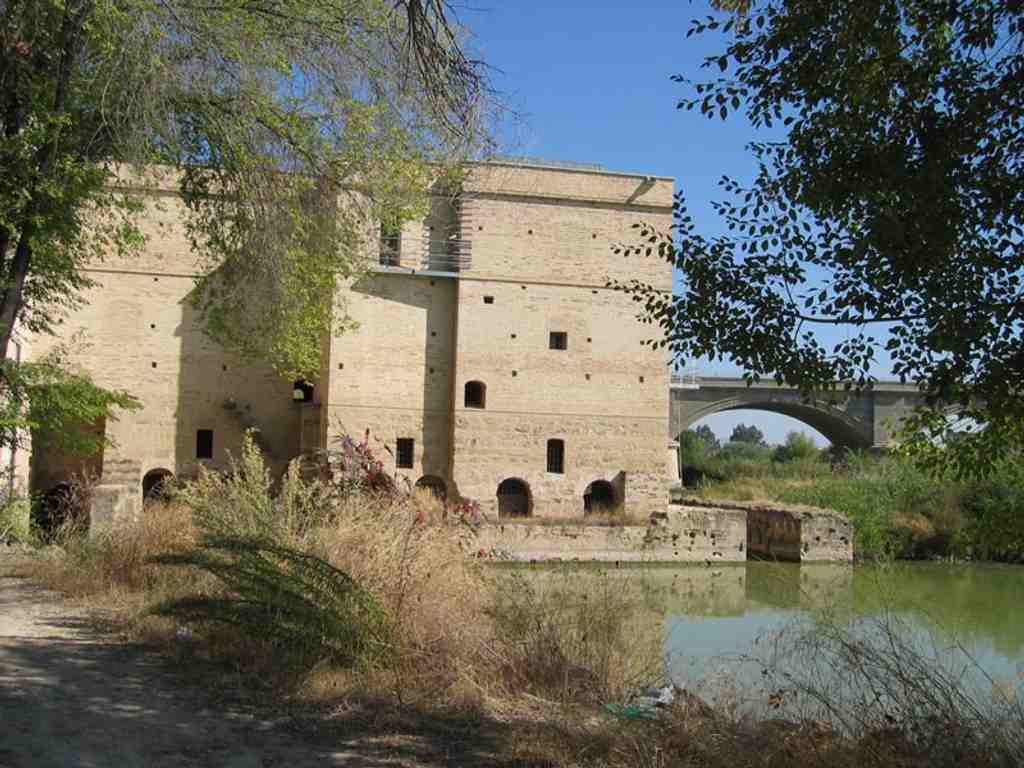
To spot the Alegría watermill, look right over the riverbank ahead of you for a large, square-shaped building made of stone and light brick, with rows of small square and arched windows, rising above the greenish waters and separated from the swooping trees by patches of wild grass.
Now, let’s imagine you’re standing here hundreds of years ago. The sun is bright overhead, but the mill’s thick stone walls offer welcome shade by the water’s edge. You feel the air growing cooler as you approach, and the steady splash and churn of the Guadalquivir River fill your ears, broken only by the occasional call of a heron swooping past. Right in front of you is the Alegría watermill-whose name means “joy”-though don’t expect it to burst into song. That’s my job!
But this place really has seen it all. Long ago, when Córdoba was under Moorish rule, this weir was already famous and called the Azuda de la Alhadra-“the green”-a hint that the city was already bustling with life, color, and, well, a lot of water technology! The weir itself formed a powerful barrier, splitting the river’s flow and feeding water right under the future site of Alegría’s mighty grinding wheels. The mill sits right between two spillways; if you close your eyes, maybe you can imagine millers with flour-dusted faces running to keep up with the current.
After the Christians conquered Córdoba in 1236, the Diocese-never one to turn down a lucrative property-quickly pounced on these mills through donations, holding onto them for centuries. During the fifteenth century, most of those mills, once busy turning wheat into soft, white flour, were converted into fulling mills instead. Fulling mills were used to clean and thicken woolen cloth, so you could say fashion swept through this riverfront! Soggy cloaks and all, six different mills once chugged away on this very weir-three for flour, three for fulling.
Of course, technologies changed-the “Regolfo” made a splash in the 1600s, and by the 1700s, you’d hear people grumbling about the “Tripas” mill. Just as you figure out how something works, it goes out of style, right?
Fast forward to 1780. Antonio Luque, hunting for opportunity or, more likely, a challenge, bought the crumbling ruins of this watermill from the Cathedral Chapter. He rolled up his sleeves and rebuilt it, giving the place its cheerful new name, Alegría. By the late 1800s, what you see today-a handsome facade with three levels-was taking shape. At ground level, you’ll spot rough, sturdy stone; above, brickwork from the 19th century. Sneak a look behind the walls, and you’d find three long chambers, each once echoing with the grind of huge millstones powered by racing water. Four of those old stones are still here, preserved as echoes of the past, while a lone turbine shaft hints at the factory’s next chapter.
In the twentieth century, the mill sprouted new floors-suddenly it was a three-story flour factory, rebranded as San José. It worked hard, spinning two sets of millstones and a water turbine tall enough to impress even the nosiest river fish. The mill soon whirred its way through various owners-from flour companies to Cordoba’s electricity firms, each chasing the spirit of industry and maybe a bit of luck.
At last, as dust settled on its gears, the city decided to transform Alegría into something truly unique. Carefully restored at the turn of this century, the building’s upper floors became the Roberto Wagner Museum of Paleobotany, part of Córdoba’s Botanical Garden. In 2002, it threw open its doors as Spain’s first museum of plant fossils-talk about a building with deep roots!
So next time you hear the river’s quiet song at this spot, think of Alegría: the mill that’s been a flour factory, fashion lab, power plant, fossil house, and a place brimming with stories. If these old stones could talk, I think they’d tell you, “Stick around-you never know what’s coming next!”




