
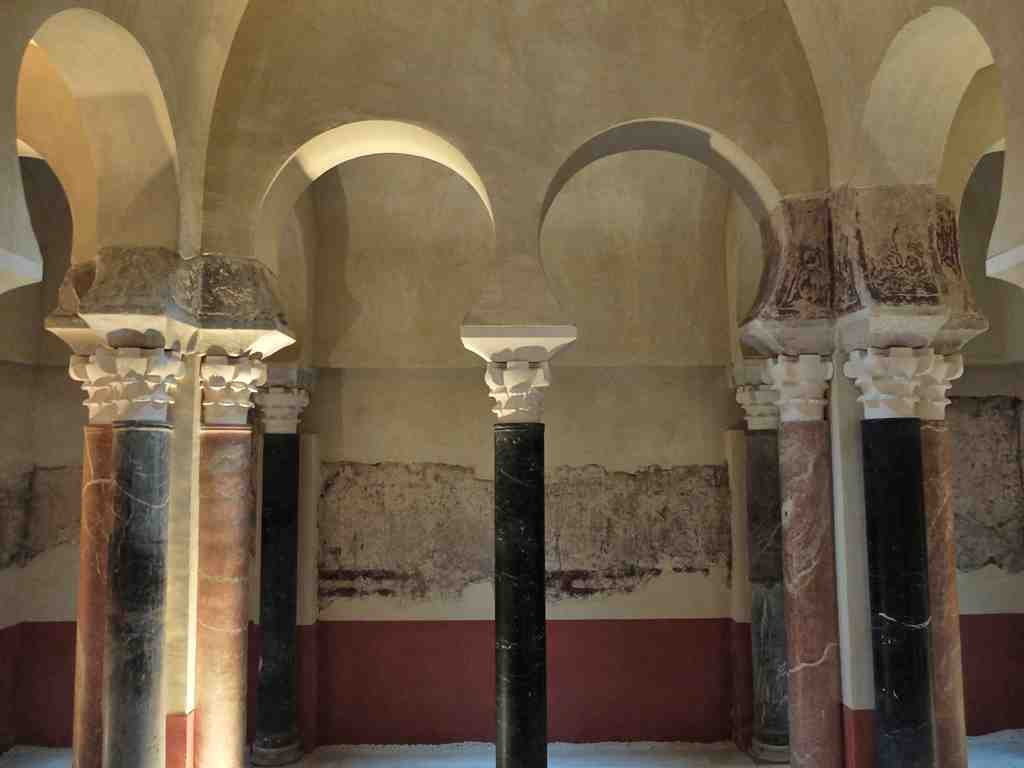
To spot the Andalusian Alcazar of Cordoba, look for a structure with beautifully carved columns of red and black marble topped with ornate capitals, supporting elegant horseshoe arches-if you see these striking arches and pillars, you’re right at the heart of history!
Alright, my friend, let’s slip back in time, just for a moment-because right where you’re standing once stood one of the grandest, most secretive power centers in all of Al-Andalus! Picture this: it’s almost thirteen centuries ago, and all around you, the gardens are bursting with citrus trees and bubbling fountains, peacocks strut through the courtyards, and the scent of jasmine drifts through the air. At the center of it all is the Alcázar Andalusí, also called the Umayyad Alcázar-a vast fortress-palace, wrapped in thick walls and filled with a dizzying labyrinth of palatial halls, secret passageways, and bustling offices.
But did you know this place wasn’t always the stronghold of powerful Muslim rulers? First, the Visigoths had their own swanky villa here-think less “Game of Thrones,” more “Romanesque Ruins with a Spanish twist.” Then, after 711, when the Muslims swept into Spain, the palace fell into new hands. Strangely enough, the early Muslim governors preferred Sevilla-but one, a fellow named al-Hurr, thought, “Hey, let’s live a little closer to the river!” and moved to the old Visigothic palace right here. If walls could talk, they’d probably have some wild stories about those first years.
Now, after the mighty Umayyad dynasty of Damascus was overthrown, a survivor named Abd al-Rahman I dashed across North Africa, dodged assassins, and made Córdoba the capital of an independent Emirate. He also became Córdoba’s top real estate renovator. Soon, he moved out of his country mansion and started building up this new Alcázar. But this was no ordinary fortress-this was a palace fit for legends. Its private wings were home to the emir, the caliph, and their families; its sprawling administrative heart kept the machinery of government ticking, and official state business was handled in grand offices protected by those thick palace walls. All told, the Alcázar covered a whopping 39,000 square meters, bigger than some small towns.
And this place had everything-lavish gardens, the city’s largest hammam bathhouse (where you could soak your troubles away, though perhaps not your political rivalries), and fountains supplied by clever waterwheels from the Guadalquivir, including the famous Albolafia noria, creaking away by the riverside. Try to imagine water sparkling in the sun, trickling through channels like music all around the palace. There was even a gigantic library, said to be the biggest in Western Europe-forget a Kindle, you’d need a camel just to carry all the scrolls!
The Alcázar and the mosque next door were connected by a secret passage (the "sabat")-perfect for an emir or caliph to slip into the mosque unseen. There were many grand entrances: can you picture the iron-studded Gate of the Hierro, whose knockers were trophies from as far away as Narbonne? Or the riverside Gate of the Embarcadero, where rulers watched military parades from a balcony, while enemies learned the hard way that you never cross the caliph.
Inside, the air would be heavy with secrets. Ministers and viziers hurried to the “House of the Ministers” for a quick word of advice (or maybe some juicy palace gossip). Servants slipped through winding corridors. Emirs met in the luminous Audience Chamber or strolled the rauda, a serene garden that also doubled as the royal graveyard. Kings, queens, poets, and plotters alike walked these very stones.
But every story gets a plot twist. In the 900s, Caliph Abd al-Rahman III built the dazzling city of Medina Azahara out of town, making it his new base. But when that city fell to ruin, Córdoba’s Alcázar reclaimed its old glory-hosting new rulers, including a king so poetic (al-Mutamid) he probably left love notes hidden in the masonry. And after the Christian conquest in 1236, parts of the Alcázar were transformed: a bishop moved in, the king of Castile took his share, and traces of this mighty palace are woven into nearly every brick of the modern city.
So if you spot an old arch here, a sunlit courtyard there, or those famous caliphal baths still echoing with ghostly laughter-let your imagination run wild. This was the beating heart of a city that once outshone the medieval world, where history, mystery, and a dash of royal drama were all just part of the daily spectacle. Now, tell me, did you bring your own royal robe? No? Well, don’t worry-you’ll always have a crown in my tour!




