
Cádiz Audio Tour: A Journey Through Time Between Domes, Towers, and Fortresses
Between Atlantic spray and golden domes, Cádiz appears like a fortress of light. Yet beneath its white facades lie stories that burn. This self-guided audio tour leads you through Cádiz to the Kathedrale des Santa Cruz, up to the Torre Tavira, and out to the Schloss von San Sebastián. Along the way, you'll discover hidden paths, voices, and traces that most visitors overlook. Who fought for power in Cádiz when cannons targeted the city? What mysteries hide behind the views from the Torre Tavira, where shadows linger longer than visitors? And why does a certain name repeatedly appear in old cathedral records, precisely at the hour of the midday bells? Every step draws you deeper. From the harbor wind to stone bastions. Drama, scandal, rebellion, and forgotten moments transform into images that repaint Cádiz. Follow the light and begin now.
Tour preview
About this tour
- scheduleDuration 30–50 minsGo at your own pace
- straighten2.5 km walking routeFollow the guided path
- location_on
- wifi_offWorks offlineDownload once, use anywhere
- all_inclusiveLifetime accessReplay anytime, forever
- location_onStarts at Kathedrale des Santa Cruz
Stops on this tour
Look to your right: Before you stands a wide, light-beige stone facade with a curved Baroque front and two massive towers, rising like twins to the sky on the left and right. You…Read moreShow less
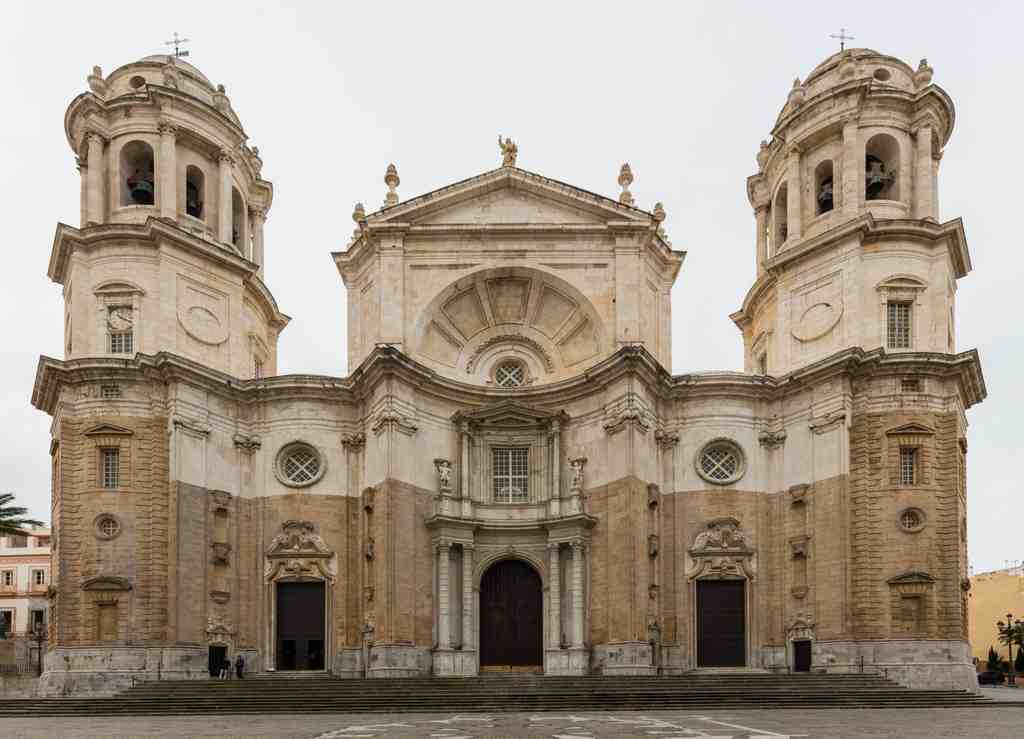
Look to your right: Before you stands a wide, light-beige stone facade with a curved Baroque front and two massive towers, rising like twins to the sky on the left and right. You stand here before the Kathedrale Santa Cruz, the 'Catedral Nueva' of Cádiz - and yes, locals deliberately call it 'new,' even though it definitely no longer falls into the 'newly built' category. The reason is simple: there's also an 'old' 16th-century Kathedrale, and Cádiz was never a city content with just one grand church. Why build anew at all? Two things converged: the old Kathedrale was not in top condition, and Cádiz suddenly became truly important at the beginning of the 18th century. In 1717, the Casa de Contratación - the authority that controlled trade with America - was moved from Seville to Cádiz. Imagine it as an economic upgrade: more money, more ships, more prestige. And when a city rises, it wants to see that carved in stone. Construction began in 1722, following plans by Vicente Acero. And then the architectural baton pass began: Acero left in 1739, Gaspar Cayón took over, then his nephew Torcuato, later Miguel Olivares, Manuel Machuca y Vargas, and finally Juan Daura. In total, construction dragged on for 116 years - a building period that would make even cathedrals take a deep breath. It was officially 'finished' on November 28, 1838, though it must be honestly said: some things, like parts of the choir and other areas, were not quite as originally envisioned. These delays are not just a footnote here - they are embedded in its appearance. Look at the front: the mix of Baroque and Neoclassicism is not an academic experiment, but the result of crises, wars, and lack of funds. France's invasions, plus the later loss of influence in America: this is exactly the kind of reality that scrambles architectural styles. When the purse strings fluctuate, so does taste. Outside, notice the typical Baroque interplay of inwardly and outwardly curved forms. And the towers: quite tall, aren't they? That's remarkable because under the Bourbons, such tall structures were actually undesirable - too easily targeted. Cádiz built them anyway. One might say: self-confidence with bells. And then the domes: The large dome over the crossing is the star, adorned outside with golden tiles that truly light up in the sun. Cádiz lies almost by the sea, and that is both a curse and a photo opportunity: salt, wind, and humidity affect the stone. Some areas suffered so much that protective nets were installed inside to prevent anything from crumbling down. Since the beginning of the 21st century, continuous restoration has been underway - a Kathedrale by the sea simply needs more care than one inland. Inside, a cross-shaped floor plan awaits you, with three naves, Corinthian columns on pedestals, and an ambulatory that feels almost like a small journey around the altar. Beneath the main altar lies the crypt - below sea level. Famous people from Cádiz are buried there, including the composer Manuel de Falla. And because this room has a peculiar acoustic resonance, every whisper sounds a bit like a statement with emphasis.
Open dedicated page →Look to your right: Before you stands a wide, light-beige stone facade with a curved Baroque front and two massive towers, rising like twins to the sky on the left and right. You…Read moreShow less
Look to your right: Before you stands a wide, light-beige stone facade with a curved Baroque front and two massive towers, rising like twins to the sky on the left and right. You stand here before the Kathedrale Santa Cruz, the 'Catedral Nueva' of Cádiz - and yes, locals deliberately call it 'new,' even though it definitely no longer falls into the 'newly built' category. The reason is simple: there's also an 'old' 16th-century Kathedrale, and Cádiz was never a city content with just one grand church. Why build anew at all? Two things converged: the old Kathedrale was not in top condition, and Cádiz suddenly became truly important at the beginning of the 18th century. In 1717, the Casa de Contratación - the authority that controlled trade with America - was moved from Seville to Cádiz. Imagine it as an economic upgrade: more money, more ships, more prestige. And when a city rises, it wants to see that carved in stone. Construction began in 1722, following plans by Vicente Acero. And then the architectural baton pass began: Acero left in 1739, Gaspar Cayón took over, then his nephew Torcuato, later Miguel Olivares, Manuel Machuca y Vargas, and finally Juan Daura. In total, construction dragged on for 116 years - a building period that would make even cathedrals take a deep breath. It was officially 'finished' on November 28, 1838, though it must be honestly said: some things, like parts of the choir and other areas, were not quite as originally envisioned. These delays are not just a footnote here - they are embedded in its appearance. Look at the front: the mix of Baroque and Neoclassicism is not an academic experiment, but the result of crises, wars, and lack of funds. France's invasions, plus the later loss of influence in America: this is exactly the kind of reality that scrambles architectural styles. When the purse strings fluctuate, so does taste. Outside, notice the typical Baroque interplay of inwardly and outwardly curved forms. And the towers: quite tall, aren't they? That's remarkable because under the Bourbons, such tall structures were actually undesirable - too easily targeted. Cádiz built them anyway. One might say: self-confidence with bells. And then the domes: The large dome over the crossing is the star, adorned outside with golden tiles that truly light up in the sun. Cádiz lies almost by the sea, and that is both a curse and a photo opportunity: salt, wind, and humidity affect the stone. Some areas suffered so much that protective nets were installed inside to prevent anything from crumbling down. Since the beginning of the 21st century, continuous restoration has been underway - a Kathedrale by the sea simply needs more care than one inland. Inside, a cross-shaped floor plan awaits you, with three naves, Corinthian columns on pedestals, and an ambulatory that feels almost like a small journey around the altar. Beneath the main altar lies the crypt - below sea level. Famous people from Cádiz are buried there, including the composer Manuel de Falla. And because this room has a peculiar acoustic resonance, every whisper sounds a bit like a statement with emphasis.
Open dedicated page →

Frequently asked questions
How do I start the tour?
After purchase, download the AudaTours app and enter your redemption code. The tour will be ready to start immediately - just tap play and follow the GPS-guided route.
Do I need internet during the tour?
No! Download the tour before you start and enjoy it fully offline. Only the chat feature requires internet. We recommend downloading on WiFi to save mobile data.
Is this a guided group tour?
No - this is a self-guided audio tour. You explore independently at your own pace, with audio narration playing through your phone. No tour guide, no group, no schedule.
How long does the tour take?
Most tours take 60–90 minutes to complete, but you control the pace entirely. Pause, skip stops, or take breaks whenever you want.
What if I can't finish the tour today?
No problem! Tours have lifetime access. Pause and resume whenever you like - tomorrow, next week, or next year. Your progress is saved.
What languages are available?
All tours are available in 50+ languages. Select your preferred language when redeeming your code. Note: language cannot be changed after tour generation.
Where do I access the tour after purchase?
Download the free AudaTours app from the App Store or Google Play. Enter your redemption code (sent via email) and the tour will appear in your library, ready to download and start.
If you don't enjoy the tour, we'll refund your purchase. Contact us at [email protected]
Checkout securely with 


