
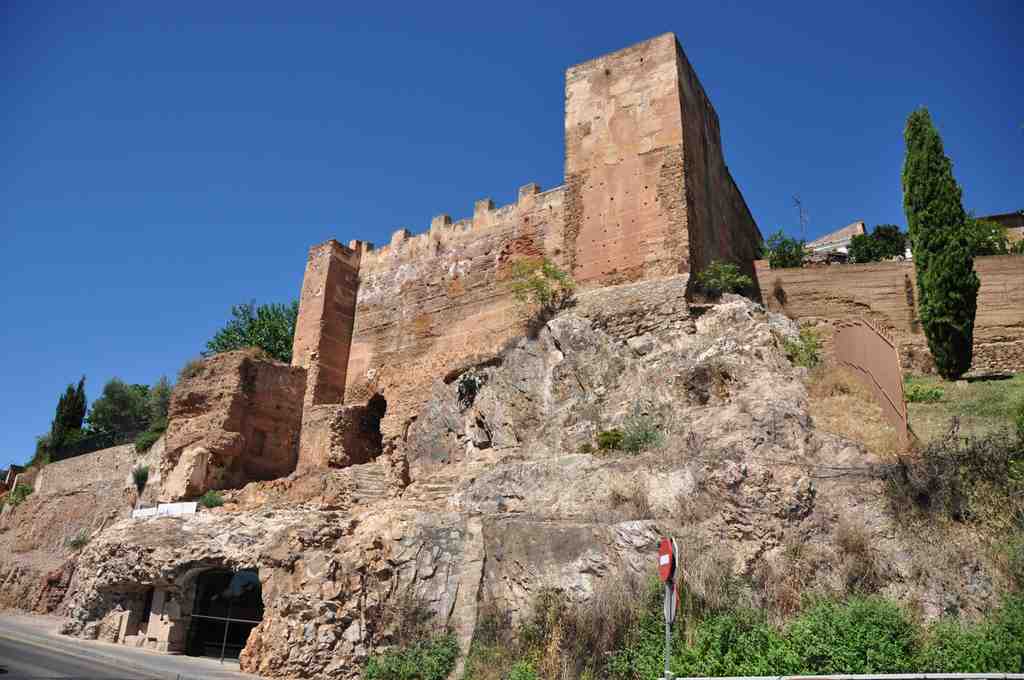
Right in front of you, you’ll notice a tall, rugged stone wall rising dramatically from the rocky hillside, its sandy-colored masonry and square towers giving it a weathered but mighty look-just scan above the road and you can’t miss it.
Now, let’s dial back the centuries together. Imagine the ground trembling lightly beneath your feet-an echo from nearly two thousand years ago, when the first stones of this very wall were set in place. The Wall of Cáceres began its life in the days of the Roman Empire, built to defend the ancient colony of Norba Caesarina. Back then, armored soldiers kept watch, their eyes sharp for trouble as the Spanish sun beat down on the brand-new stone, and the wall glimmered in the heat like the promise of safety.
Not much remains from those earliest Roman days, though-time and history marched on, carrying stories of battles, sieges, and reinventions. It was really the Almohads, mighty rulers from North Africa, who gave this wall its most recognizable look in the late 12th and early 13th centuries. They built the chunky, resilient sections you see now, using both masonry and tapial-basically clay and lime reinforced with wooden frames. If those Almohads had invented concrete, you’d be looking at history’s most persistent do-it-yourselfers! At points, this wall stretches three meters thick and climbs over ten meters high. No dragon-or medieval enemy-would’ve dared mess with that.
There’s an air of adventure written all over these ancient stones. This wall wasn’t just a pretty boundary; it was the ultimate “Keep Out” sign, defending the city from marauders and marking the outer limit of Old Cáceres. Today, it still does its job, sharply separating the time-capsule beauty of the old quarter-the bit that won Cáceres its UNESCO World Heritage badge in 1986-from the more recent neighborhoods just outside. Picture villagers bustling through narrow gates, archways clattering as merchants, travelers, and even the odd runaway sheep entered or left the heart of the city.
Maybe you’re wondering about all those mysterious towers and gates. The wall is dotted with fantastic defenders like the Torre de Bujaco and the Torre Redonda-wait, don’t be fooled by that one, it’s actually octagonal, not round! Each of these towers held silent guards, watching over the sprawling landscape. Gates like the Arco de la Estrella or the Puerta de Coria invited guests in with grand arches, while others, like the Arco del Cristo, whispered secrets of past invasions and hidden escapes.
Let’s not forget-the Wall of Cáceres holds a place of honor as one of the first officially protected monuments in Extremadura. In 1930, it was named a Bien de Interés Cultural; nearly twenty years later, much of the city followed as a historic site. So as you stand here in the shadow of the sunlit stones, you’re not just looking at a wall-you’re beside a living legend, with drama, danger, surprise, and a touch of that stubborn Spanish pride built right into every block. And hey, if you ever wanted to feel like a time traveler, you’re in the right spot-just don’t try to climb it; those Almohad architects weren’t messing around!




