
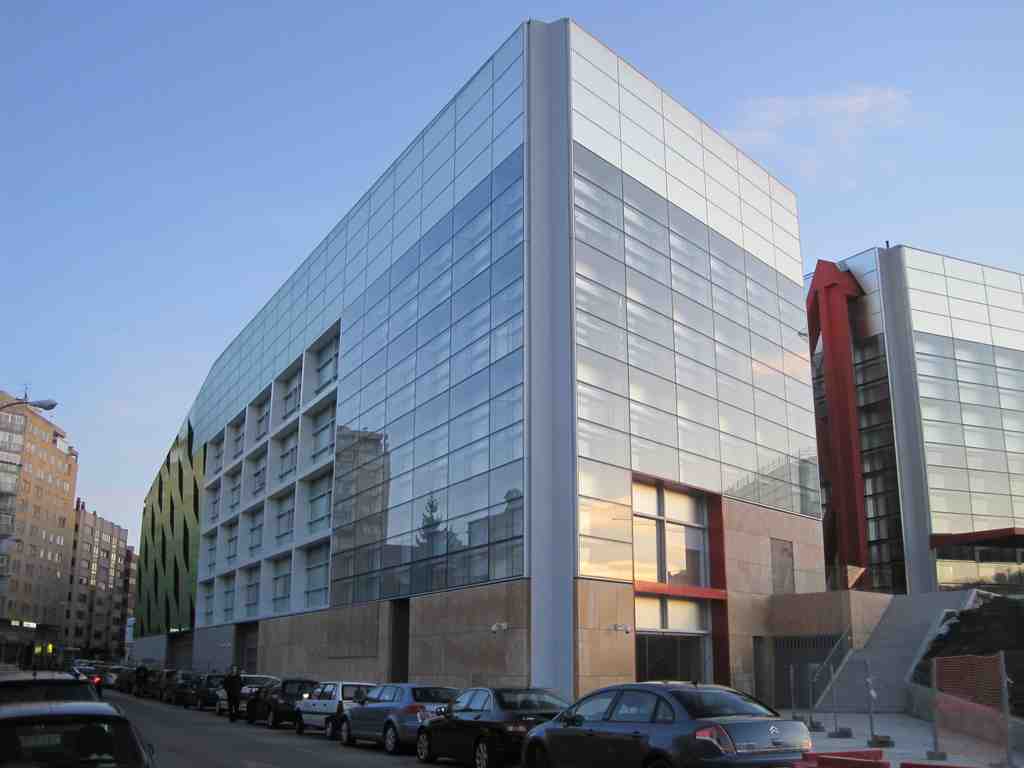
To spot the National Center for Research on Human Evolution, just look for a modern, glass-fronted building with sleek lines and a touch of red on the side, standing out clearly from the more traditional apartment blocks along the street.
Now that you’re here, welcome to one of Burgos’ most futuristic gems! This striking building you’re gazing at isn’t just a pretty face-it’s the beating heart of our quest to unravel human origins. Let your imagination wander back to 2004, when a big idea began to take shape: to create an international hub where the mysteries of our past would be unearthed using cutting-edge science and tech. With the Spanish state and Castilla y León both throwing their weight behind the project, it was finally opened in 2011, Queen Sofía herself was here for the big ribbon-cutting. So, if you feel a regal presence or hear a faint royal trumpet…don’t worry, it’s just the history echoing around!
This isn’t just any research building-it’s part of the mighty Human Evolution Complex in Burgos, closely tied to the legendary Atapuerca archaeological system. You’re basically at science’s control tower for understanding who we are and where we came from. Pop inside and you’ll find a hive of activity: four floors housing sophisticated laboratories, communal spaces, meeting rooms filled with jittery scientists and, if you listen close enough…maybe even the ghostly mumblings of ancient hominids debating whether to make a stone axe or grab a berry.
Let’s talk about what goes on in there-it might sound like science fiction, but it’s all real! Three main quests drive this place: Archaeology, hunting for clues about ancient behaviors and culture; Geochronology and Geology, figuring out time itself with rocks and sediment; and Paleobiology, the grand adventure of studying long-lost life. They’re not just staring at dusty bones-they use everything from super microscopes and lasers to computers that can 3D map the tiniest scratches left by prehistoric tools. Ever wonder how old a rock is, or what a Neanderthal snack tasted like? Someone at CENIEH is probably figuring it out right now.
Hidden within are laboratories as wild as their names: Experimental Archaeology and Taphonomy, where things are broken, burned, and buried to try to mimic what happened 20,000 years ago; labs for Archaeomagnetism, literally measuring the memory of ancient dirt; rooms gently glowing with red lights for Luminescence Dating, so precise you feel they might accidentally date your grandmother’s cookies if you left them unattended. Add advanced rooms for Archaemetry, Conservation, Uranium Series dating, and even micro-CT scanning-CENIEH is a treasure chest of scientific tools.
You’d think scientists might be stingy with their fossils and tools, but not here. Inside, you’ll find three main collections. The Osteological Comparative Anatomy Collection-say that three times fast-has both real and replica bones, from cave bears to modern mammals, so scientists have something for everyone. There’s the LITHO and CET collections: rows of stone tools and experimental objects made and used just like Stone Age people would’ve, offering a hands-on look at how people survived and thrived. And don’t overlook the Archaeopalentological Collection, stacked with relics fresh from the Atapuerca dig sites: fossilized bones, ancient animal teeth, stone knives-the whole Pleistocene party!
All of this is overseen by a unique consortium, half Spanish government, half Castilla y León government, teaming up like a scientific “Dynamic Duo.” Inside, about fifty people roam the corridors: not just researchers, but support staff and administrators, all working to bridge the gap from the Ice Age to your mobile app.
But the story doesn’t stop at these walls. CENIEH is a core part of trans-European networks, working with other museums and labs from Paris to Berlin to share knowledge. They’re also crucial to local culture, helping bring findings back to schoolkids and families-so don’t be surprised if, right now, there’s a kid inside being blown away by a digital Neanderthal showing off his latest spear.
And through it all, whether you’re a scientist, a schoolchild, or just a curious visitor with a thirst for time travel, CENIEH’s doors are open-ready to make a bit of ancient history part of your modern day. So, take a deep breath, look up at that sparkling glass facade-because you’re standing at the crossroads of yesterday and tomorrow!
Ready to delve deeper into the institution, research or the infrastructure? Join me in the chat section for an enriching discussion.




