
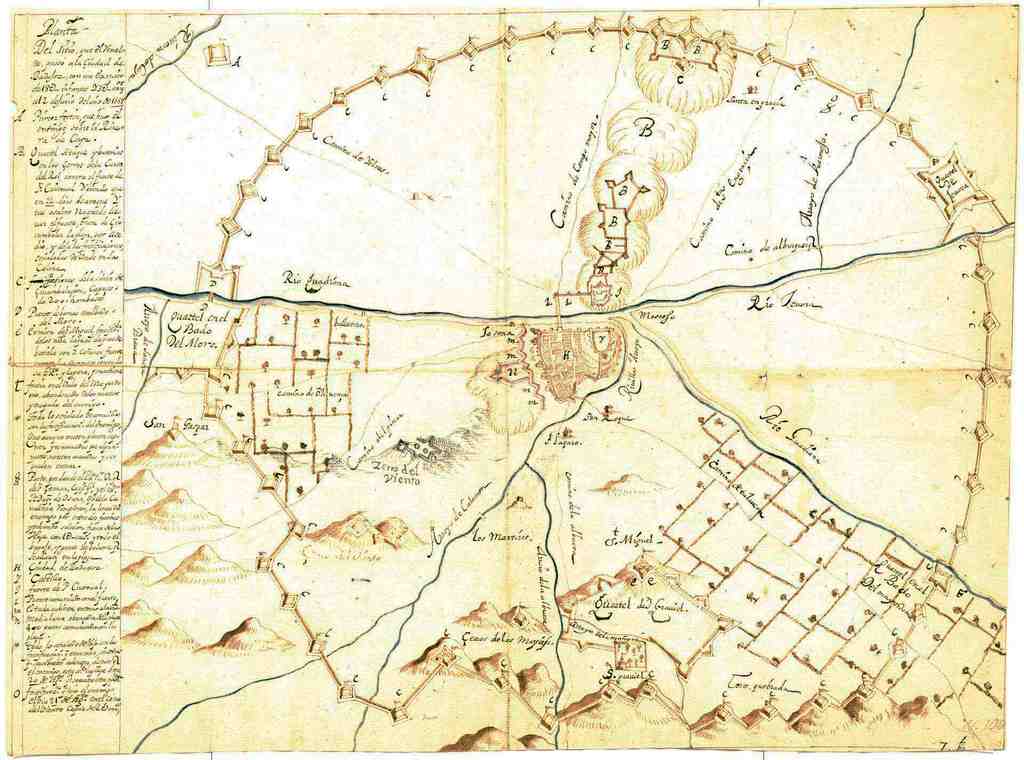
To spot the fortified enclosure of Badajoz, look straight ahead for the sprawling old stone walls and star-shaped bastions that wrap around the city-visible here in the map, you'll see a jagged outline encircling the old town, marked by geometric points and sturdy defensive lines.
Welcome to Badajoz’s mighty fortified enclosure! Imagine you’re standing where centuries of soldiers once stood, scanning the horizon for armies, smoke, and-if they were lucky-a peaceful day. But most days were anything but peaceful. This place was the city’s shield, a sprawling network of walls, gates, guard towers, and bastions built mainly between the 1600s and 1700s, with roots stretching way back to when Ibn Marwan first founded Badajoz on a much older Visigothic settlement. In fact, settlements here go all the way back to prehistoric times-so if these stones could talk, they’d have plenty of tales to tell!
Now, why build such an enormous fortress? Well, Badajoz just happened to be in the “danger zone”-strategically sandwiched between Castilla, Andalucía, and Portugal, and parked right along two major crossroads. That meant opportunity, but it also meant trouble from anyone fancying themselves a conqueror. Add to that Badajoz’s proximity to Portugal-sometimes a friend, sometimes a not-so-friendly neighbor-and you’ve got a recipe for centuries of tension, alliances, and the occasional flying cannonball.
The earliest fortifications were simple walls slapped together with mortar. Over time, rulers kept beefing them up. By the 1100s, the Alcazaba-the inner fortress-rose above you, with its still-imposing towers and thick walls. This was the stronghold, the governor’s home, the city’s last line of defense. Yet as centuries passed and cannons began to roar across Europe, those old walls started to look a bit...well, outdated. When Portugal fought for independence from Spain in the 1600s, Badajoz found itself repeatedly under siege. The Spanish Crown realized it was high time to upgrade their defenses.
Enter the era of fancy fortifications, inspired by the brilliant French military engineer, the marquis of Vauban. He designed star-shaped layouts to better deflect cannonballs and create deadly crossfire zones. Here in Badajoz, that meant new sturdy walls, bastions like the ones you see poking out at sharp angles, deep moats, caponiers, and towers. The construction went in fits and starts-think medieval DIY project with a lot of improvisation and not enough budget. But these new defenses would make Badajoz one of the most formidable border fortresses in all of Spain.
The fortified zone included everything a besieged city could need: there were secret tunnels, moats deep enough to swim in on a hot day (if not for all the arrows and musket balls), drawbridges that rattled and clanked, revellins-those triangular defensive outworks right outside the main walls-and multiple layers of walls to slow down any invader. Each bastion even had its own name and story-from the Baluarte de San Pedro, battered but unbroken after fierce fighting, to the Baluarte de la Trinidad, which literally had an ancient monastery built inside it.
During the War of Spanish Succession and later the Napoleonic Wars, these walls saw real action. Imagine the night air choking with smoke, cannons booming in the distance, and defenders racing along the ramparts. In 1812, British soldiers under General Picton stormed the walls, their boots thumping through the mud as they fought to win back the city. If you look closely at the stones, you might still spot pockmarks from musket balls, and even the numbers “1812” carefully carved out by soldiers after one of the bloodiest assaults.
Walking here, picture the generals hurriedly mapping strategies, the townsfolk sheltering behind thick stone, and the rival armies marching over the distant bridges. Over the centuries, as peace (finally!) settled, the city outgrew its ancient armor, many parts were taken down, streets were cut through, and modern buildings squeezed in. But much of the enclosure remains-an immense, silent reminder of when Badajoz was the most coveted prize on the Spanish-Portuguese border.
So, as you stand here, listen for the echoes of swords, muskets, and perhaps the faintest whoop of relief from a long-ago defender whose shift was finally over. The walls may not talk, but they sure do whisper.
To expand your understanding of the background, the beginning of the defenses or the items, feel free to engage with me in the chat section below.




