
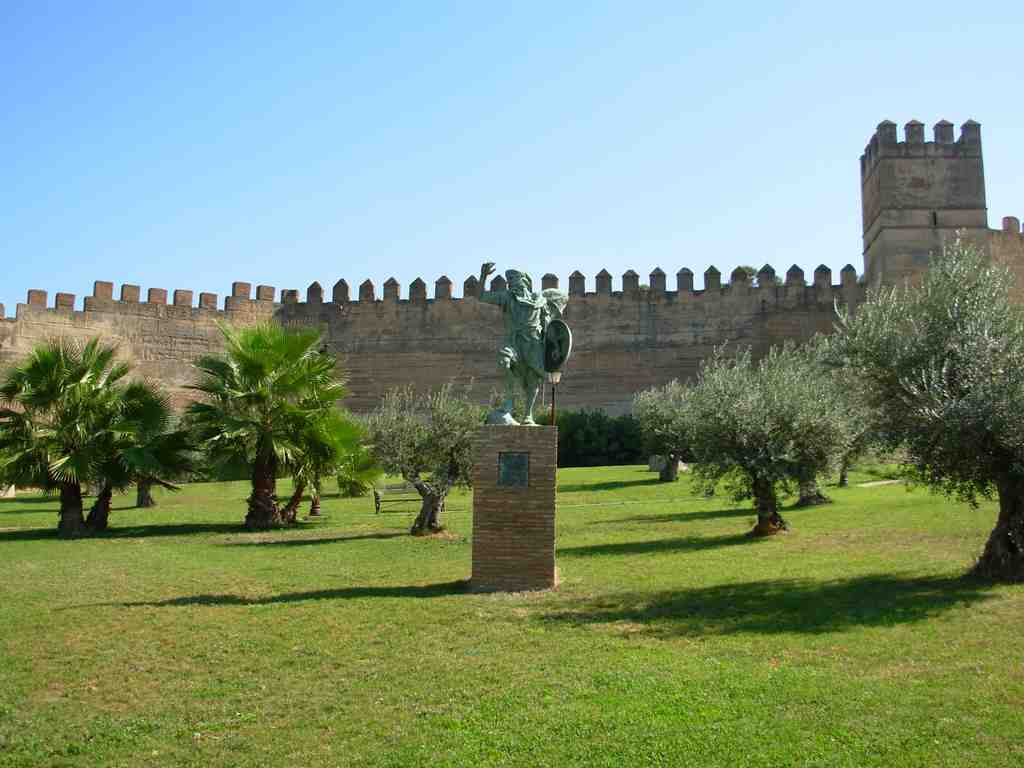
Ahead of you rises a vast, sturdy wall crowned with stone battlements, and to your right you’ll notice a square watchtower - look past the palms and olive trees, and you can't miss the immense, fortress-like Alcazaba stretching across the skyline!
Welcome to the mighty Alcazaba of Badajoz - not just the biggest in Spain, but the largest Moorish citadel anywhere in Europe! Imagine standing here over a thousand years ago, when the air would be thick with the scent of olive trees, the calls of guards echoing off those walls, and the distant rush of the Guadiana River to the north.
This fortress has stories thicker than its walls, which - by the way - run nearly 1,300 meters in a loop and once guarded a space so big, you could fit dozens of football fields inside. Founded in 875 by Abd al-Rahman Ibn Marwan, a rebel given a second chance by the Emir of Córdoba, this spot became the beating heart of a new city called Batalyaws. The original walls went up with little more than mud and dreams, but don’t worry, later upgrades made them sturdy enough to withstand both time and some not-so-friendly neighbors!
Now breathe it in: this isn’t just a castle - it’s a time machine layered with centuries. First came the Moorish dynasties, raising minarets and palaces, then in the twelfth century, the imposing Almohad walls you’re looking at today. During the days of the Taifa kings, elegant palaces and even a grand mosque filled the interior. You may still spot columns and marble repurposed from older Roman and Visigoth buildings just by walking around. Talk about recycling!
Life in the Alcazaba could be both tense and thrilling. Picture the sound of swords clashing on stone as defenders hurried along the adarve, the high walkway. During sieges, the rivers surrounding the north and east provided a natural moat, and steep slopes made it a real pain for any would-be invader to get close. Sometimes, when the city was under attack, secret paths called corachas let people sneak down to the river for water. These days, all you might need to sneak is a quick photo opportunity, not a bucket and shield!
Let’s not forget the towers - each with its own drama and personality. There’s the Espantaperros Tower, with its octagonal shape, famous for being the scarecrow of invaders and the direct ancestor of Sevilla’s Torre del Oro. Then there’s the Tower of the Seven Windows, which legend says was used for grim business during executions, though today it’s probably haunted only by curious cats and ghostly tourists.
For the curious walker, the adarve still provides a perfect viewpoint. You can imagine guards patrolling along, peeking through merlons and stone crenellations. Some areas even show the scars of war, where repairs from the 18th and 19th centuries blend into the original Almohad handiwork. And keep your eyes peeled for mysterious arabesque carvings or the odd Visigothic inscription - you never know what secret messages are etched into this place.
Inside, you’d find a patchwork of history: The grand palace of the Dukes of Feria - now the Archaeological Museum - offers tales of nobles and epic feasts. There are remnants of ancient mosques, an old military hospital turned into the Library of Extremadura, and even a lost church or two, their stones just visible beneath weeds and time. During darker times, some abandoned chapels were even used as cemeteries, the silence only interrupted by the wind rustling through ruined archways.
What’s truly remarkable is how the Alcazaba ties together centuries of life, war, faith, and strategy. From its founding days as a bold Moorish fortress, through Christian conquest, the thunder of cannons, neglect, restoration, and now your visit - it stands as a living chronicle, inviting you to step through layers of history.
So take your time, explore each shadow and stone, and remember - every echo here is a whisper from the past. And if you hear any clanking armor or ghostly chants, well, just blame it on me - your friendly, slightly spooky, digital guide!
Curious about the walls of the citadel, towers of the citadel or the the interior of the citadel? Don't hesitate to reach out in the chat section for additional details.




