
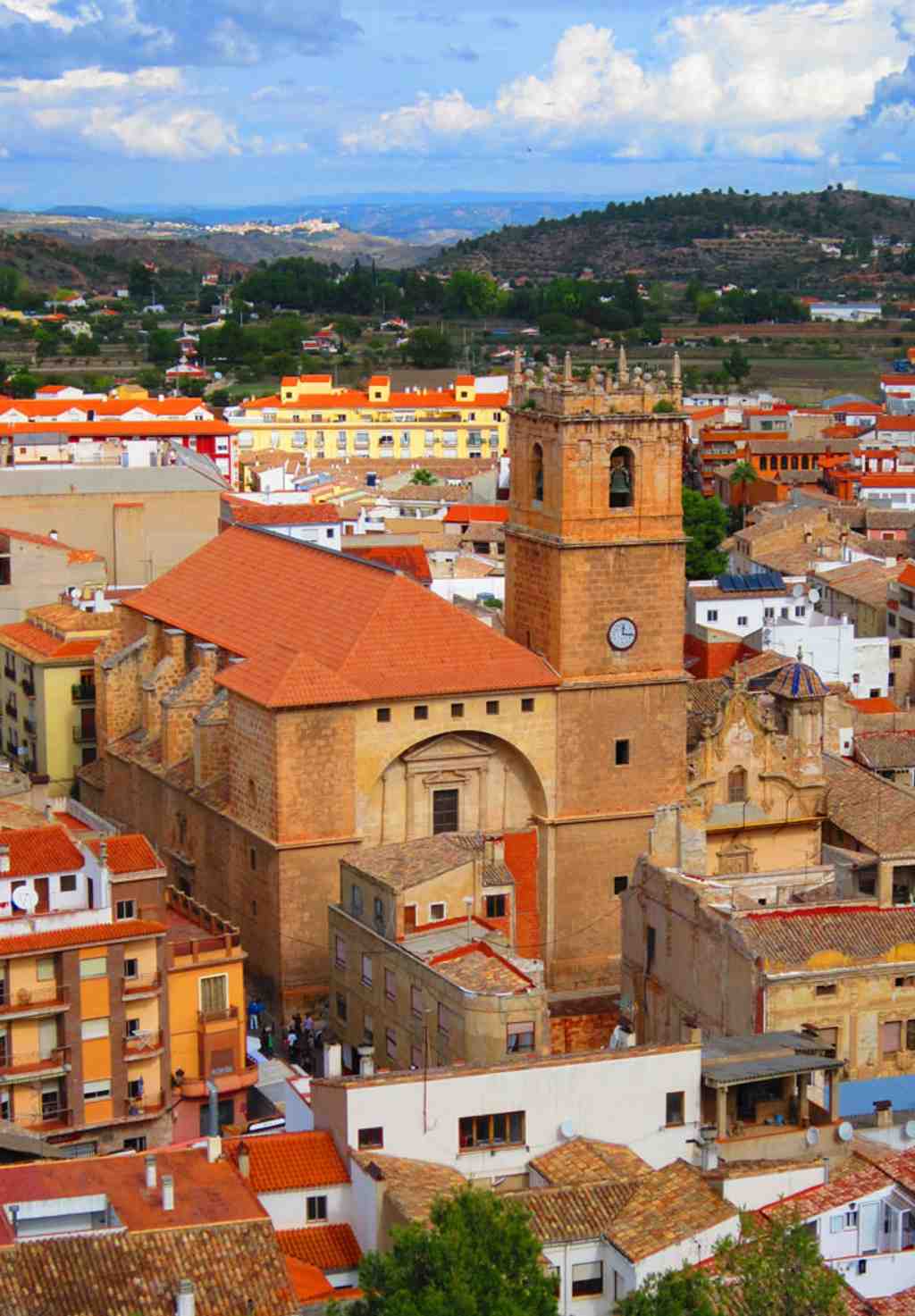
As you walk, keep an eye to your right and look for the impressive stone structure with a striking clock tower - that’s the Church of the Assumption of Our Lady in Ayora!
This stunning church stands proudly in the center of Ayora, occupying almost an entire block. It's an exquisite blend of architecture from the 16th and 17th centuries, featuring Renaissance and Mannerist styles. The church holds a treasure trove of history, including the parish archive and a sacred art museum, and has been declared a Cultural Interest Site since May 21, 1981.
Construction spanned from 1508 to 1739, reflecting a rich tapestry of Valencian architecture. Pay close attention to its nave, covered by a hidden ribbed vault that combines Gothic tradition with Renaissance influence in the molding of its profiles and arches. The main facade is a rare example of Herrerianism, uncommon in Valencian architecture.
The bell tower, with its unique Roman-style dome, and the Baroque communion chapel, with its elliptical dome and elegantly crafted chamber, are true marvels. Don't miss the intricate tiling preserved in the communion chapel's flooring (18th century) and the sacristy (16th-17th centuries), likely originating from the old choir once located in the center of the church.
The initial construction phase (1508-1577) gave birth to the octagonal apse, altar, presbytery, and ribbed vault. The second phase (1595-1628) completed the central nave, bell tower, and facade. Phase three (1693-1746) saw the addition of the Baroque chapel with its crypt, a curious elliptical chamber inspired by Central European architecture (1739), and the larger sacristy (1745-1746). Although an earthquake in 1748 caused significant damage, 19th-century modifications concealed the crevices. Restoration work in 1992 unveiled the previously hidden Gothic vault.
The church’s single nave extends 42 meters in length, 13 meters in width, and 23.6 meters in height, divided into five sections with chapels nestled between the buttresses. Corinthian capital pilasters separate these lateral chapels, supporting the vault ribs. Inside, you'll find splendid panels by Yáñez de Almedina, a Venetian-trained painter under Leonardo da Vinci's disciples, along with oils such as "The Angel Protector of Ayora" by Vicente López, and a 16th-century Valencian Gothic altarpiece.
It's an architectural masterpiece combining Gothic ribbed vaults with Renaissance moldings, a structure as rich in history as it is in artistry. Enjoy exploring this magnificent landmark!




