
Look for the pale stone base with deep round arches and iron-railed openings, set into the lower level of a grand civic building with a formal balustrade above.
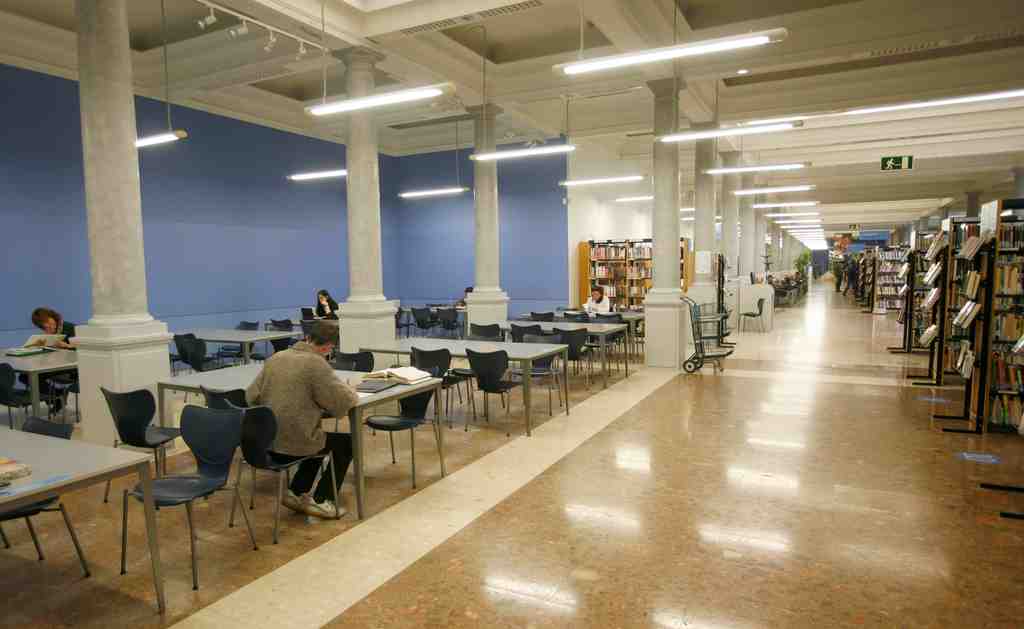
There is something quietly moving about a library at the end of a walk like this. So many of the places in central San Sebastián perform themselves in public. This one keeps the city’s inward life: its reading, its memory, its paper trail. And even that memory does not live in one room alone. The Central Municipal Library now spreads across three homes: the adult service here in Alderdi Eder, the children’s library and documentation centre for children’s books on Fermín Calbetón, and the historic collections, activity room, technical unit and direction in the Plaza de la Constitución. One institution, several addresses, as if the city had learned to shelve itself in chapters.
Its story begins with a man named Sebastián de Miñano. In eighteen forty-four, he offered the city his own collection of books. It was a generous, almost tender gesture. Then he died the following year, and his library project did not come to life. The idea had to wait. At last, in eighteen seventy-four, San Sebastián opened the Municipal Library in the old institute building at Andía and Garibai. The first shelves grew from donations, and the place began, quite literally, as a civic act of trust.
The figure I would keep in mind here is José Manterola. He took over in eighteen seventy-six. He was a writer, a teacher, and a man marked by conviction: the authorities removed him from his teaching post after he protested the law that abolished the Basque fueros, the old regional rights. He turned that loss into energy. In the library, he built the collection with fierce purpose and created what he called the Sección especial bascongada, a special section bringing together any work, in any language, that helped people study the Basque country. It gave the library a distinct soul. This would not be merely a room of books. It would be a place where a region could recognise itself.
The library kept moving, but it never lost that task. It lived in the School of Arts and Crafts on Urdaneta, then in San Telmo, then in nineteen fifty-one in the former Town Hall on the Plaza de la Constitución. Under director Rufino Mendiola, it also became guardian of something fragile: local newspapers. He saw that San Sebastián’s old press survived here almost alone, and he created the hemeroteca, the newspaper and magazine archive, so those voices would not vanish. Daily life, arguments, notices, scandals, theatre listings, griefs, triumphs: the city speaking in its own hurried ink.
Then the library changed again. In nineteen eighty-six it began lending books for ordinary home reading, not only research. The children’s section moved to larger quarters in nineteen ninety-four. The adult service came here in nineteen ninety-nine. More recently, the collections stepped into digital life, first online and then through DonostiaTEKA, so memory could travel without leaving the shelf behind.
That, perhaps, is one of this city’s finest habits: it lets institutions survive by changing their rooms, and lets buildings survive by changing their meaning. In a moment, we’ll make the brief walk to San Sebastián City Council, where that quiet transformation becomes gloriously visible. If you wish to return, the adult library generally opens Monday to Friday from ten in the morning to half past eight, and on Saturdays from ten to two and from half past four to eight.




