
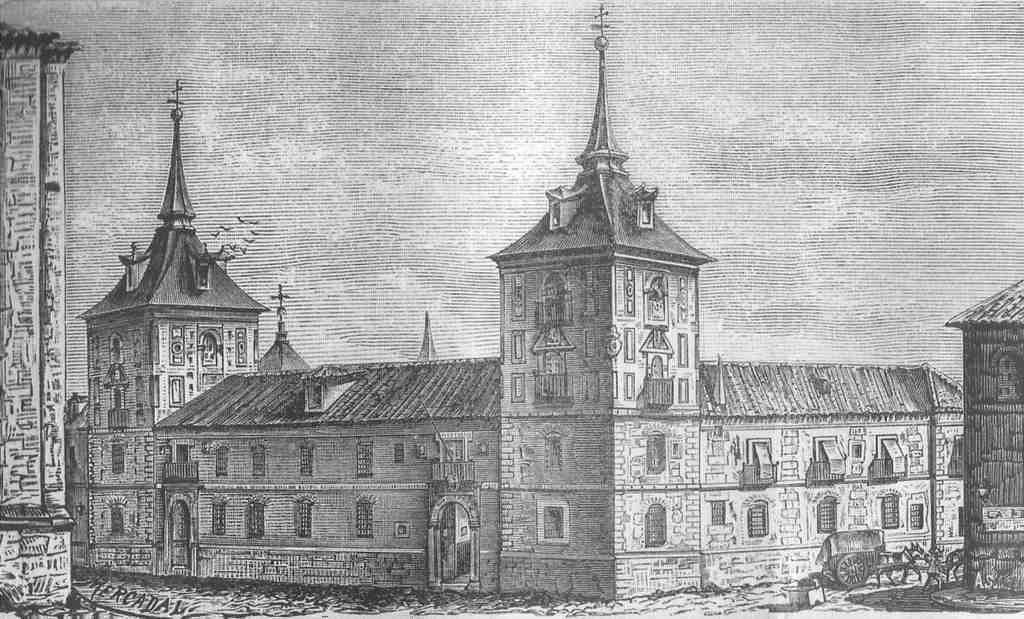
To spot the College of Malaga, look for a grand two-story brick building crowned with two elegant towers capped by pointy slate spires-these tower roofs reach up like wizard hats, each adorned with a decorative cross and weather vane.
Now, step into my time machine-don’t worry, you won’t need a seatbelt!-and imagine the street before you, alive with echoes of the 17th century. You’re standing at the gates of the College of Malaga, or as the locals of old would have called it, San Ciriaco and Santa Paula. Picture the scene: crisp morning air, bricks still slightly damp from the night, and a bustling crowd of young scholars, the first of whom arrived all the way from Malaga itself, eager and maybe a little nervous.
The story begins in 1611 with Juan Alonso de Moscoso, a bishop with a résumé longer than the main hallway inside. As a student, he once walked these streets too-though perhaps with fancier robes-and decided to create a college honoring his favorite saints and the city he served. They say he chose “San Ciriaco and Santa Paula” not just for their divine connections, but for their ties to Malaga, ensuring every homesick Malagueño would feel a bit closer to home while huddled in the chilly Castilian winters.
As construction began in 1623-imagine the clatter of tools, the laughter of laborers, and yes, plenty of arguments about budgets and blueprints. Plans might have started under the famed architect Juan Gómez de Mora, but it was Sebastián de la Plaza who hammered out most of the details. The brick walls rose slowly, interrupted often by money problems and legal spats with neighbors. (Apparently, property disputes were the true university tradition.) The building was finished nearly at the century’s end, polished off by two more architects-almost a relay race of ambition and exhaustion.
Step closer and you’ll see why it’s considered the grandest secular college in Alcalá. The façade greets you with two imposing arched entrances and those unmistakable towers topped by slate spires-like a pair of scholarly sentinels keeping watch over all who approach. Peer up, and you might spot the Latin inscription honoring Bishop Moscoso, and his coat of arms gleaming on almost every stone: proof that, even centuries ago, founders liked to leave their signatures everywhere.
Walk through these halls and you’d have seen students wrapped in deep red or maroon cloaks, sporting black caps and purple sashes-less Hogwarts, more 17th-century Spanish chic. This was a world of crowded lectures and whispered gossip, with a stunning staircase under an oval dome that made even the dreariest winter days feel dramatic.
Don’t go wandering into the wrong room-over the years, these towers have seen it all. During Napoleon’s invasion in 1809, the college almost went up in smoke. Books vanished, cloaks were traded for bandages, and the smell of fire swept through the old brick. By 1820, secret meetings of a Masonic lodge were held behind these very walls-now that’s a plot twist!
Things kept changing. After the university closed in 1836, the building morphed: artillery school, farriers for the army, an archive, even a home for orphaned girls and elderly women. Fast forward to 1949, and it transformed once more-a boarding school for adolescent boys, known as “Nuestra Señora de la Paloma,” echoing with teenage shenanigans.
Finally, in 1983, learning returned as the Faculty of Philosophy and Letters of the University of Alcalá. And in 1998, the college’s richly worn stones became part of a UNESCO World Heritage Site-a world away from its humble beginnings with twelve theology and four cannon law students from Malaga.
So as you stand here, close your eyes, listen to the echoes-bickering architects, giggling students, the proud bishop, smoky chaos, and secret societies-all woven into every inch of brick and stone. Who needs a crystal ball when you’ve got the College of Malaga?




