
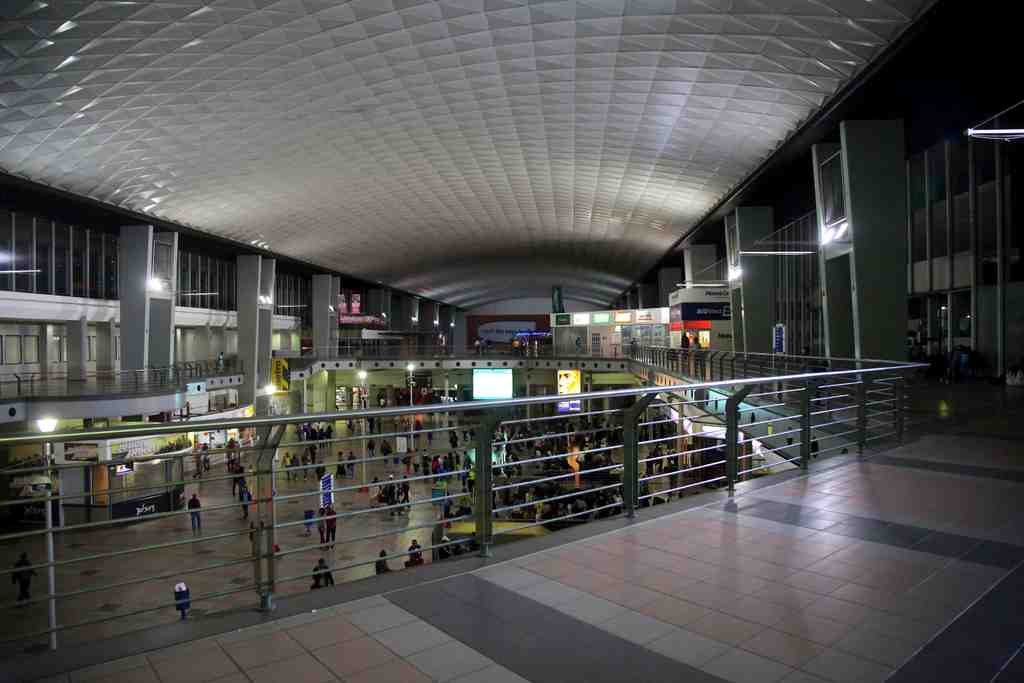
To spot Johannesburg Park Station, look straight ahead for a long, wide, modern building with a curved, diamond-patterned ceiling and plenty of glass and steel, buzzing with activity; the bustling concourse and elevated walkways are usually alive with people and flooded with light even at night.
Now, as you stand before Johannesburg Park Station, take a deep breath and listen to the hum of voices, the rhythm of footsteps, and the occasional screech of a distant train. The air here feels alive, filled with a century of arrivals and departures, laughter and worry, meetings and goodbyes-a true crossroads of a city that never stands still.
But imagine this spot in 1887, when Johannesburg was just a hint of city dust on the wind, and this land north of Noord Street was little more than wild veld. Instead of this vast steel and glass marvel, you might have seen a simple tin shed. In fact, that original “Park Halt” was named after the nearby Krugers Park, later called Old Wanderers, and it quickly became the heart of transportation for a restless gold rush town. The railway then was more like a bustling conveyor belt of coal and hope, run by the grandly named De Nederlandsche Zuid-Afrikaansche Spoorweg Maatschappij, or NZASM for short-try saying that quickly after your morning coffee!
Early on, the lines here carried coal to Braamfontein and restless passengers east to Boksburg, west to Krugersdorp, north to Pretoria, and beyond. The railway brought in dreamers, workers, and even the occasional fortune hunter, all knitted together by steel tracks. By 1892, you could hop a train from Cape Town all the way up here, and not long after, from Pretoria via the newly lowered tracks-practical, of course, so errant cows and excited gold seekers wouldn’t get flattened by passing trains.
The station grew as the city did-sometimes faster than its own shoes. At one point, they shipped a steel and glass building from the Netherlands, which had first dazzled crowds as part of the Amsterdam Exhibition in 1895. Imagine a glass-domed roof, ornate ironwork, carved oak walls, and a restaurant splashed with Dutch proverbs-“A full stomach knows no dance,” one might say while waiting for a train bound for Cape Town. A bit grand for a rough-and-tumble railway stop, but this was Johannesburg after all.
Of course, big dreams come with big drama. In 1913, riots swept the city over layoffs at the mines, and the station was set ablaze during a night of chaos when rioters-showing their creative side-cut open the fire brigade’s hoses. The station rose from the ashes, only to be outgrown again by the roaring crowds of passengers. Negotiations, wrangling, and a hefty pile of money later, Park Station expanded north onto the old Wanderers’ sport ground-imagine the uproar as train whistles replaced the shouts of cricketers.
By the early 1930s, the place had a grand new look: Tuscan columns out front, giant painted panels by local artist Jacobus Hendrik Pierneef on the walls, and the snazziest blue and white tiles in the restaurant. If you popped in for coffee, you might even find more Dutch proverbs-practically as lively as the comings and goings of white-clad officials and non-white passengers using separate, far less splendid facilities. History, for all its switchbacks, kept moving forward.
Then, in the bustle and chaos of mid-century Johannesburg, the old iron-and-glass structure was dismantled, moved, and rebuilt twice-quite a nomad itself-finally landing in Newtown where it waits, perhaps dreaming of visitors in a future museum.
Expansion came again in the 1950s and ’60s, with gleaming new concourses, even deeper sunk railway lines, and bridges swooping overhead. If you’d stood here in 1965, with the station officially opened, you’d have sensed the pulse of ten suburban lines and six main lines, and at times, a staggering 130,000 people thundering through daily-a city in perpetual motion.
But not everything here has been ordinary or safe. In 1964, Park Station was the site of a deadly bombing on a whites-only platform-a grim marker of South Africa’s tangled history. And even today, it’s a place to keep your wits about you, as reports of trafficking and crime have shadowed its corridors.
Yet, through all the decades of change, Park Station remains the central knot in Johannesburg’s web of travel. Nowadays, it’s also the proud southern end of the Gautrain-South Africa’s answer to high-speed, modern railways. Dive below Smit and Wolmarans Streets, tap your smartcard, and in ten minutes a train whisks you north through nine miles of tunnel, straight as an arrow, to the next big adventure.
So, whether you’re heading out, coming home, or just pausing for a bite under this futuristic roof, remember: Park Station is more than a place to pass through-it’s Johannesburg’s grand front door, always open, always bustling, and always ready for its next story.


