
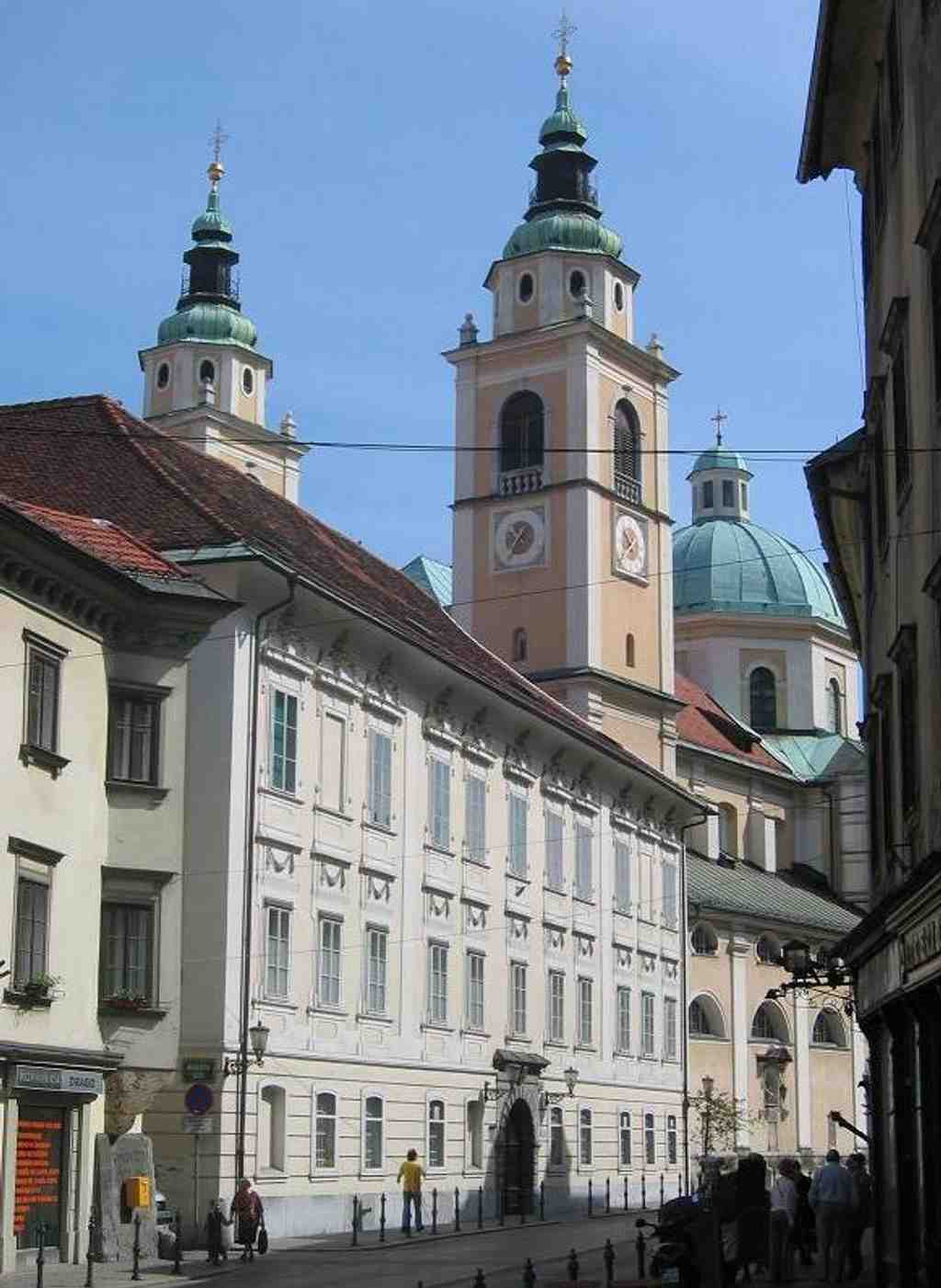
Look up ahead to spot the Roman Catholic Archdiocese of Ljubljana, with its grand white facade and twin clock-towered spires rising just above the street, and the large green-domed roof peeking out behind.
Welcome to the heart of Ljubljana’s spiritual life! You’re standing in front of the Roman Catholic Archdiocese headquarters, and, even if you’re not a fan of bells, I’ll bet you can’t help staring at those striking twin towers and elegant dome - it’s like the city decided to wear its fanciest hat today! But trust me, the story inside these walls is even grander than the view out here.
Imagine the early dawn of the fourth century, when the ancient Diocese of Emona (Ljubljana’s Roman ancestor) first opened its doors to hopeful worshippers. Back then, you’d hear the low hum of prayer layered with the bustle of Roman streets - now that’s a soundtrack for history! Yet, life was anything but calm; over centuries the seat of the diocese moved and changed, weaving through tides of empires and politics until, in 1461, along came Frederick III, the Holy Roman Emperor. With a royal flourish, he created the Diocese of Laibach right here, which Pope Pius II quickly confirmed. Suddenly Ljubljana was more than just a city; it was becoming a center of faith.
As you gaze at those towers, imagine the tension: In 1787, after years under the thumb of powerful religious neighbors like the Patriarch of Aquileia, Ljubljana’s diocese was lifted to the rank of archdiocese-a metropolis in the Catholic world! Everyone must have been celebrating, except, well… about twenty years later politics pulled the rug out from under their feet, and it got downgraded again. If only they had Yelp reviews back then for diocesan status!
Dark days swept through during the Second World War. The Nazi occupation targeted clergy and religious orders, and within just six weeks, you’d find the archdiocese nearly silenced-only 100 out of more than 800 priests remained free, while the rest vanished into the nightmare of concentration camps or lost their livelihoods as properties were seized. This city’s prayers must have felt heavier than ever, echoing off cold stone and silent pews.
But resilience is woven into these very walls. By 1961, Pope John XXIII restored Ljubljana as an archdiocese once again, and by 1968, it was back as a metropolis, spreading its influence far beyond these streets. Today, it’s the most important seat in Slovenia, with the Archbishop of Ljubljana acting as the Primate-the top banana of the nation’s Catholic hierarchy. Since 2014, Archbishop Stanislav Zore has held the post, stepping into shoes filled by many historic names (and, occasionally, stepping out when things got a little too dramatic, like the financial fiasco you won’t find in the Sunday bulletin).
So the next time you spot those clock faces, remember: you’re not just looking at beautiful architecture, but a living story of faith, power, struggle, and hope. Not bad for a place that started in ancient Rome, right? And if you listen closely, you might just hear the whispers of those who shaped this city’s soul.
Exploring the realm of the archdiocese, list of bishops of ljubljana or the list of archbishops of ljubljana? Feel free to consult the chat section for additional information.




