
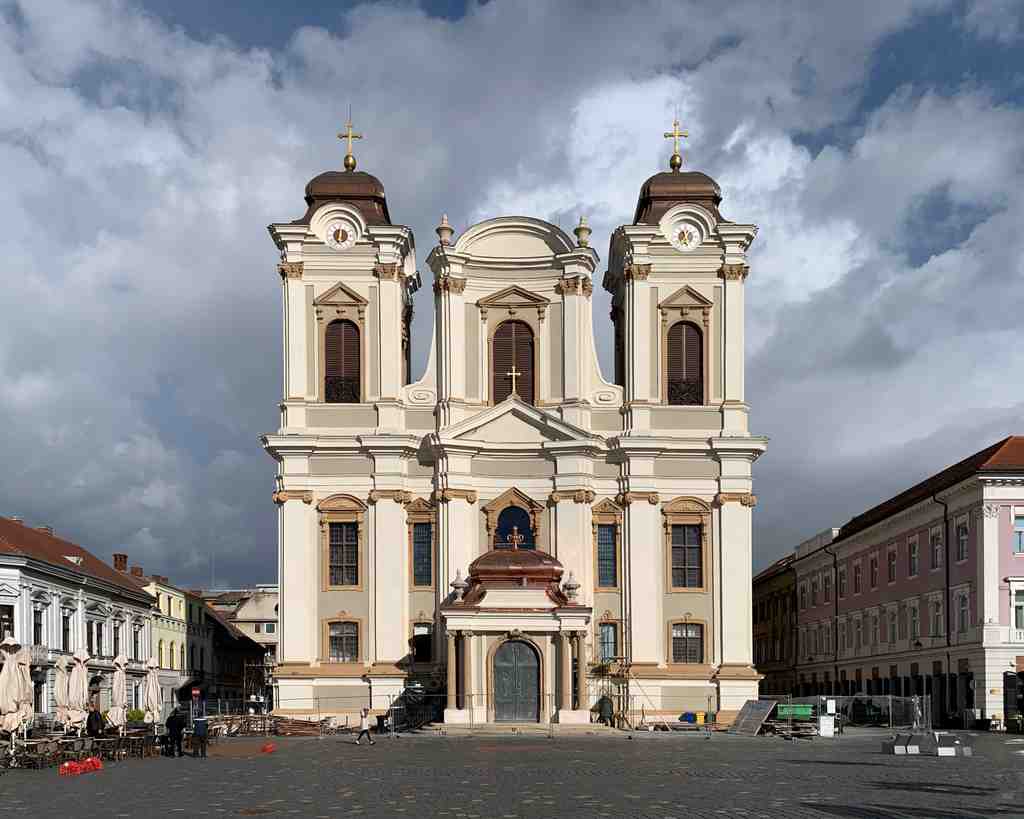
To spot the St. George Cathedral, just look straight ahead for a grand cream-colored Baroque church with two tall towers topped by bronze domes and crosses, right at the heart of the square, standing proudly among the surrounding pastel buildings.
Welcome to the stage of Timișoara’s history! With its grand twin towers and creamy, sculpted façade, the St. George Cathedral has watched centuries of drama, celebration, and even a bit of chaos unfold. Picture it: It’s the 1730s, and the city is buzzing-imagine the sound of hammers and saws as the first stones are set where you’re now standing. Timișoara had just become the seat of the Bishop, thanks to Emperor Charles VI, and suddenly the city needed more sparkle-what better solution than a colossal cathedral that looks like it could charm the socks off Vienna?
Construction wasn’t all smooth sailing. They started with grand visions in 1736, only for war to bring everything screeching to a halt after just one year. You can picture the workers grumbling, tools dropped, as the Austro-Turkish War put dreams on pause. Half built, the cathedral was just a glorious work-in-progress when Adalbert von Falkenstein, the original bishop, died-only to be succeeded by Nikolaus Stanislavich, who had quite the adventurous backstory himself, having fled Craiova ahead of the Ottomans. Now, with new determination, he dusted off the plans and called everyone back to work, the sound of hammers echoing across the square.
The cathedral quickly became Timișoara’s pride, but it grew in fits and starts-one bit finished here, one bit started there. By the late 1740s and early 1750s, finally, the walls grew high, the first holy mass was celebrated (with music specially composed by Michael Haydn, no less-clearly, they liked to do things in style!), even though half the church was shielded behind a makeshift wooden shed. The grand opening? That took a few more decades! You’d think they were making sure every stucco swirl was just right.
Carl Alexander Steinlein and Johann Theodor Kostka took over the helm for the second construction wave, adding those iconic towers-though, plot twist, their tops had to settle for clapboards instead of copper domes because, surprise, the Viennese court had a tight budget. Some things never change!
Inside, it’s a feast for the eyes. Nine altars decked out in shimmering Rococo and Baroque, statues of saints watching over worshipers, and paintings by Michelangelo Unterberger-a guy whose name might trick you into thinking he switched from painting chapels to painting frescos in some world-famous chapel elsewhere. The main altar, flanked by St. Teresa of Ávila and St. Charles Borromeo, is dazzling under Josef Moser’s silver chandelier (or the “Eternal Light,” as they call it). And don’t miss that mural: St. George himself, armored up and giving a dragon a very hard time. That’s right-the cathedral’s spiritual patron was a real dragon slayer! I bet the pigeons outside aren’t even half as dramatic.
If you listen closely from the square, you might catch an echo of the bells-the one remaining original, cast in 1763, still chimes after all these years. The crypt below carries secrets of its own. Over the centuries, it sheltered not only bishops like Stanislavich and Wagrain but also noble commanders and even some unfortunate civilians who rushed inside during city sieges when bombs tore down the roof in 1849, and the only safe place was underground beneath the cathedral’s thick floor. Imagine the silence and tension as they huddled in the dark, listening to distant thunder and waiting for safety to return.
Let’s not forget: Between the colossal organ (a replica of the one in Paris’ Saint-Sulpice, built in 1907) and the cathedral’s infamous acoustics, this place is still very much alive, regularly hosting concerts and ceremonies in German, Hungarian, and Romanian. Even Empress Maria Theresa couldn’t resist and declared it the city’s first church back in 1756.
So here you are, standing before a cathedral built on wooden pillars to stand firm above ancient marshes, a place where marble and wood came all the way from Vienna, and silver and gold glitter from every corner. Its story is one of war and peace, devotion and danger, music and mystery-and more than a little Baroque drama. Now, take a moment to step closer, touch the cold oak doors, and imagine how many people before you have come for hope, courage, or maybe to hear a little music echoing up toward the vaulted ceiling. And if you think you feel a dragon watching over you, well, maybe you do!




