
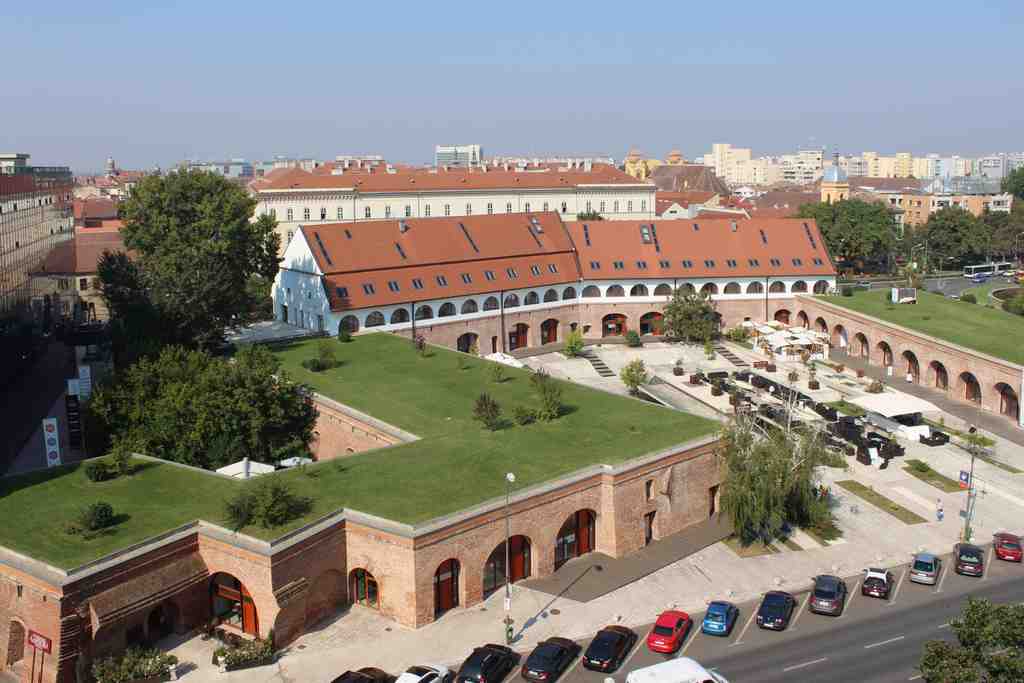
To spot the Theresia Bastion, just look for a long, red-brick wall with arched openings, topped with a lush green lawn and a white building on one corner-it stands proudly right near the busy intersection of 1989 Revolution Boulevard, with its unique grassy roof peeking above the city buzz.
Welcome to Theresia Bastion, where history-believe it or not-still sometimes echoes through these arched brick corridors! If you close your eyes for just a moment, you might almost hear the distant clatter of carriages and the shuffle of soldiers' boots. This mighty structure, stretching across about 1.7 hectares, is the largest and best-preserved chunk of what once was Timișoara’s defensive fortress. Now, before you start picturing knights in armor and drawbridges, let me unwind its story for you.
Once upon a chilly October in 1716, the air was thick with tension as Eugene of Savoy and his Habsburg army stormed the city, taking it from the Ottoman Turks. Back then, the Turkish fortress walls-let’s just say-weren’t a match for the new “bang and boom” of modern warfare. So, the Austrians decided to tear it all down and start afresh. Fast-forward just a few years, and you’re standing in front of the first piece of their new masterpiece-the Theresia Bastion! Construction began in 1732, right after clever engineers made sure the Bega River’s waters brought life, and a little extra moat drama, right to the foot of these walls.
Originally, this wasn’t just any old wall. It was a ravelin, surrounded by water, designed to guard the food warehouses and powder room with fierce determination. If you ever wondered what defensive architects dream about, it’s this: thick brickwork, angled flanks for firing at would-be intruders, and a secret retreat for when things got dicey. In fact, the Theresia Bastion was so well-defended, it was meant to serve as a final refuge-like the “last cookie in the jar” of fortresses, always fiercely protected.
But this place wasn’t all muskets and mayhem. Over the centuries, these echoing halls played host to all sorts of curious characters. Imagine the clang of hammers from workshops, the stomping of boots in riding schools, and, I kid you not, apprentice duels in the old fencing halls. Even the state archives, boarding schools, and a rather mysterious ethnographic collection found a home here. By the end of the 19th century, Timișoara decided it didn’t need most of its walls anymore (there goes the neighborhood!), but the Theresia Bastion survived, because-unlike the rest-it had usable rooms all up and down its length. Practicality saved it from the wrecking ball!
These days, instead of echoing with battle cries, you’ll hear café chatter, glasses clinking, and perhaps even the thumping beat from a nightclub hidden behind those sturdy walls. Take a deep breath-you might smell roasted coffee, food wafting from nearby restaurants, or even the musty pages of the Banat Village Museum’s ethnography collections.
Of course, keeping a structure this old standing takes a little TLC. In the late 1960s, architects-in their infinite 20th-century wisdom-decided to pour a little concrete and open up a new passage for cars and pedestrians. But, oops, they also erased a lot of the original details, and the defensive ditch shrank dramatically. Fast-forward again to the 2000s, and the bastion got a fresh round of restoration. Builders this time removed the old concrete, added timber frames in the brick arches, transformed the attic into an event space, and showed off those ancient wooden beams-some of them still standing strong after nearly 300 years.
So as you stand here in the center of the old city, imagine yourself as both a defender and a witness to centuries of change. Look left and right along the two long flanks-once studded with cannon embrasures-and imagine the bustle of soldiers, clerks, and students all sheltering inside. The angled corners you see? They were designed for defense, forming a sharp 72° point to the east, with the “ears” of the bastion poking out on either side.
Today, Theresia Bastion is more than just bricks and memories. It’s a passage, a gathering place, and-let’s be honest-a great spot for a secret snack or a night out. Next time you hear echoes in the vaults, just remember, it might be the past saying, “Hey! Not bad for a 300-year-old wall, huh?”




