
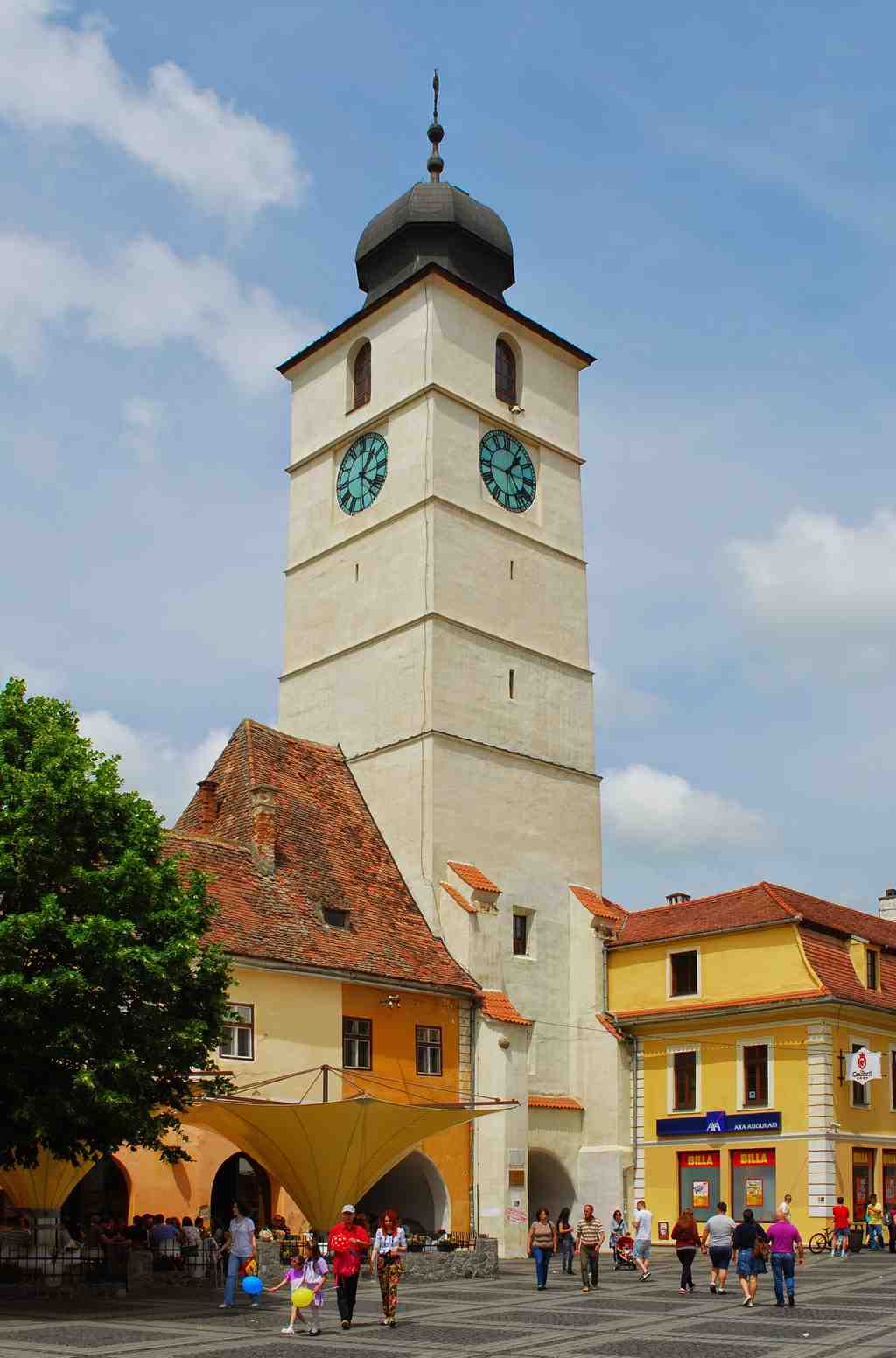
Look up at the tall, square tower built from white plaster, topped with a dark bulb-shaped roof and large blue clock faces. This is the Council Tower, the famous passageway connecting the Large Square and the Small Square.
It was originally built back in the thirteenth century, acting as a fortified gate to protect the second ring of the city. However, only the very bottom section of that original structure still stands today. The rest of it had a rather dramatic remodeling. In fifteen eighty-five, a painter named Johann David was standing on high scaffolding, carefully decorating the ceiling of the passageway.... Without warning, the entire upper section of the tower collapsed, tragically burying the artist under a mountain of rubble.
The city came together to rebuild it between fifteen eighty-six and fifteen eighty-eight, paying for the construction out of their own pockets. If you look closely near the roof, you might notice four small turrets at the corners. That was not just a decorative choice. Those four turrets signaled that Sibiu possessed the ius gladii, a Latin term meaning the right of the sword. It was a public warning that the local magistrates had the legal authority to sentence criminals to death.
Over the centuries, the tower has served as a grain silo, a prison, and even a temporary natural history museum in the mid-nineteenth century. They eventually had to move the museum exhibits because the thick stone walls were much too damp. It also served as a fire watchtower, which was a tough job. In seventeen twenty, the city magistrates ordered the guards to beat a drum every thirty minutes throughout the night. This was mostly to prove to the citizens below that the watchmen were actually awake and looking for smoke.
The roof itself has a bit of a chaotic history. It used to be a tall pyramid, then a shorter pyramid, until the current bulb shape was added in eighteen twenty-six. Then, during the First World War in nineteen seventeen, the German army stripped off the entire copper covering of the roof to melt it down for munitions, leaving the building totally exposed to the elements until the war ended.
The clock at the top has its own stories, too. The original mechanism was made entirely of wood. The current metal machinery was installed in nineteen hundred and six, and a dedicated local clockmaker named Andrei Albert still climbs the narrow, spiral staircase to oil the gears. He had his work cut out for him in two thousand nineteen, when a violent lightning storm struck the tower and completely stopped the clock. Strangely enough, the hands froze at exactly twelve o'clock.
These two stone lions carved into the lower walls still act as historic guardians of the gate, having miraculously survived the dramatic collapse centuries ago. Take your time admiring the details, and whenever you are ready, we can wander over to the next stop.


