
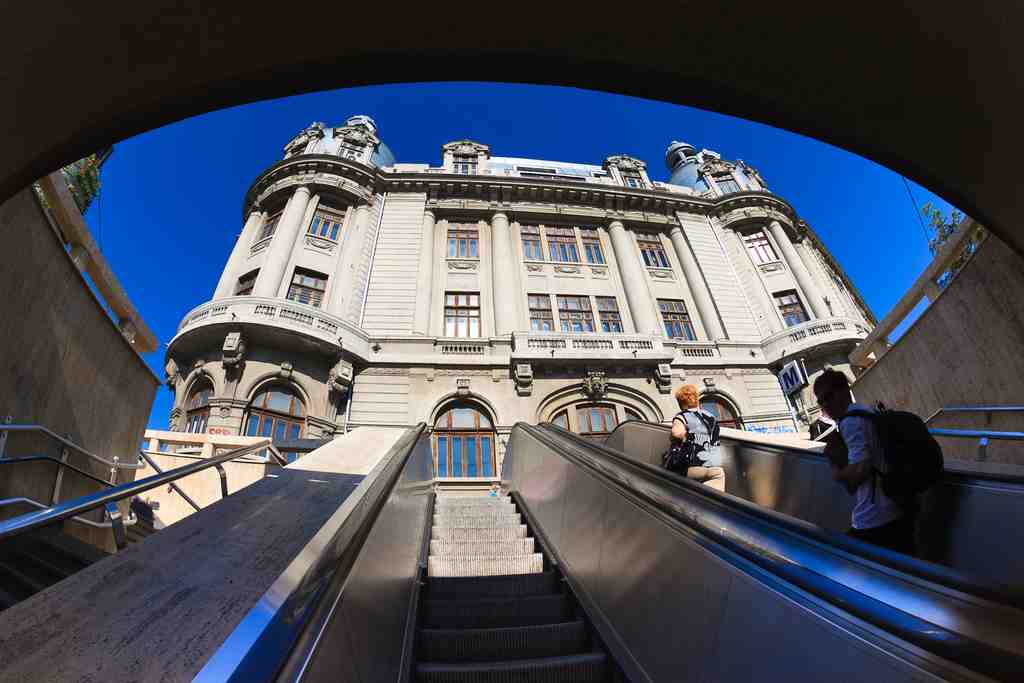
To spot the University Palace, just look up toward the elegant neoclassical façade towering above you, with its grand round corners wrapped in columns and topped by impressive dome-shaped roofs.
Now that you’re here, standing at the heart of University Square, take a big breath and imagine this spot as the center stage of Bucharest’s story! This mighty building looming before you, rising for six stately floors, wasn’t always a palace of learning. Once upon a time, monks wandered here, for this was the sacred ground of the old Saint Sava Monastery. But in the rush and dream of the 19th century, Bucharest needed a home for its boldest minds. And so, on a crisp day in October 1857-when horses still rattled through muddy streets-architect Alexandru Orăscu lay the foundation stone. A metal box was sealed inside, holding the city’s hopes and an official document, like a time capsule buried for the future.
The construction spanned over a decade, finishing in 1869, just in time for the waves of knowledge seekers to flood in. In its earliest days, the palace gathered more than just the University’s faculties. It was a buzzing hive-a Senate chamber, the proud vaults of the Academy, the Central Library, a Fine Arts School, and, for good measure, even a pinacotheca and the Museum of Natural History! If you listen closely, perhaps you can hear the ghostly echoes of heated debates, chalk on blackboards, and the hint of library dust as students hustled between rooms.
But the Palace didn’t stop growing-no, it had to keep up with Bucharest’s curiosity! New side wings, designed by Nicolae Ghica-Budești, emerged between 1912 and 1926, elegantly stitched onto Orăscu’s dream. The palace’s very skin tells you its story: rugged stone ground floor, vast round arches, a parade of strong Doric pilasters, and above it all, playful roof windows peeking from beneath the domes. At the corners, massive round towers clad in pillars look like they’re ready to break out into a waltz at any minute. Honestly, it’s hard to blame them-this is a building with serious style!
Now, here’s a twist worthy of any academic drama: look up in your mind’s eye at the central pediment-once sculpted with a glorious relief by Karl Storck, showing Minerva crowning the arts and sciences. She stretched out a laurel crown to a graceful muse of poetry, while around her, the arts and sciences lounged in all their finery. But in 1944, American bombs rained down, and that masterpiece crumbled. Only fragments survive, tucked away in a city museum. The statues you see today? They’re muses added in 1929 by Emil Wilhelm Becker-a true family affair, as his very own daughter was the model!
Over time, the palace became a little too crowded for comfort-a victim of its own popularity-so most institutions moved out, leaving the palace to its original children: the students. Today, you’ll find the Faculty of Geography, Mathematics and Informatics, Letters, Foreign Languages, History, Chemistry, Business, and many more. Just think, the echoes of hundreds of thousands of hopes, dreams, and hard-fought midnight study sessions live in these stone walls.
So, as you stand in this square, let your imagination travel through all those stories-monks, master builders, muses, scholars and rebels. Each left a little magic here-giving the University Palace a pulse and a presence that’s very much alive. Now, isn’t that the kind of place where you’d want to chase a dream or two?




