
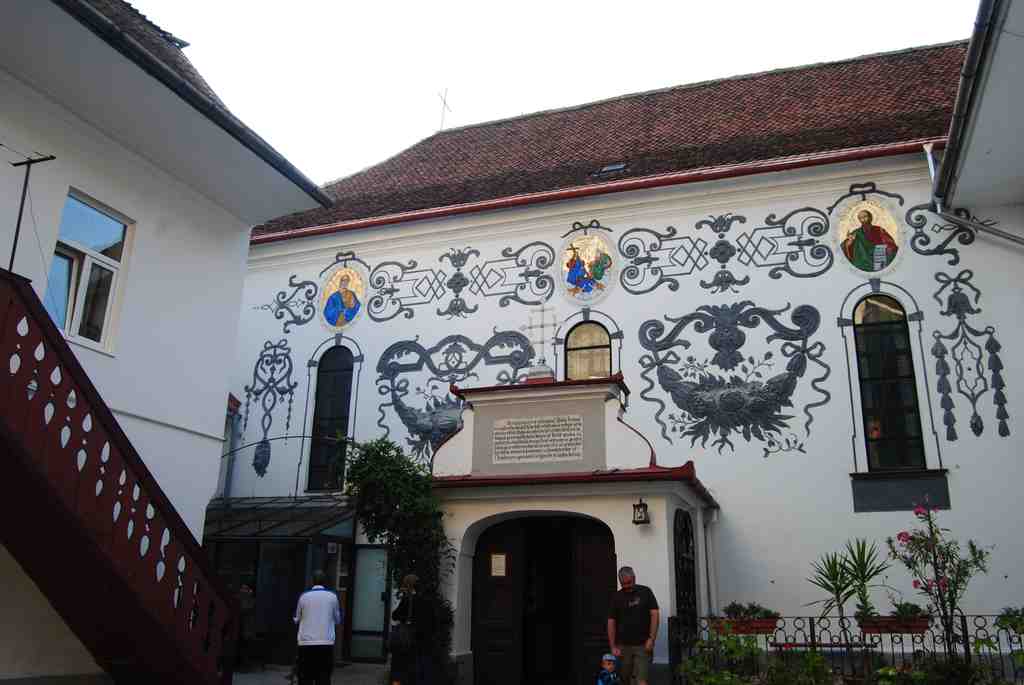
To spot the "Holy Trinity - Greek" Church, just look for a charming white building tucked slightly back from the street, decorated with striking black baroque scrollwork and three shimmering gold-and-color icons gleaming above the entrance.
Now imagine yourself standing before this unique church, its façade alive with swirling decorations, the air filled with the faint scent of blooming flowers from the courtyard plants. It may be a peaceful sight now, but the story behind this church is anything but calm. Picture the year 1784: the people of Brașov are bustling through the old marketplace known as Târgul Cailor, and suddenly, the clang of bricks and stone being carried echoes through the yard. After years under strict rules, Emperor Joseph II has issued his decree of religious tolerance, and the local Orthodox merchants are eager to build a place of worship-though the authorities have said, “Alright, but you have to put it out of sight! Not smack on the street!” That’s why you’ve found it nestled away, always a little shy.
But they triumph, raising their church stone by stone on the spot of an older 17th-century chapel. Most of these benefactors come from the Balkan Peninsula, bringing not just generous donations but their Greek spirit too. Local hero Panaiot Nica and other Macedonian-Romanian founders pitch in, alongside noble exiles from Muntenia-Brâncoveanu, Văcărescu, Mavrocordat, and Suțu families-creating a real who’s who of historic benefactors.
The celebration at the church’s grand opening in 1788 must have been something-bells ringing out over Brașov, priests chanting, the courtyard filled with the city’s most colorful merchants and leaders, all watched over by the stately Orthodox Bishop from Sibiu.
But harmony didn’t last long. Soon, a tug-of-war broke out! “It’s a Greek church!” said one group. “No, it’s for all of us!” said another. Lawsuit after lawsuit dragged on for a staggering one hundred years. Picture heated meetings, furrowed brows, perhaps the odd dramatic storm outside to match the tempers within. Tired and defeated in court, the Romanians eventually gave up in the late 1800s and moved on to build their own church in Brașov’s main square.
For a while, this was strictly “the Greek church,” but in 1924, it returned under the Orthodox jurisdiction of Sibiu and, from 1942 onward, services were once again held in Romanian. The churchyard holds many secrets: pass through the gate and under the old defense tower-once part of Brașov’s fortifications and later repurposed as a bell tower with a wooden toaca for even more music in the air.
Take a closer look at the architecture-the church itself is a historic heavyweight, 20.5 meters long, 8.5 meters wide, its stone-and-brick walls thick with history and gossip. The baroque façade, twirling stucco trim, and the three glowing icons (Saint Peter, the Holy Trinity, and Saint Paul) form a magical welcome. Inside, the baroque style continues, with lush stucco garlands and bas-relief flowers curling above your head. The iconostasis gleams, draped in gold leaf, while up above, the ceiling is crowded with angels and saints painted in the 19th-century Western style.
Don’t miss the graveyard in the back, either. Here you’ll find the resting places of those noble families, along with a mitropolitan bishop from Muntenia-plus, intriguingly, the oldest cross in the region, carved all the way back in 1292 and rehomed here for safekeeping in 1980. Just imagine the generations that have walked these grounds, leaving quiet prayers behind like footprints.
If you listen closely, you might even hear echoes of heated whispers from past disputes, the murmured prayers of the faithful, and the soft rustle of leaves in the old cemetery. This is a church founded on hope, survived on persistence, and filled, even now, with stories that refuse to fade away.
If you're keen on discovering more about the historian, architecture or the painting, head down to the chat section and engage with me.


