
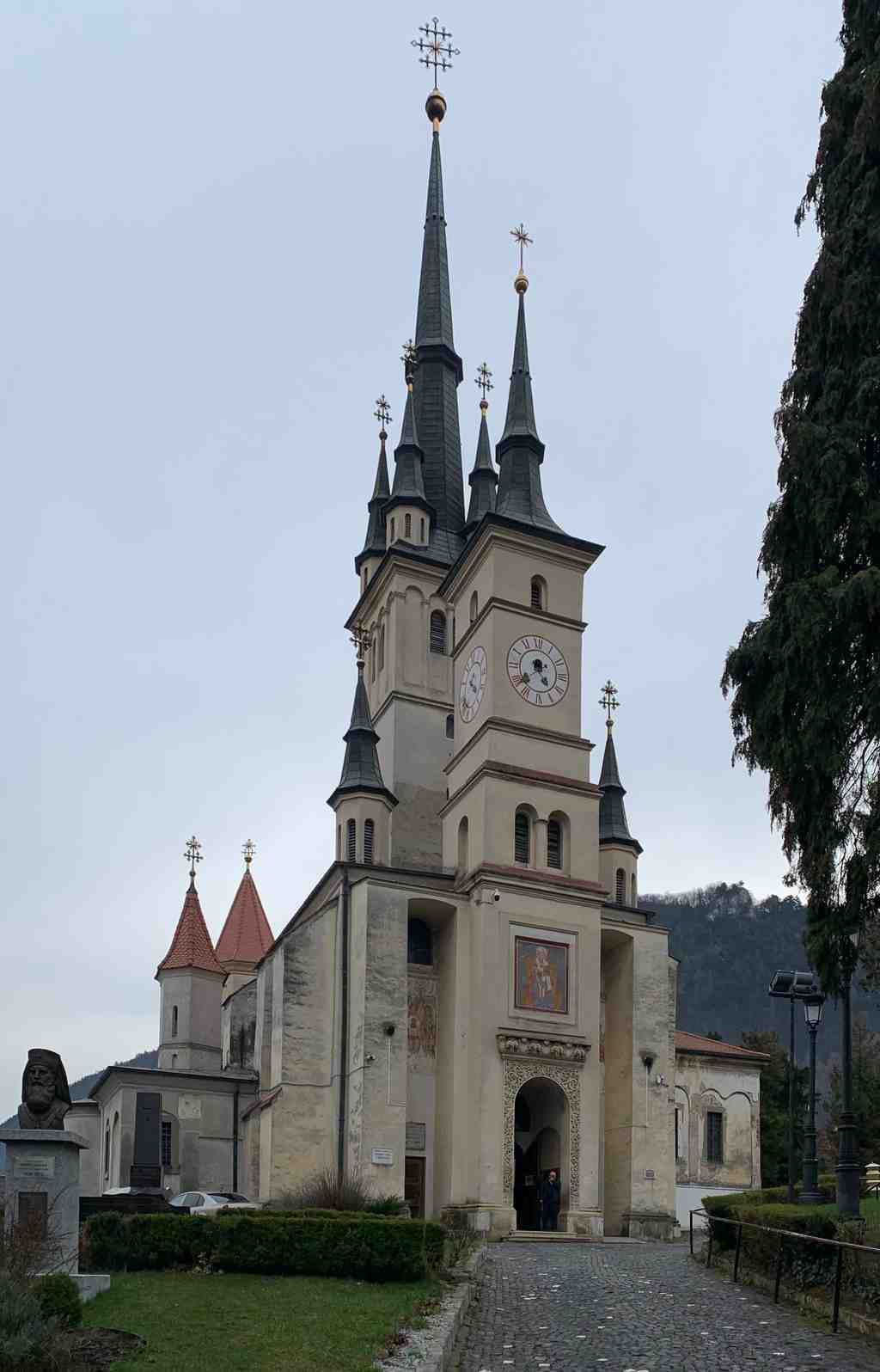
Look ahead for a grand church with creamy stone walls, a tall clock tower, and spires rising like rockets-its main entrance sits at the end of a cobbled path, so you can’t miss it!
You’re standing at the threshold of time itself! Imagine the year is 1292: this very spot holds only a simple wooden cross, swaying gently as the people of Șcheii Brașovului gather in the misty mountain air. The wooden church that would one day become the majestic St. Nicholas Church was mentioned by none other than Pope Boniface IX all the way back in 1399-though, if churches could talk, you’d probably hear, “Hey, finally some recognition!” from those first logs and beams.
As you take in the view today, picture the flurry of activity between 1495 and 1519 when the humble wooden church was slowly transformed into a fortress of faith built from cold, unyielding stone. The locals worked alongside powerful friends-Voivode Vlad Călugărul, followed by the mighty Neagoe Basarab-each pitched in to make the church grander than anyone expected, with a solid, rectangular nave and a striking polygonal apse. By 1519, St. Nicholas stood larger than planned, almost as if it wanted to remind the mountains who was boss here in Țara Bârsei.
But the work never stopped! In 1584, another ambitious prince, Petru Cercel, rolled up his sleeves and started adding a porch and a choir fit for a chorus of angels, plus a shimmer of painted icons over the altar. While he set his creativity loose, Moldavian Voivode Aron Vodă dropped by in 1595, deciding the church needed a bell tower-because ringing bells have a way of waking up history, wouldn’t you agree? Inside, the walls were painted with biblical scenes that felt almost alive, as if saints and apostles were elbowing for space.
Wave to your left and right-see those smaller chapels? They blossomed in the 1700s, each with its own story. The northern chapel, finished in 1734, was helped along by Lady Ancuța, daughter of Constantin Brâncoveanu. Not to be outdone, Brașov’s merchants chipped in for the southern chapel between 1750 and 1752. Chapels here are like the cherry on top: one holds an elegant iconostasis carved with swirling Brâncovenesc motifs, the other brims with paintings of the Annunciation and the Apocalypse of Saint John. Just imagine, painters leaned in close by dim lantern-light, their brushes dancing over stone as they depicted saints spinning the “Wheel of the World”-saints, apparently, were ahead of Galileo when it came to planetary motion.
And for a bit of royal bling, look up at the middle tower topped with four mini-turrets. In 1751, Empress Elizabeth of Russia sent a sparkling donation of 13,000 florins for the church’s clock tower. Rumor has it that the villagers had enough left over for cake-but don’t quote me!
Walk carefully on the cobblestones and listen-each stone could tell you about Michael the Brave, who once came here, and whose legendary entry into Brașov was immortalized by muralist Mișu Popp in the 1800s. Step inside and the colorful frescoes wrap you in stories of battles, coronations, and Romanian heroes-all painted by famous artists like Constantin Lecca and Costin Petrescu. The saints practically wink at you from the walls.
But this is more than just a church. Under its gentle shadow, the First Romanian School sprang to life in 1495. This was where children mastered their ABCs, and where deacon Coresi published the very first books in Romanian. Imagine the scratch of quills on parchment and the scent of ancient paper-the church became a hive of learning, so lively that even the local Junii Brașoveni Society met here. They funded Brașov’s first gymnasium and a bustling library, keeping wisdom alive through centuries.
In the old churchyard, history rests in peace: celebrated figures like Ioan Meșotă and Nicolae Titulescu are buried among whispering trees. There’s a statue of Coresi, and nearby, the First Romanian School still stands as a proud neighbor. All around are voices of poets, monks, and rebels who molded this city’s spirit.
So, as you stand here, take a deep breath and let the past wrap around you like the incense that once drifted through these arches. Legends, laughter, faith, and the tireless hum of learning-they’re all waiting here, just for you. Don’t worry, St. Nicholas has seen it all before, and he’s happy to share his tales!
For further insights on the architecture, painting or the cultural activities, feel free to navigate to the chat section below and inquire.


