
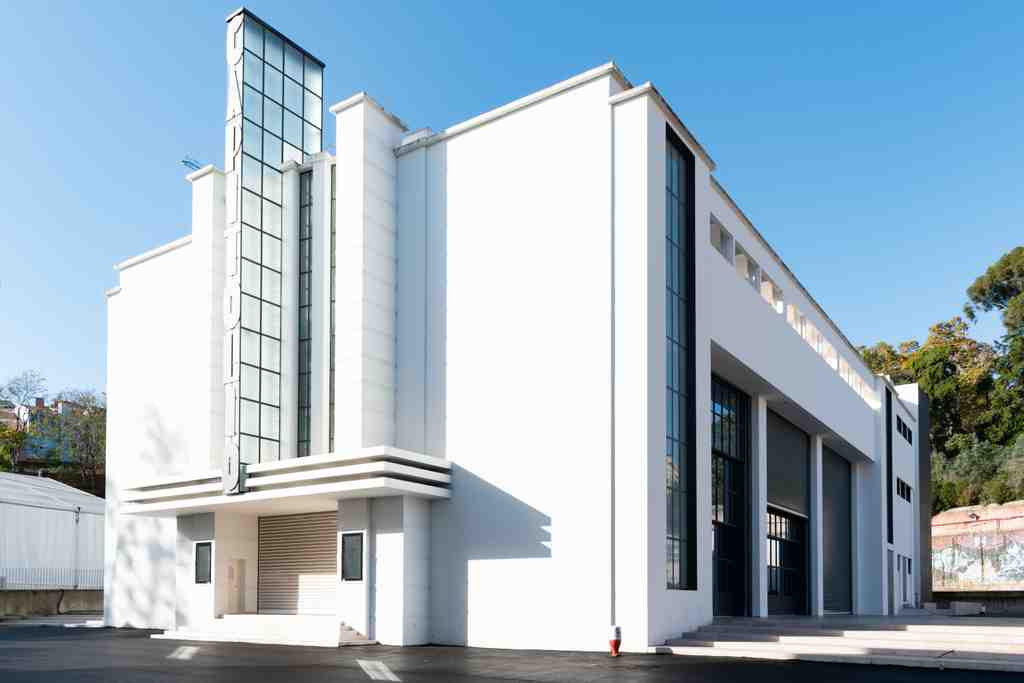
Ahead of you is a tall, gleaming white building with a glass tower and vertical “CAPITOLIO” letters, standing bold and modern right in the middle of Parque Mayer-just look for the clean lines, sharp angles, and that striking glass tower rising up above the entrance.
Step a little closer and just imagine it’s July 1931. The doors swing open and you can almost hear the excited chatter of Lisbon’s moviegoers, ready to step into a world of glitz, innovation - and just a bit of chaos. The Capitol Theater, or Cineteatro Capitólio, wasn’t just a movie house. It burst onto the scene as something the city had never seen: an art deco marvel in pure white, all crisp corners and glass that gleamed in the sunlight. It looked like a spaceship had landed in old Lisbon, and it was here to sweep everyone into the modern age.
Designed by architect Luís Cristino da Silva, Capitólio was a real revolutionary-not just in its bold style but also in its soul. It was a place where the old ways of doing things got left at the door, making it one of the most important symbols of “First Modernism” in Portugal. With its minimalist lines, fierce symmetry, and that unforgettable glass tower, Capitólio was so futuristic that local architects probably spilled their coffee just looking at it. The technical achievements were astonishing for the time too-the building’s skeleton was of reinforced concrete, a wild, modern material back then.
Inside, the world changed. Capitólio could host 1,500 people standing or seat 400 in plush comfort once the stage was tucked away, allowing for grand productions, wild concerts, elegant theatre, cinema, and even-you guessed it-roller skating parties on the roof. If these walls could talk, they’d belt out jazz, recite a stirring monologue, and maybe even whisper about a stunt or two in the balcony. From the earliest days, this was a house for Lisbon’s dreamers. Here, you’d catch major theatrical troupes (like when the grand national theatre burned down and the city’s finest actors needed a safe stage), Hollywood premieres, and even a little good-natured chaos, thanks to wrestling matches and boxing bouts.
Of course, not everything here was quite so buttoned-up. Fast forward to the 1970s, after Portugal’s Carnation Revolution, and the theater found itself starring in a much cheekier role-showing films like “Deep Throat” and other scandalously popular movies. Lines snaked around the block, and if those walls could blush, they probably would have changed color daily. Lisbon had never seen anything like it, and for a while, this very theater became the nation’s unofficial headquarters for freedom of expression-and more than a few delighted gasps.
In the 1980s, the rooftop skating rink was reborn as “Roller Magic,” where people wobbling on skates boogied to disco. But like many legends, Capitólio fell on hard times and closed its doors in the 1990s, its shining white walls slowly growing silent.
Then came a second act worthy of the wildest musicals! From 2012 to 2016, a massive restoration swept through-costing roughly 10 million euros, mostly paid by the city with a little help from Casino Lisboa. The renowned architect Alberto de Souza Oliveira led a mission to bring back the building’s glory, recovering its modernist beauty and making it, once again, ready for new generations. The fresh white walls, restored glass tower, and upgraded stage equipment won Capitólio the 2016 Valmor Prize for Architecture-the Oscars of Portuguese buildings!
Now under the careful eye of EGEAC, Lisbon’s cultural management company, the theater’s lights are on again, welcoming big shows, movies, and everything in between. If the spirit of the place feels electric, it’s because you’re standing where generations of Lisboetas came to be entertained, shocked, delighted, and amazed-sometimes all in one evening!
So take one more look and let your imagination fill the square: the music, the crowds, the skates, the laughs, and perhaps a racy night or two. At the Capitol Theater, the show-like all great stories in Lisbon-never really ends.




