
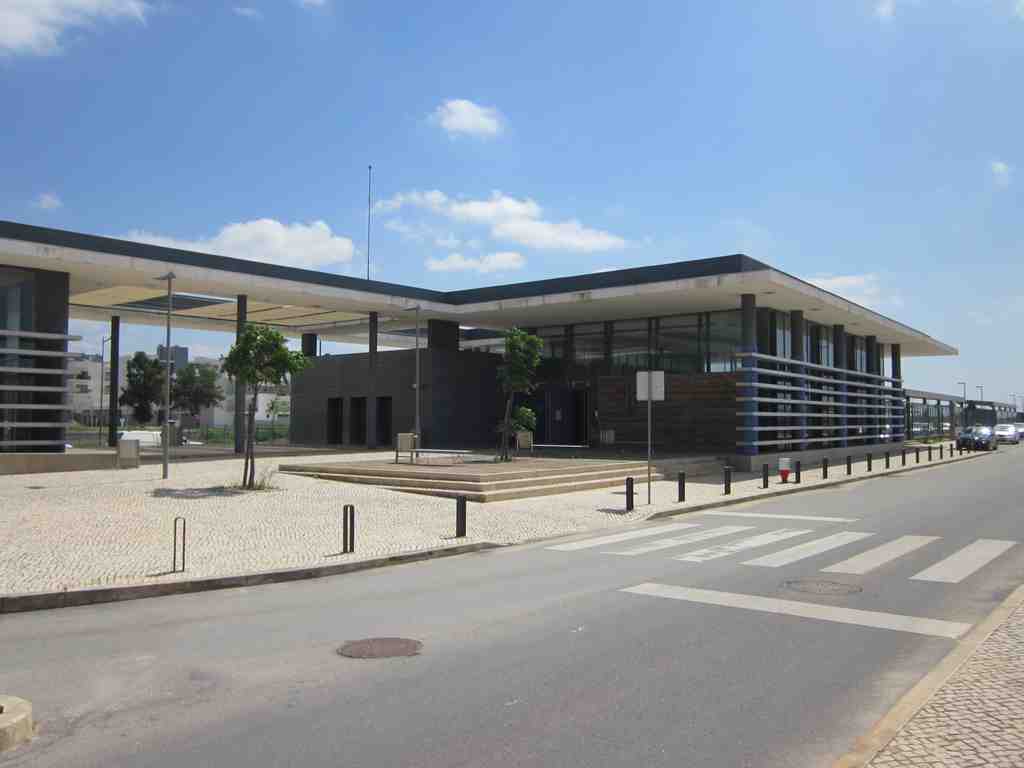
To spot Lagos Train Station, look for a modern, flat-roofed building with wide glass windows and horizontal lines, just at the north edge of town near the road with the striped crosswalk.
Welcome to the very first stop of your adventure-Lagos Train Station! Take in the gleaming sunlight reflecting off those broad glass windows and the slick, angular roof-it’s the perfect showcase of “new meets old,” but you wouldn’t guess at a glance the decades of dreams and drama hiding beneath this humble platform.
Picture it: late 1800s, and Lagos might as well have been on another planet. Journeys from Lisbon sounded like the beginning of an epic quest-first, a train to Beja, then a bumpy carriage to Mértola, finally hopping on a boat downstream toward Vila Real de Santo António, before clambering back on land and onward along the Algarve’s wild coastline. Imagine travelers, tossing in their seats, wishing for smoother rides. The region, with industries starting to sprout like wildflowers-think canning factories packed with the scent of fresh fish-knew it needed a true iron lifeline.
A British businessman named Joseph Bleck tried to pull this off, proposing a railway from Lagos all the way east to Vila Real, but his plans fizzled out faster than a firecracker in the rain. Not to worry-by the turn of the 20th century, the Portuguese government had picked up the steam, commissioning studies, proposing new tracks, and finally, after several law changes and not a little political drama, the grand plan was set: the Algarve’s very own railway, from Tunes to Lagos.
Flash forward to July 30, 1922. Lagos was thrown into proper party mode as the original station burst open with music, sports, and one very celebratory train-just imagine the clatter of a steam engine rolling in, greeted by the raucous cheer of the crowd. The first station, a little ways from where you’re standing, had a beautiful coat of Art Nouveau-style tiles, dazzling visitors with their bold patterns and hues. The station quickly became a town hub, bustling with locals, workers from the newly built railroad neighborhood, and of course, passengers eyeing distant horizons.
But it wasn’t always smooth riding from there. Critics grumbled about the lack of shelter from sun or rain (classic Algarve, right?), and poor lighting inside. Still, the railway began to reshape Lagos. Water pipelines, better roads, bus lines whisking travelers from Sagres right here-each decade brought a hum of activity, from new locomotive sheds to the advent of regional trains that bound Lagos tighter to the rest of Portugal.
By the late 20th century, the tracks of destiny shifted again. Passengers now rolled in on InterRegional trains, and new ideas for modernizing the station started rolling around faster than a loose suitcase. Major upgrades arrived in the early 2000s; out went the old, in came this snazzy new building-yet the heart of the station, full of stories and echoes, remained constant. One for the trivia fans: the old roundhouse for locomotives was shaped like a fan, covered with shed roofs, and even eyed as a future railway museum, though local politics meant its fate still hangs in the balance-perhaps like a ghost train waiting for the right hour.
Today, dozens of trains pass through each day, carrying tourists, commuters, and dreamers off to destinations like Faro, all under the endless Algarve sky. Let yourself imagine those early 20th-century crowds, the whistle of the very first trains, the hopes pinned on every journey. Lagos Train Station is still the end of the line for the Algarve railway-the “final stop,” as signs proudly announce-but for everyone who arrives, it’s always the beginning of something new.
Ready to ride the rails of history? Or, at the very least, enjoy the air conditioning and a snack from the station café. Just remember: here in Lagos, every platform is a platform for adventure.


