
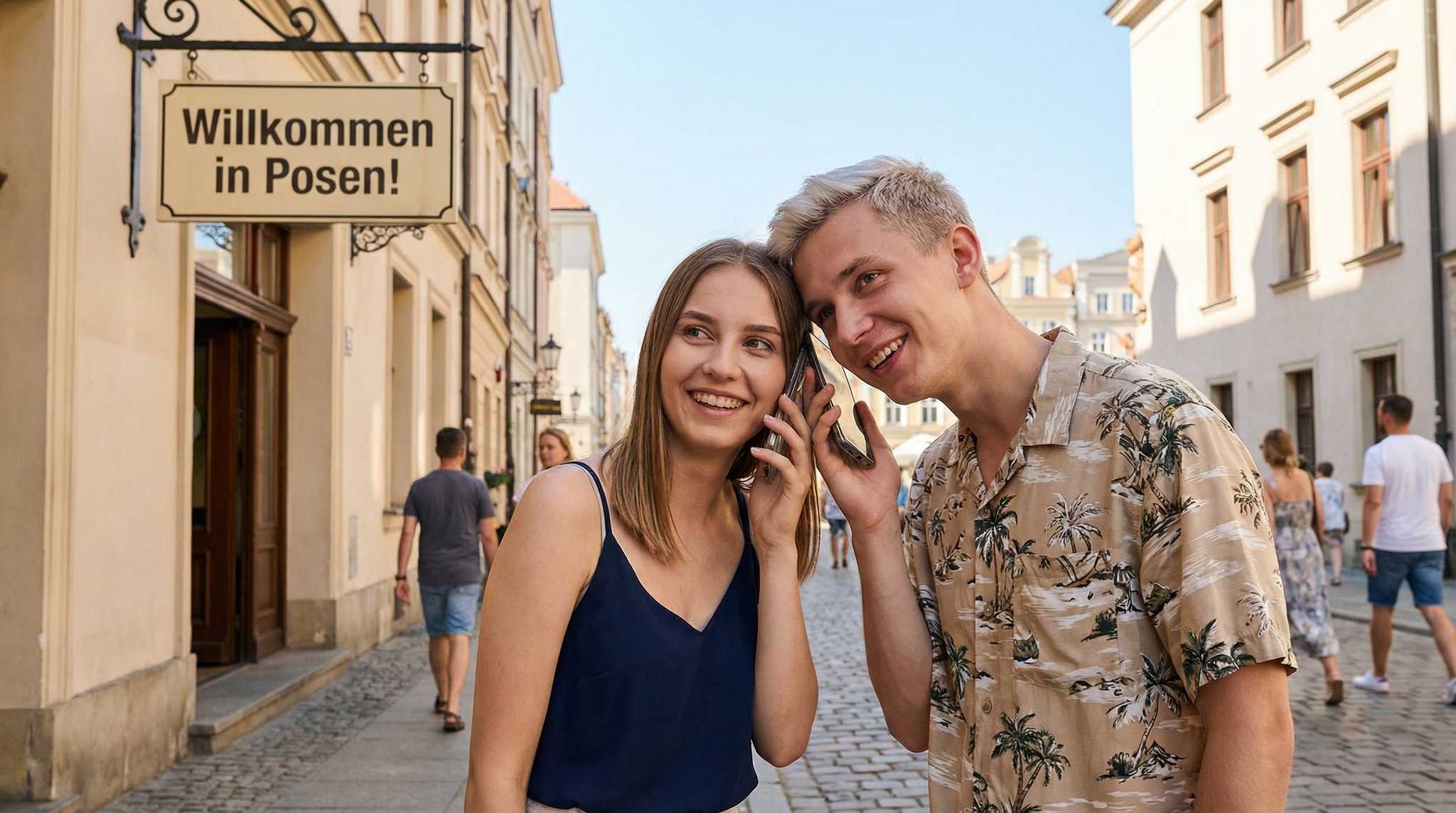
Poznań Audio Tour: Between Imperial Palace, Monasteries, and Royal Castles
Discover the historic heart of Poznań with our fascinating city tour! Begin at the magnificent Poznań Town Hall, where history comes alive, and admire the impressive architecture of the Prussian Settlement Commission. Immerse yourself in the majestic atmosphere of the Imperial Castle and experience the rich cultural heritage of Poznań firsthand. A perfect tour for anyone who wants to experience the history and charm of this wonderful city!
Tour preview
About this tour
- scheduleDuration 40–60 minsGo at your own pace
- straighten3.0 km walking routeFollow the guided path
- location_on
- wifi_offWorks offlineDownload once, use anywhere
- all_inclusiveLifetime accessReplay anytime, forever
- location_onStarts at Adam Mickiewicz University in Poznań
Stops on this tour
Before you stands a magnificent, bright building with a richly decorated gable facade and two distinctive towers on the left and right - just look for the towers with the green…Read moreShow less
Before you stands a magnificent, bright building with a richly decorated gable facade and two distinctive towers on the left and right - just look for the towers with the green dome roofs and you've found the Adam Mickiewicz University! Imagine you are standing exactly where, for more than 400 years, young minds have dreamed, debated, and sometimes even felt a little anxious about exams - after all, who hasn't? It's hard to believe, but the history of this university began as early as 1611, when King Sigismund III Vasa first allowed the Jesuits to establish a college here. Back then - you'll smile - Wi-Fi and smartphones were, of course, unthinkable, but even then, the spirit of curiosity sparkled in the minds of the students. But it wasn't always as peaceful as it is today. Over the centuries, the university mirrored Poland's turbulent history. It was confirmed by three different kings, endured through the era of partitions by Prussia, Russia, and the Habsburgs - sometimes it was a flourishing institution, sometimes a silent monument when its gates were closed. Imagine how, in the 18th and 19th centuries, resistance against oppression was secretly planned in dark rooms, while outside the wind swept over Poznań. Fancy a little time travel? 1919 was a famous year, because finally, teaching in Polish was officially allowed again - a celebration for everyone who cared about Poland's future! The rebirth of the university was celebrated with great fanfare, 308 years after its founding and fittingly on the 400th anniversary of the Lubrański Academy; after all, they wanted to show: We do not forget our roots. Originally, it was called Piast University - doesn't that sound like medieval splendor? Just one year later, it was renamed University of Poznań. Later, after the turmoil of World War II - during which classes were secretly held in hidden apartments so the Nazis couldn't control everything - a new patron was chosen: Adam Mickiewicz, the great Polish poet (and romantic!). Since 1955, his name has brought the spirit of rebellion and freedom to the university - a perfect fit. Imagine brave professors in the grim war years secretly teaching while danger lurks outside, and students who, even in the dark, never stop asking questions. A bit like a spy movie, don't you think? But after the war, the university not only made political history but also scientific history. From Poland's first sociologists - yes, the subject was invented here! - to botanists who created new research institutes, Poznań became an academic powerhouse. And today? There are over 40,000 students here - a few more than 400 years ago! Over 4,000 lecturers ensure that no one sleeps through their lessons (at least most of the time...). If you look around, you'll see the historical heart of the university: the Collegium Minus, where concerts take place in a magnificent auditorium, the Collegium Iuridicum for law students, and, not far away, one of the largest libraries in the country - the perfect hiding place from exam stress. There's even one of the largest collections on Freemasonry in Europe - James Bond's bookshelf would be envious! And for all adventurers: The university owns research facilities as far as Spitsbergen, where scientists have observed polar bears while doing research. So real adventures aren't just found in the lecture hall! Famous names, of course, also passed through here: Nobel laureates, prime ministers, famous judges, and even the occasional Enigma codebreaker - without the mathematical geniuses from Poznań, the Allies might never have solved the famous German code in World War II. Today, this university is not only a symbol of knowledge and freedom but also a vibrant meeting place for tinkerers, poets, dreamers, and all who want to turn ideas into the future. And don't worry, the only test you have to pass now is finding the next stop on the tour - without any panic about exam questions! Now, with all these stories in your head and perhaps the faint giggle of past students' ears, you can continue your tour. Poznań's most exciting corners are already waiting for you! Fascinated by the locations, the staff and student numbers, or the reputation? Let's talk about it! More information can be found in the chat section.
Open dedicated page →Before you rises a mighty, bright sandstone building, with tall towers and small battlements, as if it sprang directly from a knight's film; just look straight ahead, and you'll…Read moreShow less
Before you rises a mighty, bright sandstone building, with tall towers and small battlements, as if it sprang directly from a knight's film; just look straight ahead, and you'll see the imposing rows of Romanesque windows and the sloping, dark roofs that define the profile of the Imperial Castle. So, welcome to the center of Poznań's old 'Imperial District' - and now hold on tight: what looks like a medieval fortress is actually a palace from 1910, or rather, a 'youngster' among Europe's castles! Carriages once rattled past here, soldiers marched up and down, and the scent of freshly cut rose garden hung over everything. Imagine: while the walls and towers are silent today, back then, dust and the sounds of construction workers echoed through the air. Franz Schwechten, the architect, built this castle for the powerful German Emperor Wilhelm II, who regularly burst in with his own ideas - well, if you're going to do it, do it right! But, beware, the name here is a little historical joke: In German, it was called 'Königliches Residenzschloss' (Royal Residence Castle), because Wilhelm II was Emperor of Germany, but King of Prussia. However, the Poles call it 'Kaiserliches Schloss' (Imperial Castle), because the word 'royal' for them is firmly linked to the old Polish rulers and the true royal castle. A bit like neighbors who can't agree whether the dog's name is Bello or Max... The choice of location, by the way, was anything but accidental. Poznań was to be rebuilt - according to the Prussians' will - into a new German center, and Josef Stübben, a famous urban planner, designed a district full of impressive buildings: the post office, theater, university, and in the middle, like the icing on the cake: this 'fairy tale castle.' Although the old fortress was demolished, the new power naturally had to make a statement. The surroundings became the heart of Poznań's new Prussian character. Architecturally, Wilhelm absolutely wanted the strong, heavy, and 'most German' style: Neo-Romanesque, huge arches, rough stones, and turrets everywhere. On one side, the Emperor himself slumbered in his luxurious apartments; on the other, grand receptions and lavish parties took place. The Emperor even had a private Byzantine-style chapel in one of the towers, plus his own entrance - who likes walking through the main hallway when you're an Emperor? A particularly charming detail: In the courtyard, a lion fountain, modeled after a Spanish design, bubbles - a small homage to the Alhambra in Granada. Perhaps Wilhelm secretly dreamed of sunshine instead of Prussian rain, who knows! There were rooms for the court marshal, halls for grand receptions, and - of course - huge beds for Wilhelm and his wife, connected by a corridor. So they could secretly meet at night if one snored? Oh, being an Empress couldn't always have been easy... Now, let's fast forward to when the castle was just finished: In 1910, glasses clinked for Emperor Wilhelm's move-in. The construction cost five million marks! And yet, Wilhelm only lived here very, very rarely. Luckily for the cleaning crew! After World War I, the castle passed to the new Polish state and became the presidential palace; in between, universities, scout associations, and authorities moved in. One could say: a castle for all walks of life. When the Nazis occupied the city in 1939, everything was rebuilt so that Adolf Hitler could conveniently drop by. Architects like Albert Speer worked on the 'new style' - less fairy tale, more megalomania. Hitler's private office even got a heated balcony, and in the basement, a bunker for 375 people awaited; the drama never stopped. After the war, the castle was briefly a prisoner-of-war camp, then a barracks for the Polish army. The communist rulers actually considered demolishing this 'symbolic building of the occupiers,' but in the end, they simply lacked the money - a stroke of luck for us today! Some German symbols and the damaged tower were removed, but the rest remained. Over time, the castle once again became the heartbeat of the city: The former throne room now serves as a cinema, other rooms are now galleries, theaters, pubs, music clubs, or even embassies. And the inner courtyard often transforms into an open-air cinema or concert venue in summer - so stories here are as plentiful as sand on the beach. And every year on November 11th, Poznań celebrates St. Martin's Day here with parades and music. So, as you walk through the rose garden, briefly imagine Wilhelm II, the Polish presidents, Hitler, and hundreds of other figures passing through these corridors - a building where centuries meet, full of stories that would almost be too crazy for television. And in the end, you'll see: it's not really a castle at all, but a small time machine... Are you ready to delve deeper into the naming, location, or architecture? Join me in the chat section for an enriching discussion.
Open dedicated page →Before you rises a mighty, impressive building of dark stone with many windows and a large dome in the center - find it directly at the end of the avenue, framed by the bare trees…Read moreShow less
Before you rises a mighty, impressive building of dark stone with many windows and a large dome in the center - find it directly at the end of the avenue, framed by the bare trees of the park. You are now standing in front of the former Prussian Settlement Commission, and I invite you to take a small leap in time - don't worry, we'll stay dry, even if things sometimes got a bit uncomfortable. Imagine: The year is 1886, carriages rattle over the cobblestones, the air is filled with the scent of coal and a bit of office dust. In this house sat the gentlemen of the so-called 'Royal Prussian Settlement Commission for West Prussia and Poznań' - the name is as complicated as the politics forged here. Amidst thick files, maps, and much, much ink, they planned one of the most ambitious, yet controversial, settlement attempts in old Europe: they wanted to bring as many 'German' farmers as possible to the land - land predominantly inhabited by Poles. Bismarck, with his famous barbed-wire gaze (and certainly a thick cigar in hand), was the initiator. His goal was to put more land into German hands, more precisely: ethnically German hands - as it was officially stated in their papers. If you could hear the footsteps in the hallway now, they wouldn't be just any officials, but the architects of a large-scale plan for the 'Germanization' of Polish territories. The Polish nobility and Catholic clergy were to be weakened, and land was to be specifically sold to Germans - sometimes with gentle pressure, sometimes with furious paperwork and, from 1908, even by expropriation through law. And now pay attention, because here German thoroughness was mixed with a good dose of ideology! The commissioners dreamed of a 'German protective wall': German villages all around, perhaps a few proud Polish settlements in the middle, but as completely surrounded as possible by their German neighbors - as if 'being Polish' could simply be erased with houses and farms! Almost like a strategy game, but without a reset button and with real people. By the way: The Polish population was as tough as Poznańer Rogale (Poznań croissants). When land purchases for Germans were enforced, Polish residents banded together, founded their own banks, collected money - and bought their land back if necessary! Sometimes it was a real race to the notary: Who gets there first? Berlin had the millions, but the Poles had heart and ingenuity. And they founded their own settlement societies, bought estates, supported each other. Hard to believe, but despite all the commission's money and official stamps, out of over 800 purchased estates, more than 200 went back to Polish owners! A bit like a relay race - only the baton was a piece of land. In its 32 years of existence, the commission settled 21,000 German families, but spectacularly missed its goal of 40,000 families. Even this didn't stop the official ponderers from inventing ever new creative laws - a house could only be built if the official in distant Poznań gave his approval! If you sounded Polish, you often got a no. This caused international outrage, even newspapers in Paris and Vienna sharpened their pens against Prussia. And now for a little goosebump moment: After the end of World War I, the Polish national colors returned to this mighty building. The German settlers fled - or were, according to Polish law, expropriated. The history, however, remained controversial: Even in the 1920s, there were fierce negotiations about who truly owned the land, and the International Court of Justice intervened. So you see: Behind this defiant stone facade lies not a dry administrative office, but a place where identity, language, faith, and power performed their very own dance. A bit of espionage, a bit of economic thriller, a bit of drama - and all with real consequences for thousands. Who knows, perhaps the walls still tell their stories of secret lists, nocturnal consultations, and the incessant clatter of typewriters. Oh, and if you're wondering: The Nazis later found this idea of control and Germanic land acquisition so practical that they immediately planned another 'Reich Settlement Commission' - but this time with cruel, unimaginable consequences. Fortunately, the winds of history have turned - and today, the former commission is a memorial to a chapter of history that shows: No administration in the world can simply erase the heart of a nation. Feel free to pause for a moment, take a deep breath. Or sit on one of the benches in the park - out here was often the only moment of peace amidst all the political noise. To expand your understanding of the name, background, or goals, feel free to engage with me in the chat section below.
Open dedicated page →
Show 10 more stopsShow fewer stopsexpand_moreexpand_less
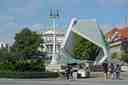
Before you now opens a large, rectangular square with a striking modern glass sculpture and a bubbling fountain, surrounded by magnificent old buildings - just look where it's…Read moreShow less
Before you now opens a large, rectangular square with a striking modern glass sculpture and a bubbling fountain, surrounded by magnificent old buildings - just look where it's most open and you see the gleaming glass surfaces! Welcome to Freedom Square - or, as the locals like to say, 'Plajta.' Are you standing right in the center too? Then you're surely already feeling the history that hangs in the air here. And don't worry: you don't have to hold a parade here, but if you feel like it, you can practice a little march step, because before, this huge square was designed so that an entire infantry regiment could line up in full formation. The square has probably seen more boot tips than the local shoe store! Imagine, it's the late 18th century. Out here was actually a slope: the Musza Góra, named after the old Muszyński family who owned the land for centuries. The city of Poznań had big plans, but then came the Second Partition of Poland - and the dreams were over. Only after 1798 did the Prussians tear down the medieval city walls and incorporate the surrounding suburbs, like the famous 'Kundorf.' And so the vision of an 'Upper Town' emerged, and our square here was the icing on the cake! The land, by the way, was bought for 2500 thalers - at that time, you could probably have clothed all of Poznań... - and the area was leveled. The new square was named Wilhelmsplatz, in honor of King Frederick William III, and was proudly the jewel of the city. But times change: In 1803, a massive fire broke out nearby. The old Jewish cemetery disappeared, the district was redeveloped, and finally, the square transformed into a park - with trees and lots of green. In Napoleonic times, a new name even took hold: the square was dedicated to Napoleon! But after the fall of the Duchy of Warsaw, like bread returning home, the name Wilhelmsplatz returned. The 19th century remained exciting: the eastern side remained a park, the western side transformed into a place for monuments. Here once stood a huge lion, called the Lion Monument, commemorating the Prussian victory in the Battle of Náchod in 1866. Just a few steps further, the monument of General Steinmetz in the sky. And in 1902, Frederick William III was even immortalized in stone again here - so many Prussian rulers that the square was almost a monarchy in miniature! But what the square has experienced again and again: renamings and redesigns. After World War I, everything was suddenly Polish again! On January 26, 1919, brave Greater Polish soldiers and their general took their solemn oath here. By the way, a commemorative plaque still reminds us of this today. Less than three months later, all German monuments disappeared, and Wilhelmsplatz officially became plac Wolności - Freedom Square. Then it was redesigned again: trees fell, only young trees remained. Electric lamps were installed - a real high-tech highlight back then! Where pompous monuments once stood, there were now flowerbeds. And the city dreamed of new monuments, for example for Bolesław Chrobry, but as is often the case with grand plans: in the end, bureaucracy won. There almost would have been a great 'Freedom Fountain' - but the wastebasket was faster! Jump to 1937: The futuristic PKO BP building in a modern style was built here - and if you still like modernism today, you'll spot it. Shortly before World War II, a deep trench was dug across the square - as an air-raid precaution. And, surprise: with the Germans, Wilhelmsplatz returned, and everything was neatly tidied up. After the war, then the big bang: On February 25, 1945, three days after the liberation of Poznań, thousands gathered here for the first Polish demonstration. So much optimism was in the air back then that you almost feel you can still sense it if you breathe deeply. In the 60s, everything was turned upside down again by architects Milewski and Skupniewicz. The trees were cleared again, but the new fountain with the statue of Hygieia became the centerpiece - let yourself be inspired by the splashing. In 1994, the square was supposed to become like the famous Piazza Navona in Rome, but that too remained a beautiful idea on paper. Finally, in 2005, the next change came: new paving, new planting, a chic underground parking lot, and the legendary fountain gave way to a flowerbed. Today, the square is used for exhibitions, large open-air beer gardens, and many colorful activities - from monumental sculpture festivals to summer refreshment breaks! Hast du Lust auf einen kleinen Exkurs? The square also holds a real technical highlight! In building number 14, once the seat of the Union insurance company, one of Poland's oldest functional elevators still chugs through the floors to this day. Sounds like Harry Potter, doesn't it? And now take a very close look around: In every corner, ancient plane trees rise, which were officially declared natural monuments in 2023. They bear the names of renowned professors like Alina Hejnowicz and Józef Paczoski. If you like, place your hand on one of the barks - who knows, maybe you'll hear the whisper of all the history that still resides in these branches. And now - let yourself be refreshed by the fountain, admire the modern glass architecture, and enjoy the bustling activity around you. Oh, and if you get hungry: an ice cream stand is never far away - welcome to Freedom Square, between history, present, and a pinch of everyday magic!
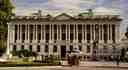
Open dedicated page →Look straight ahead - the building with many columns and a greenish roof, directly opposite the square, is the imposing Raczyński Library! And if you're looking for a special…Read moreShow less
Look straight ahead - the building with many columns and a greenish roof, directly opposite the square, is the imposing Raczyński Library! And if you're looking for a special detail: the statue with a fountain in front of it - that's Hygieia, watching over all the knowledge. Imagine you're standing here in old Poznań in the 19th century. Horse-drawn carriages clatter and suddenly a solemn drumroll sounds: Count Edward Raczyński not only invested money, but also heart and mind into this bibliophile gem. The neoclassical columns you see are reminiscent of the Louvre in Paris - yes, here you almost get the feeling that Mona Lisa is about to peek around the corner! But the Raczyński Library was more than just a place for books from the very beginning. It was loved by the citizens - even by those who only came to play chess or read newspapers. But, alas, during World War II, the smell of smoke and ashes suddenly filled the air. The Nazis blew up the building, and almost all the books were destroyed by fire - imagine the letters rising like butterflies into the sky! A true nightmare for all bookworms. But Poznań did not give up. Like a superhero in a book costume, architect Janina Czarnecka came into play and rebuilt the library after the war. Now it houses over a quarter of a million books - and the number grows every year. Between 2010 and 2013, a brand new wing was added, almost as modern as a spaceship, without Captain Kirk ever having stopped by. And all this with the friendly support of the European Union, which probably also likes libraries. The current director, Anna Gruszecka, ensures that not only books but also memories of famous writers are preserved here. So, if your Wi-Fi ever goes out: you're guaranteed to find something exciting to browse here. History lives on in the Raczyński Library - and perhaps the spirit of Count Edward will wink at you during your next browse.
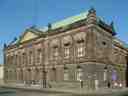
Open dedicated page →Right in front of you rises an imposing, dark-toned building with a magnificent facade, large windows, and fine mosaic details directly under the green roof - look out for the…Read moreShow less
Right in front of you rises an imposing, dark-toned building with a magnificent facade, large windows, and fine mosaic details directly under the green roof - look out for the inscription 'MUZEUM NARODOWE', then you'll know you're in the right place! Welcome to the National Museum in Poznań! Imagine how, as early as the 19th century, the first curious visitors stepped through the huge double doors, unaware of how many small and great adventures would be hidden behind these walls. The history of this house is as colorful and surprising as a grab bag - and it actually begins long before anyone even thought of today's museum. Originally, this spot housed a small collection that the friends of science - that sounds almost as mysterious as a secret society, don't you think? - had lovingly put together. There were Polish and Slavic antiquities, coins, old books, and a considerable stock of drawings, engravings, and paintings, all through generous gifts such as from Seweryn Mielżyński, who not only collected books and pictures but also promptly bought the property. I imagine his neighbors back then marveling: a man hoarding paintings as if they were chocolate bars! And then: his own gallery in 1882 - back then, it was all called the 'Mielżyński Museum.' But wait, the building in front of you only comes into play when the Prussians founded a provincial museum here in 1894. Your memory aid: in 1902, it received an imperial name - Kaiser Friedrich Museum - and a brand new, specially designed building on Freedom Square. Exactly this building here! Perhaps the scent of old imperial grandeur still wafts through the stairwell - or at least the caretaker sometimes wonders how many colorful stories the old stones could tell if only they could speak. From 1919, after World War I, the museum became Polish and was now called 'Muzeum Wielkopolskie.' The collection grew: modern painting crowded in with ancient artifacts, and the rooms became increasingly full. Three main areas emerged: Painting & Sculpture - which you can still find in the main building today - an archaeological museum, and a natural history collection at the zoo. Imagine the hustle and bustle when visitors suddenly stand among stuffed animals, wondering if the painting on the wall is moving or if it was just the wind whistling through the window! Oh, and then - as everywhere - war came and caused quite a mess. The Germans gave the museum its old imperial name again, stole the most valuable artworks to the depths of Reich warehouses, or caused destruction. Especially during the heavy battle for Poznań in 1945, there was great loss, many pieces disappeared, others were destroyed, and it was quite silent in the ruins. But already in the same year, reconstruction began - true to the motto: giving up is not an option, we'll just start all over again! Since 1950, the house has proudly borne its current name: National Museum Poznań. And it continues to grow as if it has spring fever: the instrument collection gets its own museum, the history of Poznań is shown in the Town Hall, a Russian palace wing is converted for handicrafts, further branches are created outside in Gołuchów, and even the famous Adam Mickiewicz gets his own memorial in Śmiełów. If you look at the facade now, you might discover the colorful mosaics that were reinstalled in the 1970s according to Zbigniew Bednarowicz's design. And if you feel that the building is particularly elongated - don't worry, the new little wing, added in 2001, is affectionately called 'Dackel' (Dachshund) by the locals because it is so long and low. So dogs are even at home in museum architecture, albeit only as a nickname. The museum lives like a colorful earthworm: it digs through the city's stories, grows with each decade, and is full of surprises. Particularly proud today is the huge collection of paintings and sculptures, but also of the posters, the design - everything that creative people produce. Photography, video, film, even ethnographic peculiarities can be found in the network of branch museums that has emerged here. And if you're wondering what happened to the collection of the noble Raczyński family: a part of it, collected in Rogalin, came back as a foundation, celebrating a joyful reunion with old acquaintances here. And do you know what the museum was awarded for in 2024? Grand Prix 'Izabella' for the best museum event in all of Wielkopolska! And if that's not worth applause, then I don't know what is. So, as you step over the threshold now, remember: you are not just entering a temple of art, but a house full of stories that has seen many a secret and many a treasure. And beware: some visitors claim that old museum ghosts sometimes dart around the display cases at night - well, hopefully, you'll only encounter friendly ghosts inside!
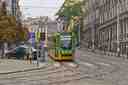
Open dedicated page →You are now standing directly in front of Podgórna Street - look ahead at the green and yellow tram descending a sloping street between old, venerable facades! Imagine: As early…Read moreShow less
You are now standing directly in front of Podgórna Street - look ahead at the green and yellow tram descending a sloping street between old, venerable facades! Imagine: As early as the 19th century, this street was a place full of stories - and steep enough that many a coachman would have broken a sweat here! Podgórna, formerly also called Bergstraße (Mountain Street), stretches like a ribbon from Aleje Marcinkowskiego to plac Wiosny Ludów, and it has experienced many name changes - just like a chameleon that's never quite sure which color is in vogue. During the communist era, it was called 'Walki Młodych' for a while, but this naming met with about as much approval from residents as a cold rain in November. But let's start where the big little dramas began. Karol Marcinkowski, a doctor and committed citizen, once lived here, moving into the small, neoclassical house at Podgórna 6 after his release from prison in 1837. Marcinkowski was something like the Chuck Norris of Poznań - he brought the cholera epidemic to a halt, didn't get a trophy for it, but got his freedom back and became a city legend. A commemorative plaque on his house still reminds us of this today. Note: This shows that a little medical knowledge can indeed be life-saving - and in this case, even made city history! Barely a year after Marcinkowski's death, Paul von Hindenburg, the later German Reich President, was born here. The irony: while the Poles were proud of one resident, the Germans wanted to establish a 'Hindenburg Museum' here. But too late! The Polish owners of the old walls did not agree, and the commemorative plaque for Hindenburg only hung on the house for a few years during the German occupation in World War II. If the house had ears, it surely would have heard many whispers about identities and power shifts. If you feel the tram tracks under your feet, then you're ready for the next story: The tram line along Podgórna was feared! Imagine, it's downhill, and the tram develops a life of its own... In the old days, the conductors bravely had to stand at the 'Hameln' (a specific braking position), ready for emergency braking if the tracks became too slippery or the brakes failed. There was even a daring test drive: In the 60s, they loaded the tram with as many heavy stones as a hundred passengers - to test if it would remain safe. The result? The conductors could finally be dismissed, but until then, this was the 'action attraction' for tram enthusiasts. Today, modern brakes take care of the problem. Nevertheless: anyone riding the tram down the hill still has a small adventure - and all without a roller coaster ticket. Speaking of change - Podgórna is like a history book with many bookmarks. Formerly, merchants and fine ladies rode in carriages here; later, political name changes and demonstrations shaped the street's appearance. After an uprising of young people in March 1945, someone wanted to rename the famous 'ulica Święty Marcin' to 'Walki Młodych.' But a dispute erupted, which was fought out in the newspaper - and the criticism led to Podgórna being given its new name instead. Perhaps that's a small lesson: sometimes it's better to just change the street - instead of stirring up the whole boulevard. Today, the tram runs on two tracks right through the street - with connections to all corners of Poznań. Whether you're traveling towards Dębiec, Górczyn, or Stomil, it always smells a bit like the past here - mixed with the scent of autumn leaves and exhaust fumes - but that's exactly what makes this place so special. The once popular puppet theater was also located under house number 8: the voices of clattering puppets filled the room here before the small theater moved to a larger stage. So, hold a moment, look at the tracks and the passing trams. Podgórna - one name, many stories. Not for the faint of foot, but a paradise for the curious! Are you ready to delve deeper into the characteristics, traffic organization, or communication? Join me in the chat section for an enriching discussion.
Open dedicated page →Before you rises the imposing neoclassical Hotel Bazar, with its two distinctive square towers at the corners, the large inscription 'BAZAR' between the windows, and the…Read moreShow less
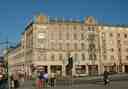
Before you rises the imposing neoclassical Hotel Bazar, with its two distinctive square towers at the corners, the large inscription 'BAZAR' between the windows, and the elaborately decorated main building facing the intersection - just look towards the street corner with the magnificent windows and the tall ornamental gables. Imagine, we turn back the clock to 1838: Instead of honking cars and cell phone conversations, you hear the bustling activity of ambitious Poznań citizens who were determined to make a statement. In the heart of the city, Karol Marcinkowski and a handful of like-minded individuals - doctors, landowners, a carpenter, and even a judge - founded a joint-stock company. Yes, shares really existed back then! But these gentlemen didn't have profits in mind, but 'useful initiatives': the house's surpluses were to serve the welfare of the population, and businesses were only allowed to be run by Poles. Clever, right? Thus, Hotel Bazar quickly became a symbol of Polish self-awareness in Prussian-ruled Poznań. The foundation stone was laid on a frosty November day in 1839 on the newly created Paderewskiego Square. When the building stood in 1842 - still without the distinctive corner wing towards the avenue, which only followed at the end of the 19th century - people marveled: it was the largest secular building in the city. Imposing like a fairy tale castle with facades in noble Neoclassicism, crowned by artfully designed towers and an elegant portico that seems to reach almost into the clouds. Look up - the triangular gables tell of old grandeur. But the best things happened behind these walls: ideas buzzed and hummed here! The Bazar not only hosted the Science Club, the Center for Agriculture, or the Banking Association - even the famous Hipolit Cegielski sold his ironware here. Newspapers were founded, visions were forged, and in the social casino, citizens argued and laughed - nobles, intellectuals, and millers shoulder to shoulder at the table! And if someone got too wild, like Marcin Kasprzak with his communist revolutionary calls, he was democratically escorted out. On the spot, of course - the Poznańers stuck together, but revolution had to stay outside. It got really exciting in 1848, when the national committee met in the Bazar - here pulsed then literally the heart of Poland's resistance during the Spring of Nations. Many years later, at Christmas 1918, the famous pianist Ignacy Jan Paderewski checked into a room. He stepped to the window - perhaps you can imagine the crowd waiting below - and delivered his fiery speech. What a moment! These few minutes triggered a fireworks display of liberation: a few days later, the Greater Poland Uprising began. In its heyday, the Bazar was a place for splendid banquets, lavish parties, and elegant evenings. People ate, drank, and danced, often to melodies conjured by famous guests like the Wieniawski brothers on their violins. No wonder a bronze commemorative plaque still reminds us of them today - if you see it, feel free to read what music meant to the city. Writers and thinkers also once passed through these doors. Chess masters, musicians, politicians - through these doors went the greats of Poland. Even crime novels are set here today: whether Aleksander Alechin and his simultaneous chess game with 32 opponents - which, by the way, became the stuff of a real page-turner - or murderous machinations in dark novels... The Bazar remains alive, whether with a champagne glass or a Sherlock hat! But it wasn't always glamorous. In World War II, the hotel was renamed 'Posener Hof,' but it burned down as early as 1945. The post-war period brought a true miracle of improvisation: in 1949, just in time for the big trade fairs, guests had to be accommodated again - but not a single building plan existed! So architect Henryk Marcinkowski eagerly plunged into an old monograph and reconstructed the interior based on pictures and memories. Imagine: tracing paper, coffee scent, and the eager arguments of craftsmen echoing through empty halls… But the Poznańers simply don't give up! After some detours and changes of ownership in the communist era, the Bazar eventually returned to the hands of its old company. Since the 1990s, it has been diligently renovated, and every room, every corner tells its own stories: of conspirators, composers, chess masters, and the happy nights, when people found a piece of Polish freedom here. Do you see the facades, the magnificent portal, the sweep of the old architecture? Slowly let your gaze wander from corner to corner - you're not just looking at bricks and plaster, but at a building that truly makes Poznań's proud heart beat. Perhaps you can even hear a faint echo of old conversations and melodies… If you are curious about the building's description, guests, or the gallery, the chat section below is the perfect place to seek clarity.
Open dedicated page →To discover the Royal Castle of Poznań, just look ahead to the hill: the tall, square brick tower with its battlements is hard to miss, and the striking stepped gables above the…Read moreShow less
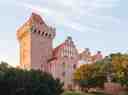
To discover the Royal Castle of Poznań, just look ahead to the hill: the tall, square brick tower with its battlements is hard to miss, and the striking stepped gables above the windows immediately catch the eye. Imagine you are standing exactly where it all began almost 800 years ago. It is the year 1249 - the ground beneath your feet was then Góra Zamkowa, the Castle Hill, today better known as Przemysława Hill. Przemysł I, a duke with a great thirst for power - and apparently also for wine, as he stored his noble vintage deep in the cellars! Here, a stately brick tower was built first, with its own well inside - so that no one would die of thirst during a siege. A wooden palisade and earthworks protected the small duchy against sinister enemies and curious neighbors. Well, the story got really exciting when his son Przemysł II appeared. He had big plans: he wanted to reunite the fragmented Polish crown. A king needs a suitable castle, right? Barely crowned king - bam, murdered a year later! Tragically, isn't it? Sometimes the job of king is just a seasonal side gig. So the construction wasn't finished, but his successors, the Piasts from Głogów, completed the huge edifice: a hall for 2,000 guests! Here, people celebrated, held meetings, and ate mercilessly. In the stuffy cellars: prisoners. Above you: wooden locks and vaults for banquets. To be a guest in the Middle Ages meant: whoever was invited here truly belonged to the upper ten thousand! The representative halls on the first floor showed power, influence, and… let's be honest: the pride in their own architecture. But Poznań was no place for retirement - disasters like the great city fire of 1536 did not spare the castle either. But in good old tradition, the governor had it rebuilt immediately in the fashionable Renaissance style - practically a medieval makeover! Later, when the Swedes raged, Muscovites and Saxons smashed everything to pieces, the castle was a single field of ruins. If the walls here had ears, they would still tremble with fright today! But the history wouldn't be half as exciting without a shot of mystery and a bit of goosebumps, would it? The most famous legend revolves around the devil himself: when Poland was baptized, the Prince of Darkness was seized with envy. He simply tore a hill from the earth near Gniezno to block the Warta - and thus Poznań - to block. Only the good devil was a little too self-confident. While he was celebrating, the roosters began to crow, dawn broke, and - bam! - the demons were so startled that they simply dropped the hill. Let's imagine that: in the middle of the night, suddenly loud crowing everywhere! But that's not the only dark story. The castle was haunted by the ghost of the White Lady, Ludgarda, the wife of Przemysł II. Allegedly, she was murdered in 1283 because she did not bear an heir to the throne - a boisterous conspiracy in which even chroniclers of the time preferred to note 'unclear circumstances.' Her ghost is said to have wandered through the halls as a white figure, and the 'Black Knight' complained outside the castle wall. Well, got goosebumps yet? Centuries rushed by, kings came and went: weddings were celebrated here, like that of Salomea in 1249, Casimir III in 1341, and other dukes and ladies graced the halls. Peace treaties were sealed in the hall, rulers from distant lands visited the castle. So whoever stands on the castle ramp today can almost feel the echo of these voices, the pounding of hooves, the clinking of armor. In the 18th century, the castle transformed: the last great Starost Kazimierz Raczyński turned it into an archive. Afterwards, the Prussians tore down a part, built new administrative buildings - administration instead of conspiracy, how boring! But at least walls from the 13th and 14th centuries remained, two meters thick, defying time! In the 20th century, in the destructive whirlwind of World War II, the castle again fell victim to artillery fire - the hill was a firing line. But Poznań doesn't give up! The remains became an archive, then a museum, rebuilt and restored. Today, you can stroll through halls full of art: the Museum of Applied Arts shows how creative humans have always been when creating beautiful or practically useful things. And don't forget to look for the three plaques during your tour: they tell of Kazimierz Raczyński, the Teutonic Order, and the coronation of Przemysł II - history as a scavenger hunt! But be careful who you meet in the corridors. Perhaps the White Lady will rush past, gray and sad, followed by the weeping Black Knight at the gate… What a castle, what stories - and you are standing right in the heart of it!
Open dedicated page →Directly in front of you rises a mighty, yellow-washed church with two onion domes and an elegant Baroque facade - look for the tallest building with the green spire roofs, and…Read moreShow less
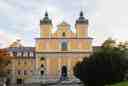
Directly in front of you rises a mighty, yellow-washed church with two onion domes and an elegant Baroque facade - look for the tallest building with the green spire roofs, and you've reached your destination! Imagine, we travel back together to the 17th century. Here, at the foot of the so-called 'Castle Hill,' where the city walls once protected Poznań, stood... nothing. Only the wind whistled, and perhaps a cunning squirrel scurried by, searching for an architectural wonder. Because let's be honest: what would a city be without its dramatically hidden stories? Back then, Bishop Andrzej Szołdrski wanted to bring the Franciscans to Poznań. 'We need more monks in the city!', he probably thought - but the other orders, especially the resident Bernardines, were as thrilled about it as a cat about bath time. So there was a bit of holy bickering, and the Franciscans were initially sidelined - to today's ul. Grobla, far from the center. But they didn't give up! Because their wooden church burned down 10 years later (presumably a very hot service...) they had to move on and got a new home and an even older church building. But the goal was clear: their own magnificent church within the city walls! So - and now hold on tight - in 1668, after several attempts and many prayers (and probably a few desperate sighs while looking at the building authority), they finally got their plot of land right here at the foot of the Castle Hill. A certain master builder Jan Koński was commissioned with the construction in 1674. But, as is typical with church constructions, everything dragged on like chewing gum on the sidewalk in summer: it took a full 54 years until its final completion in 1728. Inside, pure Baroque awaits you: a three-nave basilica with a main nave spanned by an ornate barrel vault with windows. There, the magnificent main altar gleams golden, full of stucco decorations and painted frescoes - created by the brothers Adam and Antoni Swach, two legendary Czech Franciscans. If you've ever wondered how many saints can fit on an altar at once: next to the painting of St. Anthony of Padua stand two mighty wooden figures - St. Augustine and Francis of Assisi, both seemingly having rushed to the altar. A special attraction is the chapel with the image of the 'Miraculous Madonna of Poznań,' painted in 1666 by Marcin from Śródka, who probably had no idea then that his work would gain such a legendary reputation. Two years after its creation, people sought her blessing, and soon the image was known as miraculous! Since then, generations have made pilgrimages here. And in 1968, centuries later, the image was even crowned by the famous Cardinal Stefan Wyszyński, while a certain Archbishop of Kraków named Karol Wojtyła watched - yes, the same one who would later rise to number one on the world's Pope list. The church experienced in its history many heights and depths - literally also structurally: In the 19th century, the order was suppressed, the sacred building was quickly converted into a warehouse by the Prussians (it probably smelled less of incense, more of mothballs...), later almost completely destroyed, damaged again in the war, and rebuilt first after the war. Each layer of masonry tells of courage, hope, and a pinch of truly monastic perseverance. Inside, you'll find something both eerie and fascinating: a collection of 14 Baroque funeral portraits, wooden stalls, and ornate tombs - a journey through Poznań's history in a circle, once clockwise! And as if that weren't enough, right next door stands a monument to the legendary 15th Poznań Uhlan Regiment, as if they too are watching over the constant in this city: Always onward, always again, always full of stories! And here you stand now - in the midst of this patchwork of triumph, tears, triumphant vaults, and the occasional miracle that might just happen in the next moment. Who knows, perhaps you'll meet a particularly friendly Father who has another little anecdote up his sleeve - and if not, then Andreas, your digital city guide, always has another monastery joke ready! Would you like to know more about the architecture, the sanctuary of Our Lady of Miracles of Poznań, or the guardian? Ask in the chat section and I will enlighten you.
Open dedicated page →Directly in front of you lies Plac Wielkopolski: The rectangular square is easy to recognize by the many green and white market stalls that form a striking sea of tents in the…Read moreShow less
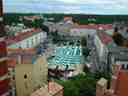
Directly in front of you lies Plac Wielkopolski: The rectangular square is easy to recognize by the many green and white market stalls that form a striking sea of tents in the center of the square - just look where the bustling activity pulsates between the old and new house facades! Welcome to Plac Wielkopolski, a square that has stored more stories in its cobblestones than many a great-uncle tells at family gatherings! Imagine you are now standing in the middle of the former suburb of Glinki, surrounded by lively market stalls, the sound of vendors hawking their fresh tomatoes and fragrant breads, and - if you listen very carefully - the occasional squeak of a tram. But did you know that clay pits and brick kilns once dominated the scene here? The ground beneath your feet was a real brick paradise in the Middle Ages. Anyone who trudged through the mud back then would surely never have imagined that centuries later, hip city dwellers would be looking for avocados! In the 17th and 18th centuries, the hiss and clatter of gunpowder echoed here, as the shooting society regularly met at a shooting range to crown the best marksman. All, of course, under the strict eye of the brotherhood - and probably with the help of a small schnapps, because back then it was already said: first shoot, then toast! Eventually, the square became more civilized - in 1786, believe it or not, Jan Geisler opened one of Poznań's first coffee houses right here. The scent of coffee, the gentle clinking of cups... enjoy this image while the present-day market pulsates around you. Coffee and commotion, that actually fits the program here: From 1847 onwards, the square became the center of hunger riots, where angry people demonstrated for bread and hope. It really needed a bakery, not police! The history of the name is almost a small noble soap opera: After Geisler came the Sapiehowie, a noble family with a fox in their coat of arms (no joke!), who gave their name to the square. After 1945, 'plac Sapieżyński' finally became 'Plac Wielkopolski,' and with that, the princely times were officially bid farewell. To the south of the square, a small reservoir even gurgled until 1876 - a remnant of the old mill stream. Today, only a beautifully landscaped green strip to see, where you can sit on a bench and observe the colorful hustle and bustle. Time relentlessly swept over the square: during World War II, almost all the historic houses around the square were destroyed; only a charming Art Nouveau tenement house and the Prussian State Archives remained standing. The rest dates from the 1950s and clearly bears the charm of socialist architecture: large, simple residential blocks, but certainly with an attempt to imitate a bit of pompous frills - after all, the new square was supposed to bridge the gap between old and modern Poznań, ornate and practical at the same time. The story gets really exciting in the 70s, when the new Solna street severed the historical connection to the neighboring Holy Cross area - a bit like an involuntary haircut that always remains visible. And then there's a little curiosity from the era of the People's Republic: Plac Wielkopolski was then THE secret meeting place of the gay scene - it's rumored that more flirting happened here than bananas were sold! Finally, also pay attention to the tram tracks that cleverly snake around the market halls and houses. They form a loop that is actually only used in emergencies. Perhaps today you'll hear the rattling and ringing, but perhaps also just the murmur that has wafted over this very special square for centuries. Welcome to the heart of Poznań, where every stone seems to tell its own story - and it never gets boring.
Open dedicated page →Before you stands the radiant Poznań Town Hall - a magnificent, white building with a striking clock and a tall, tower-like roof, which, with its three-story, richly decorated…Read moreShow less
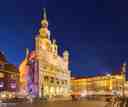
Before you stands the radiant Poznań Town Hall - a magnificent, white building with a striking clock and a tall, tower-like roof, which, with its three-story, richly decorated loggia and the golden eagle statue on top, truly stands out from the colorful market square; look out for the tallest building directly overlooking the square! Welcome to the last stop of our tour - but don't worry, the best is always saved for last… and the Poznań Town Hall knows how to make an entrance! Imagine: You're standing in the middle of a lively market square, surrounded by fragrant restaurants, laughing people, and cobblestones under your feet. Before you, the Town Hall rises like a magic castle from a fairy tale book. The walls glow in the warm light, the gilded accents sparkle - and at the top, quite cheekily, the white eagle perches with outstretched wings. Right next to it is the clock - and you should pay special attention to it, because something very special happens here! But first, let's go back to the 13th century: The city of Poznań has just been founded, merchants are shouting out their wares, and from the new Town Hall - then a simple, rectangular building with only one floor - there's the smell of parchment and old files. Beneath your feet are the ancient cellars, which later became warehouses, prisons, torture chambers, and eventually even a restaurant and museum. Over the centuries, the Town Hall grows piece by piece, the square becomes increasingly busy. During the great city fire of 1536, things get really hot here! Smoke rises, and the proud Town Hall stands heavily damaged. Then a famous builder from Italy arrives: Giovanni Battista di Quadro. The man brings a touch of “La Dolce Vita” to Poland, gives the building a dazzling loggia face, adds an extra floor, and builds a tower that almost reaches the clouds. Particularly proud is the city from 1551 on its new, colorful Town Hall clock, because below it - now hold on tight - every noon, two mechanical goats appear, dueling precisely at 12 o'clock with a round of headbutts! No wonder all tourists stand here punctually like anchovies during market season. But why goats, you ask? The legend tells of a clumsy cook who messed up the venison roast for a feast and, at the last moment, stole two goats from the pasture. The runaways escape him, climb to the horror of all onto the Town Hall tower, and have a brawl up there - which is so much fun that the city mayor pardons both animals and the cook. So that everyone never forgets how funny such a goat collision is, the builder incorporates them as a mechanical spectacle above the clock. But the Town Hall is not only known for goat fun - it is a historical stage. Imagine: kings and city councilors meet here, Renaissance halls fall in love with gilded ceilings, judgments are passed, masked balls are celebrated, and several renovations are held over the centuries. Once, lightning destroys the spire and goats, later a hurricane rips off the roof, and again and again, the magnificent facade is tinkered with, painted, and renewed. In times of war, citizens even hide the golden eagle statue - for fear it might be lost. But after every storm, after every catastrophe, the Town Hall rises again, more beautiful than before. The pompous great hall is adorned with pictures of old heroes, opulent frescoes glow on the ceiling, and through the ancient corridors, the echo of the city's history still resonates. Not to forget: the mysterious melody, the so-called hejnał, which still sounds from the tower on the hour. Another legend is hidden here - allegedly, this melody was once given to a boy who helped a wounded raven. Years later, when the city is threatened by enemies, the boy blows exactly this signal - and a swarm of angry ravens saves all of Poznań! And while you now stand before this magnificent facade, look closely at the figures: Between the arcades below stand ornate ladies representing virtues like patience, prudence, justice, and bravery - and above, the list of old kings. Some visitors believe that at night, the figures might come to life and retell their old stories. Take a moment, feel the history and the tingling sensation that you are standing on centuries-old cobblestones, amidst goat sagas, robber tales, and real heroes. And the next time you hear a clock strike or see goats, think of the Town Hall here in Poznań and perhaps, just perhaps, you'll feel a tiny bit of the old magic of the place. Would you like to explore the goat and horn call, the rooms, or the external features in more detail? Come to me in the chat section to have a detailed discussion.
Open dedicated page →
Frequently asked questions
How do I start the tour?
After purchase, download the AudaTours app and enter your redemption code. The tour will be ready to start immediately - just tap play and follow the GPS-guided route.
Do I need internet during the tour?
No! Download the tour before you start and enjoy it fully offline. Only the chat feature requires internet. We recommend downloading on WiFi to save mobile data.
Is this a guided group tour?
No - this is a self-guided audio tour. You explore independently at your own pace, with audio narration playing through your phone. No tour guide, no group, no schedule.
How long does the tour take?
Most tours take 60–90 minutes to complete, but you control the pace entirely. Pause, skip stops, or take breaks whenever you want.
What if I can't finish the tour today?
No problem! Tours have lifetime access. Pause and resume whenever you like - tomorrow, next week, or next year. Your progress is saved.
What languages are available?
All tours are available in 50+ languages. Select your preferred language when redeeming your code. Note: language cannot be changed after tour generation.
Where do I access the tour after purchase?
Download the free AudaTours app from the App Store or Google Play. Enter your redemption code (sent via email) and the tour will appear in your library, ready to download and start.
If you don't enjoy the tour, we'll refund your purchase. Contact us at [email protected]
Checkout securely with 


