
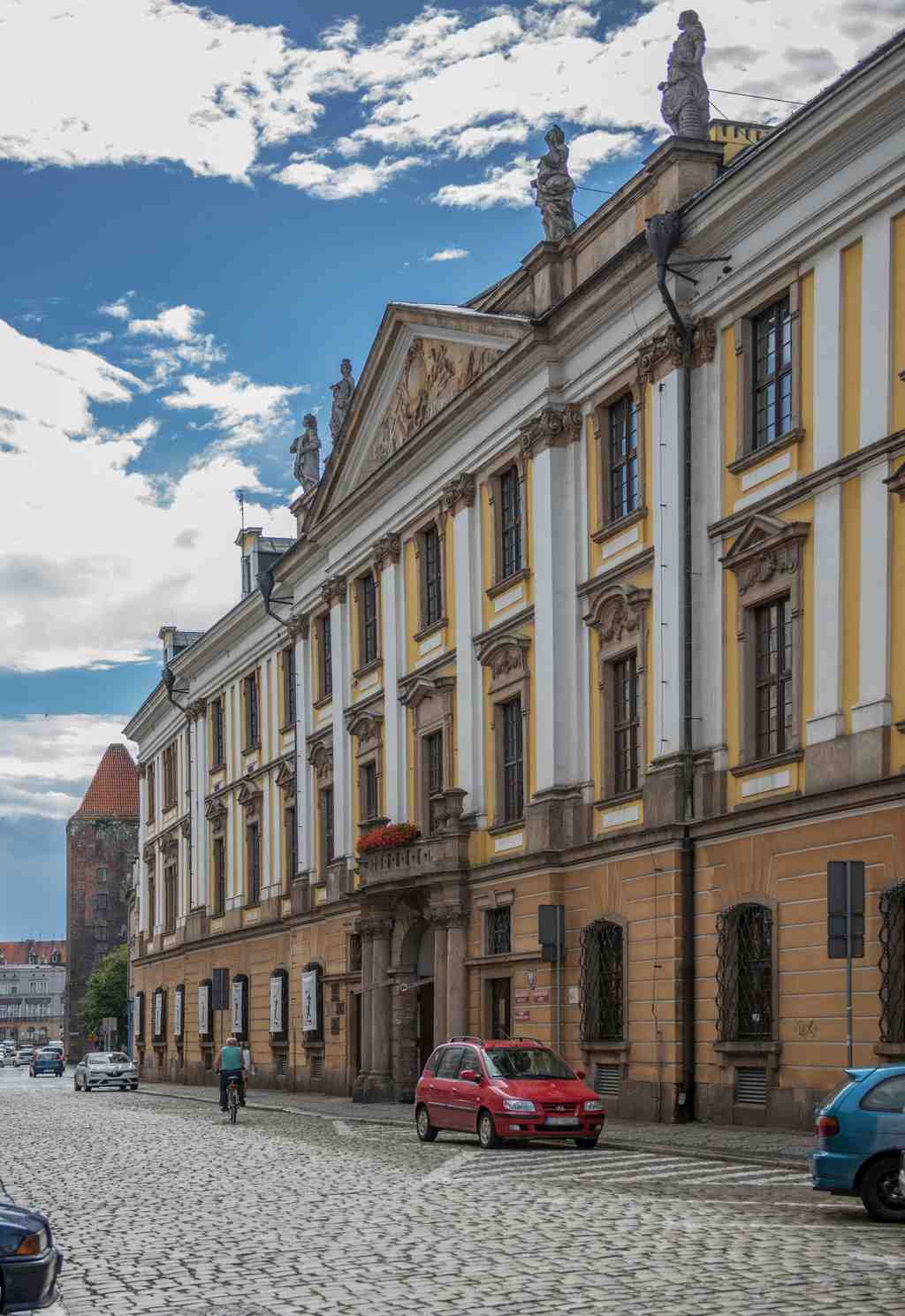
To spot the Liegnitz Ritter-Akademie, look for a grand baroque building stretching along the cobbled street, with eye-catching yellow and white columns, large windows, and statues standing regally atop the roofline.
Welcome to the legendary Liegnitz Ritter-Akademie! If these walls could talk, they’d probably ask for a powdered wig and recite Latin poetry. Imagine stepping into the early 1700s: the air smells faintly of waxed wood and old parchment, and fancy carriages rumble up to these doors. This was the top school for Silesia’s young nobles, dreamed up by Duke George Rudolf, who left a hefty fortune to educate Protestant boys-only to see his dream hijacked by the Habsburg emperor in a titanic struggle between religions, armies, and the fate of the region. After years of drama, the Treaty of Altranstädt finally cracked open the vault and, at last, this academy was built between 1726 and 1738, designed by the famous Joseph Emanuel Fischer von Erlach.
Picture boys in crisp blue and yellow uniforms bustling about, books in hand, but no swords-sorry, swashbucklers! The academy boasted a staff that read like a who’s who of Enlightenment thinkers, with scholars, historians, and even a mineralogist among its teachers. By 1809, though, the classrooms echoed with more crickets than chatter-only seven students remained, bravely outnumbered by the janitors. Later, when the academy let in non-nobles, the place thrived, bustling all the way to 1945.
Then came another plot twist: after World War II, Soviet boots and officers’ barked commands echoed through these halls, as the Northern Group of Forces set up headquarters here. Only in 1992 did this building breathe freely again, eventually being restored to its former glory. So take a moment to imagine it all-the midnight secrets, the brilliant lessons, and a few ghostly laughs from centuries of change. Isn’t history grand?


