
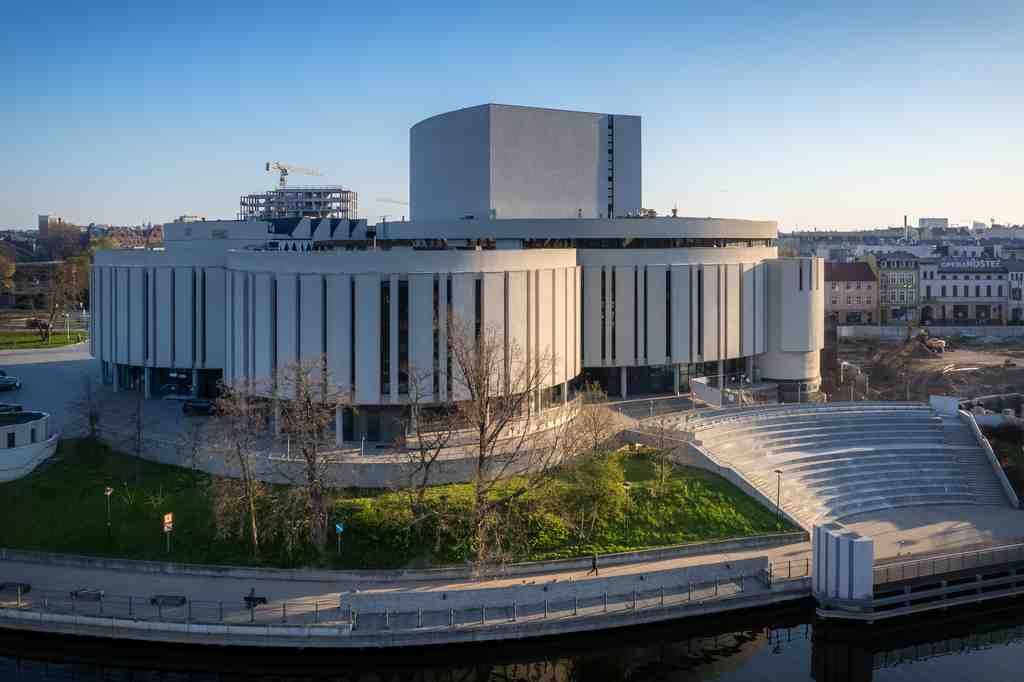
Ahead of you is a striking cluster of glass and concrete circles, with broad curved walls and a smooth rounded mass that makes Opera Nova look a little like a modern ship moored beside the Brda.
It’s a bold first impression, isn’t it? This isn’t some dusty old opera house dressed in velvet nostalgia. Opera Nova feels futuristic even now, and that fits the story. Bydgoszcz founded its permanent opera company in nineteen fifty-six, after decades of trying to give the city a true musical stage of its own. The spark came from Felicja Krysiewicz, a singer, pianist, and tireless organizer who pushed the idea forward when it still sounded a little impossible. The first team prepared its opening production almost entirely out of sheer devotion, and that debut mixed Moniuszko’s Flis and Verbum nobile with the ballet Wesele w Ojcowie.
For years, the company had talent but no proper home. Performers rehearsed wherever they could, then appeared on borrowed stages around the city. Even so, the opera grew fast. It turned state-run in nineteen sixty, built its own orchestra a few years later, and eventually became the only opera house in the whole Kuyavian-Pomeranian region, and one of only ten opera stages in Poland.
Now look at the building itself. In the early nineteen sixties, architect Józef Chmiel won a national competition with a daring design made of intersecting circles. That’s why the whole complex feels like geometry set loose beside the river bend. The plan first imagined four circles, then shifted and shrank during redesigns, and the version in front of you settled into three major ones. Inside, one holds the main auditorium, with an amphitheater-style seating bowl - meaning the audience rises in tiers like in an ancient theater, without aristocratic boxes separating people into ranks. It was meant to feel communal, like everyone shares the same breath before the first note lands.
And getting this place finished... well, that took a stubborn kind of faith. Builders began work in the early nineteen seventies. Then came shortages, funding problems, and long pauses. The half-finished shell turned into a local legend, the “eternal construction site.” But in nineteen ninety-four, instead of waiting politely for perfection, the city did something brilliant: it staged the first Bydgoszcz Opera Festival right inside the raw unfinished building. Audiences sat on five hundred wooden chairs borrowed from the army, surrounded by bare walls, and somehow that rough setting only made the performances feel more electric. That festival helped save the project. After thirty-four years and five months of building, Opera Nova finally opened officially in two thousand six.
Today the place carries opera, operetta, ballet, musicals, education programs, and a major annual festival. So this building isn’t just a venue; it’s a victory lap poured into concrete and glass.
If you need practical details later, the administrative side generally operates Monday through Friday from seven A-M to three thirty P-M, and stays closed on weekends.
Opera Nova shows you exactly how patient a city can be when it decides culture matters.
Take a moment to soak in those sweeping curves, and when you’re ready, we’ll wander on to the Poor Clares Monastery.




