
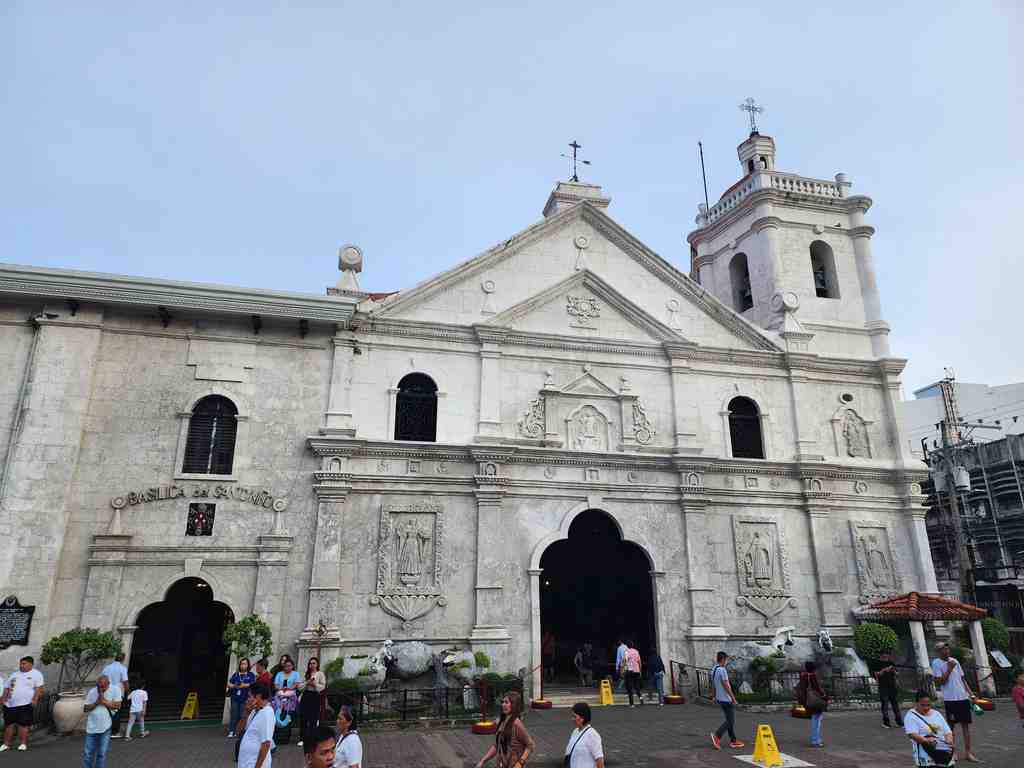
Look ahead for a grand, white-stone church facade with arched doorways, carved saints in alcoves, and a bell tower rising on the right-if you spot this impressive sight bustling with visitors, you’ve found the Basilica del Santo Niño!
Now, let’s imagine standing here in the heart of Cebu, where the air is thick with the smoky scent of melting candles and the sound of footsteps mingles with excited whispers of visitors-because you’re actually gazing at the oldest church in the entire Philippines. More than four centuries ago, in 1565, two Spanish friars, Fray Andrés de Urdaneta and Fray Diego de Herrera, arrived on these shores with Miguel López de Legazpi. They built this holy place right on the spot where a tiny image of the Child Jesus-the Santo Niño-was uncovered in a humble, burnt hut. Talk about finding treasure where you least expect it!
But how did that image get here? Let’s rewind further, to 1521, when Ferdinand Magellan sailed across the wild seas and presented the Santo Niño figure to the queen consort of Rajah Humabon upon her conversion to Christianity-think of it as a royal baptism gift, except this one sparked a tradition that would shape the faith of an entire nation. Over forty years later, after Legazpi and his men razed a village, a soldier named Juan de Camuz discovered the statue hidden away in a box, perfectly preserved despite the devastation-sort of like history’s best game of hide and seek.
The first attempt at a church was humble: wood and nipa, little defense against fire, as it tragically burned down within a year. They tried again and again-another with bricks and stones, but even that one ran into problems. Finally, in 1735, the resilient friars decided to go big or go home, gathering stone, help, and know-how from the entire community, parishioners, and even neighboring towns pitched in-imagine the air filled with the clang of tools and chatter about getting the walls just right. By 1740, the Basilica stood strong-and the miraculous Santo Niño was placed in his rightful home, safe at last, to the joy of every Cebuano.
Time marched on, and the church became more than just stone and prayer. Pope Paul VI elevated it in 1965, proudly calling it “the symbol of the birth and growth of Christianity in the Philippines.” From then on, families flocked here week after week, rain or shine, to gaze at the glass-encased Santo Niño, light candles in the “dagkutanan,” and join in the vibrant dance of the Sinulog festival every January. If you think Sundays are busy, try squeezing in during Sinulog-3,500 people might crowd into the open-air Pilgrim Center right across from you!
Though earthquakes-like the huge one in 2013-tried to bring these walls down, the Basilica’s spirit proved stronger. Restorers carefully tested old stone, cleaned each detail, and, like doctors for ancient buildings, injected lime water to keep the walls standing tall. The belfry and main doors came back to life just in time for Christmas 2014, and by 2016, the bell tower rang out louder than ever.
The story of Santo Niño isn’t just about old stones and relics-though the museum here does house centuries-old church treasures, golden chalices, ancient priestly robes, and saintly statues old enough to need their own birthday cakes. It’s a living legacy, wrapped up in Friday devotions, joyful festivals, and an endless tide of hope from Cebuanos and Filipinos everywhere.
So, as you stand here, you’re in the presence of a piece of living history-one that has survived fire, earthquake, and centuries of change, all thanks to a tiny statue that brought faith, tradition, and a whole lot of dancing to Cebu. If you listen closely, you might catch the joyful laughter of devotees heading to light a candle for their wishes and gratitude.
Wondering about the church complex, location or the devotion to the holy child? Feel free to discuss it further in the chat section below.


