
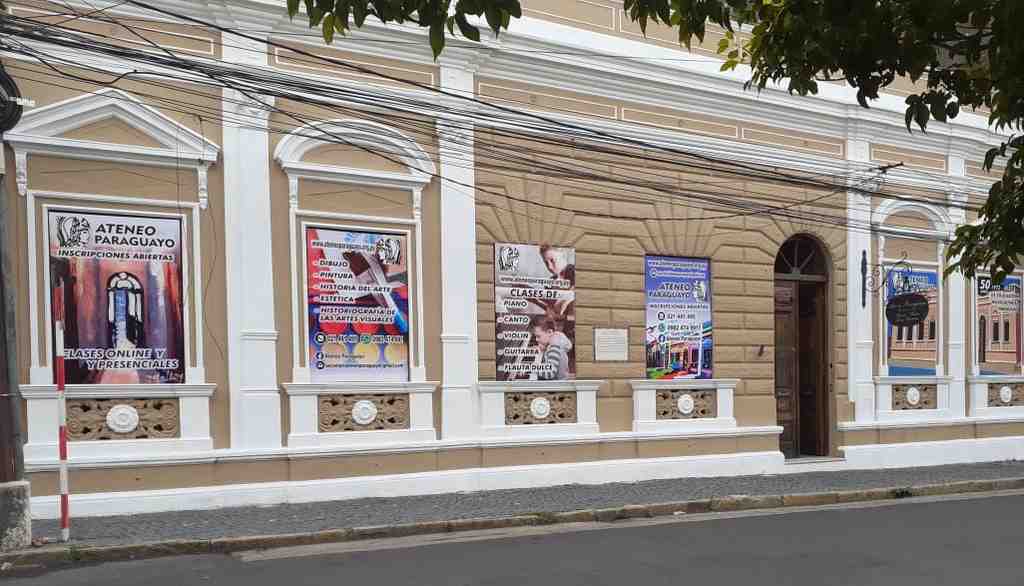
Right in front of you, you’ll spot the Paraguayan Athenaeum by its classic tan façade, tall arched doorway, white decorative moldings, and colorful posters inviting you to discover art and culture; just look for the large windows and banners framed in white along the sidewalk.
Welcome to the grand old Paraguayan Athenaeum! You’re standing before the oldest art and culture institution in all of Paraguay-older than most of the pipes in Asunción and probably more reliable, too. Now, close your eyes for a moment and let your imagination travel back to July 28, 1883. The city buzzes in the heat of summer, horse carriages clatter by, and inside this very building, a group of passionate thinkers and dreamers gathers. Among them, Cecilio Báez, pen in hand, writes the founding act-his friends Ramon, Guillermo, Benjamín, and others nodding proudly, excited to bring music, literature, and the fine arts to Paraguayan life.
But as any good story goes, it wasn’t all smooth sailing. By 1889, fierce political disagreements made these friends frown more than smile. The original Athenaeum dissolved-poof!-but out of its ashes, something just as marvelous appeared. In these rooms, in that same year, the National University of Asunción was born, proving that good ideas are simply too stubborn to vanish forever.
As you stand here, imagine the second chapter: the “Instituto Paraguayo” of 1895, inspired by the fancy French model. Its halls burst with music, gymnastic routines, lively drawing classes, and a library packed to the rafters. The best Paraguayan minds and talents-future stars like Agustín Pío Barrios and José Asunción Flores-walked these halls. Meanwhile, in 1913, a bunch of young folks, fresh from studying abroad and bursting with energy, created the “Gimnasio Paraguayo,” firing up even more passion for knowledge and creativity, turning this spot into the beating heart of culture in Paraguay.
Fast forward to 1933. Bullets fly in the Chaco War, but even amid the chaos, two rival institutions shake hands and finally unite, becoming the modern-day Athenaeum. Today, it’s still alive with music, laughter, and clinking piano keys. It’s a living legend, now led by Professor Álvaro Morel Aquino, who brought the joyful Suzuki method to musical learning here.
So, as you take in the grand arches and history-stained stones, think of all the young artists, musicians, teachers, and bright sparks who walked through these very doors, determined to create, share, and keep Paraguay’s cultural soul shining bright. Not bad for a building with better attendance than most Paraguayan soccer matches!


