
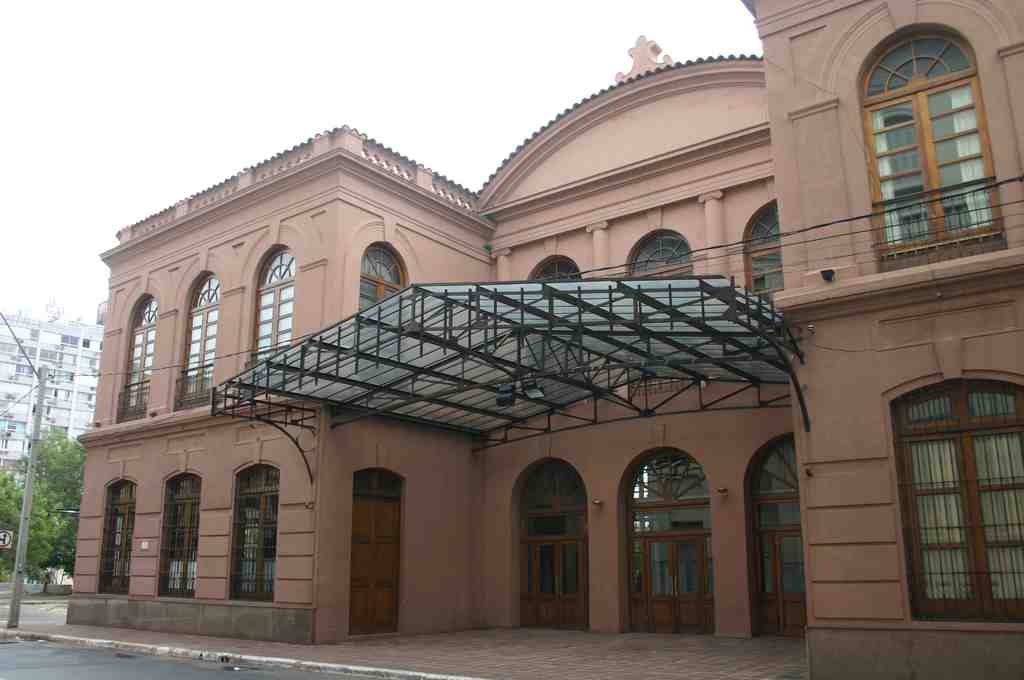
To spot the Municipal Theatre Ignacio A. Pane, look for a grand pinkish-peach building with tall arched windows and a large glass-and-metal canopy jutting over the entrance-right in front of you at the corner of the street.
Now, as you stand here, take a deep breath and imagine: it’s the year 1843. This place isn’t filled with actors and glittering lights just yet-instead, it’s swarming with serious-looking politicians and a few nervous guards. Why? Because that year, the very first building here served as the meeting spot for Paraguay’s First National Congress. Imagine the echo of determined voices bouncing off these walls, history literally in the making. But President Carlos Antonio López had something else in mind-a place where all of Asunción could gather, not just politicians obsessed with paperwork!
He called on a Spanish journalist and playwright, Ildefonso Antonio Bermejo, to help imagine something grander: a true theatre. So, in 1855, the old Congress building’s stage was set-literally-and on November 4, the new theatre blazed to life! Can you hear the stir of excitement in the air? Paraguayans of all walks, squeezing into rows, ready to be dazzled by opera, zarzuela, drama and, of course, more than a little over-the-top applause.
But the theatre was a bit like a dramatic character in its own right-never content to stand still. In 1886, along came Baudillo Alió, a Catalan businessman with a vision fit for a spotlight. He was granted the land, bulldozed the old shell, and began work on a brand-new “National Theatre.” Three years later, in 1889, the curtain rose to reveal the completed masterpiece. The opening night boomed with music: Verdi, Schubert, and the Spanish Company Orchestra, La Estudiantina Española Figaro, all taking turns to fill these walls with sound.
The years rolled on, and the theatre just kept evolving. In 1894, a renovation brought private boxes and lush courtyards filled with garden air-imagine the scent of flowers mixing with a hint of stage dust! Even as political winds swirled, famous foreign actors and local legends made this place the beating heart of Asunción’s culture. Whether it was opera, operetta, or a classic tear-jerker, the “Primer Coliseo” became synonymous with spectacle and community.
Ownership changed hands-by 1939, it was in the grip of the Municipality-though by 1949, it picked up a new name in honor of Ignacio A. Pane, a nod to the past and a leap into the future.
But, like every good story, there was a plot twist. By the 1990s, the old beauty was fading. Parts of the building even collapsed. The theatre closed in 1995, and for a while, it felt like the final curtain had fallen. But then came a comeback worthy of a standing ovation! Restoration teams, architects, and cultural dreamers rolled up their sleeves. From 2004 to 2005, the entire site was transformed-new steel slipped into the old bones, modern features blended with original shapes, and new courtyards sprouted up as multipurpose halls. Picture a mix of old-world charm and cool, contemporary edges, all set within nearly 5,000 square meters.
These days, it’s not just about evening shows: the theatre houses a café, drama classes, and event spaces-meaning you never know if you’ll hear a mysterious rehearsal, an enthusiastic applause, or simply the hum of daily city life.
So, next time you look up at that elegant façade, just remember: this is a theatre that has survived revolutions, renovations, and more costume changes than you can count. Isn’t it grand to be standing in the wings of history?


