
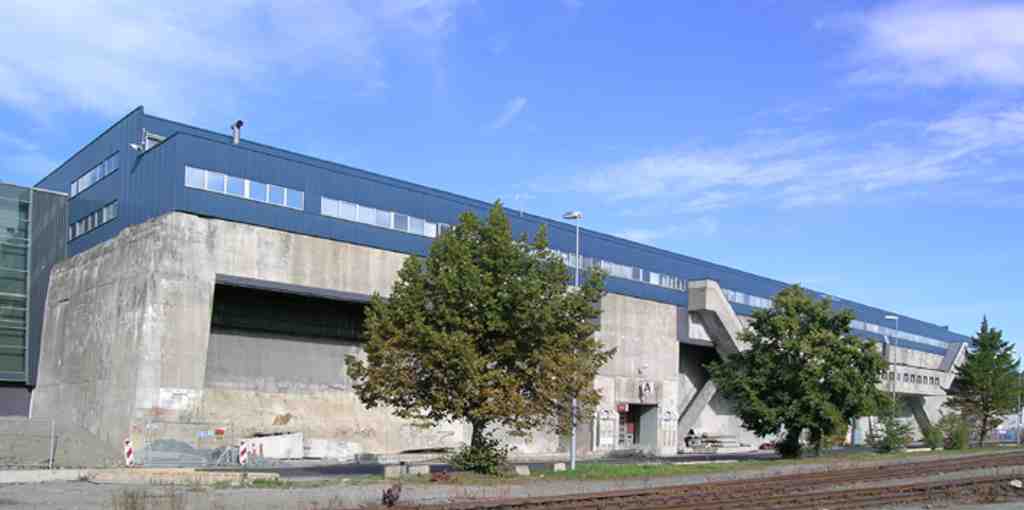
To spot Dora I, look for an enormous, fortress-like concrete building with thick walls and a flat roof, stretching long behind the railway tracks, topped by a modern blue upper story that almost looks like a giant, window-lined box sitting on an older, grey bunker.
Now, take a deep breath and imagine you’ve just stepped back into the world of wartime Trondheim. Right in front of you stands Dora I - the city’s grandest concrete giant, a real-life relic of World War II. Behind those unyielding, grey walls is a story built with sweat, steel, and more than a little wartime drama.
Back during the chaos of 1940, when Norway fell under German occupation faster than you could say “smørbrød,” German naval officers soon realized Norwegian shipyards weren’t quite up to keeping their prized U-boats afloat. So what did they do? Well, they ordered up a monstrous bunker to keep their submarines safe from the relentless eyes in the sky. And believe me, when the Germans say “bunker,” they really mean it: Dora I’s concrete roof is thicker than a stubborn Norwegian winter, with over three meters of grumpy, steel-reinforced protection!
Construction began in 1941, with the Todt Organization and Sager & Wörner from Munich managing the show. Their hired hands, however, were mostly forced laborers dragged in from occupied lands, including many Serbians. The worksite became a tough, tense world, with workers battling cold, hunger, and each other’s languages as much as they battled with backbreaking construction. Listen carefully - doesn’t this place just hum with echoes of clanging tools and shouted orders? Here’s one chilling rumor that kept the workers up at night: when a wall collapsed, five Serbian workers lost their lives, and some whispered that their bodies-like curses-remained forever sealed in the concrete slabs. German engineers decided that didn’t make for sound construction, though, so the truth is a bit more mundane - the bodies were removed, but the legend lingers in the air like the smell of old diesel fuel.
But it wasn’t just tough labor; getting enough building material was like trying to collect sunshine in a bucket. Norway, with its picturesque wooden houses, proved a terrible supplier of concrete. Sand, gravel, and steel often had to be shipped in over seas rougher than a bear on a unicycle. Roads and railway tracks vanished regularly under heaps of snow and ice, and even the prefab huts shipped in for workers ended up being as useful as a chocolate teapot. Sometimes the only thing running on schedule were the rumors!
Dora I was supposed to have a grand second floor with offices and workshops, but after all these headaches, they abandoned that plan. The land itself was soft and muddy, making the structure settle like a tired sumo wrestler. In fact, the whole bunker sagged up to 15 centimeters. Building Dora I was a Herculean task, but eventually, in 1943, it opened its submarine jaws to the German Kriegsmarine as the home base for the mighty 13th U-boat Flotilla.
These roaring steel monsters would glide in and out of their blast-proof garage, hiding from overhead bombers. The Allies did try to knock this place out, and in 1943 and ’44, you’d have heard the thunder of distant bombs and read reports of big delays and heavy destruction on the surrounding area. Yet the Dora I bunker itself came away with only minor bruises-tough cookie, this one.
Then came the war’s end. The Germans surrendered, and you can almost picture the moment: silence, only the restless lap of water and footsteps echoing through the cavernous pen. There were plans to blow up Dora I with dynamite, but local officials soon realized that would add a little too much “open-plan” to the neighborhood, not to mention some serious property damage.
Instead, Norwegian submariners made themselves at home until the 1950s-yes, keeping their own fleet inside what was once the enemy’s fortress! Later, two blue-painted stories were added, making the building look like someone tried to put a trendy hat on an ancient viking. Today, these submarine pens, which once bristled with secrets and danger, are filled with archivists, bowlers, business folks, and civilian boats bobbing gently in the pen. If these concrete walls could talk, they’d surely have a few salty tales to share-and perhaps, just perhaps, a joke about how they used to house fleets and now they shelter bowling shoes.
So take it all in: thick, battered, and stubbornly standing-Dora I turned from fortress of war to warehouse of memories. If you listen closely, you might just hear the whispers of the past blending into the laughter and life of today.


