
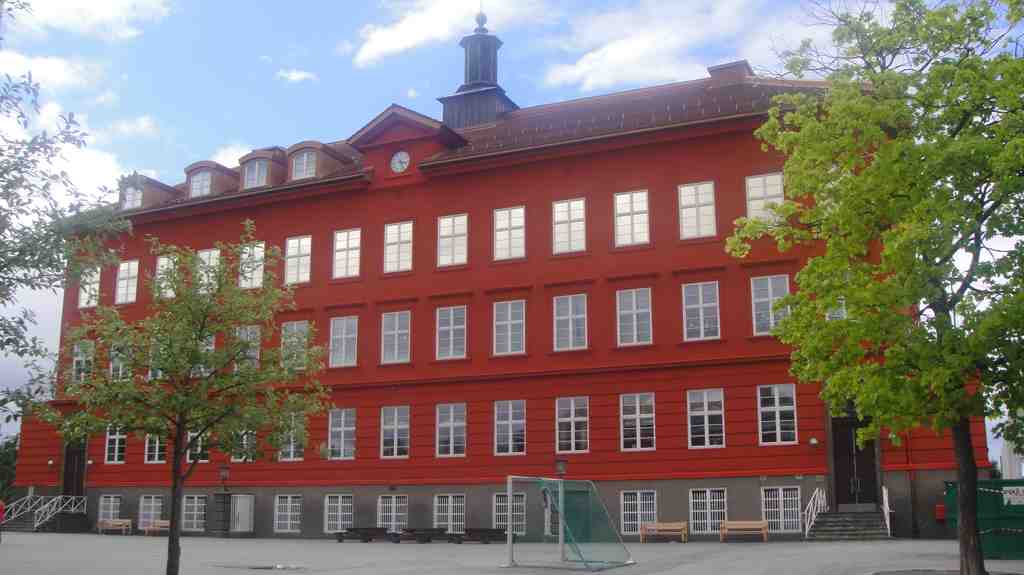
You’re looking for a large and unmistakable red-brick building with a little tower and a clock at the top-right in front of you, stretching across the square, you can’t miss it!
Now, picture yourself standing right here back in the crisp autumn air of 1898. Imagine there’s no grand red wall yet-just five cheerful wooden pavilions, freshly built and smelling of sawdust and promise. With laughter bouncing off the rooftops, children rush through the new Bispehaugen School’s doors, probably without even knowing that this place would become a cornerstone of Trondheim’s community.
But long before any of these buildings sprang up, kids from the Møllenberg area walked dusty roads to Bakklandet Friskole-a school born in 1778 by the inspiration of Bishop Marcus Fredrik Bang, with separate classes for boys and girls. Boys were eventually moved to an old mill called Graamølna. During recess, wild with energy, some students jumped right out the windows for a refreshing swim in the sea below. I bet the teachers were always on high alert!
As Trondheim began to grow through the 1880s and 90s, there was a baby boom on Møllenberg-a lot of kids needing more space to learn and play. The poor old Graamølna just couldn’t keep up; between rickety floors and overcrowding, it wasn’t unusual for students to dream of a spacious, proper school above the bustling city streets. So, the local leaders decided: it was time for a state-of-the-art school, something grand enough to hold up to 1600 students. Arguments broke out at City Hall-should Bispehaugen be made of several small wooden buildings or just one enormous brick masterpiece? In the end, they started with the pavilions. By September 26, 1898, Bispehaugen opened its doors with a whoosh of cold air and new hopes, but even that soon felt cramped.
Fast forward to 1918, a decision was made: it was finally time for a school as solid and bright as the city’s spirit. A whole new red-brick giant began to rise, built at record speed on a plateau that offered sweeping city views-imagine the clang of bricks and the shouts of masons. The final result was so impressive that it earned the architect, Carl J. Moe, a special award for excellence. Trondheimers called it “the city’s most splendid new creation,” and you can see why.
Inside, students found wide, sun-filled corridors and classrooms designed for fresh thinking-a real upgrade from jumping out windows for fun, though I suspect some mischievous spirits still lingered. There were, believe it or not, gym classes held beneath the beams of the attic, sunlight pouring in through skylights. Wouldn’t you love to have done cartwheels up there?
Bispehaugen was also famous for its school band, the legendary “Småbispan,” first started back in 1909. You can almost imagine the sound of trumpets and drums drifting across the neighborhood on parade day. And here’s a fun twist: it was for boys only at first, until 1955, when girls-finally!-were allowed to join, bringing a whole new energy and balance to the band.
Standing here now, you might notice the gentle curve of the street, how the school seems to anchor this whole block. It divides old Trondheim into before and after-before Bispehaugen, when students took chilly plunges during recess; and after, when the city’s children had the grandest of stages for learning, exploring, and making a bit of noise of their own.
So, take a look up at those rows of bright windows-imagine the buzz of new ideas flowing, and remember, every corner of this place has stories etched into its red-brick bones. Onward with the tour? I promise the next stop won’t require you to jump out any windows!


