
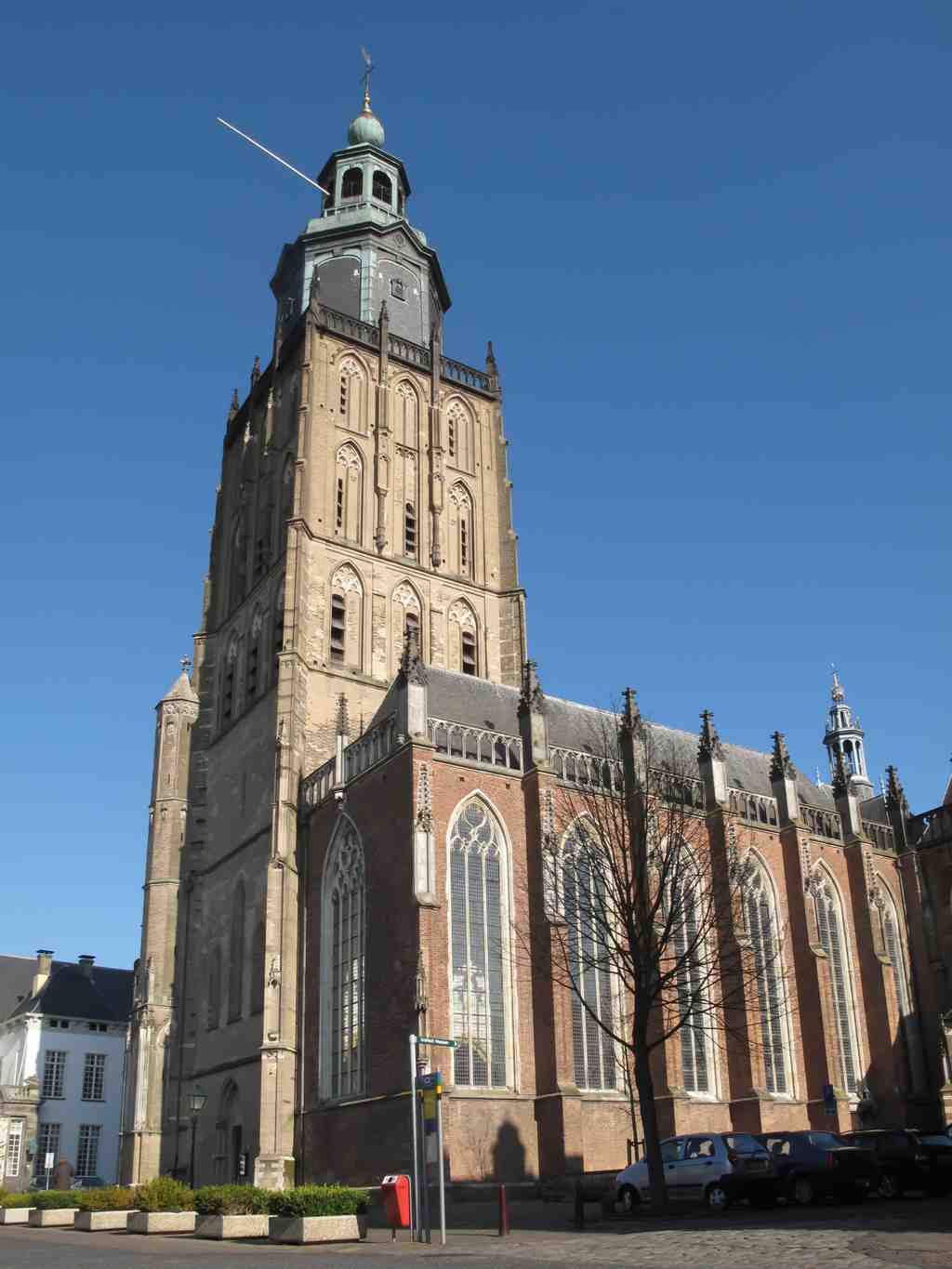
To spot Saint Walburga's Church, look up for its impressive tall tower with a green-topped cupola rising above a grand row of pointed arched windows set into its brick-and-stone walls-it's truly impossible to miss as you stand here at the 's-Gravenhof square.
Now, imagine yourself walking these cobblestones nearly a thousand years ago. The story of Saint Walburga’s Church goes all the way back to the ninth century, when just a humble stone chapel stood here. That little building was the great-grandparent of this mighty church you see today! Over time, Zutphen grew, and so did the church, turning from a modest Romanesque structure into the grand basilica standing before you. It’s as if every century tried to outdo the one before, adding a new touch-a bit like builders playing the world’s longest game of architectural Jenga.
Picture the scene around 1100, the air thick with the echo of hammering and chisel work, as stone masons raised the first great walls. By the early 1200s, the church was dramatically remodeled, becoming a Romano-Gothic basilica. The soaring tower was built and raised even higher over the years-at one point reaching a dizzying 107.5 meters! For a while, it was actually taller than the Utrecht Dom tower, until a bolt of lightning (the dramatic kind, the stuff of fairy tales!) struck in 1600. That trimmed the tower’s ambitions, topping it off at a mere 76 meters-but hey, that’s still a neck-aching height!
This church was not just a building; it was a community hub, a spiritual center, and sometimes, a stage for a bit of drama. There’s plenty of that here! Remember the great fire of 1446? The church’s stone tower had to be heightened, and in the late 1400s, they added a spectacular spire-like putting a wizard’s hat on a giant! More chapels sprouted up around the choir, and big, bold transepts stretched out the church’s arms.
Let’s stroll forward a little to the Renaissance. There was a time when the tower’s spire, the “peperbus” (that’s Dutch for “pepper pot”-I promise, it kind of looks the part!), gleamed atop the church. But on March 30, 1948, another fiery misfortune struck and the spire burned down. It sparked a “heated” debate (get it?) for decades about how best to rebuild it. Eventually, in 1970, a new spire rose-just like the old one-a phoenix atop stone wings.
Now, let’s sneak a peek at the treasures within: you’d find a late 12th-century sarcophagus lid, iron chandeliers glittering like golden crowns, a bronze baptismal font from 1527, and grave slabs stretching from the 1400s to the 1700s, each with their own whispered stories.
If you’re an organ fan, hold onto your hat! The church’s big Bader organ, built in 1639, is the largest Dutch organ from the late Renaissance and early Baroque periods. It was reshaped and expanded over the centuries, but recently restored to sound just like it did almost 400 years ago. If these pipes could talk, they’d probably play a tune just for you.
And speaking of stories, did you know the church used to house one of Europe’s only three remaining chained libraries? Yes-books locked up tight so no one could run off with them, and believe me, the librarian was probably just as strict as your high school principal.
For centuries, Saint Walburga’s was the heart of Zutphen. But in 1591, everything changed: the church became Protestant, and all the grand Catholic altars disappeared-over 40 of them, swept away by the tide of history. The crypt’s vault was demolished and the floor leveled, erasing secrets from below.
Even the trees here have their stories. A mighty silver maple once grew beside the church-a leafy giant-until 2009 when it was declared too old and mighty for its own good. Still, it got a second act: its wood became a quartet of string instruments, which played their first concert right next to the church. Talk about a key change!
As you gaze up at Saint Walburga’s Church, feel the weight and wonder of centuries pressing close around you. Every stone, every window, and every sound tells the story of Zutphen’s soul-rising, echoing, and somehow, remarkably, still singing today.
Eager to learn more about the renaissance, eighteenth to twentieth centuries or the inventory? Simply drop your inquiries in the chat section and I'll provide the details you need.


