
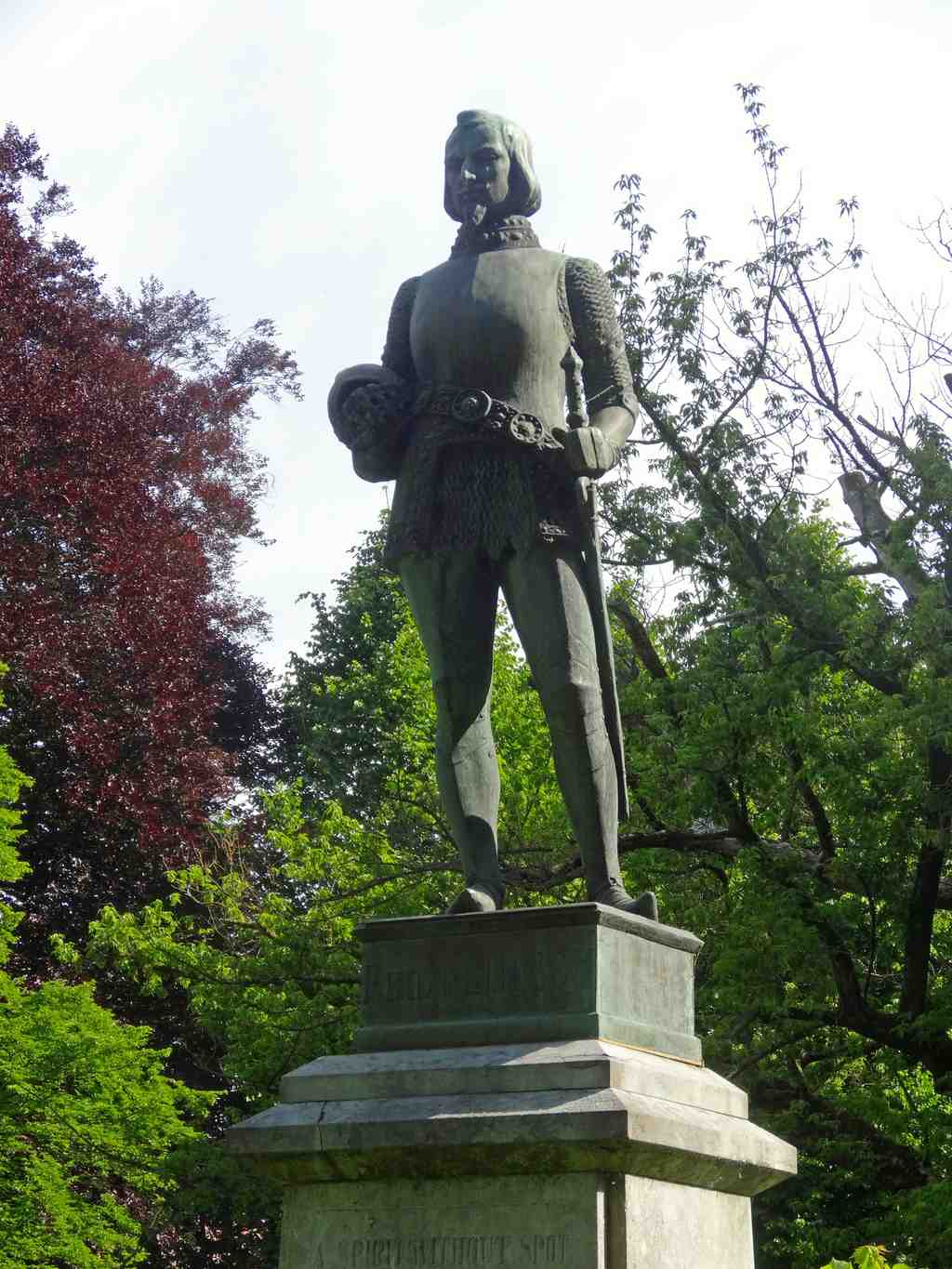
You’ll spot the Memorial to Sir Philip Sidney standing tall in front of you-a bronze statue of a man in shining armor, helmet in hand, perched on a sturdy stone pedestal set against a backdrop of leafy trees. Just look for the knightly figure keeping a silent watch over the park!
Now, step a little closer-it’s story time, and this monument has more drama than a Shakespearean play! Here stands Sir Philip Sidney, not just any knight, but an English nobleman, poet, and all-around Renaissance superstar. Imagine the clang of armor as Sidney leads his men across the dew-speckled fields of Zutphen, the air thick with anticipation of battle. In 1585, Sidney marched with his uncle, the Earl of Leicester, on a mission to help free the Dutch from Spanish rule. The Netherlands were smack in the middle of a tug-of-war for independence, and Sidney stepped right into the thick of it-becoming the governor of Vlissingen and fighting shoulder to shoulder with his allies here.
But fate, and perhaps a rogue Spanish musket, had other plans. On the muddy battlefield near Warnsveld, not far from where you stand now, Sidney was struck in the knee. Thousands of stories say he was offered water as he lay wounded, but seeing a dying comrade beside him, Sidney uttered the famous words, “Thy necessity is yet greater than mine,” and passed the drink along. Now that’s what you call chivalry-he put Camelot’s knights to shame! Sadly, he died of his wounds a month later, but not here. Despite wishes for him to be memorialized in Dutch soil, his body was sent back to England, to be buried in St Paul’s Cathedral-a true cross-Channel hero.
It wasn’t until more than 300 years later, in 1913, that Zutphen decided it was time to honor this valiant Englishman. The statue you see, crafted by the Haarlem silversmith and sculptor Gustaaf van Kalken, was set atop a granite pedestal in the leafy Slingerbos park during a grand festival for Dutch independence-complete with speeches, anthems, and enough honorary committees to fill a small castle. The monument is a detailed work: Sidney stands in full armor, helmet in his right hand, his left gripping his sword, his leg turned like he’s about to step right off the pedestal and back into action. Notice the Sidney family coat of arms just below the inscription, “a spirit without spot,”-pretty dramatic, but, well, he lived up to the title.
The base tells you more-Sidney is described as an “nobleman, poet, statesman, warrior for our freedom,” while on the back, you’ll find the names of the committee members who raised the funds to make this possible. Zutphen wasn’t the only place to remember Sidney. In 1923, Shrewsbury, his English hometown, unveiled a similar statue, and even Arnhem, where Sidney died, features a stone marker in his memory.
When the sunlight hits the bronze and the trees rustle around, you can almost hear the echo of old battles and the solemn applause of a grateful city. Sir Philip may not have been buried in Dutch ground, but here he stands, forever guarding Zutphen-a true knight whose legend refuses to rust!


