
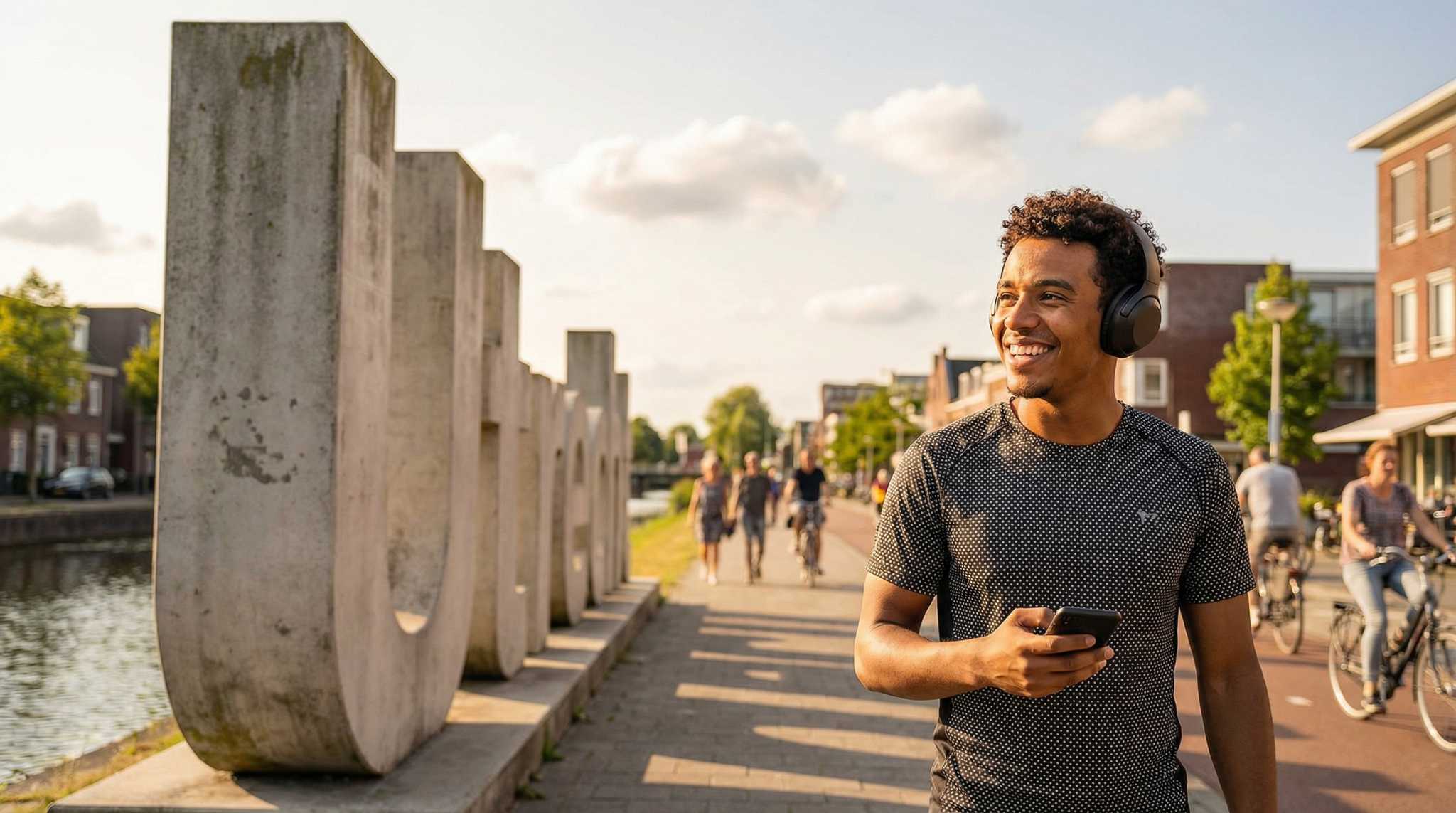
Utrecht Audio Tour: Timeless Treasures of Binnenstad’s Hidden Paths
Beneath the cobblestones of Utrecht lie centuries of blood, betrayal, and whispers that refuse to stay buried. Unlock the city’s dark heart with this self-guided audio tour. Wander away from the crowded squares to uncover the scandalous secrets and forgotten rebellions hidden in plain sight. Why was the powerful Duitse Huis locked away from the eyes of the public for generations? What sinister force lurks behind the silent walls of the Buurkerk? Is it true that the Centraal Museum hides a masterpiece painted in the darkest hour of a merchant’s ruin? Trace the path of forgotten power brokers and rogue iconoclasts. Feel the pulse of the city as you navigate its winding alleys and shifting shadows. Experience a transformation where every stone tells a story of survival and intrigue. Plug in your headphones and prepare to unmask the secrets that define Utrecht.
Tour preview
About this tour
- scheduleDuration 40–60 minsGo at your own pace
- straighten3.1 km walking routeFollow the guided path
- location_onLocationNieuwegein, Netherlands
- wifi_offWorks offlineDownload once, use anywhere
- all_inclusiveLifetime accessReplay anytime, forever
- location_onStarts at St. Mary's Church, Utrecht
Stops on this tour
Look for the towering stone facade characterized by its two tall square towers with pointed green roofs and a large central circular window. Now, prepare yourself for a massive…Read moreShow less
Open dedicated page →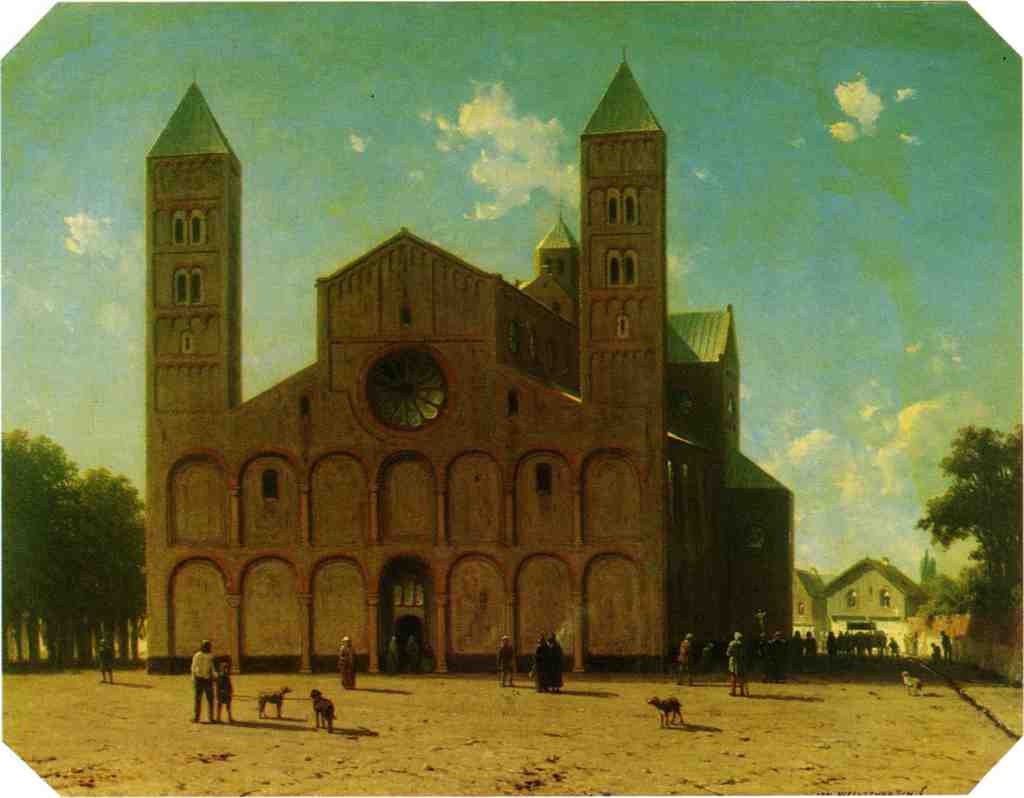
St. Mary's Church, UtrechtPhoto: Jan Weissenbruch, Wikimedia Commons, Public domain. Cropped & resized. Look for the towering stone facade characterized by its two tall square towers with pointed green roofs and a large central circular window. Now, prepare yourself for a massive plot twist. That magnificent structure you are picturing is completely gone.
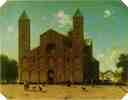
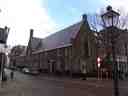
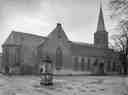
What you are actually looking at today is just a fraction of the original St. Mary's Church, also known as Mariakerk. Check your screen to see an eighteen forty drawing of the grand church just before its final demolition. Back in the eleventh century, this was one of the finest Romanesque buildings in the Netherlands. Romanesque architecture is known for its massive, fortress-like scale and thick semi-circular arches.
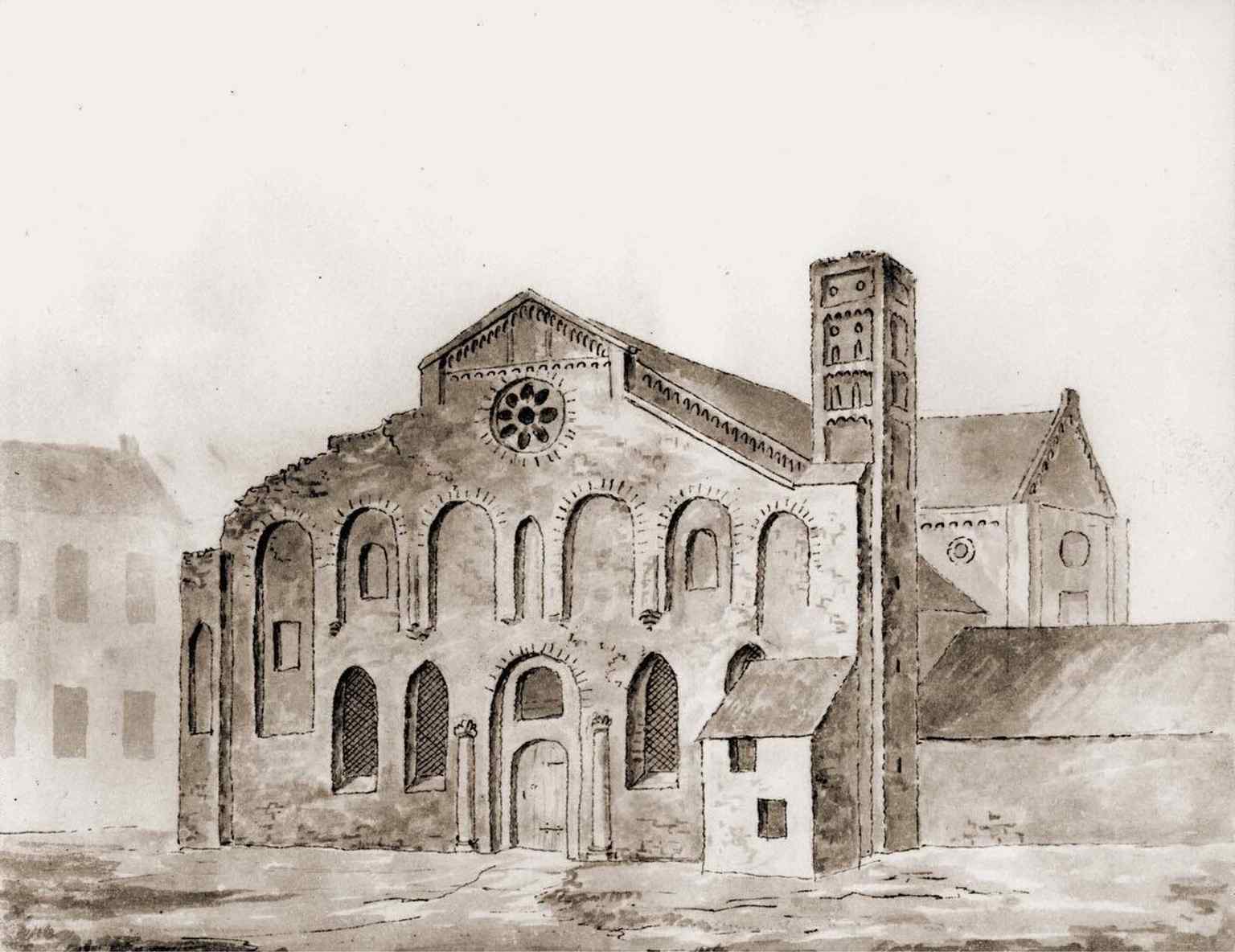
This 1840 drawing illustrates St. Mary's Church from the southwest, offering a glimpse of its appearance shortly before its final complete demolition in 1844, when only the Gothic choir remained.Photo: Frans Nicolaas Marius Eijck van Zuylichem, Wikimedia Commons, Public domain. Cropped & resized. The story begins with Emperor Henry the Fourth and Bishop Conrad of Utrecht. They founded the church together as a bold symbol of the Emperor's power. By ten ninety-nine, the builders finished the choir, and the project seemed destined for glory. But things took a violent turn... That same year, unknown attackers murdered Bishop Conrad. With the Bishop dead, construction ground to a complete standstill.
Decades passed. Finally, after eleven thirty-three, builders returned to the site, but they brought a radically different vision. They constructed the nave, which is the long central approach to the main altar, in the Lombard style. This gave the church a gorgeous Italian appearance that you simply could not find anywhere else north of the Alps. It was incredibly unique.
Sadly, the magnificent church faced a brutal downfall. During a military siege in fifteen seventy-six, enemy cannon fire blasted the north tower to rubble. Then, in eighteen thirteen, Emperor Napoleon Bonaparte delivered the fatal blow. He ordered his men to tear down the church simply so he could sell the stone and timber for cash. By eighteen forty-four, the main building was entirely wiped off the map.
So, how did anything survive? Take a look at your app to see the tranquil modern cloister. A cloister is a covered, arched walkway that traditionally encloses a square courtyard. This beautiful stone corridor managed to survive Napoleon's wrecking crews for one simple reason. At the time of the demolition, the cloister technically belonged to the territory of the Old Catholic Church, which legally protected it from destruction.
Today, the cloister rests quietly behind the Utrecht Conservatory, a surviving piece of a vanished empire. If you want to explore the space, keep in mind it is generally open from ten A-M to five P-M most weekdays.
Take a moment to soak this in. When you're ready, we can head to the next stop.
You are standing in Mariaplaats, a wide open square paved with patterned bricks, lined with ornate multi-story brick facades, and anchored by a prominent, classic stone water pump…Read moreShow less
Open dedicated page →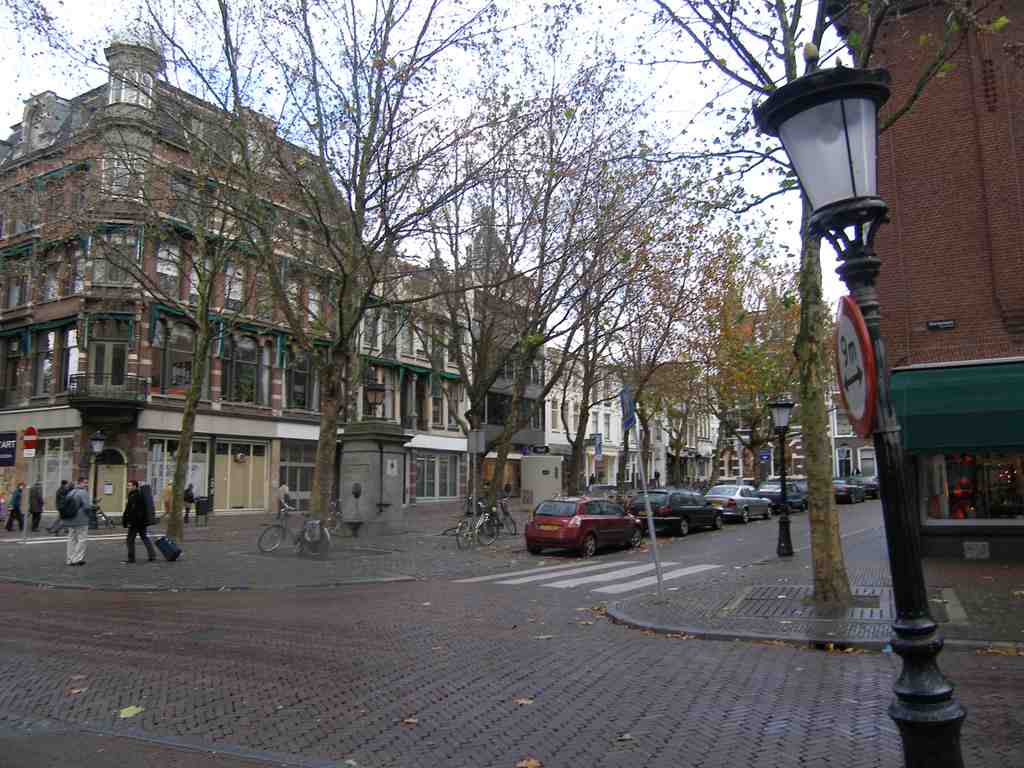
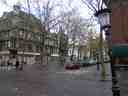
MariaplaatsPhoto: Japiot, Wikimedia Commons, CC BY 3.0. Cropped & resized. You are standing in Mariaplaats, a wide open square paved with patterned bricks, lined with ornate multi-story brick facades, and anchored by a prominent, classic stone water pump right near the center. Just a few minutes ago we explored the remains of Saint Mary's Church, and believe it or not, this entire plaza is actually the ghostly footprint of that massive vanished complex!
For centuries, the land you are standing on was split into two completely different worlds. One part was an immunity, a special zone governed by church law where high-ranking priests lived in grand houses away from the common folk. The other part, starting way back in thirteen ninety-one, was a chaotic, bustling public market. Imagine cows mooing, merchants shouting over piles of colorful rags, and farmers hawking fresh fruit.
Glance at your screen for a moment to see how that public energy continues today. The square frequently hosts major gatherings and protests, like this modern environmental demonstration featuring an incredible ice sculpture of a polar bear.
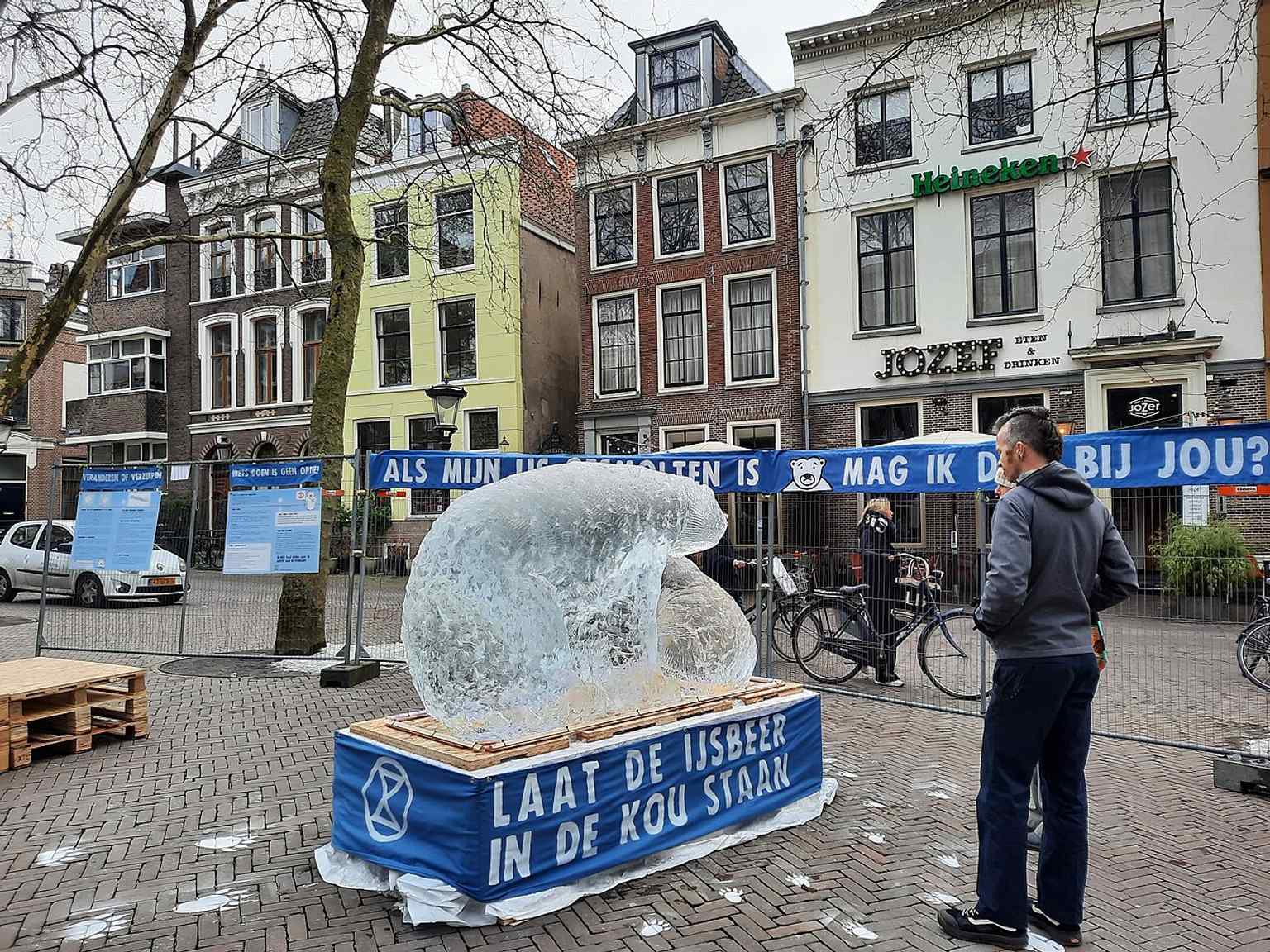
The Mariaplaats, a historic market square, hosts a protest featuring an ice sculpture of a polar bear, reflecting its continued use as a public gathering space for various events.Photo: Ciell, Wikimedia Commons, CC BY 4.0. Cropped & resized. Now, look back at that stone water pump we noticed earlier. That is the Saint Maria Pump, a protected national monument, and it holds a delicious secret. Back in the day, the groundwater right here was widely considered the absolute best in the Netherlands. It was so pristine and sweet that wealthy citizens in Amsterdam actually paid to have it shipped to them by boat, and elite beer brewers demanded it for their premium recipes.
But right alongside that pure drinking water was something a little less refreshing. Beneath the pavement lies a massive medieval sewer system. When developers finally decommissioned those old drains in nineteen fifty-eight, an ingenious city official actually built a sort of periscope, a peeping tube, so curious pedestrians could safely peer down into the ancient subterranean tunnels.
This plaza perfectly preserves the layered echoes of solemn priests, noisy merchants, and incredibly thirsty brewers. Take your time to soak in the atmosphere... and whenever you are ready to keep exploring, we can stroll over to our next destination.
On your right is a massive, square brick tower featuring tall, pointed arched windows and a curious, small domed structure capping its flat roof. Welcome to the Buurkerk, the…Read moreShow less
Open dedicated page →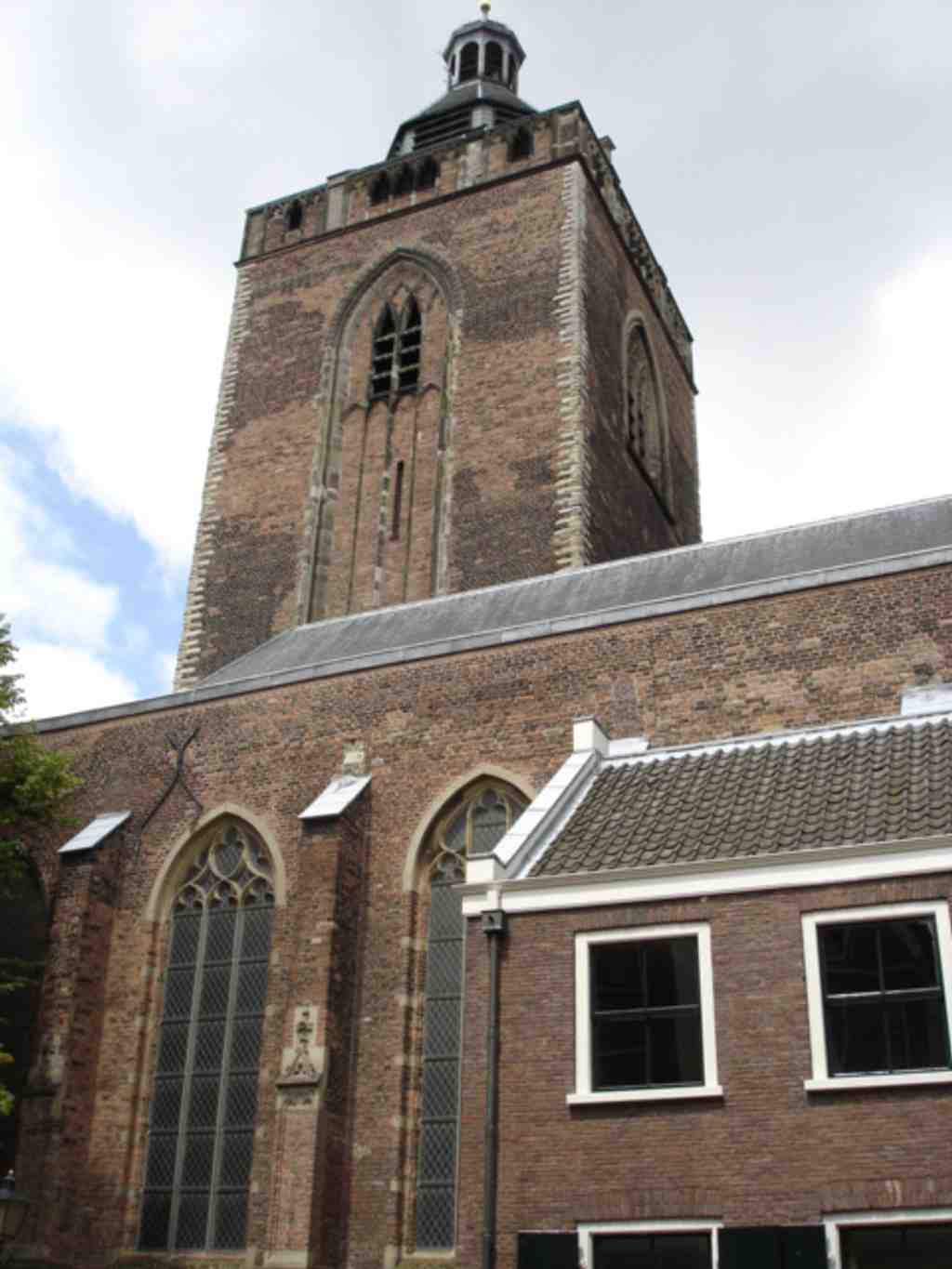
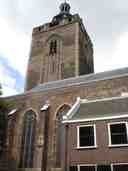
BuurkerkPhoto: Pepijntje, Wikimedia Commons, CC BY-SA 3.0. Cropped & resized. On your right is a massive, square brick tower featuring tall, pointed arched windows and a curious, small domed structure capping its flat roof. Welcome to the Buurkerk, the oldest of the four medieval parish churches in Utrecht!
This place began in the tenth century right in the middle of a bustling trade district. For hundreds of years, this was the absolute heartbeat of the city. It was not just a place of worship. The local trade guilds, which were powerful medieval associations of craftsmen like bakers and blacksmiths, set up their own altars right inside. The church even held two sets of bells. It had sacred church bells, but it also held the secular city bells. The city used the ban-bell to announce public executions and council decisions, while the wake-bell told the guards when to open and close the city gates.
But look up at that tower. The builders started it around thirteen seventy, and they had grand ambitions. They planned to build a towering, eight-sided lantern on top, just like the famous Dom tower nearby. But those plans never materialized. Instead, the builders capped it with a temporary roof. If you check your app, you can see a close-up of that temporary top, which has stubbornly survived since thirteen eighty-eight. Sometimes, temporary solutions really do last forever.
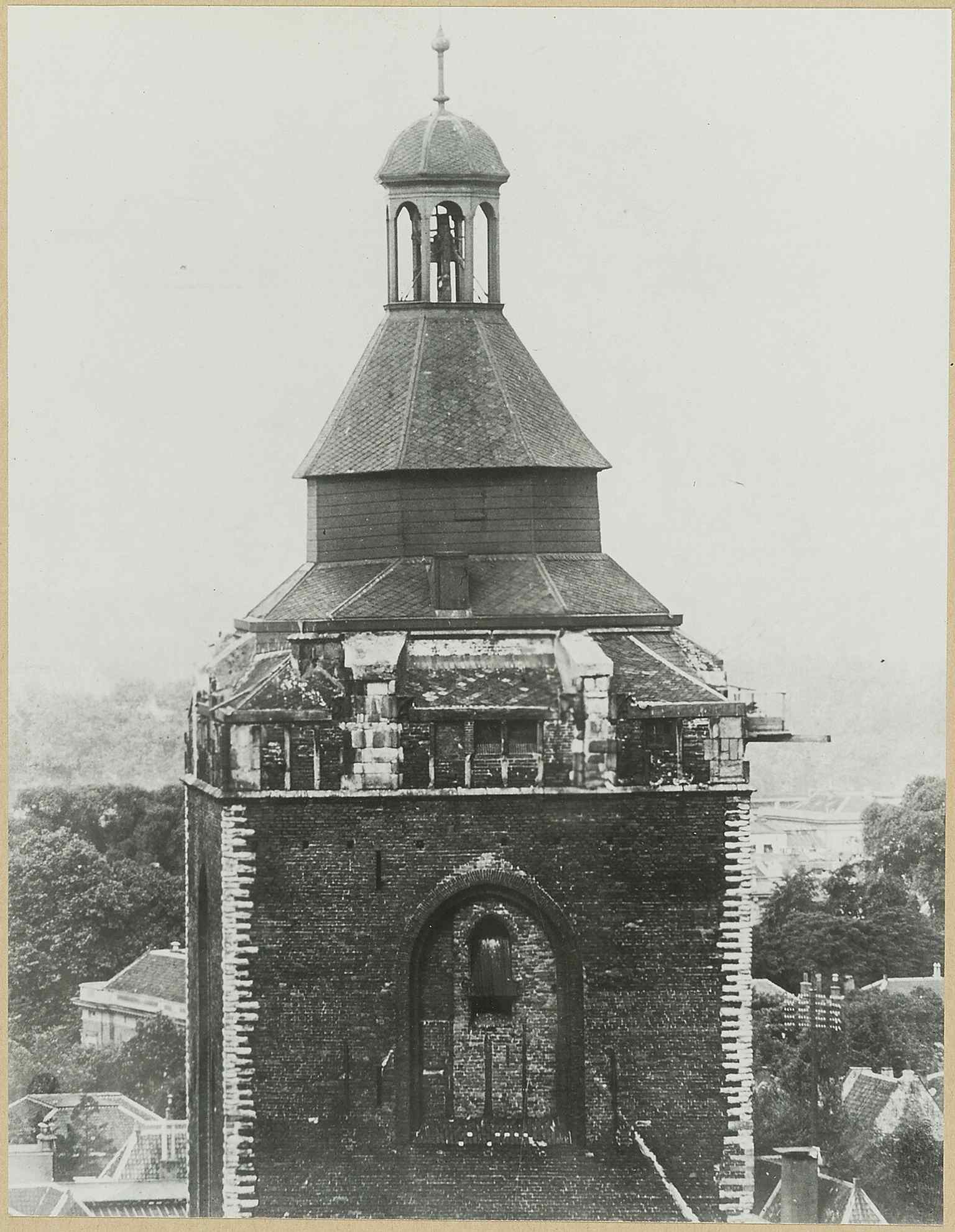
This detail of the Buurkerk tower highlights its 'temporary' top, as original plans for a taller, Domtoren-like structure were never realized.Photo: Unknown authorUnknown author, Wikimedia Commons, CC BY-SA 4.0. Cropped & resized. The Buurkerk holds some truly wild stories. In fourteen fifty-seven, a woman named Berta Jacobsdochter, better known as Sister Bertken, decided to leave the outside world entirely. She asked the builders to wall her into a tiny cell right inside the church. She lived entirely enclosed in that little room for fifty-seven years, writing beautiful poetry and prose until she died at the age of eighty-seven.
The church also had a bit of a traffic problem. By fifteen eighty-six, the locals had developed a terrible habit. Instead of walking around the massive building, people just drove their carts and horses directly through the choir, the large eastern section of the church where the priests usually sang. The city got so tired of the chaos that they simply demolished the entire choir to build a proper street.
Over the centuries, the Buurkerk survived massive city fires, a devastating summer storm in sixteen seventy-four that ripped off the roof, and French soldiers who used the holy space to store hay and bake bread. Since nineteen eighty-four, the building has held a totally different kind of magic, as the national museum of self-playing musical instruments. Have a look at your screen to see a fascinating comparison showing a seventeenth-century Smith's Guild memorial board, spanning the transformation from a historic church into a lively musical clock museum.
The museum has its own operational schedule, but you can admire this incredible exterior twenty-four hours a day, seven days a week. It is amazing how a building can completely transform its purpose over a thousand years. Enjoy the lively atmosphere, and when you are ready, let's head to the next stop.
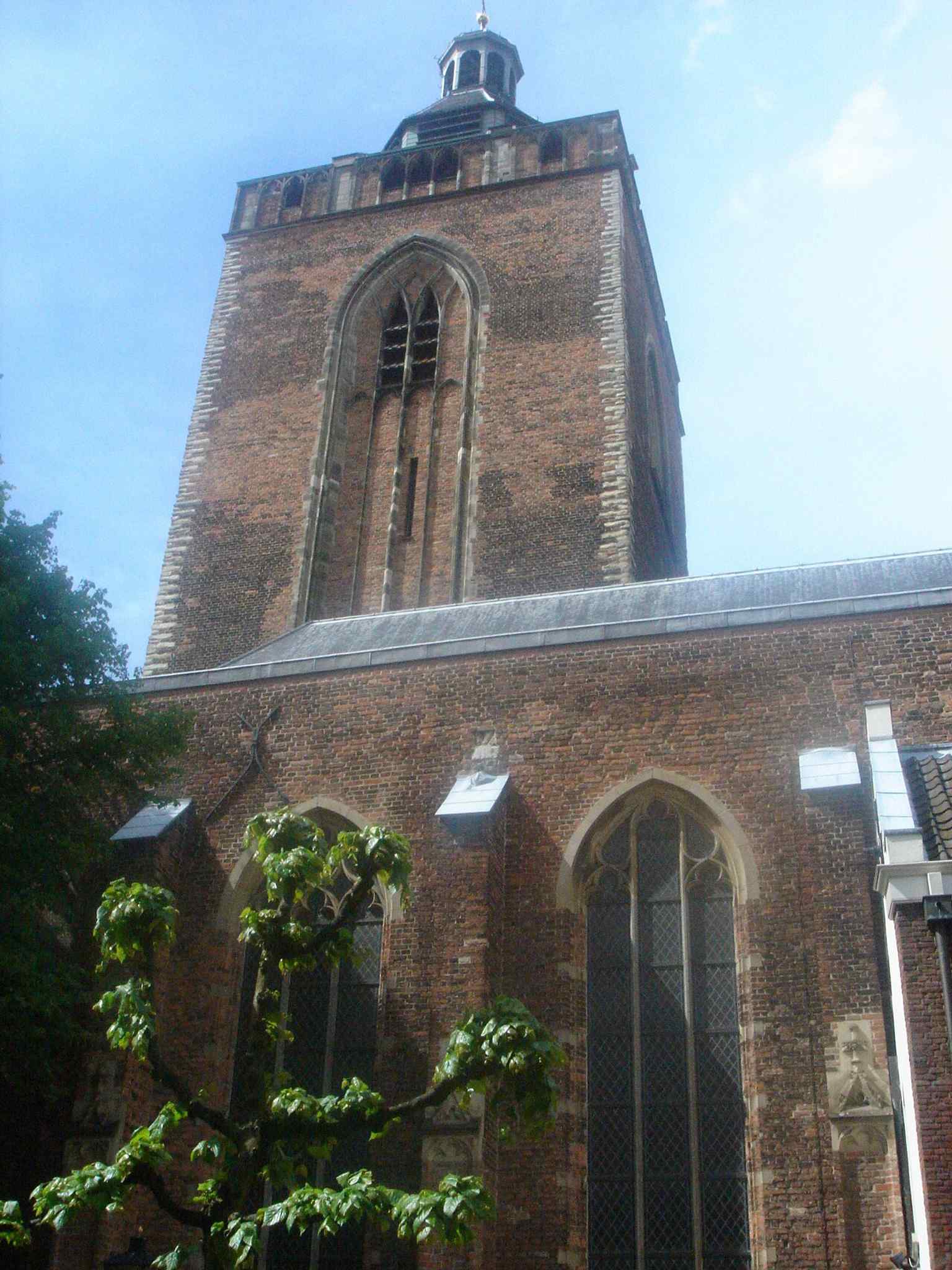
This contemporary exterior view of the Buurkerk shows the building as it houses the Museum Speelklok today, formerly the oldest parish church in Utrecht.Photo: Pepijntje, Wikimedia Commons, CC BY-SA 3.0. Cropped & resized. 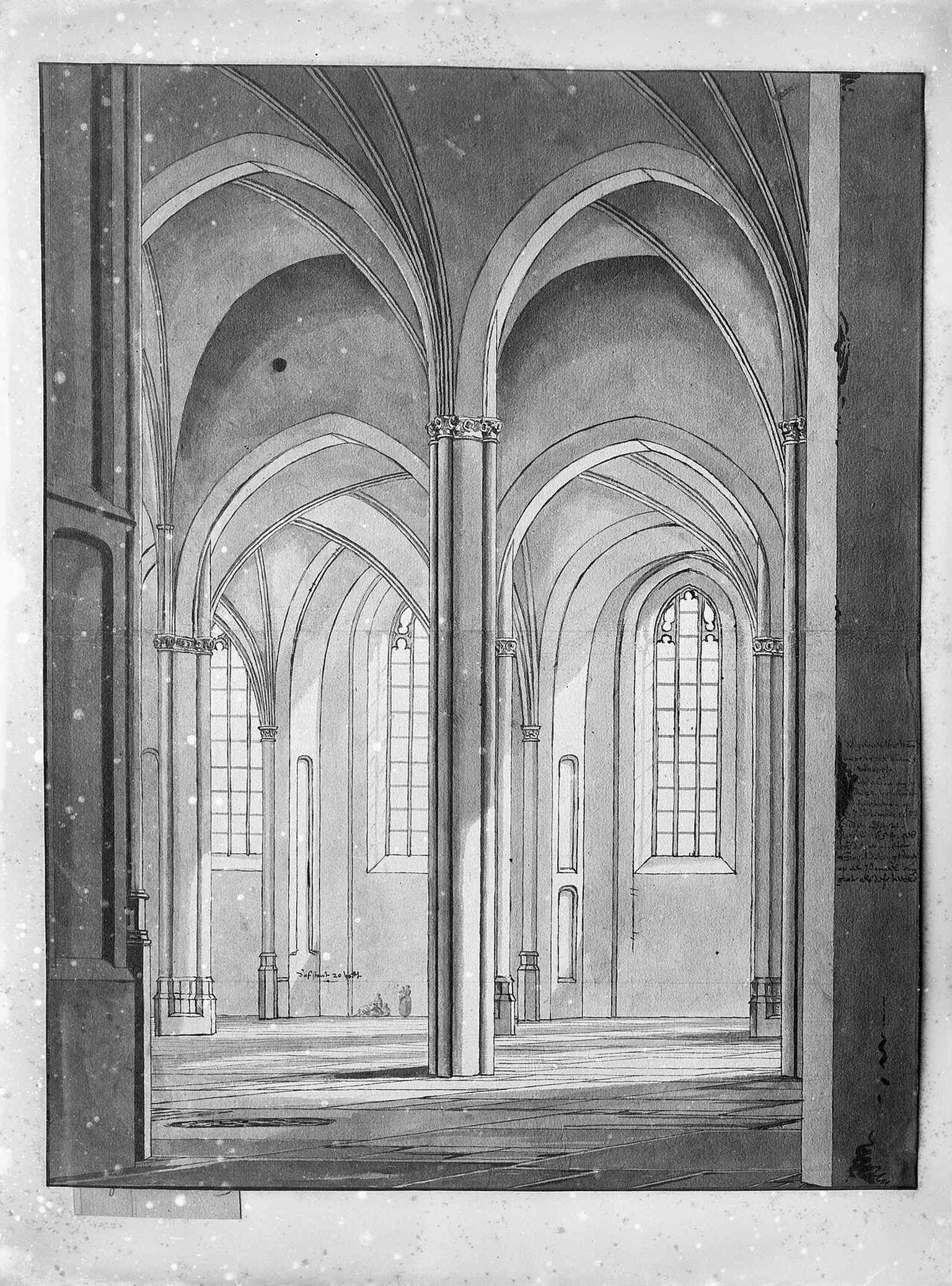
This historical artwork, based on a drawing by Pieter Jansz. Saenredam, provides a rare glimpse into the church interior before its extensive transformations.Photo: Unknown authorUnknown author, Wikimedia Commons, CC BY-SA 4.0. Cropped & resized. 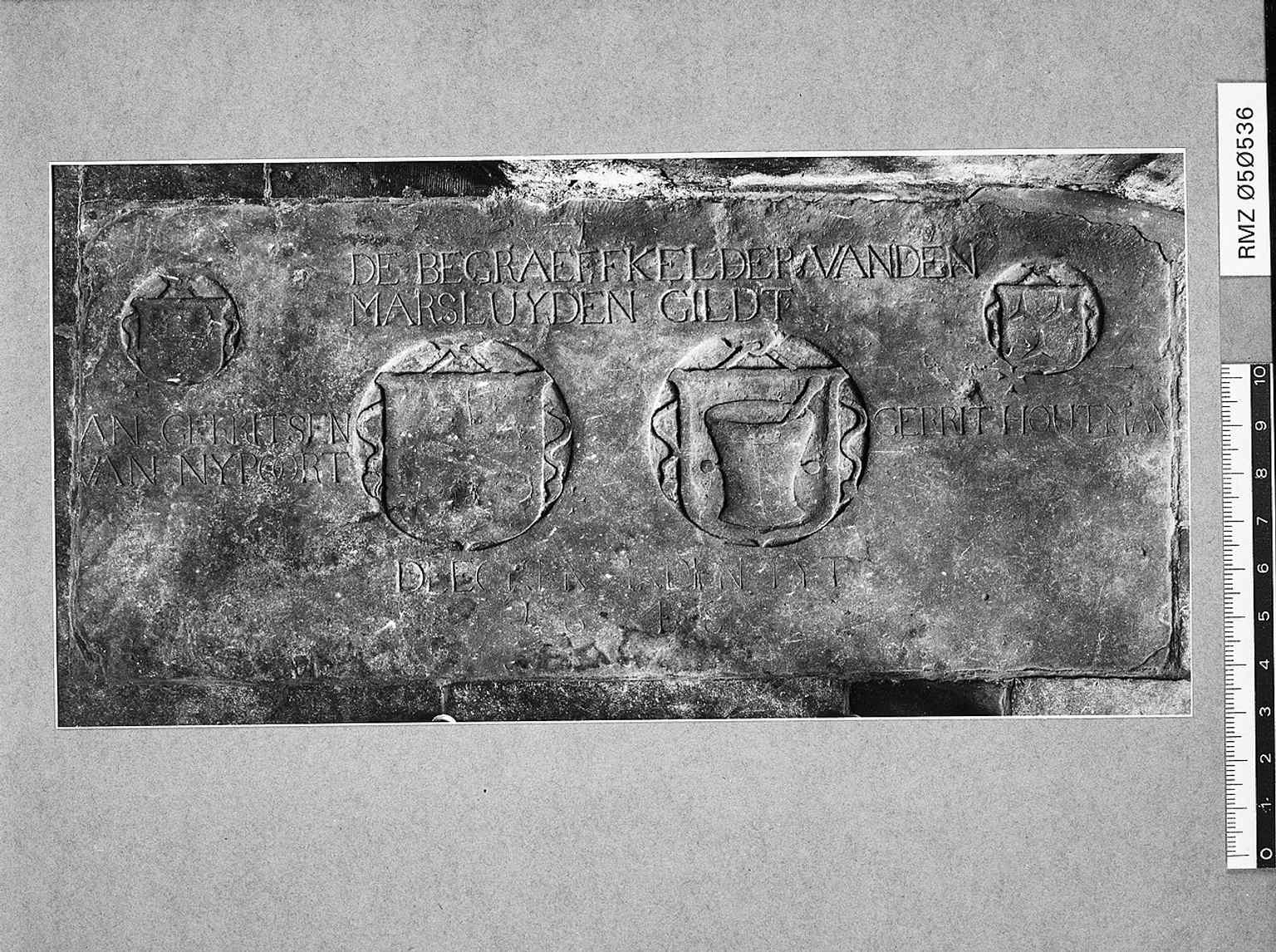
A gravestone belonging to the Market Bell Ringers' Guild, connecting to the church's significant bell collection which included both city and church bells.Photo: G.Th. Delemarre, Wikimedia Commons, CC BY-SA 4.0. Cropped & resized. 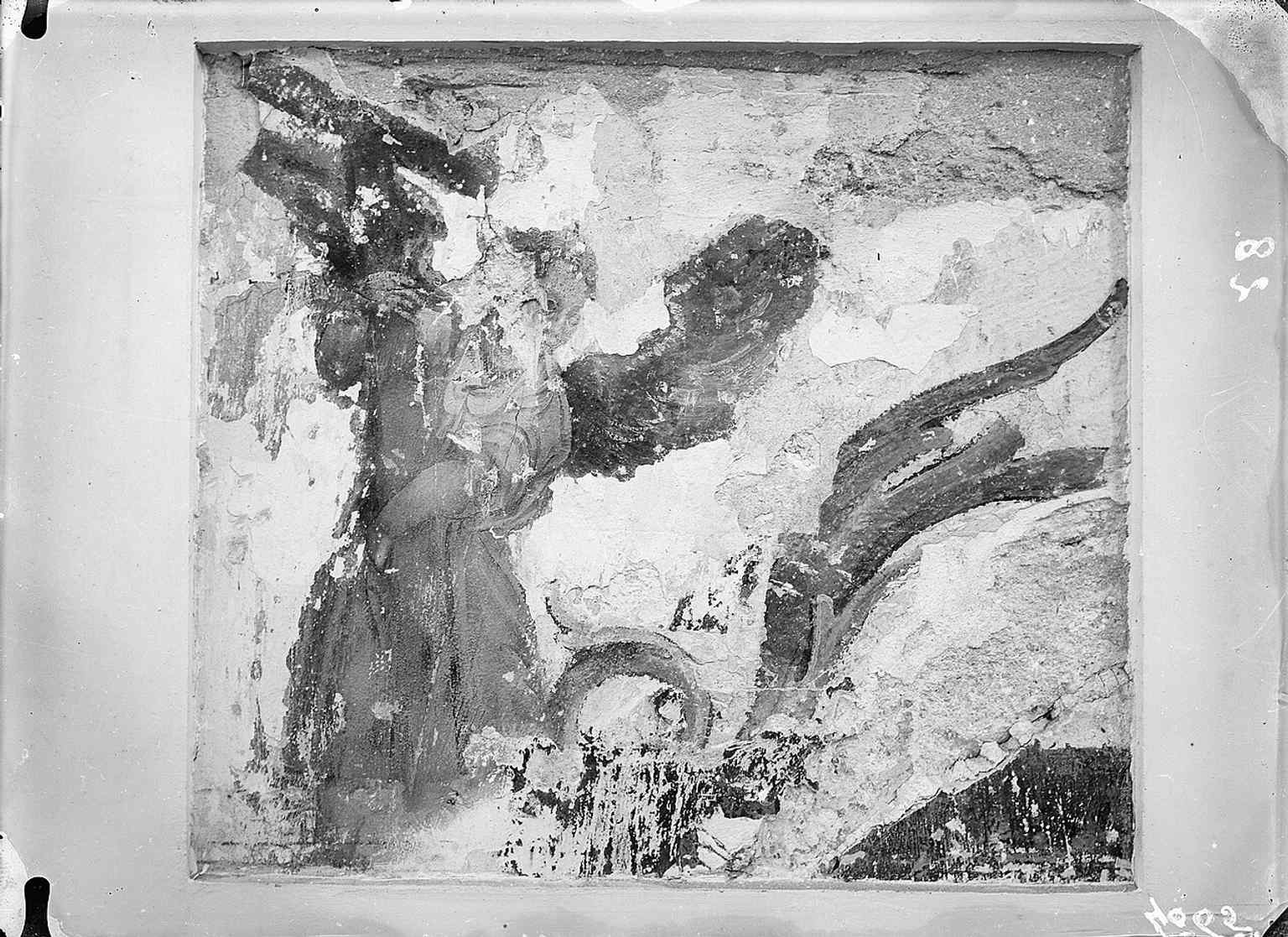
One of the 15th and 16th-century murals, showing an 'Angel with cross', still visible in the church and reminding visitors of its original religious function.Photo: Unknown authorUnknown author, Wikimedia Commons, CC BY-SA 4.0. Cropped & resized. 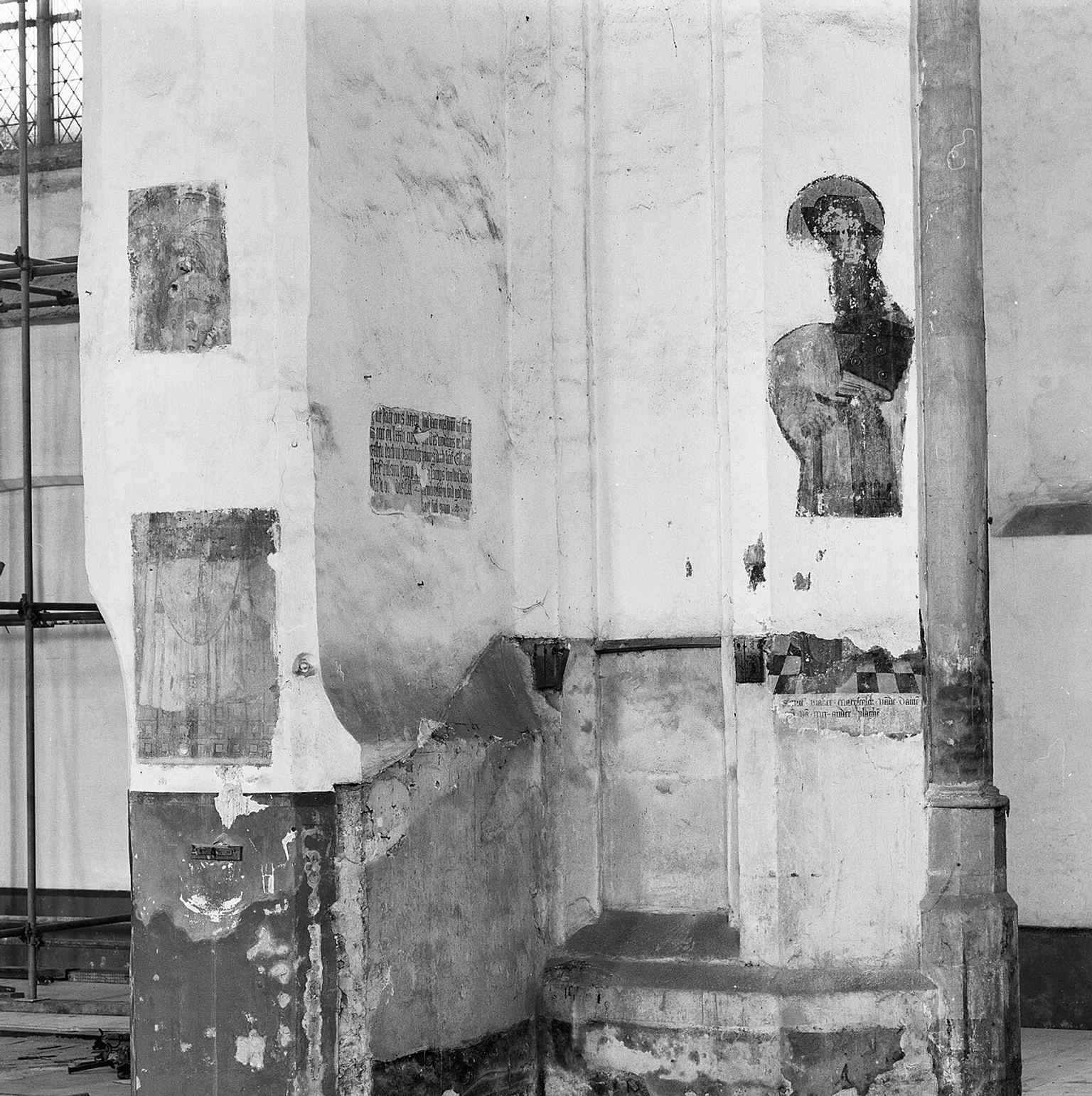
Further detail of the historical murals, a testament to the church's rich interior embellishment before its conversion into a museum.Photo: Ton Schollen, Wikimedia Commons, CC BY-SA 4.0. Cropped & resized. 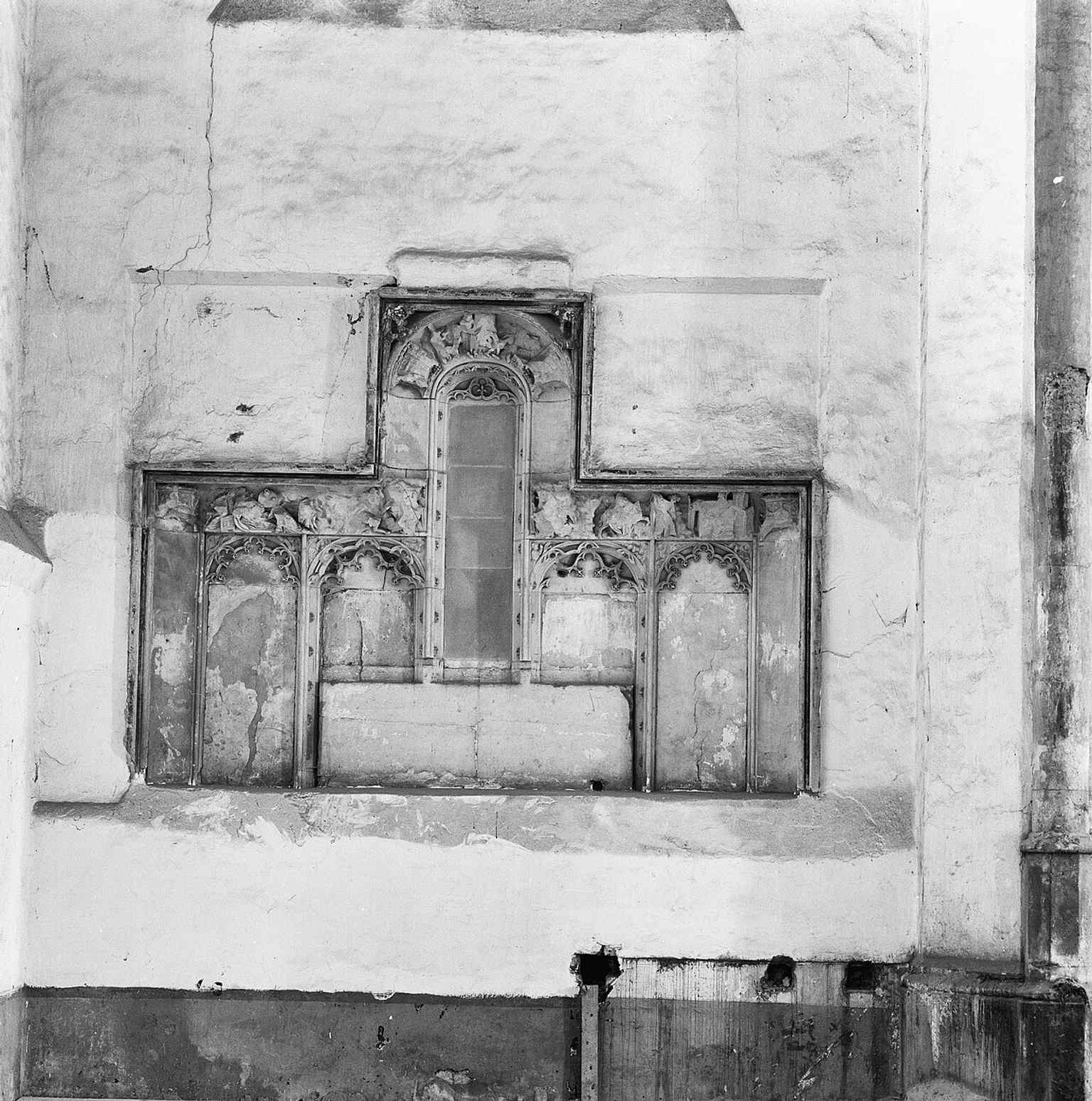
An altar retable that hints at the church's grand interior, which was extensively beautified with additions like an organ and a copper choir screen between 1456 and 1499.Photo: Ton Schollen, Wikimedia Commons, CC BY-SA 4.0. Cropped & resized. 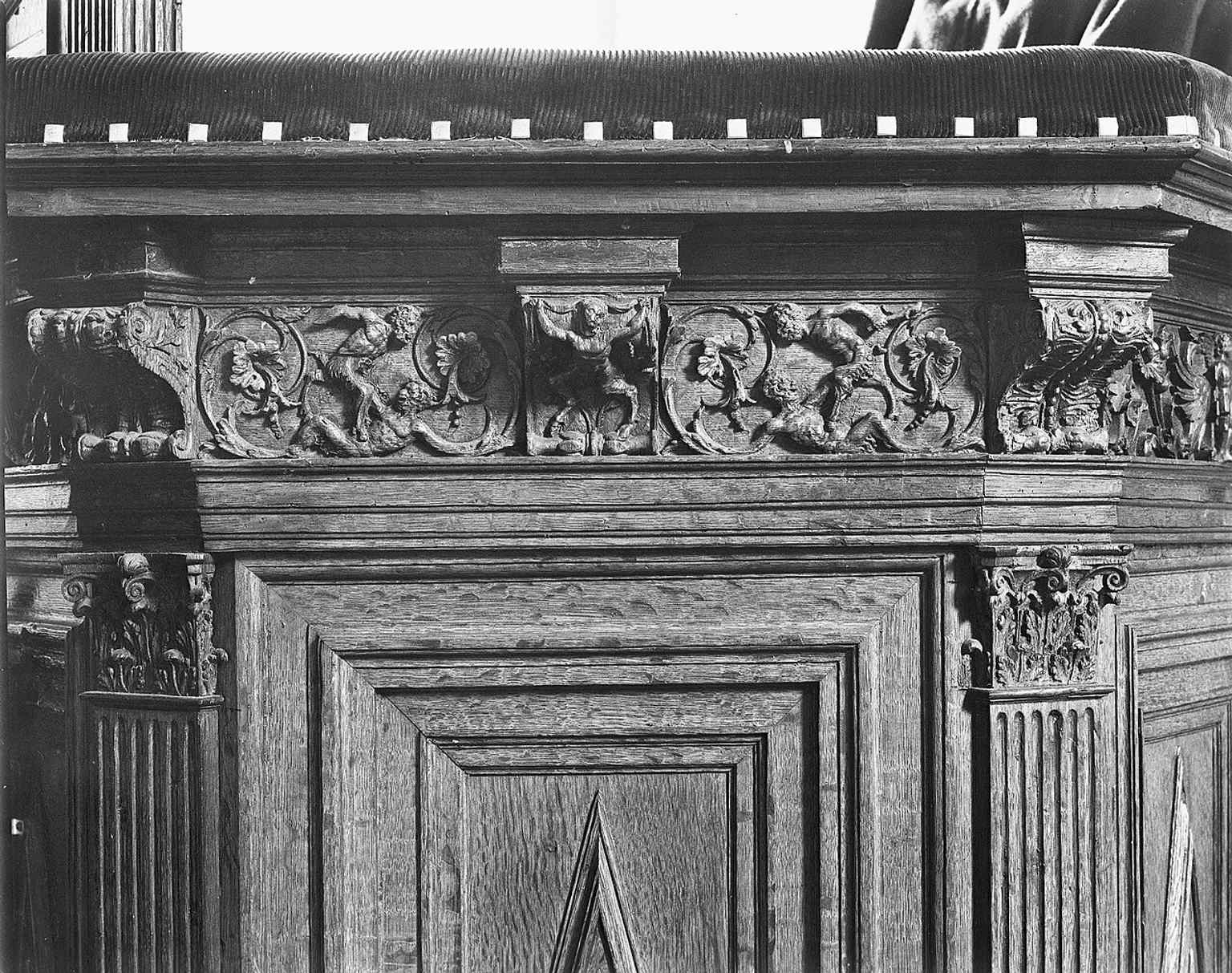
An ornate detail from the pulpit frieze, showcasing the elaborate craftsmanship found within the church during its historical use.Photo: G.Th. Delemarre, Wikimedia Commons, CC BY-SA 4.0. Cropped & resized. 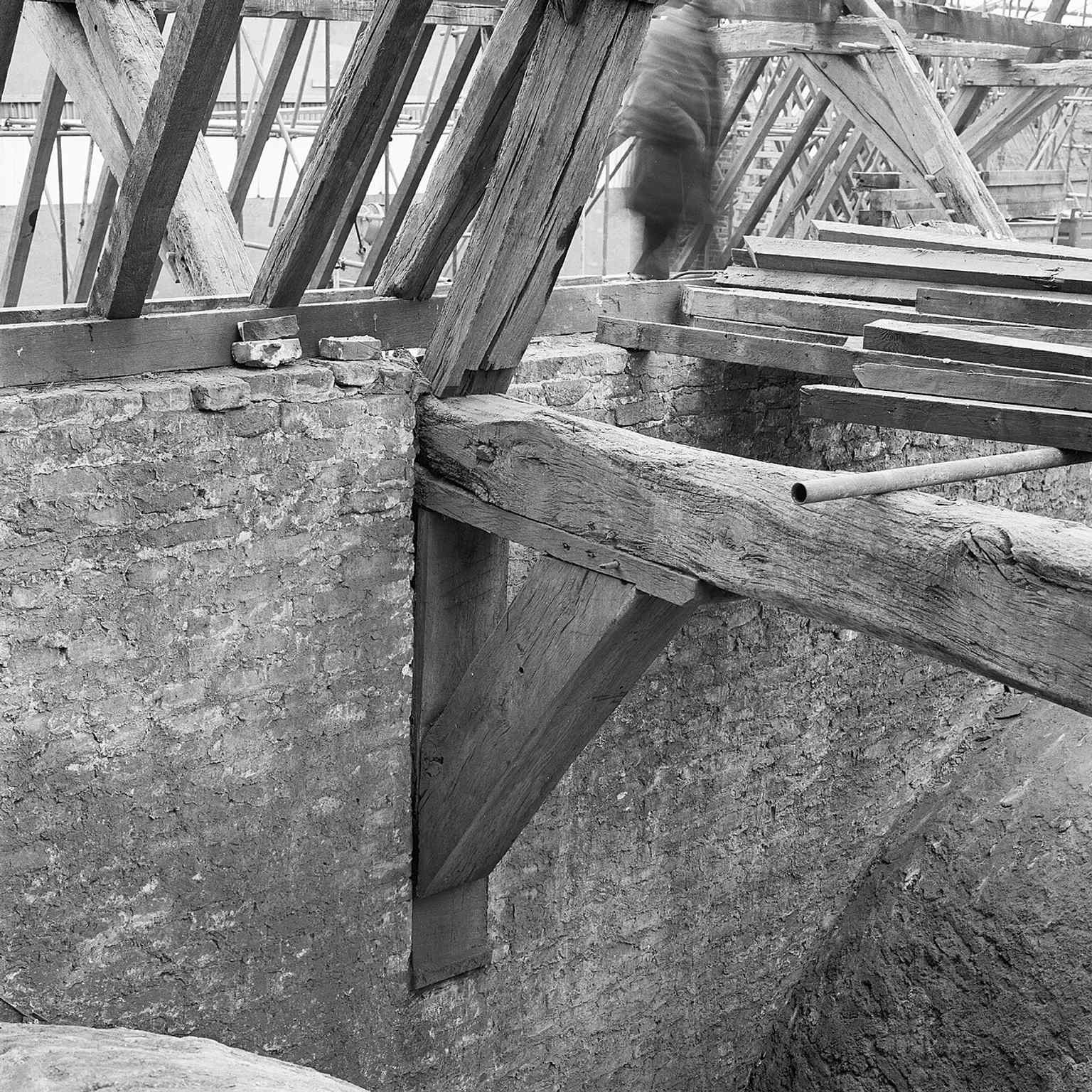
This exposed tie beam illustrates the building's historical construction, with the original medieval roof being destroyed in the 1674 summer storm and replaced by three lower ones.Photo: Ton Schollen, Wikimedia Commons, CC BY-SA 4.0. Cropped & resized. 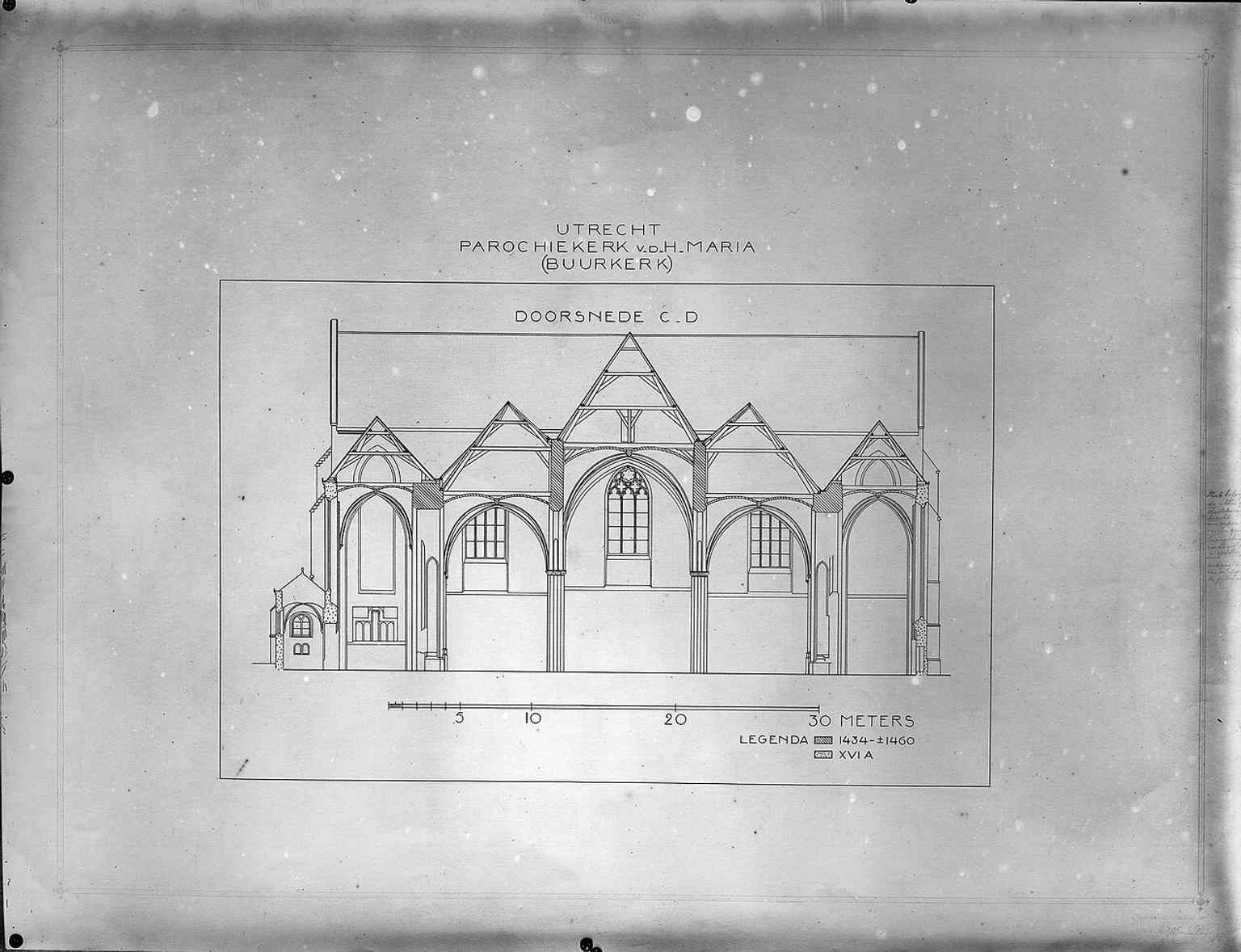
A 1923 cross-section drawing provides insight into the architectural structure of the church, which was rebuilt several times after fires and expanded into a three-aisled hall church.Photo: Unknown authorUnknown author, Wikimedia Commons, CC BY-SA 4.0. Cropped & resized. 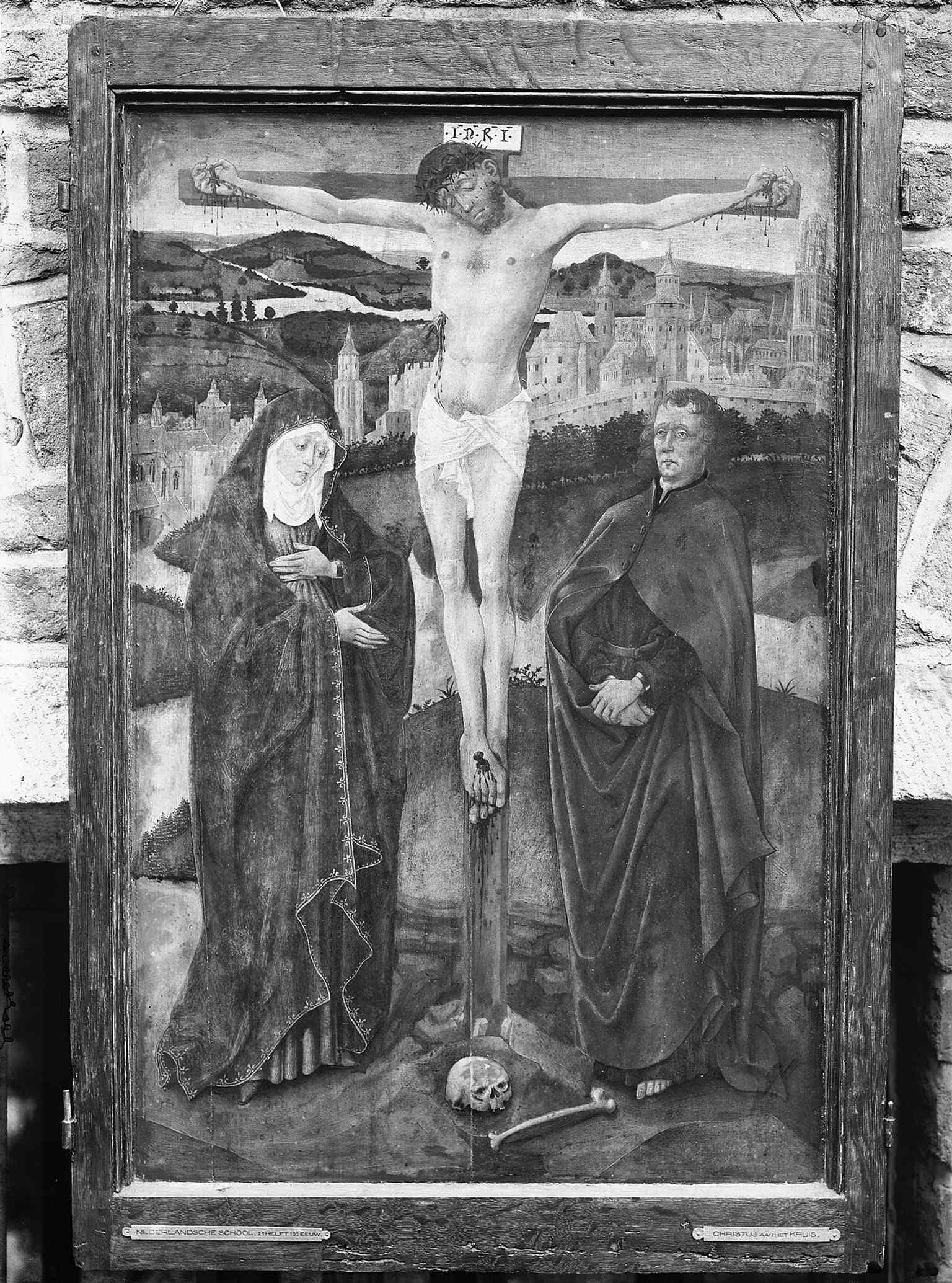
This 15th-century Dutch triptych features the Buurkerk and Domtoren in the background, showcasing its appearance in the city centuries ago.Photo: Unknown authorUnknown author, Wikimedia Commons, CC BY-SA 4.0. Cropped & resized.
Show 11 more stopsShow fewer stopsexpand_moreexpand_less
Look for the sturdy arched wooden door set inside a light stone frame, topped by a classic triangular peak and a small golden crown and hammer floating right above the entrance.…Read moreShow less
Open dedicated page →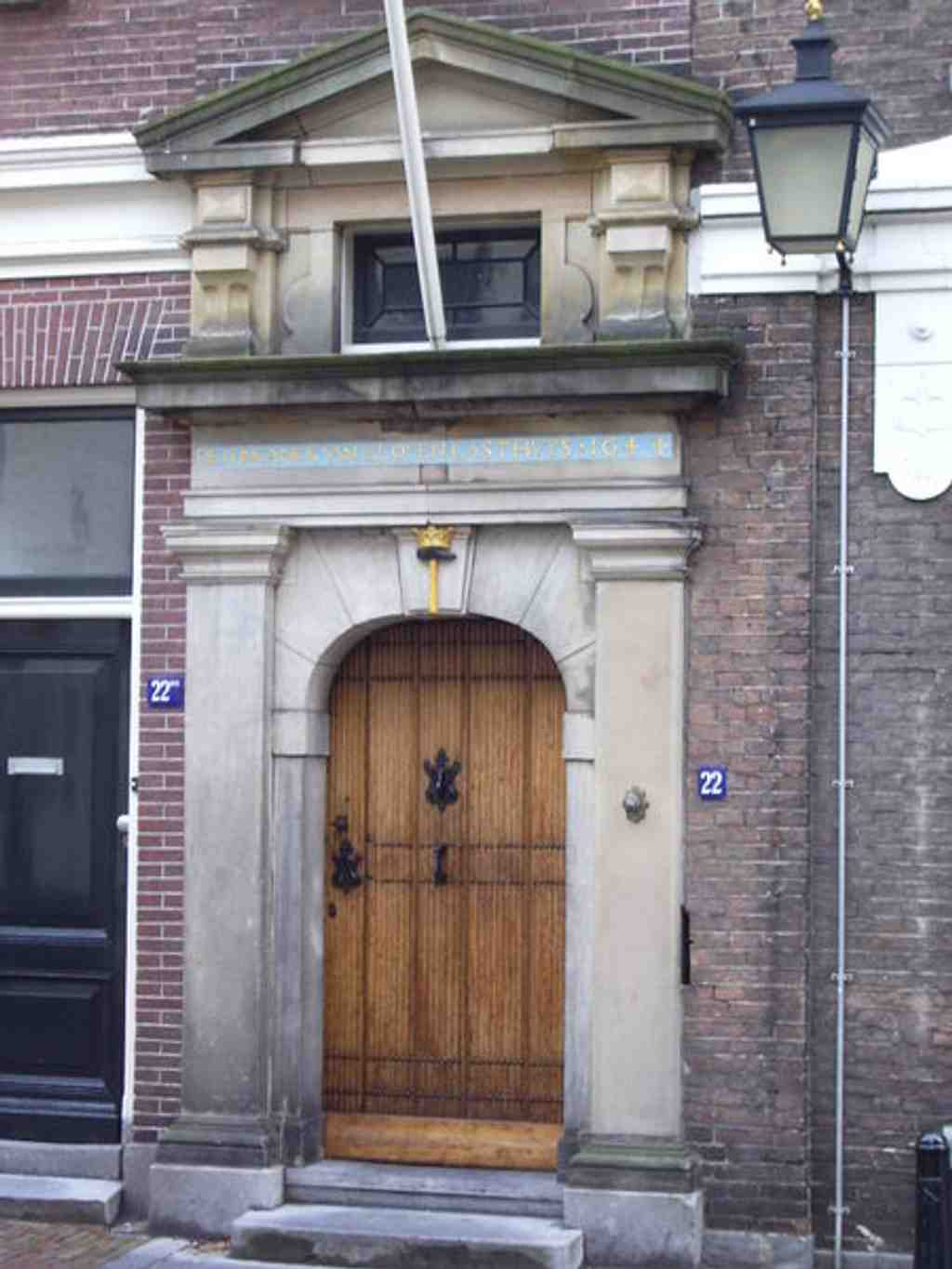
St. Eloy's HospicePhoto: User:Dosmit, Wikimedia Commons, CC BY-SA 3.0. Cropped & resized. Look for the sturdy arched wooden door set inside a light stone frame, topped by a classic triangular peak and a small golden crown and hammer floating right above the entrance. You are standing in front of Saint Eloy's Hospice, the home of the very last surviving medieval guild in the entire Netherlands.
Back in the Middle Ages, guilds were powerful associations of craftsmen who essentially controlled their trades. The Guild of Smiths was an absolute heavyweight. It included everyone from heavy-hitting blacksmiths and weapon forgers to delicate gold and silver smiths. They controlled the local market, enforced strict quality standards, and trained members step by step from raw apprentices up to master craftsmen. They were a massive political force, too.
But they also took exceptional care of their own. In fourteen forty, the guild bought this exact property on Boterstraat to create a hospice. It was a safe haven designed to lodge and care for aging, poverty-stricken smiths and their widows. It was effectively a medieval forerunner to mutual medical and funeral insurance. You can take a quick peek at your screen to see how this beautiful gate has stood firm while the street around it modernized over the last century.
The real question is, how did this specific guild survive when every other guild vanished?
For that, we have to thank a spectacular bureaucratic loophole. In seventeen ninety-eight, Napoleon Bonaparte abolished all guilds across the lands he conquered, effectively wiping out centuries of tradition overnight. The blacksmiths of Utrecht, however, simply crossed out the word guild on their paperwork, officially renamed themselves the Blacksmith Trade Organization, and quietly carried on. Napoleon never noticed, and the brotherhood survived.
Even today, the governing brothers, known as regents, continue the charitable work they started centuries ago. Way back in fifteen seventy-one, a brother named Adriaan Willemszoon van Dashorst left them an inheritance to buy bread for the poor. The guild honored that exact will until nineteen sixty-two, handing out weekly bread coupons to struggling locals.
Inside, past that heavy wooden door, the modern brothers still meet every Monday. They talk, have a drink, and play an old traditional Dutch game called kolf. Check out the image in your app to see their private, centuries-old playing court. Kolf is a bit like a mix between golf and ice hockey, played with heavy curved bats and solid wooden balls. The brothers bought that very court in seventeen thirty, and it even features a beautiful brass inlay in the floor.
This building is a living time capsule, carrying a brotherhood of metalworkers straight through the centuries. Appreciate this rare survivor. When you're ready, we can head to the next stop.
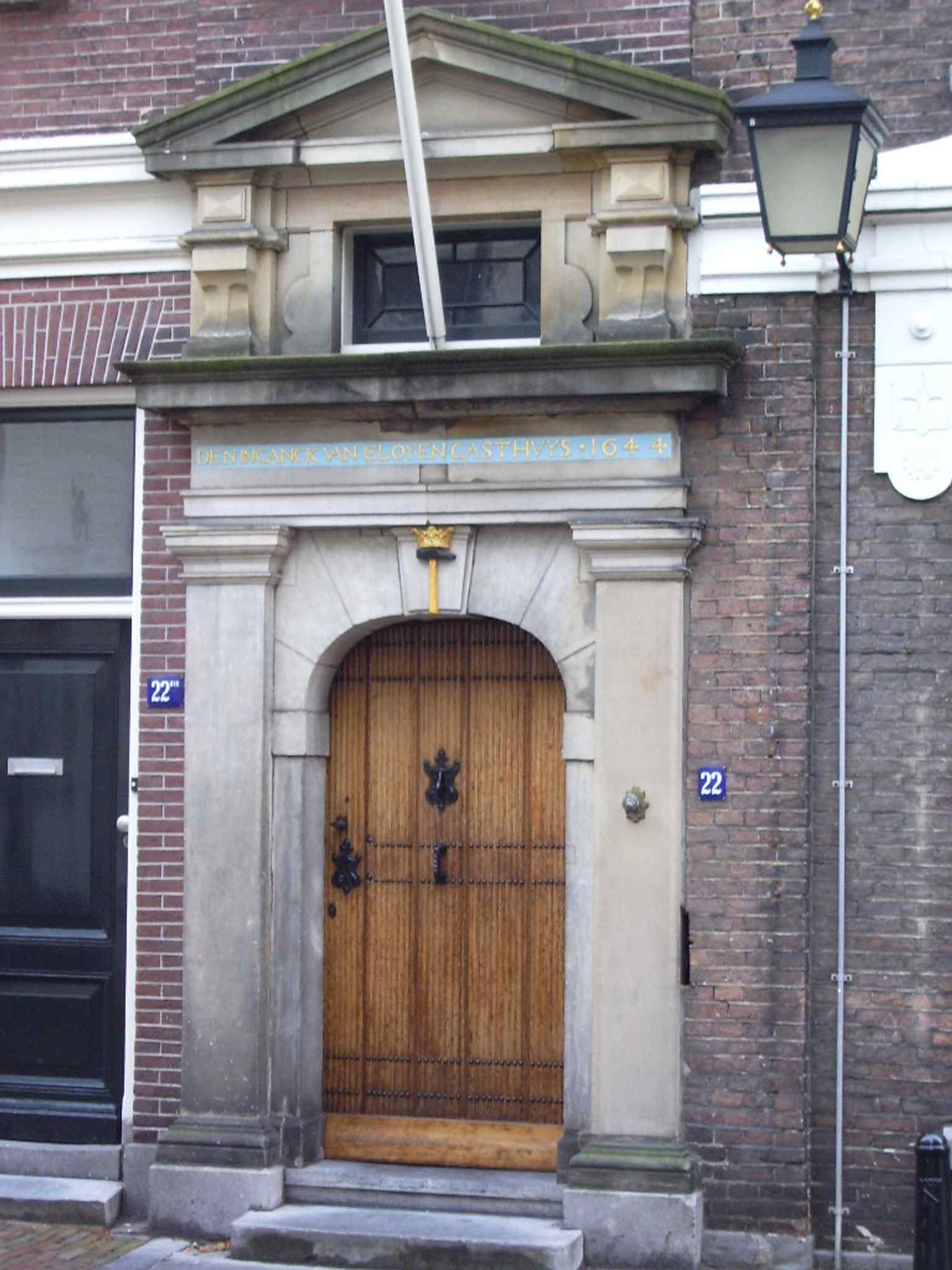
The entrance to St. Eloy's Hospice, a guildhall that has been continuously occupied by the guild of smiths since 1440, surviving even after Napoleon abolished guilds.Photo: T Houdijk, Wikimedia Commons, CC BY-SA 3.0. Cropped & resized. 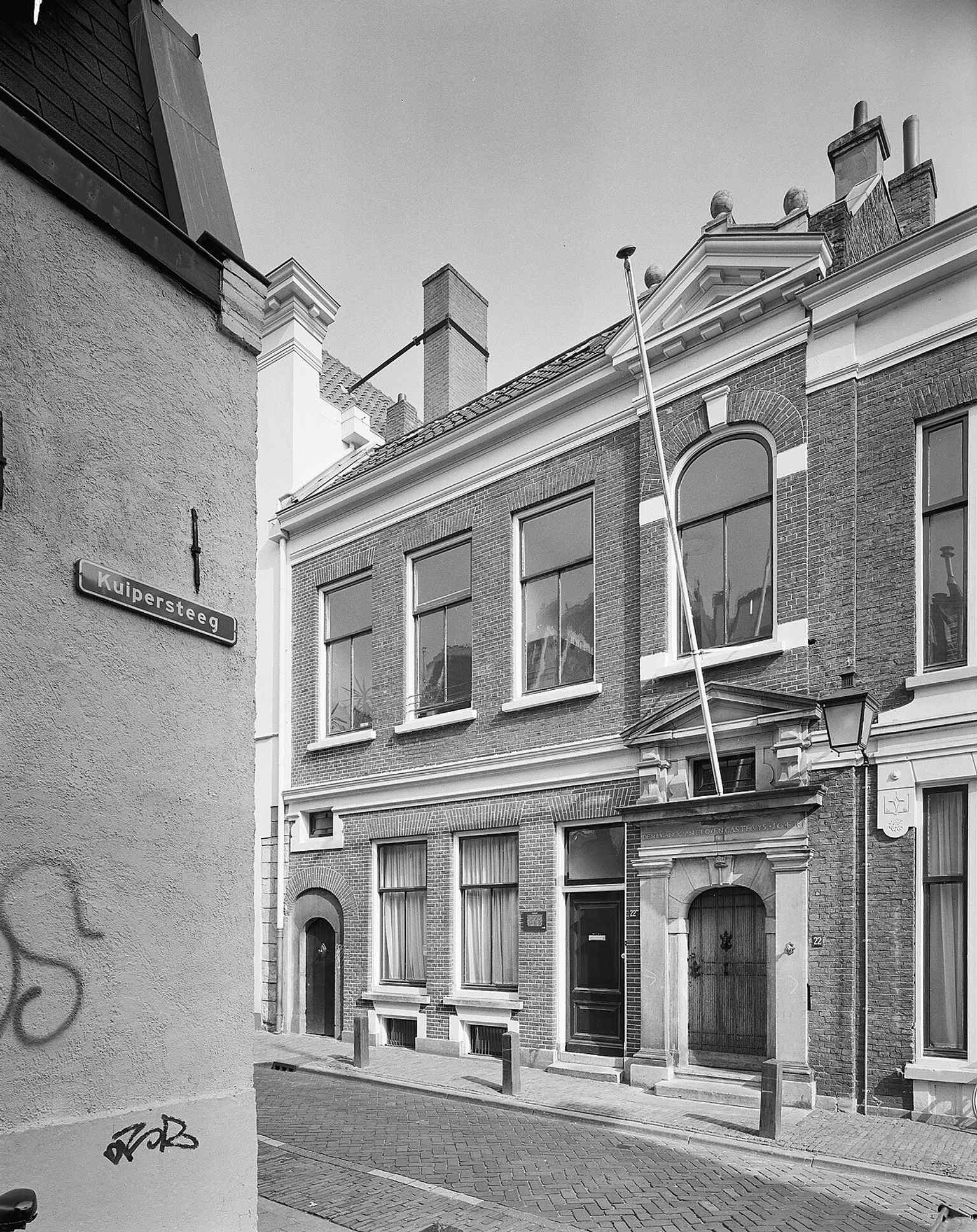
The well-preserved facade of St. Eloy's Hospice, maintained by its governors who adapt to modern demands while preserving its historical and architectural integrity.Photo: A. J. van der Wal, Wikimedia Commons, CC BY-SA 4.0. Cropped & resized. 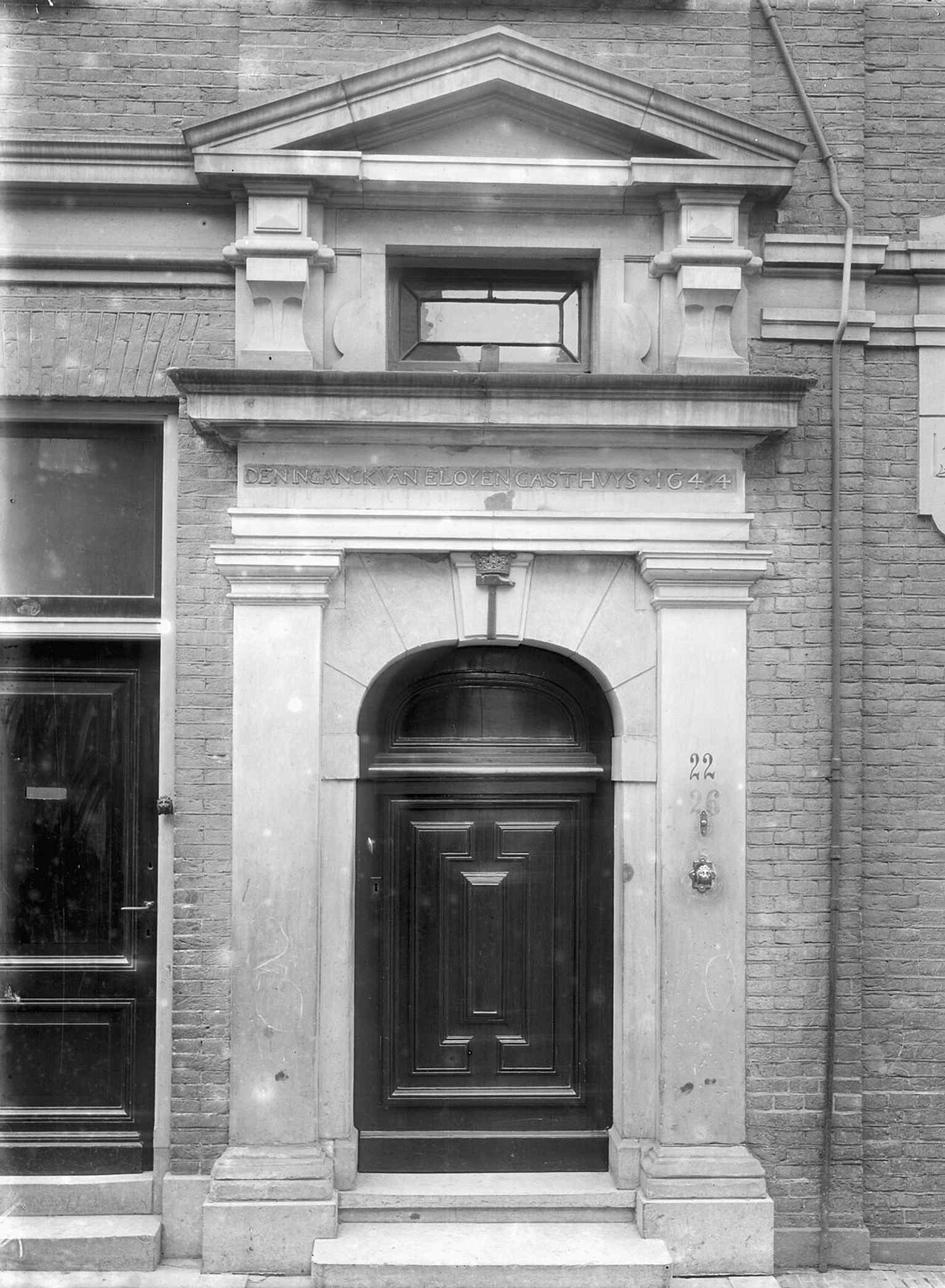
A historical photograph from 1925 of the gate in Boterstraat, where the Guild of Smiths acquired the property for their hospice in 1440 to care for old and infirm members.Photo: Unknown authorUnknown author, Wikimedia Commons, CC BY-SA 4.0. Cropped & resized. On your right is the Duitse Huis, a monumental brick complex marked by its striking stepped gables, a prominent central doorway framed in stone, and tall arched windows that hint…Read moreShow less
Open dedicated page →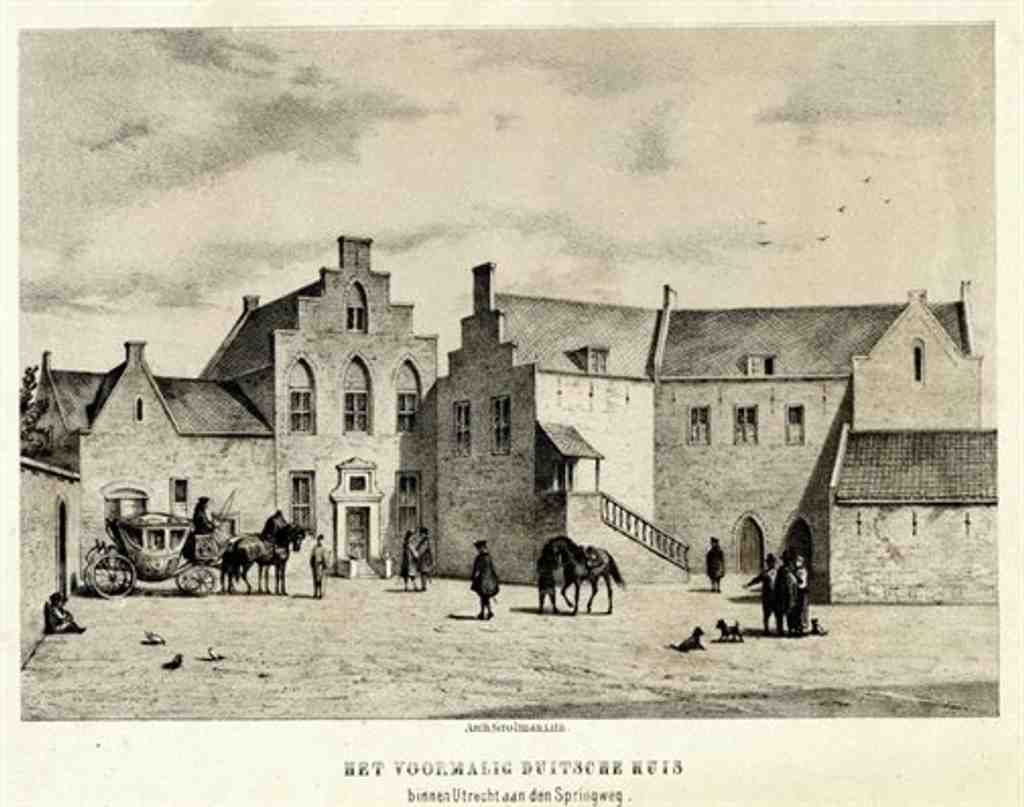
Duitse HuisPhoto: Anthony Grolman uit ca 1880 naar een tekening van Abraham Rademaker uit ca. 1720, Wikimedia Commons, Public domain. Cropped & resized. On your right is the Duitse Huis, a monumental brick complex marked by its striking stepped gables, a prominent central doorway framed in stone, and tall arched windows that hint at its medieval origins.
In thirteen forty-eight, the Bailiwick of Utrecht built this magnificent monastery as their local headquarters. A bailiwick, by the way, is simply a district managed by a commander. The Teutonic Order was a mighty Christian military group, much like the famous Knights Hospitaller. These knights and priests took strict vows of poverty, chastity, and obedience, yet they controlled vast agricultural lands across the Netherlands to fund their military campaigns in the Holy Land and the Baltic region.
Fast forward to fifteen forty-five. Emperor Charles the Fifth visited Utrecht, and the Duitse Huis hosted a spectacular meeting of the Order of the Golden Fleece. Imagine the grand refectory, the massive dining hall where the knights usually ate in silence, suddenly filled with elaborate feasts. Even King Henry the Eighth of England and King Francis the First of France belonged to this prestigious knightly circle. To accommodate these royal VIPs, the main building was heavily upgraded. Gothic windows were converted into bright bay windows, and the ceiling joists were raised to create an awe-inspiring space.
Check your screen for a sixteenth-century painting depicting the fierce land commanders of the order who walked these very halls.
But the political winds shifted drastically. By fifteen eighty, the regional government demanded the dissolution of all Catholic institutions. It seemed the knights would lose everything to the state. However, their commander, Jacob Taets van Amerongen, fought back fiercely. He argued his men were essential for defending the empire with weapons against foreign enemies. The order managed to survive by making a massive ideological compromise, officially converting to Calvinism in sixteen thirty-seven. This incredible tactical move allowed them to keep their property and preserve a staggering archive of historical records, including old charters with wax seals and medieval coins dating all the way back to the start of the thirteenth century.
The complex faced physical threats, too. In sixteen seventy-four, a terrifying windstorm completely ruined the main church, which towered over the surrounding area. Later, in eighteen twenty-three, King William the First transformed the remaining grounds into a highly modern military hospital. Step back over a century to see how the historic courtyard of the land commander's house has weathered the passage of time, capturing the enduring legacy of the Teutonic Order in Utrecht.
After the military finally left in nineteen ninety, the buildings sat empty and were briefly occupied by squatters. But in nineteen ninety-two, the modern descendant of the knightly order repurchased the property. During the massive renovations that followed, archaeologists were stunned to find a Roman cemetery from forty BC buried directly underneath the garden. Talk about layers of history. Workers even uncovered a sandstone fireplace engraved with a double-headed eagle, the personal emblem of Charles the Fifth.
This resilient stone fortress has survived religious upheaval, brutal storms, and military occupation, returning beautifully to its roots of hospitality and care. Take your time soaking in this quiet courtyard, and whenever you are ready, we will head over to our next stop.
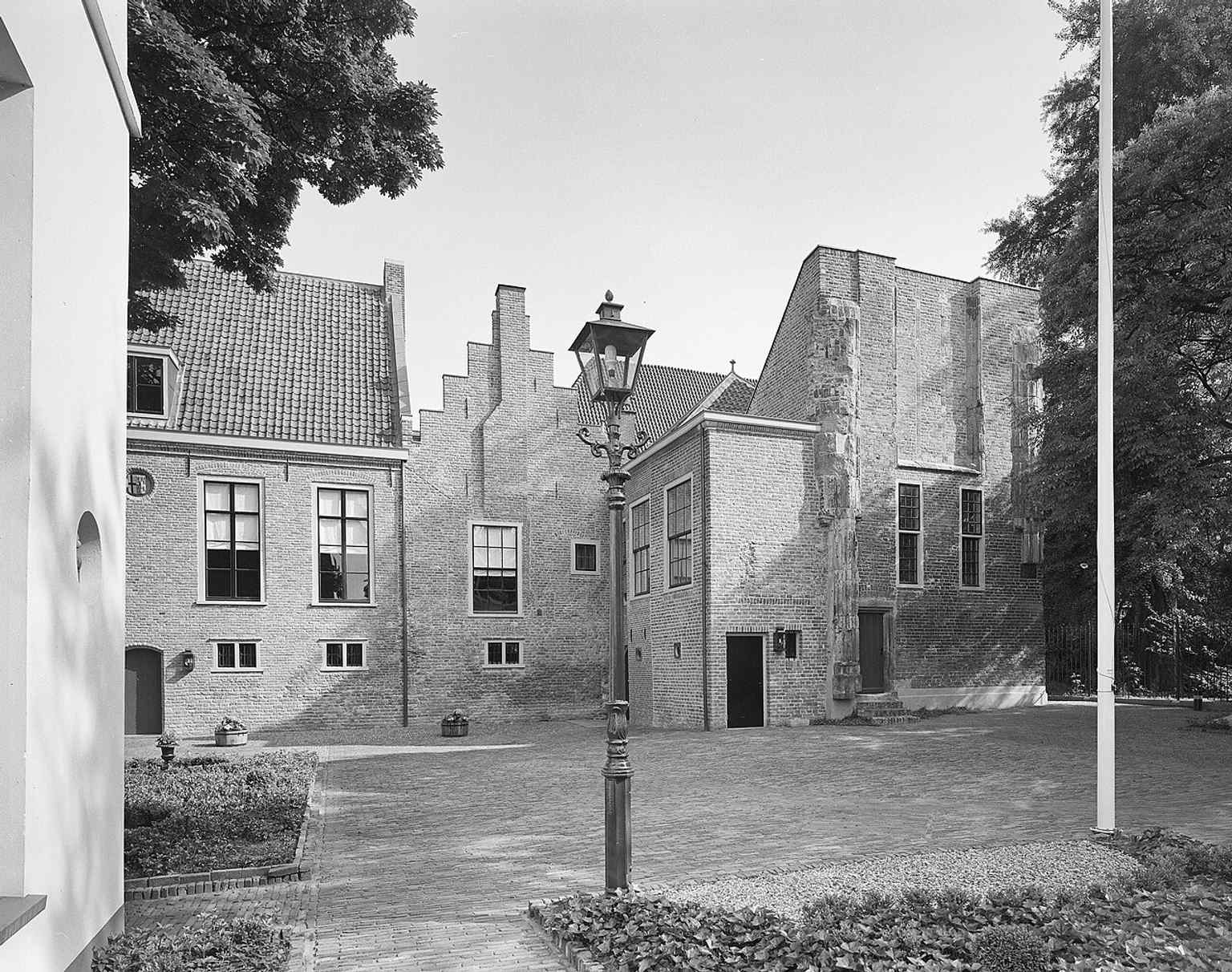
The tranquil inner courtyard and the 15th-century Commander's house, which now serves as the headquarters for the Bailiwick of Utrecht charity.Photo: A. J. van der Wal, Wikimedia Commons, CC BY-SA 4.0. Cropped & resized. Look to your left, and you will spot a long, dark red brick building with a steeply pitched roof and a striking, tall arched gothic window on its right gable. This is the…Read moreShow less
Open dedicated page →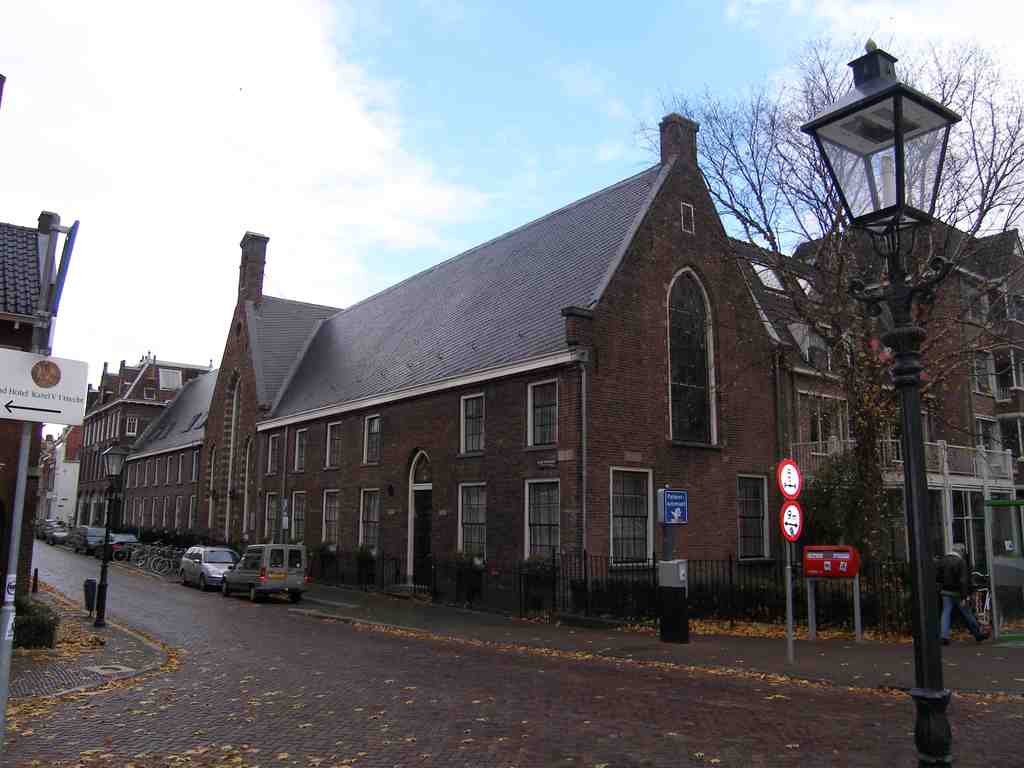
BartholomeïgasthuisPhoto: Japiot, Wikimedia Commons, CC BY 3.0. Cropped & resized. Look to your left, and you will spot a long, dark red brick building with a steeply pitched roof and a striking, tall arched gothic window on its right gable. This is the Bartholomeïgasthuis.
Back in thirteen sixty-seven, this started out as a humble shelter for weary pilgrims and beggars. But it struggled to survive. Then, in thirteen seventy-eight, a wealthy nobleman named Willem van Abcoude stepped in with a massive donation. He completely transformed the place, renaming it the Saint Bartholomeus Gasthuis, and decreed that from then on, it would only take in the sick. Gasthuis essentially means a guest house or hospital, a sanctuary for those with nowhere else to go.
Willem even set up a brotherhood of twenty-three men to guarantee the hospital's future, laying down strict rules in a foundation letter. He also created a charity fund to hand out weekly support to the city's poor. That incredible legacy of care stuck. Up in the structure, there is a bell cast in fourteen seventy-one by Steven Butendycke. It is the second oldest bell in Utrecht, and volunteers still ring it every single day at twelve P-M, exactly as they have for centuries.
By sixteen thirty-two, the hospital added a Regentenzaal, a magnificent boardroom for its directors. A few years later, they commissioned a master weaver from Delft, Maximiliaan van der Gucht, to create four enormous, custom wall tapestries. These tapestries are a unique masterpiece of Dutch weaving history. You can take a peek at your screen to see the elegant interior and its original beamed ceiling. And if you want to see how beautifully those seventeenth-century tapestries have been preserved over the decades, check out the historic before and after comparison in the app.
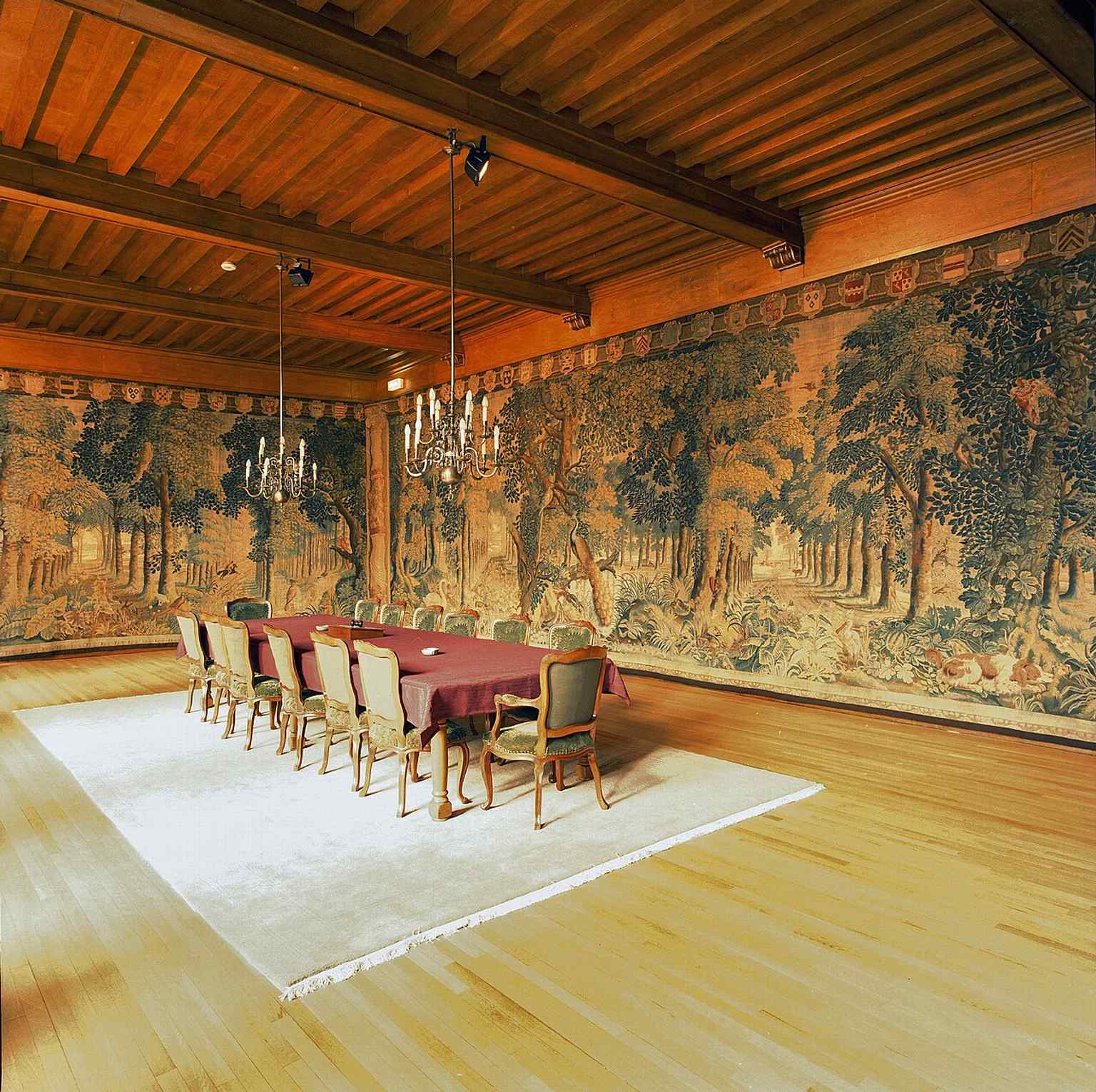
The elegant interior of the Regentenzaal, showcasing its elaborate tapestries and original beamed ceiling, where the regents have met since 1818.Photo: A. J. van der Wal, Wikimedia Commons, CC BY-SA 4.0. Cropped & resized. Everything changed in eighteen eighteen. The King demanded that the local university have a clinical hospital, but the city authorities realized they did not actually have one. Their solution was to force all seven of the city's independent guest houses to merge into this single building. To fit everyone inside, they ripped out the old bed boxes and built an entire new floor right through the middle of the medieval sick ward. That is why the exterior looks the way it does today, though they did leave that lovely gothic window intact.
After dodging the wrecking ball in the nineteen eighties, this remarkable building celebrated its six hundred and fiftieth anniversary in twenty seventeen. The doors are open every day of the week from eight thirty A-M to eight P-M if you ever want to step inside. What an absolute triumph of survival. Reflect on this long legacy of care. When you are ready, let's keep walking.
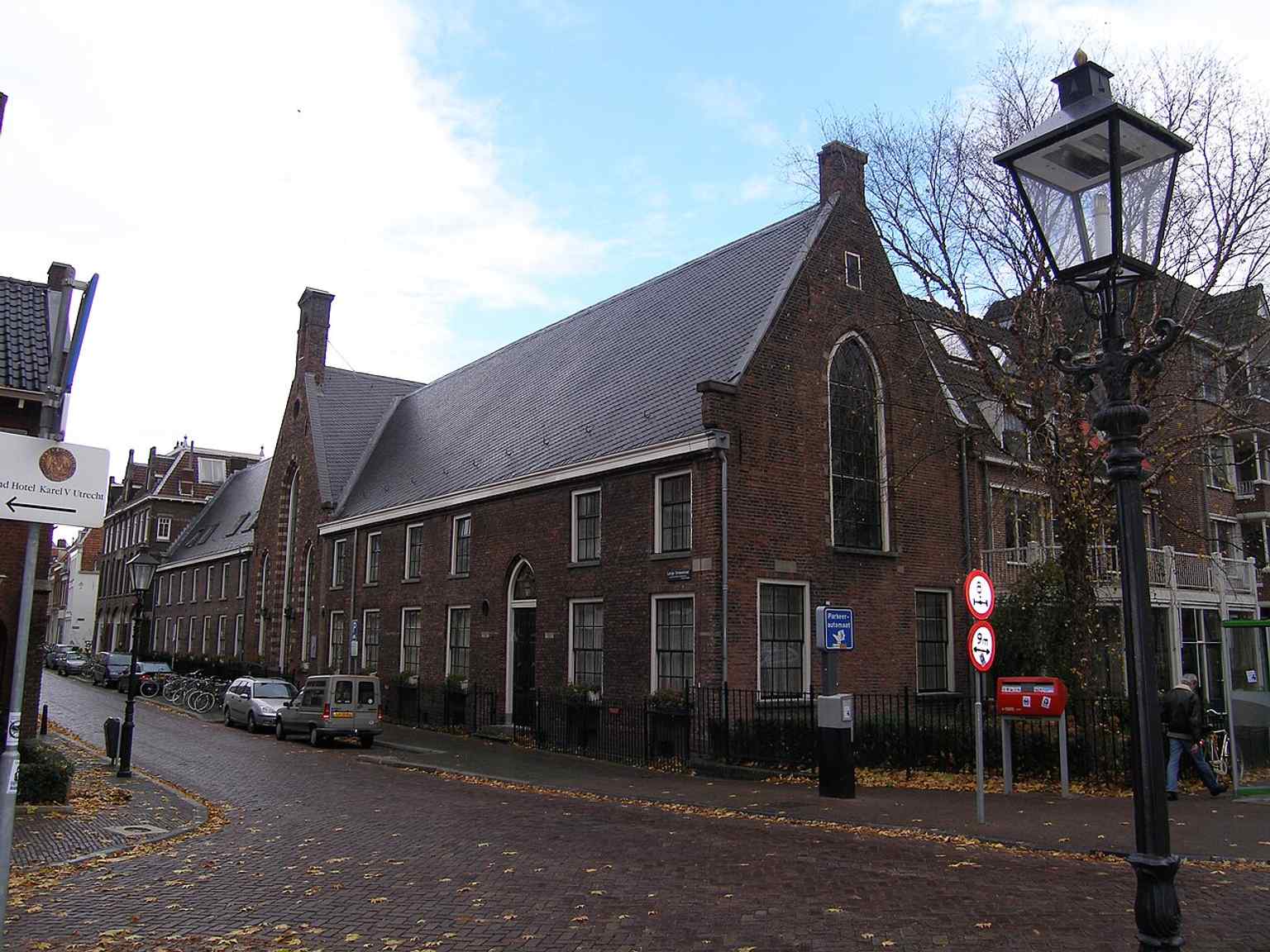
A modern view of the Bartholomeïgasthuis, which celebrated its 650th anniversary in 2017, after significant renovations in the 20th and 21st centuries.Photo: Japiot, Wikimedia Commons, CC BY 3.0. Cropped & resized. 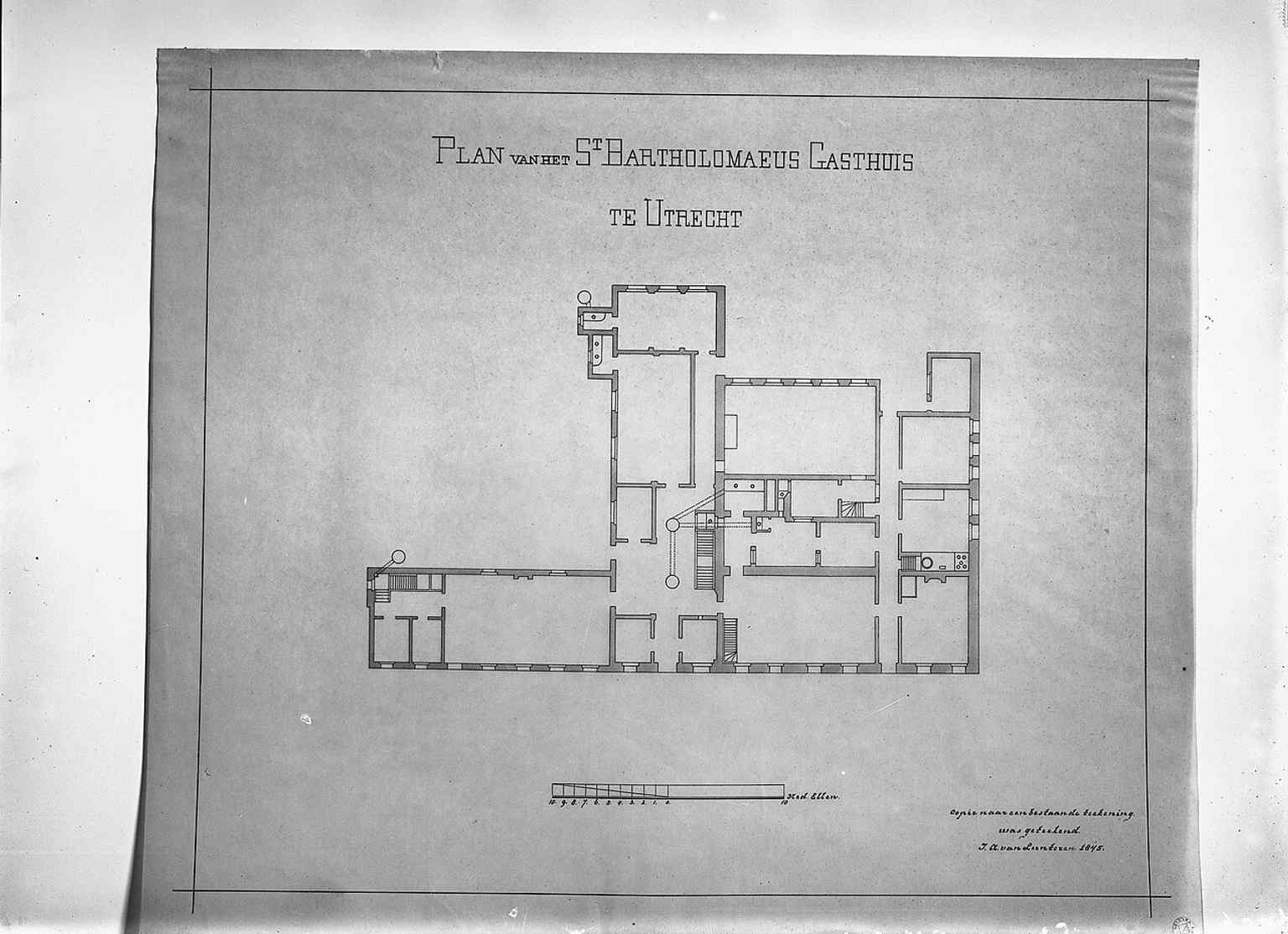
This 1845 blueprint shows the layout of the Bartholomeïgasthuis after its designation as a general gasthuis in 1818, which led to significant internal and external structural changes.Photo: Unknown authorUnknown author, Wikimedia Commons, CC BY-SA 4.0. Cropped & resized. 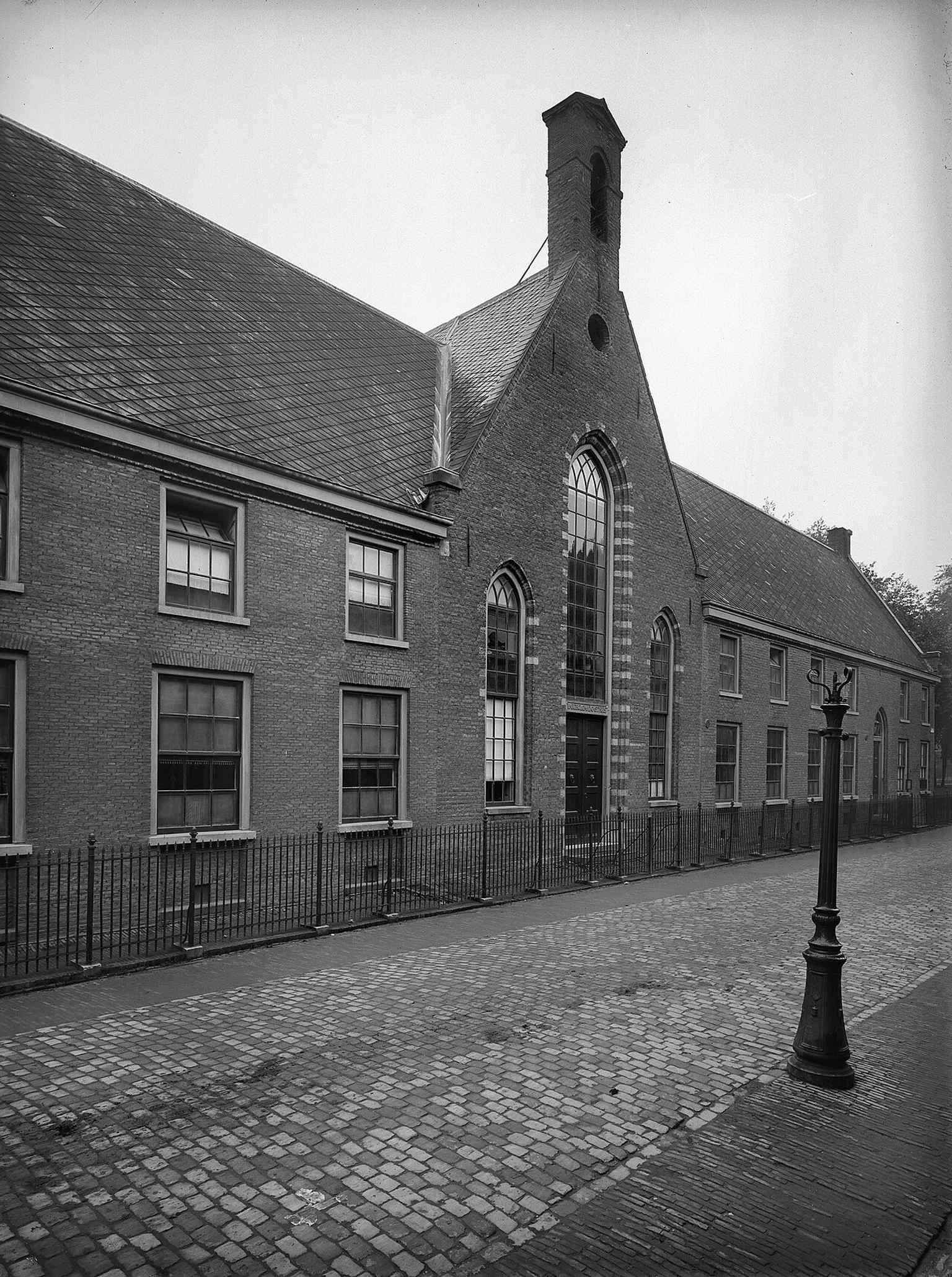
The historic front facade of the Bartholomeïgasthuis in 1920, showing its appearance after the significant alterations made in 1818 when it became a general hospital.Photo: Unknown authorUnknown author, Wikimedia Commons, CC BY-SA 4.0. Cropped & resized. 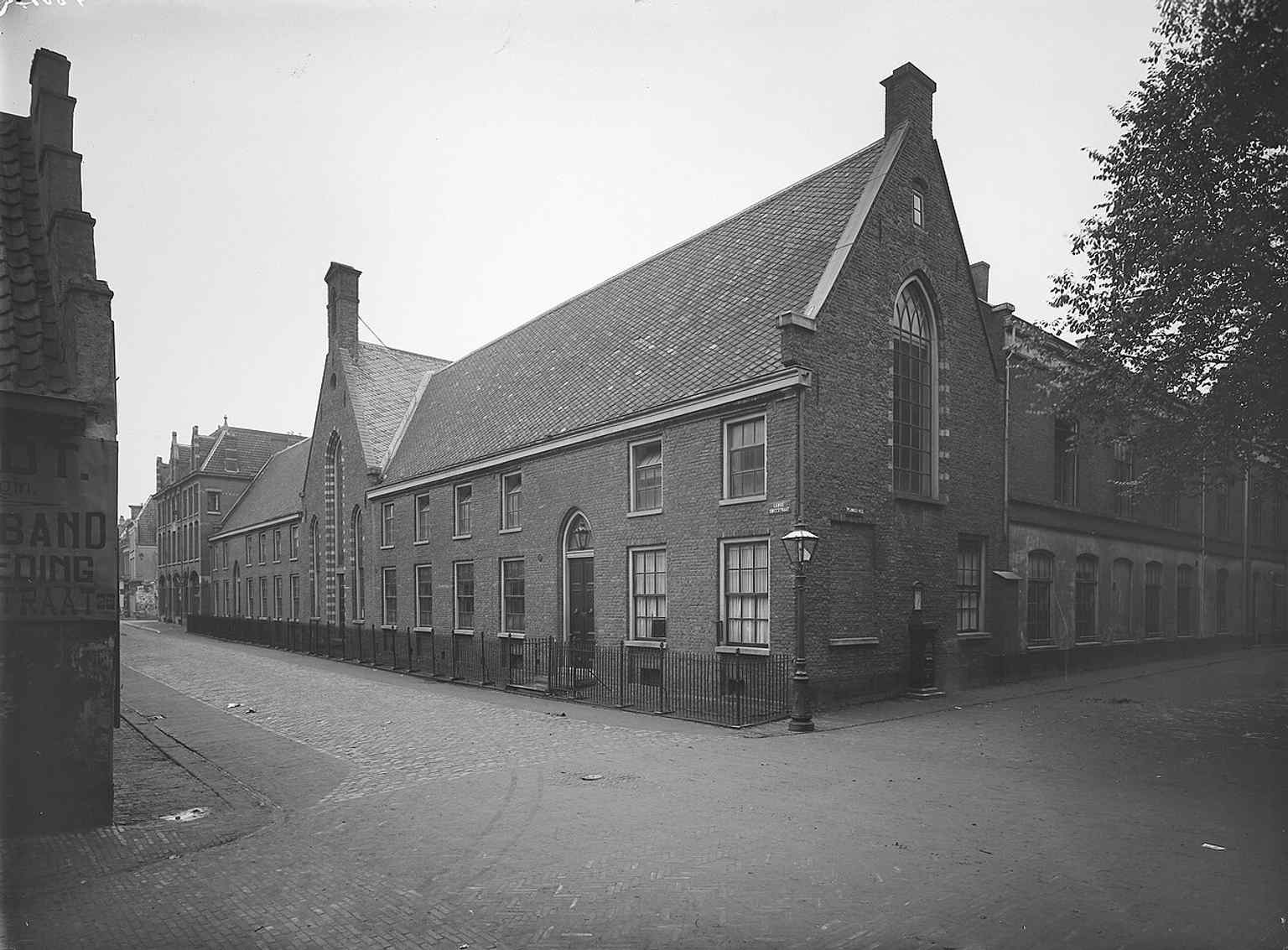
The various facades of the Bartholomeïgasthuis as seen in 1920, reflecting the architectural evolution since its foundation in 1378 and subsequent improvements.Photo: Unknown authorUnknown author, Wikimedia Commons, CC BY-SA 4.0. Cropped & resized. 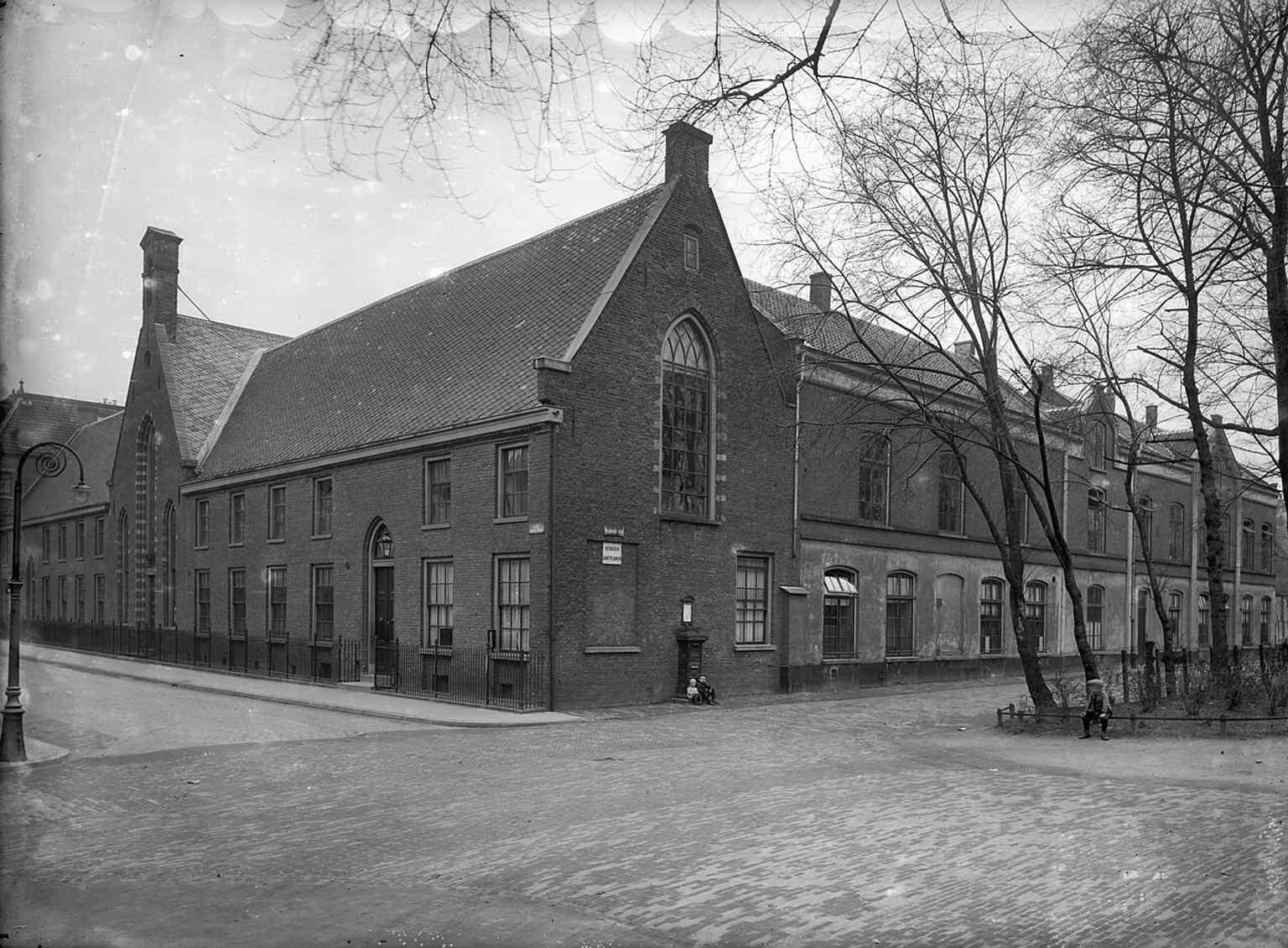
A view of the Bartholomeïgasthuis from the southeast in 1925, highlighting the building's historical architecture, which was founded in 1378 and improved by Willem van Abcoude.Photo: Unknown authorUnknown author, Wikimedia Commons, CC BY-SA 4.0. Cropped & resized. 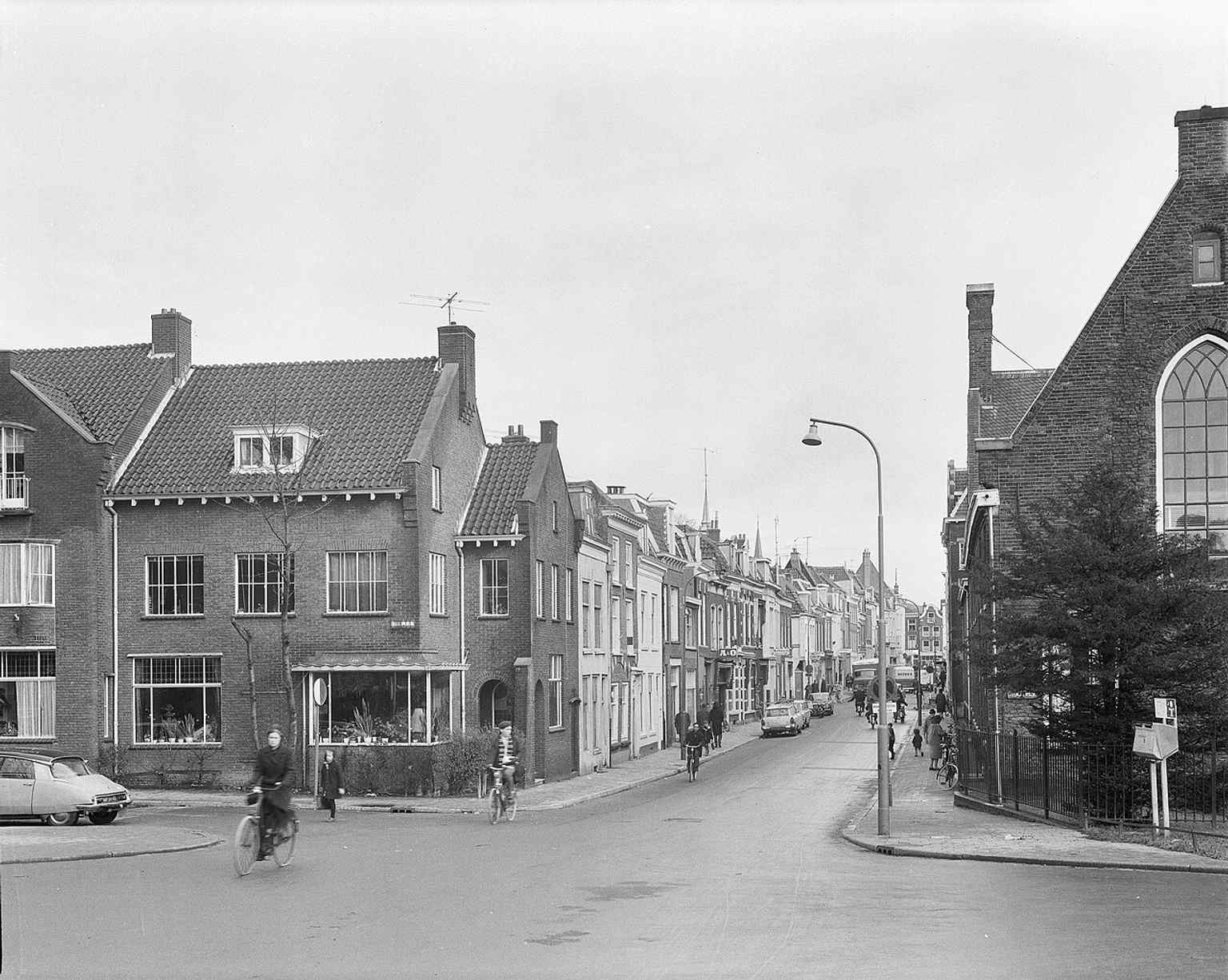
A 1966 view of the Bartholomeïgasthuis from Geertebolwerk, showcasing its urban setting. The building underwent extensive renovations in the 1980s and 2012 to meet modern requirements.Photo: A. J. van der Wal, Wikimedia Commons, CC BY-SA 4.0. Cropped & resized. 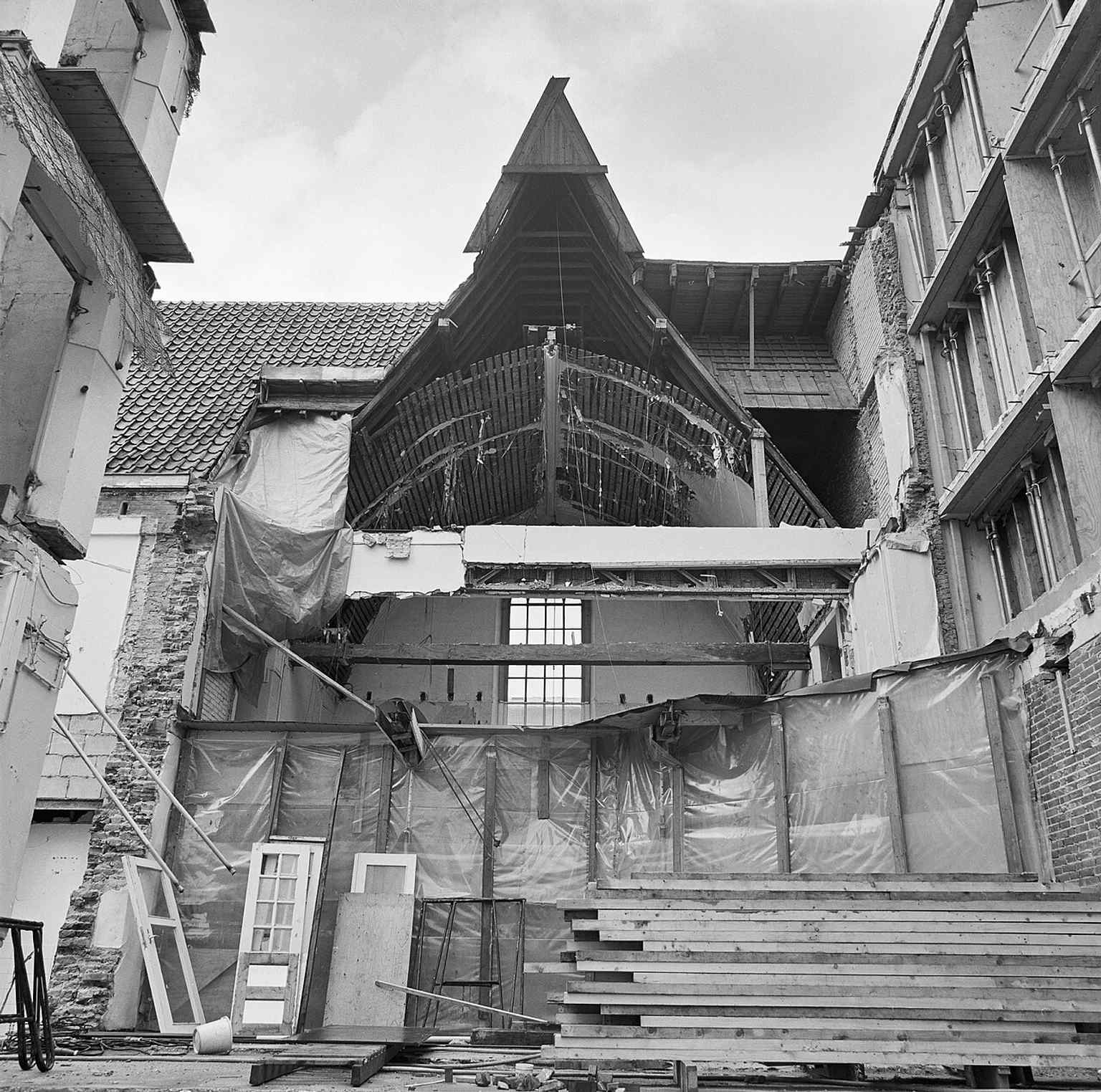
The exterior of the original sick ward in 1986. This part of the building notably lost much of its gothic character after 1818 renovations which included new windows and an interim floor.Photo: Ton Schollen, Wikimedia Commons, CC BY-SA 4.0. Cropped & resized. 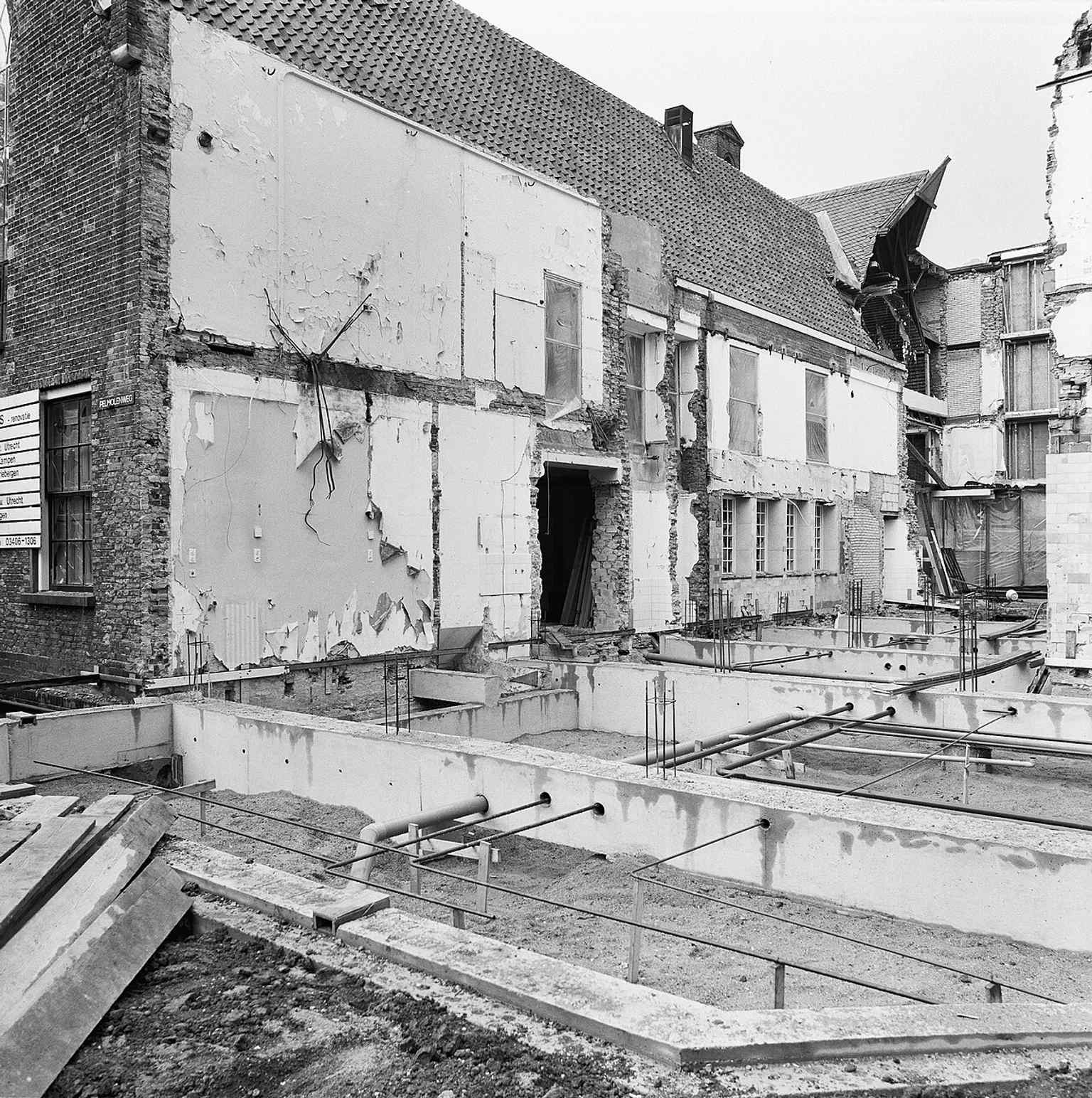
The rear facade of the western wing in 1986, revealing aspects of the Bartholomeïgasthuis less commonly seen from the front, reflecting its historical extensions and modifications.Photo: Ton Schollen, Wikimedia Commons, CC BY-SA 4.0. Cropped & resized. 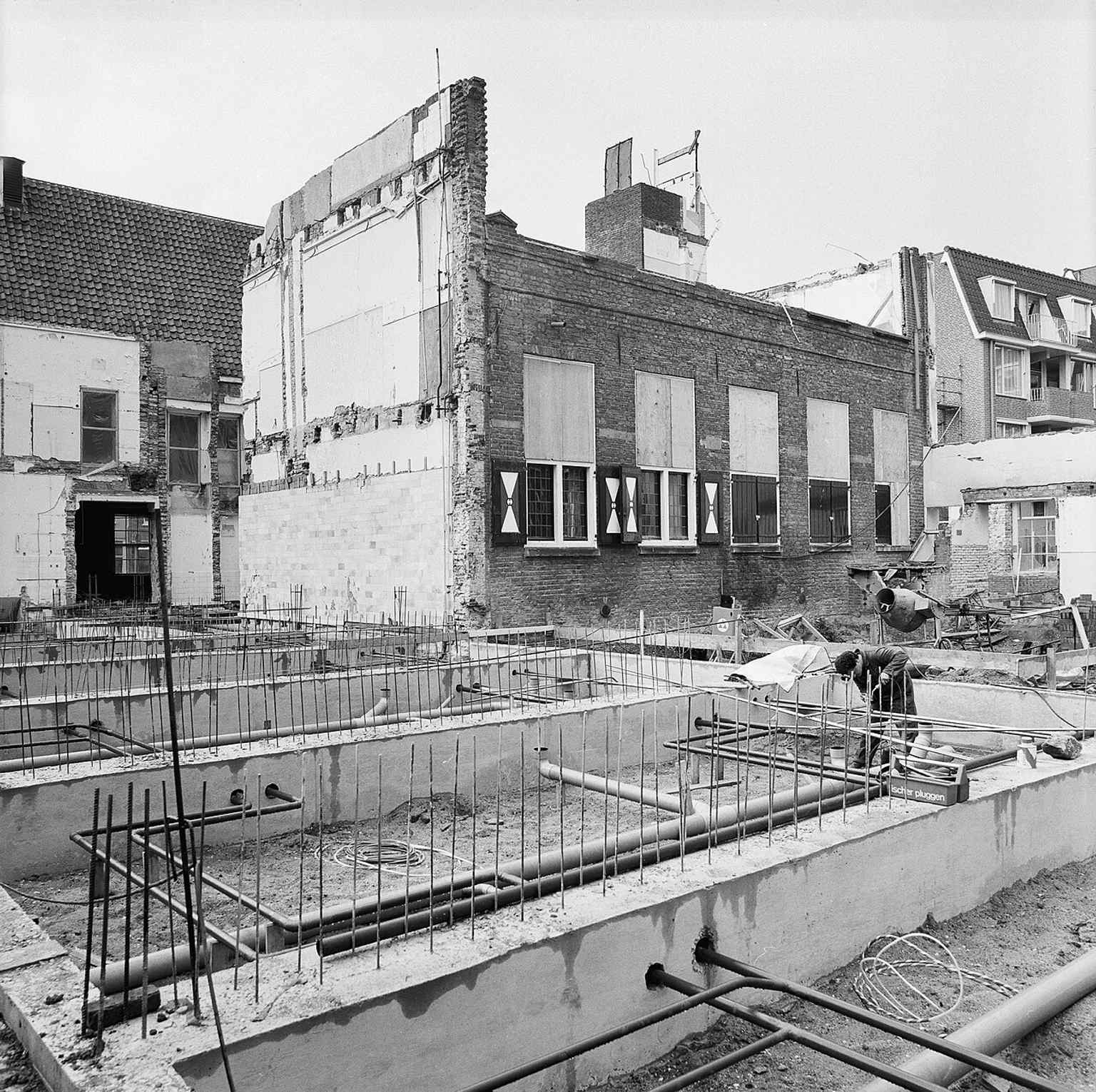
An exterior view from 1986 showing an addition to the original sick ward, illustrating the continuous evolution and expansions of the Bartholomeïgasthuis over centuries.Photo: Ton Schollen, Wikimedia Commons, CC BY-SA 4.0. Cropped & resized. 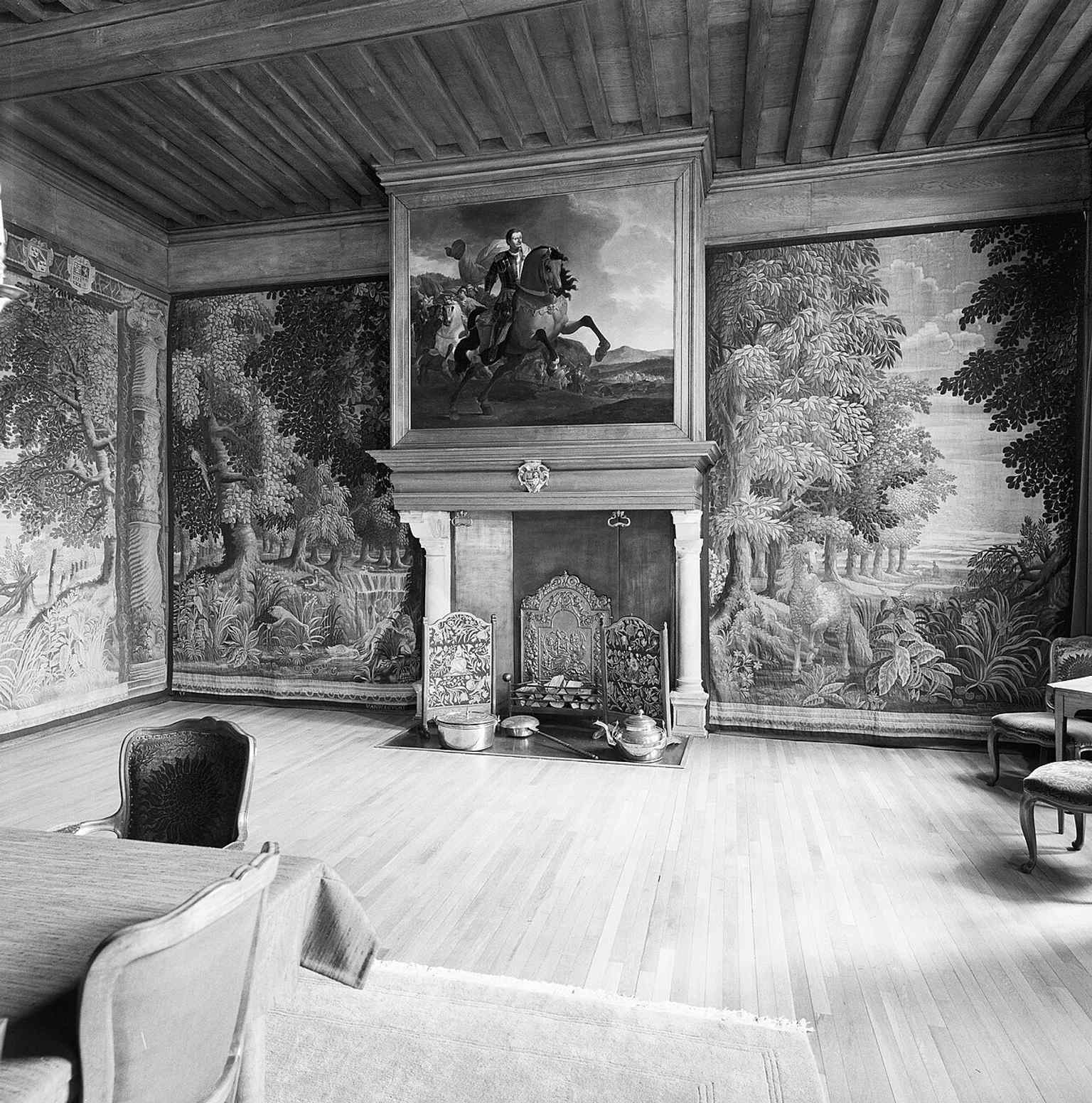
A close view of the 17th-century tapestries and chimneypiece in the Regentenzaal. These four tapestries, created in 1642 by Maximiliaan van der Gucht, are celebrated as unique Dutch cultural heritage.Photo: A. J. van der Wal, Wikimedia Commons, CC BY-SA 4.0. Cropped & resized. 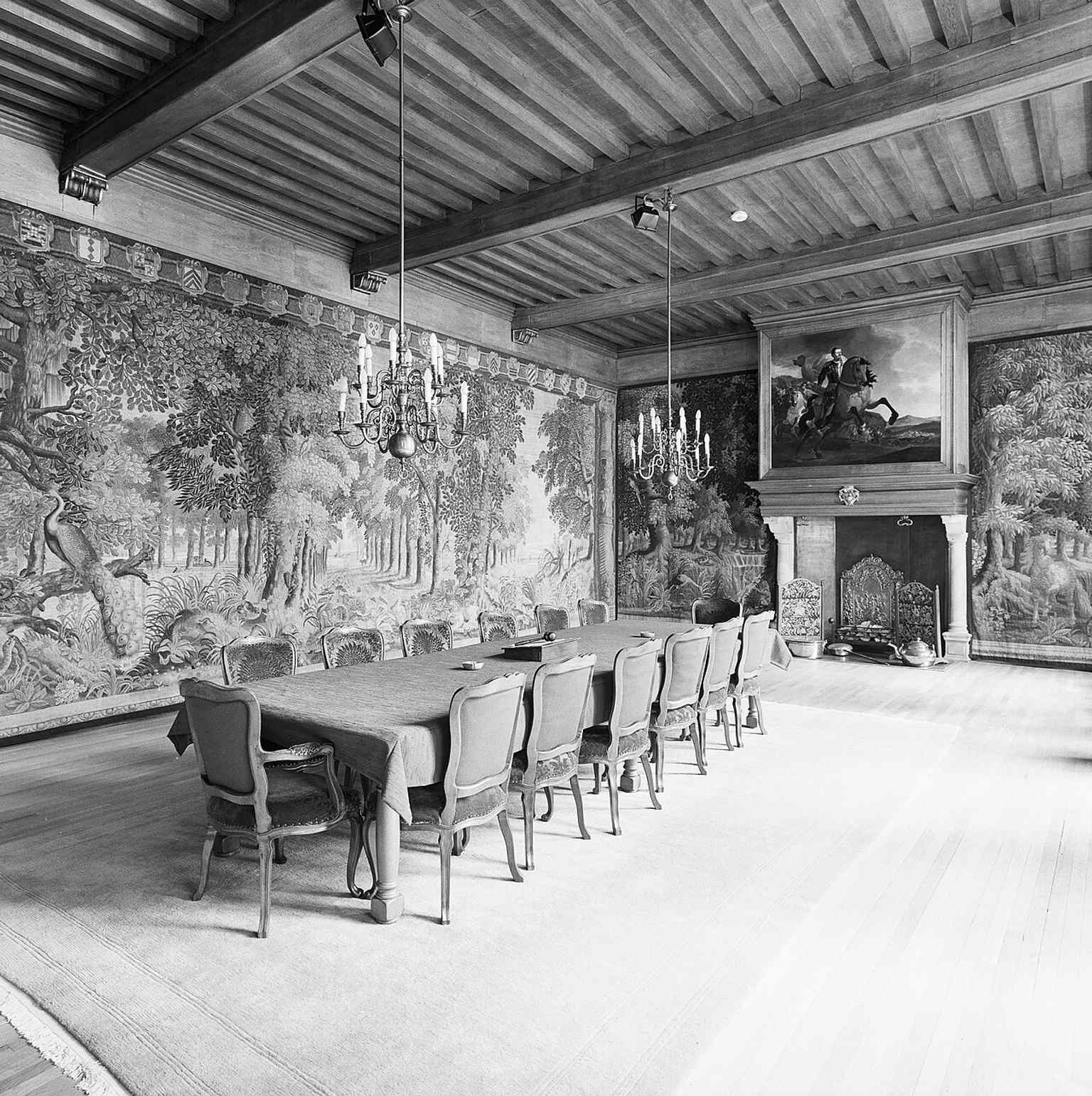
An expansive view of the Regentenzaal, featuring the historically significant 17th-century tapestries that were specifically designed for this room and installed in 1642.Photo: A. J. van der Wal, Wikimedia Commons, CC BY-SA 4.0. Cropped & resized. On your right, you will see a long row of uniform dark brick houses topped with a continuous, sloping red tiled roof dotted with dormer windows, all watched over by tall, vintage…Read moreShow less
Open dedicated page →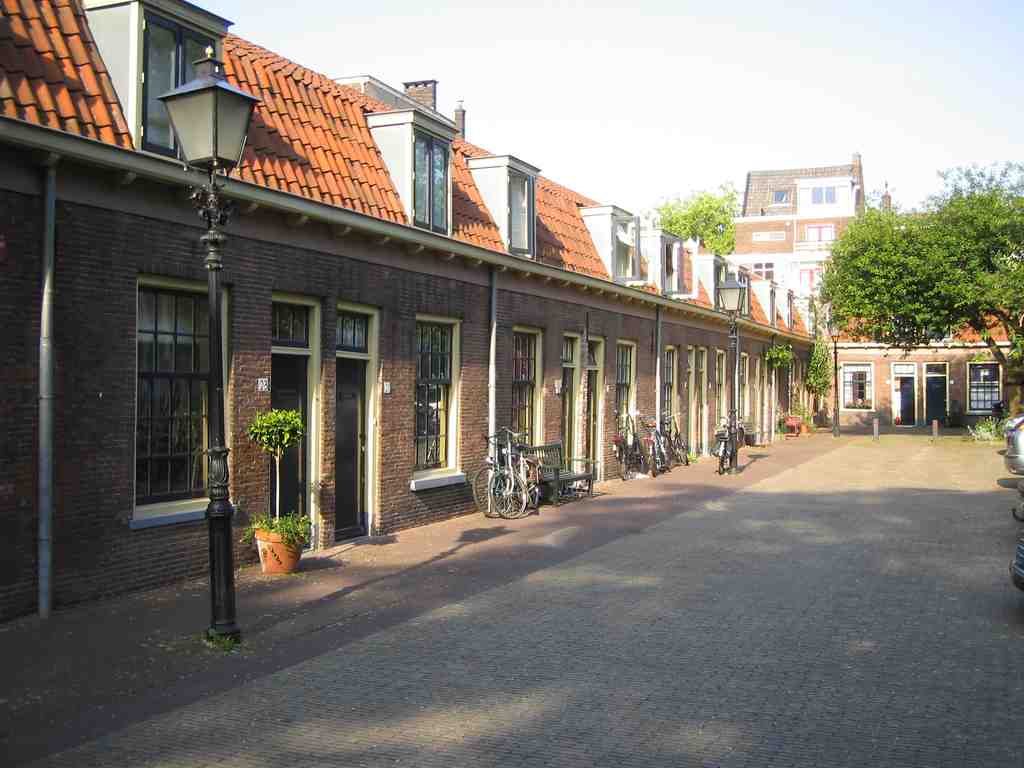
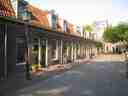
Seven alleysPhoto: Kattenkruid, Wikimedia Commons, CC BY 3.0. Cropped & resized. On your right, you will see a long row of uniform dark brick houses topped with a continuous, sloping red tiled roof dotted with dormer windows, all watched over by tall, vintage iron streetlamps. This is De Zeven Steegjes, or the Seven Alleys. Back in eighteen forty-two, the Catholic Poor Board hired two architects to build simple housing here for large families relying on charity.
At the time, cities were dangerously overcrowded, and the terrifying threat of cholera hung in the air. To fight the deadly disease, the government banned dead-end slums. They demanded straight streets so the wind could sweep right through and clear out the bad air.
It might sound surprising, but these homes were considered far ahead of their time, even though the Poor Board built them without kitchens or private toilets! It was not until nineteen fifty-two that the city finally replaced the outdoor shared latrines with actual indoor toilets.
For decades, politicians constantly debated bulldozing the whole neighborhood because the tiny houses seemed too outdated. Thankfully, they chose to renovate instead. Today, one hundred sixty-six of these monumental homes are left, full of life and a deeply connected community that even throws a massive three-day street festival every August.
This little working-class village survived the centuries and stands proudly as a testament to the resilient spirit of everyday people. Enjoy the quiet charm of these streets. When you feel ready, we can head to the next stop.
Up ahead on your left, you will spot Geertekerk, a vast brick building defined by its tall arched windows and a sharp needle-like spire. Interestingly enough, this was the…Read moreShow less
Open dedicated page →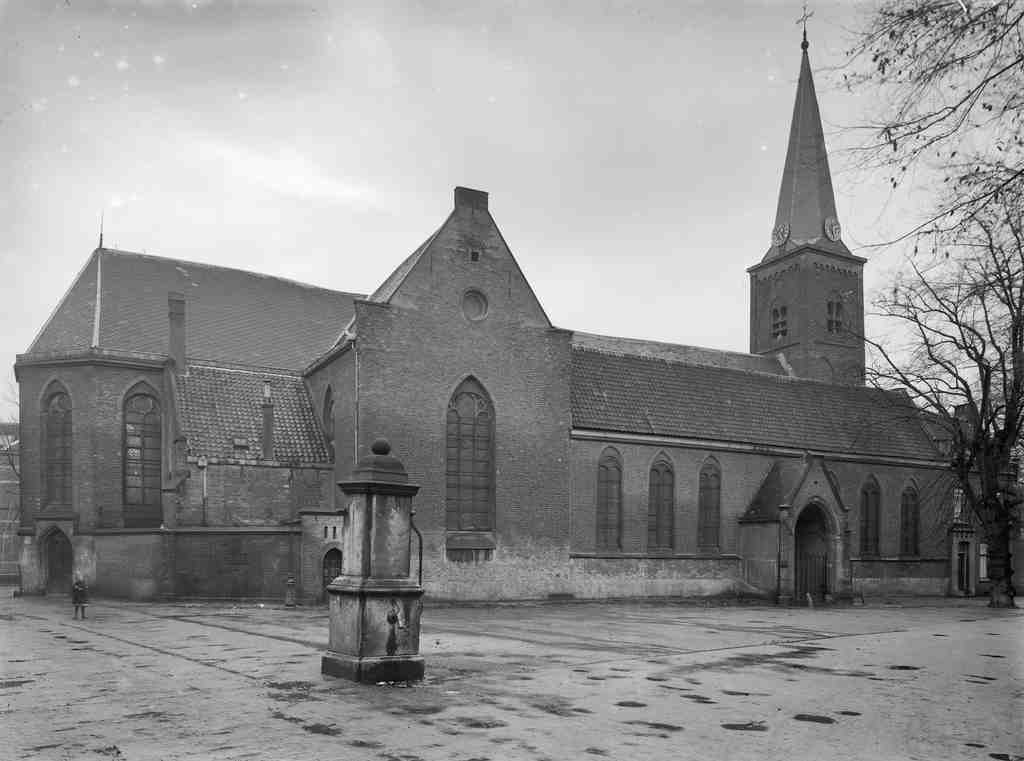
GeertekerkPhoto: Unknown author, Wikimedia Commons, CC BY-SA 4.0. Cropped & resized. Up ahead on your left, you will spot Geertekerk, a vast brick building defined by its tall arched windows and a sharp needle-like spire. Interestingly enough, this was the smallest and youngest of Utrecht's four medieval parish churches. Originally built outside the city, builders relocated it inside the protective walls between twelve forty-eight and twelve fifty-nine. Take a quick look at your screen to see a before and after comparison showing how its imposing western facade and tower have anchored the streetscape since nineteen thirty.
These walls hold incredibly wild history. In the fifteenth century, a religious woman named Agnes van Zantwijck became an anchorite here, meaning she chose to be completely walled into a tiny cell attached to the church, living in total isolation.
Over the centuries, this building lived a thousand lives. It served as a military barracks, a horse stable, and a warehouse. In eighteen fifty-five, when the river Rhine flooded, hundreds of displaced people rushed through those doors for emergency shelter. By the nineteen forties, the church was a total ruin, with trees growing right up through the nave.
Thankfully, a dedicated community completely restored the space in the nineteen fifties. Check out the photo in your app to see the stunning eighteen oh three pipe organ they installed inside.
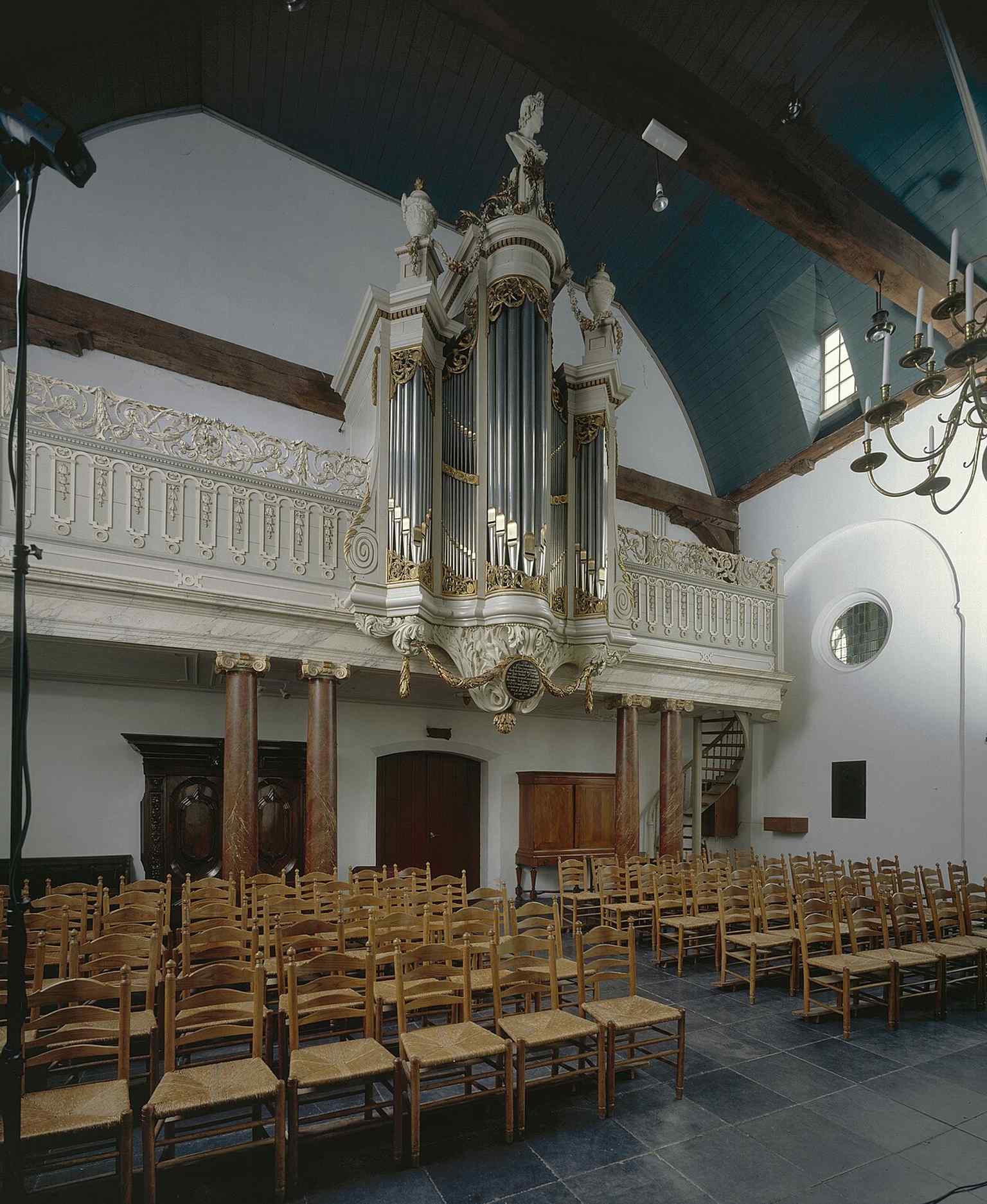
A detailed view of the 1803 Johannes Stephanus Strümphler organ, which was relocated to Geertekerk in 1956 from the Doopsgezinde kerk in De Rijp.Photo: J.P. de Koning, Wikimedia Commons, CC BY-SA 4.0. Cropped & resized. Today, this resilient sanctuary echoes with beautiful orchestral music. Listen for the faint echoes of music, and when you are ready, we can head to the next stop.
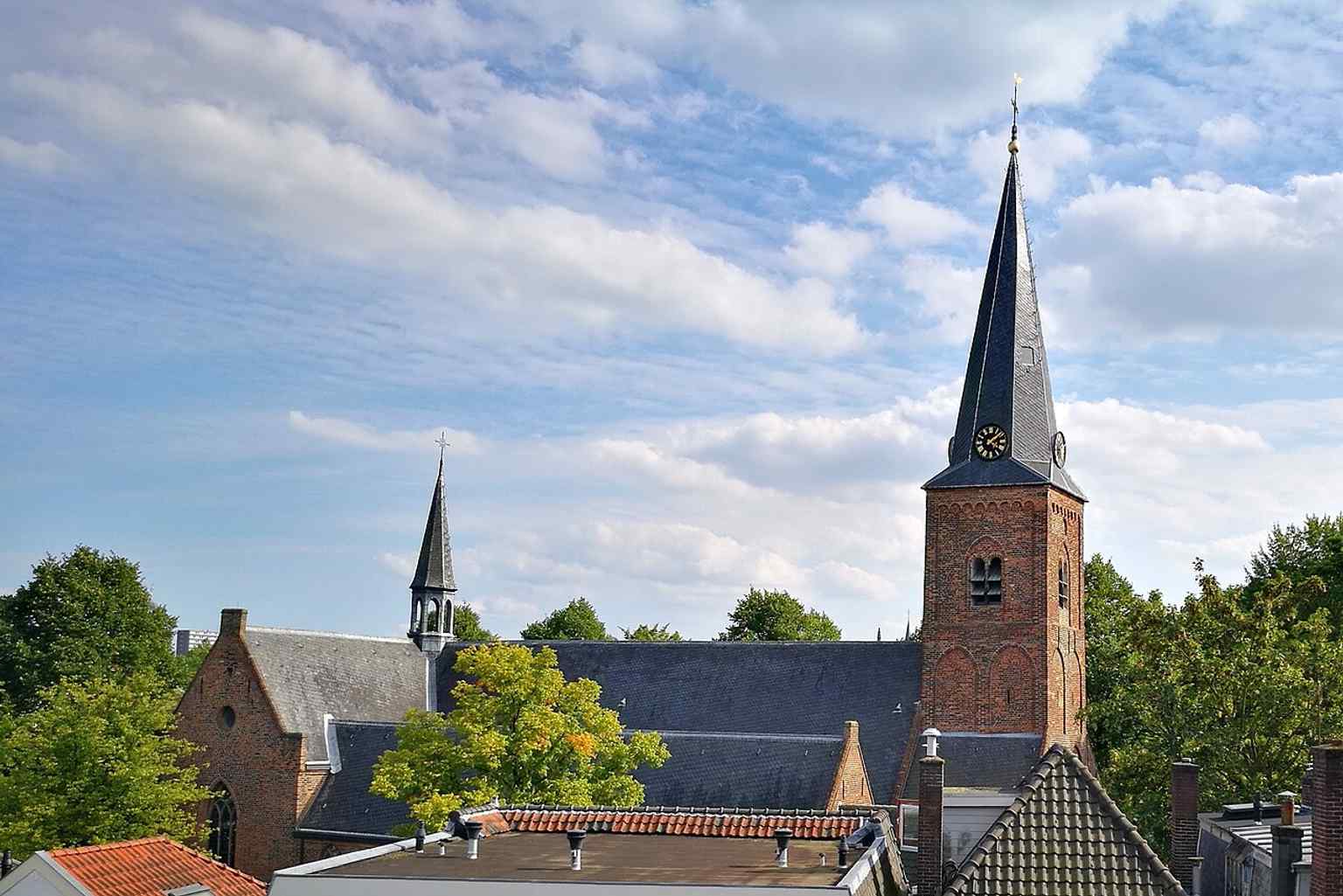
A clear exterior view of the Geertekerk from 2017, showcasing its sober, almost village-like character after the 1954-1956 restoration.Photo: NorthLaker, Wikimedia Commons, CC BY-SA 4.0. Cropped & resized. Look down at the street to find a continuous line of light gray square stone blocks embedded in the darker red brick pavement, each bearing a single deeply carved capital letter.…Read moreShow less
Open dedicated page →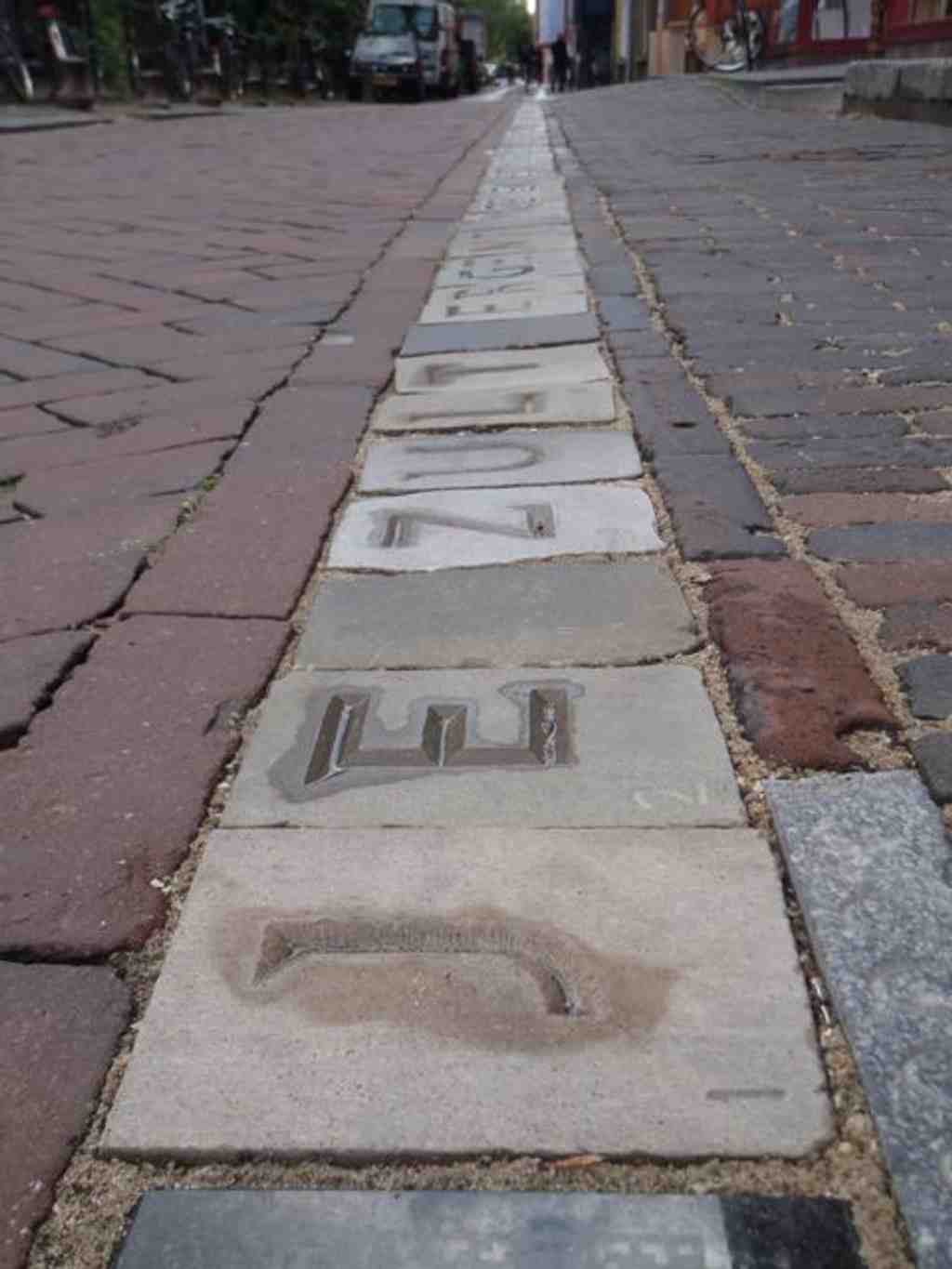
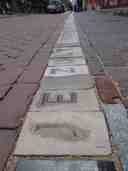
The Letters of UtrechtPhoto: EphemeralKnowledge, Wikimedia Commons, Public domain. Cropped & resized. Look down at the street to find a continuous line of light gray square stone blocks embedded in the darker red brick pavement, each bearing a single deeply carved capital letter. This is the Letters of Utrecht, an endless poem unfolding directly on the ground before you. Every single Saturday, at exactly one o'clock PM, a stone mason hews a brand new letter into the next paving block. They plan to keep doing this for as long as Saturdays exist. It takes about three years just to publish an average sentence, and the poem grows by only five meters a year.
It was dreamed up by the Utrecht Guild of Poets. Take a glance at your screen to see image one. That is a close up of the initial pieces, unveiled on the second of June, two thousand and twelve, by Mayor Aleid Wolfsen. He actually chiseled the block for that day himself. The custom font was designed specifically for this route by Hanneke Verheijke.
The concept is entirely brilliant! It is inspired by projects focused on deep, long term thinking, like the Ten Thousand Year Clock being built in Texas. In fact, the very first block in this poem, carrying the letter J, was cut from the same Texan mountain range as that clock. This project is what artists call a social sculpture, which is a kind of living artwork meant to shape human society and make us think about our collective future.
It is entirely funded by citizens who sponsor a letter to leave their mark for posterity. The poet keeps the upcoming words a strict secret. If people keep funding it, this creeping line of text will eventually trace the giant letters U and T across the city map. Future generations will have to decide where the poem goes after the year twenty-three fifty. Since this street is public, this expanding masterpiece is always open for you to explore.
Take a moment to read the carved stones and ponder the future. Whenever you are ready, we will wander toward our next stop.
Look for the tall dark brick building framed by large stone pilasters and a grand double door topped with a fanlight window. This does not look much like a church, does it? In…Read moreShow less
Open dedicated page →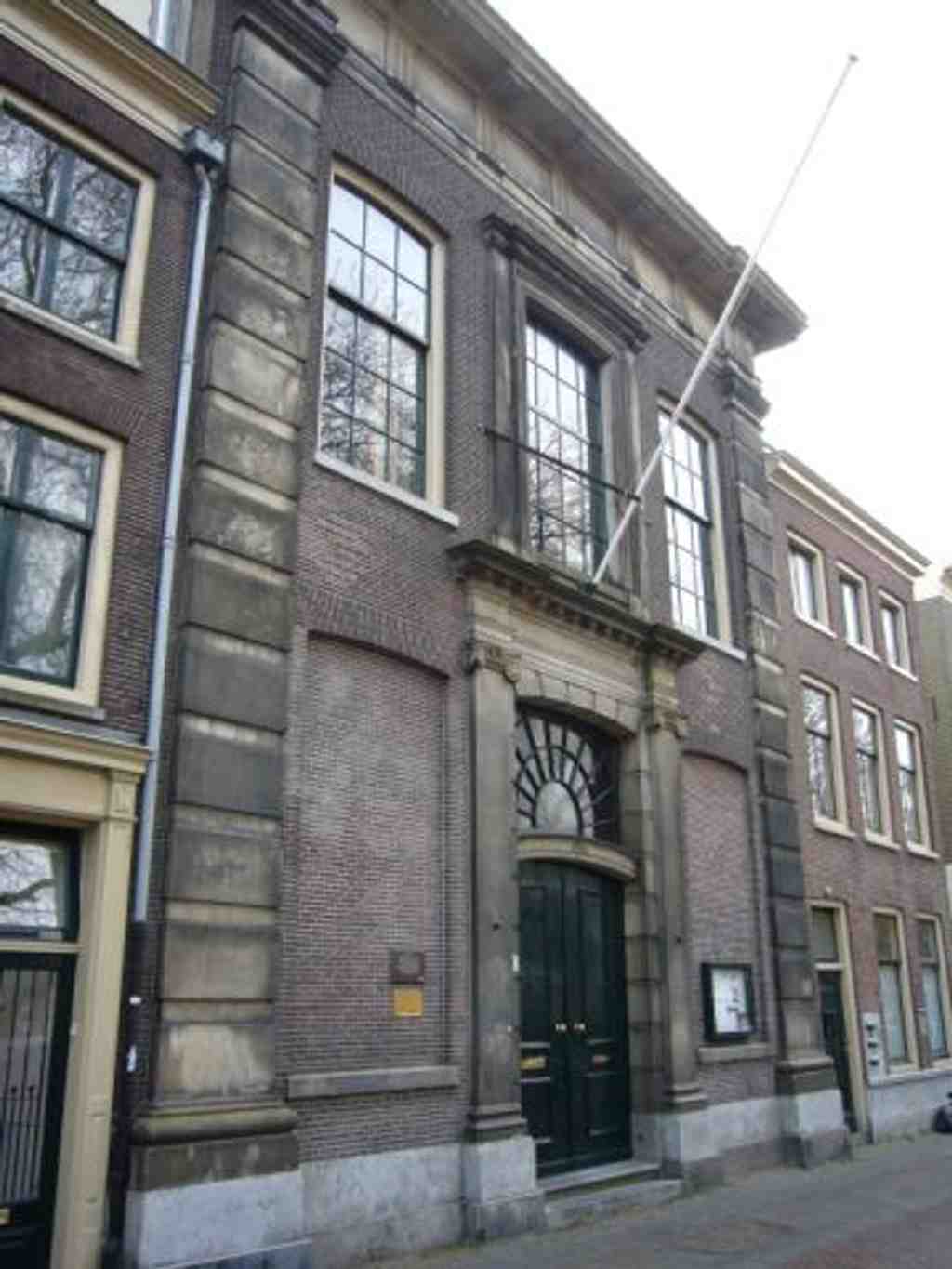
Mennonite ChurchPhoto: Pepijntje, Wikimedia Commons, Public domain. Cropped & resized. Look for the tall dark brick building framed by large stone pilasters and a grand double door topped with a fanlight window. This does not look much like a church, does it? In seventeen seventy-three, architect Willem de Haan gutted a medieval canal house to build this Mennonite Church. Because Mennonites, a peaceful Protestant group, were barely tolerated by the state, their places of worship had to hide in plain sight. De Haan designed this facade to look exactly like a stately mansion. You can see how perfectly this disguised western facade has held up over the decades by checking the comparison image on your screen. Inside, the space embraces the strict Louis the sixteenth style, favoring clean and simple geometric lines. Look at the photo on your phone to see the hidden sanctuary, featuring remarkable yellow windows from nineteen twenty-two and a magnificent Bätz organ built in eighteen seventy. The building is only open to visitors for an hour on Sunday mornings from ten to eleven A-M. It is a brilliant piece of architectural camouflage. Take your time admiring the disguise, and whenever you are ready, let us head to the next stop.
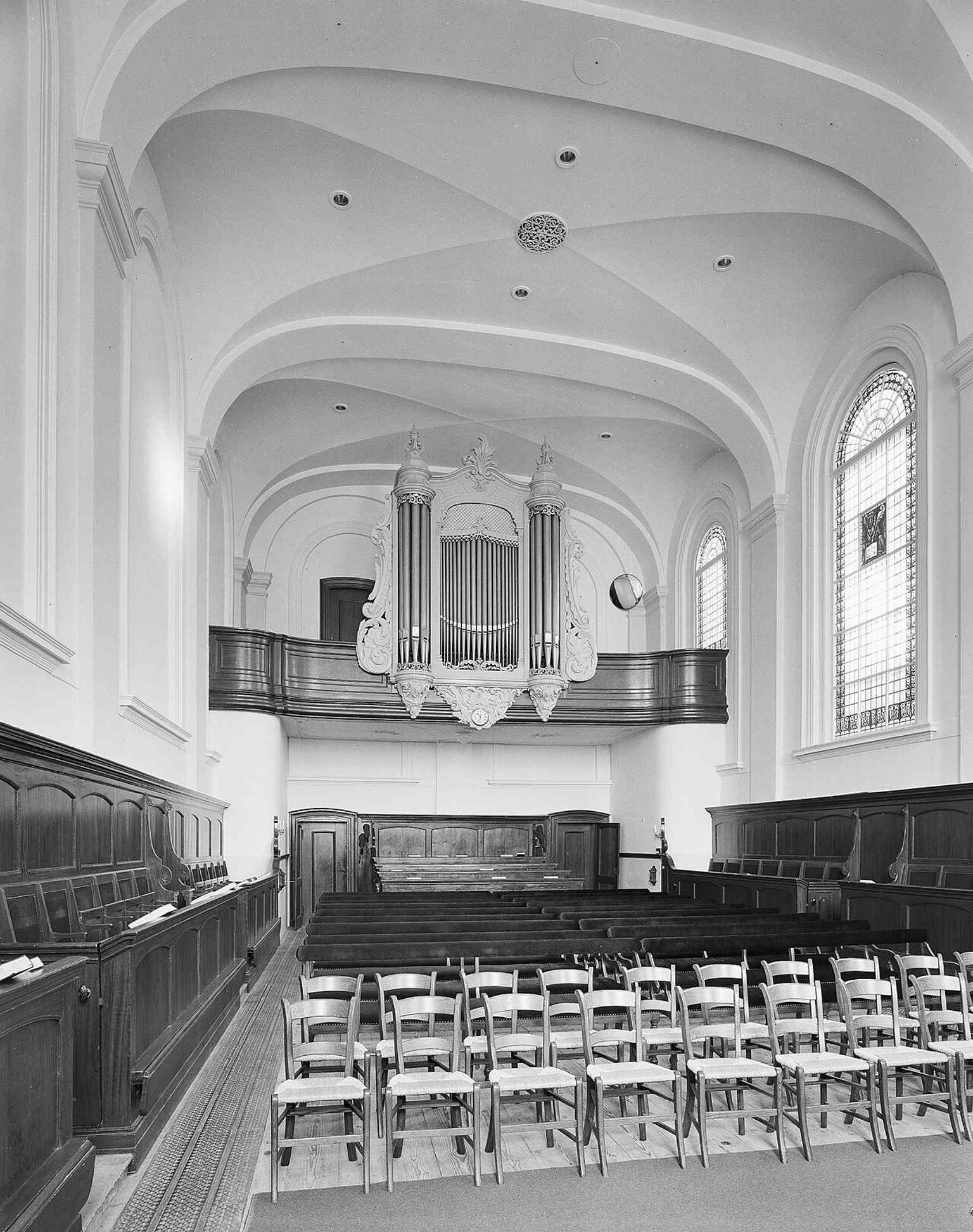
The elegant interior view towards the west, featuring the pews and the Bätz organ. This perspective likely includes the 'remarkable yellow windows' installed in 1922.Photo: A. J. van der Wal, Wikimedia Commons, CC BY-SA 4.0. Cropped & resized. 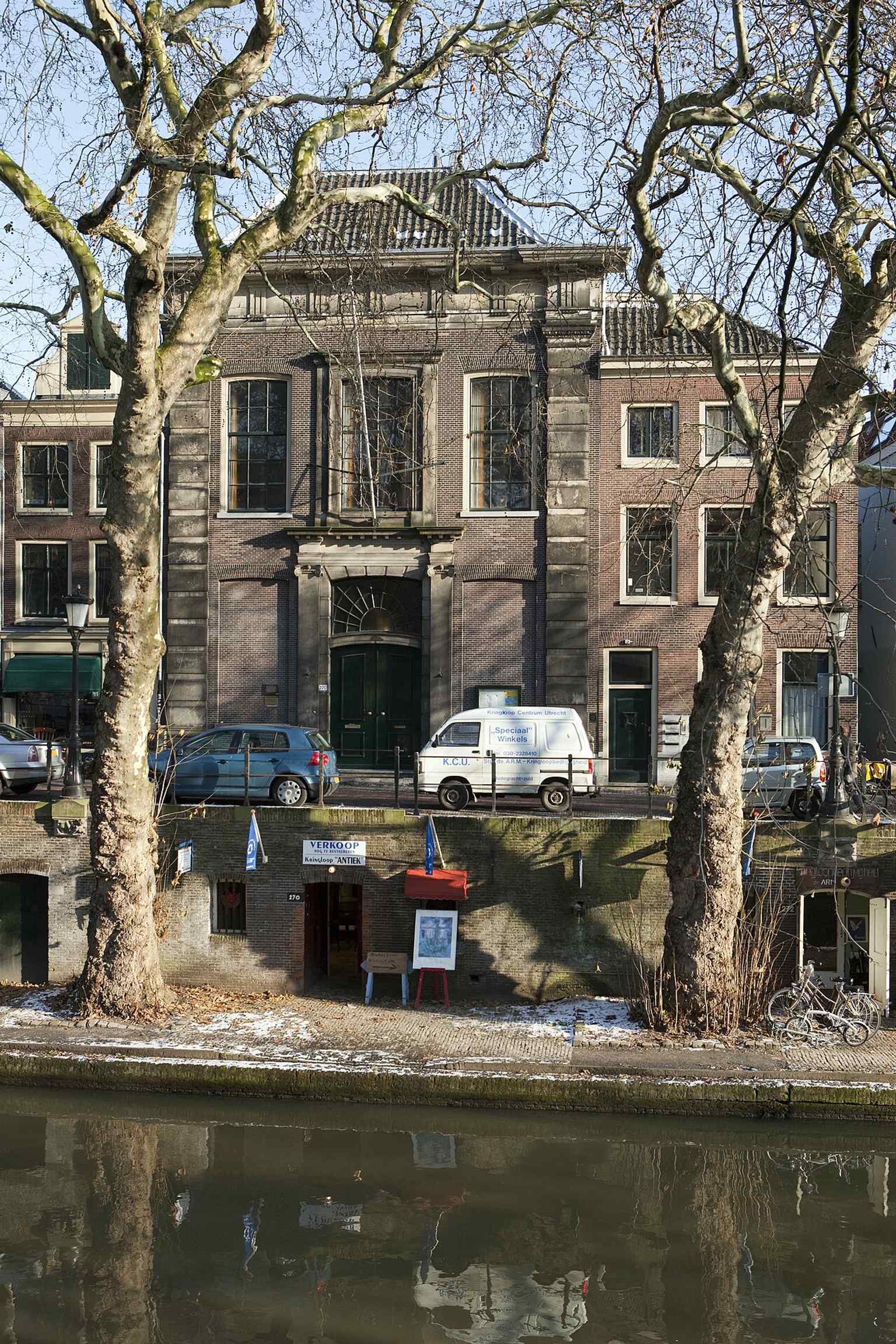
The church's prominent facade on the Oudegracht, designed in 1773 to resemble a stately mansion rather than a visible church due to the Mennonites' tolerated status at the time.Photo: Kris Roderburg / Chris Booms, Wikimedia Commons, CC BY-SA 4.0. Cropped & resized. 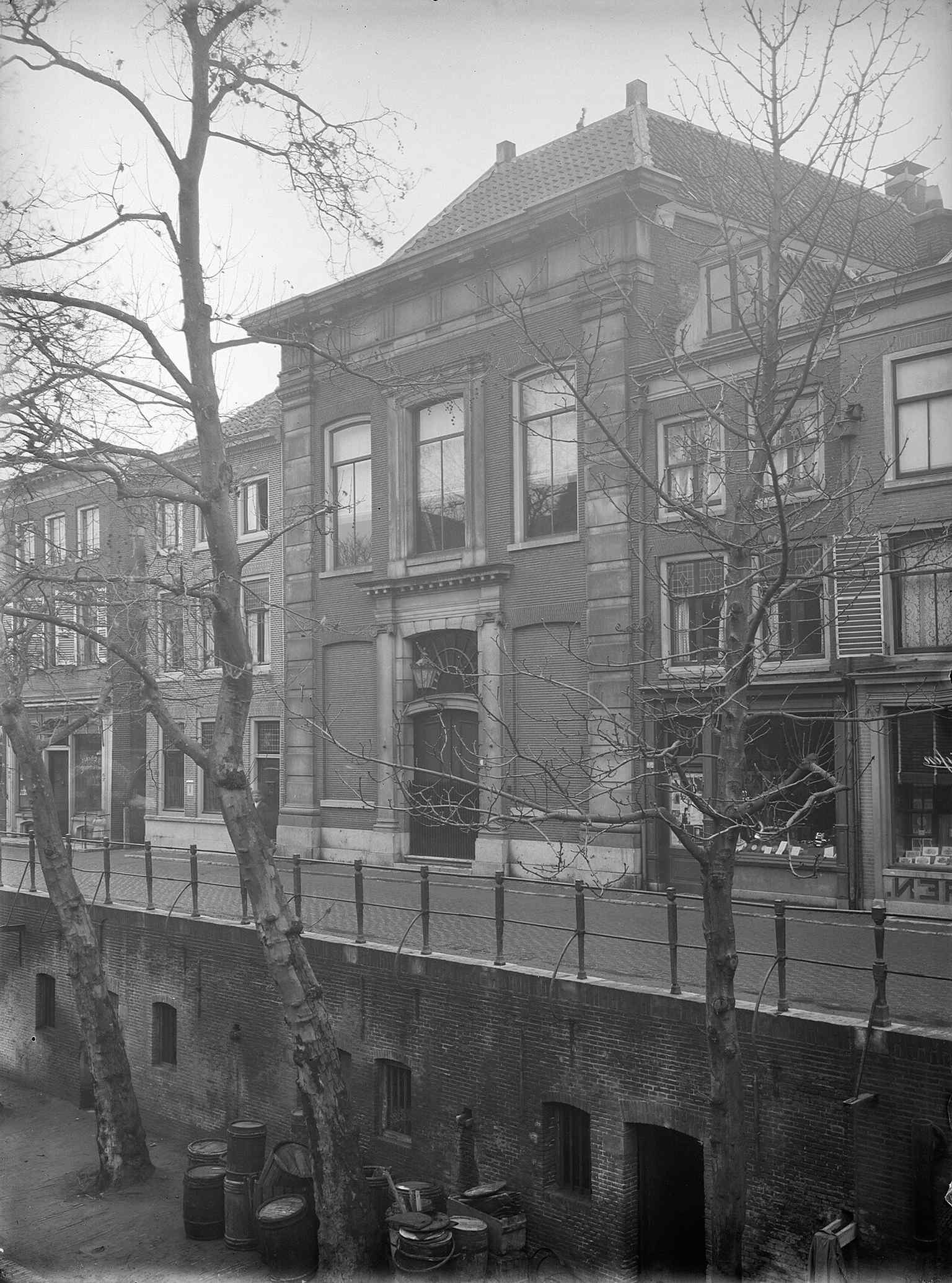
A historical view of the church's west facade from 1921, showing its discreet mansion-like appearance on the Oudegracht, an approach chosen when Mennonites were only tolerated.Photo: Unknown authorUnknown author, Wikimedia Commons, CC BY-SA 4.0. Cropped & resized. 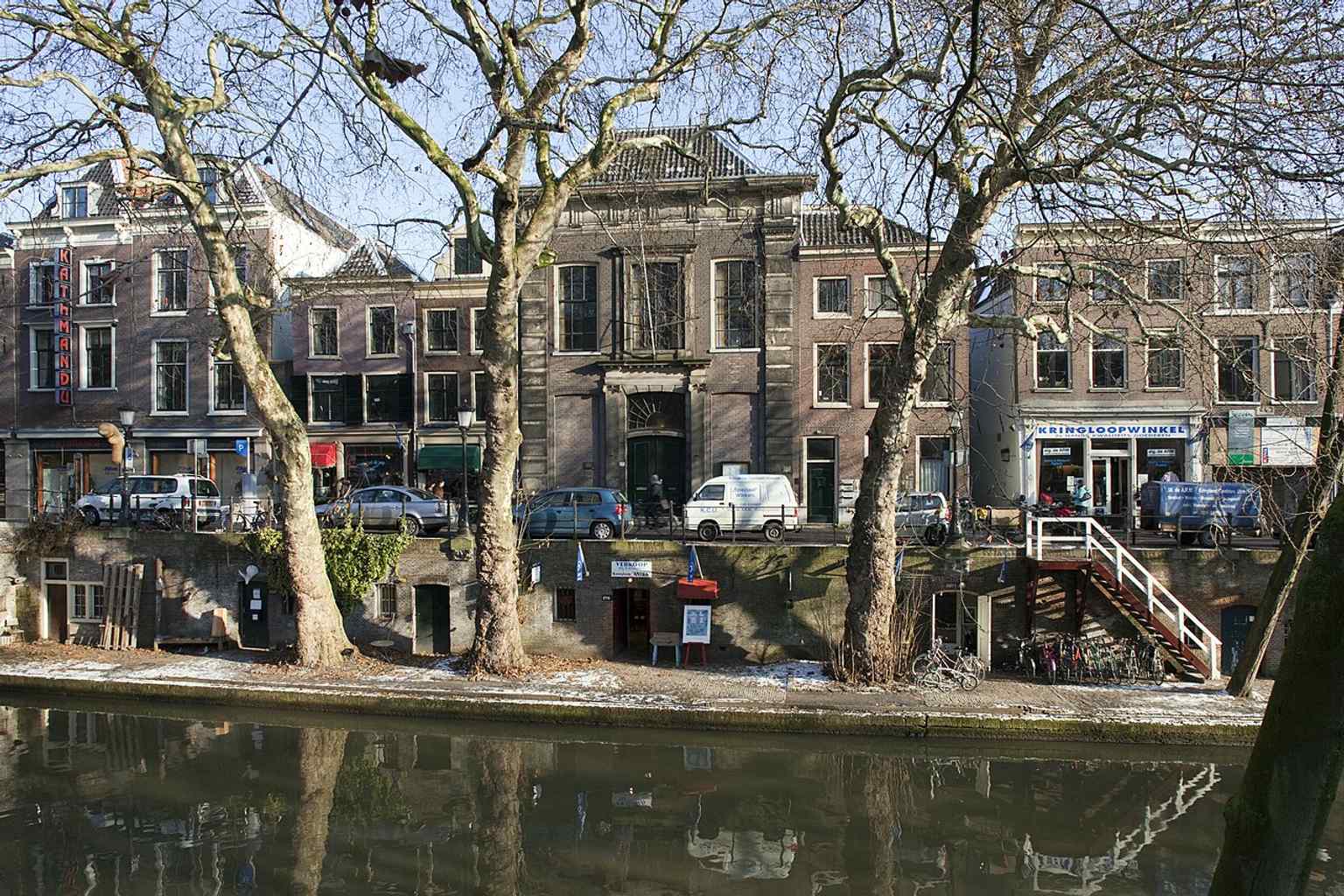
A wider exterior view of the church's west facade on the Oudegracht, illustrating its integration with the surrounding medieval canal houses.Photo: Kris Roderburg / Chris Booms, Wikimedia Commons, CC BY-SA 4.0. Cropped & resized. 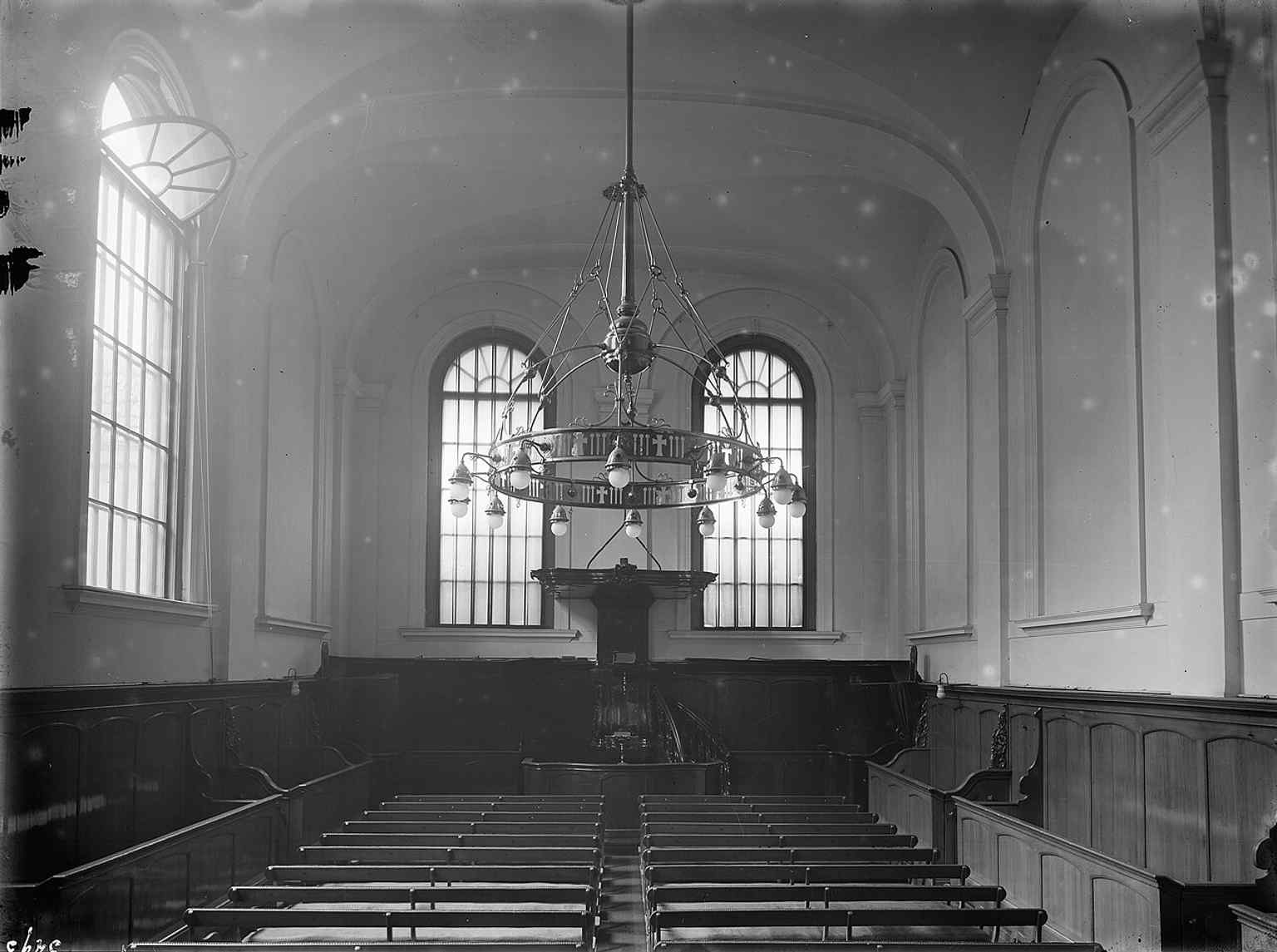
A general interior view of the small hall church from 1921, showcasing its simple yet strict Louis XVI style and the pulpit.Photo: Unknown authorUnknown author, Wikimedia Commons, CC BY-SA 4.0. Cropped & resized. 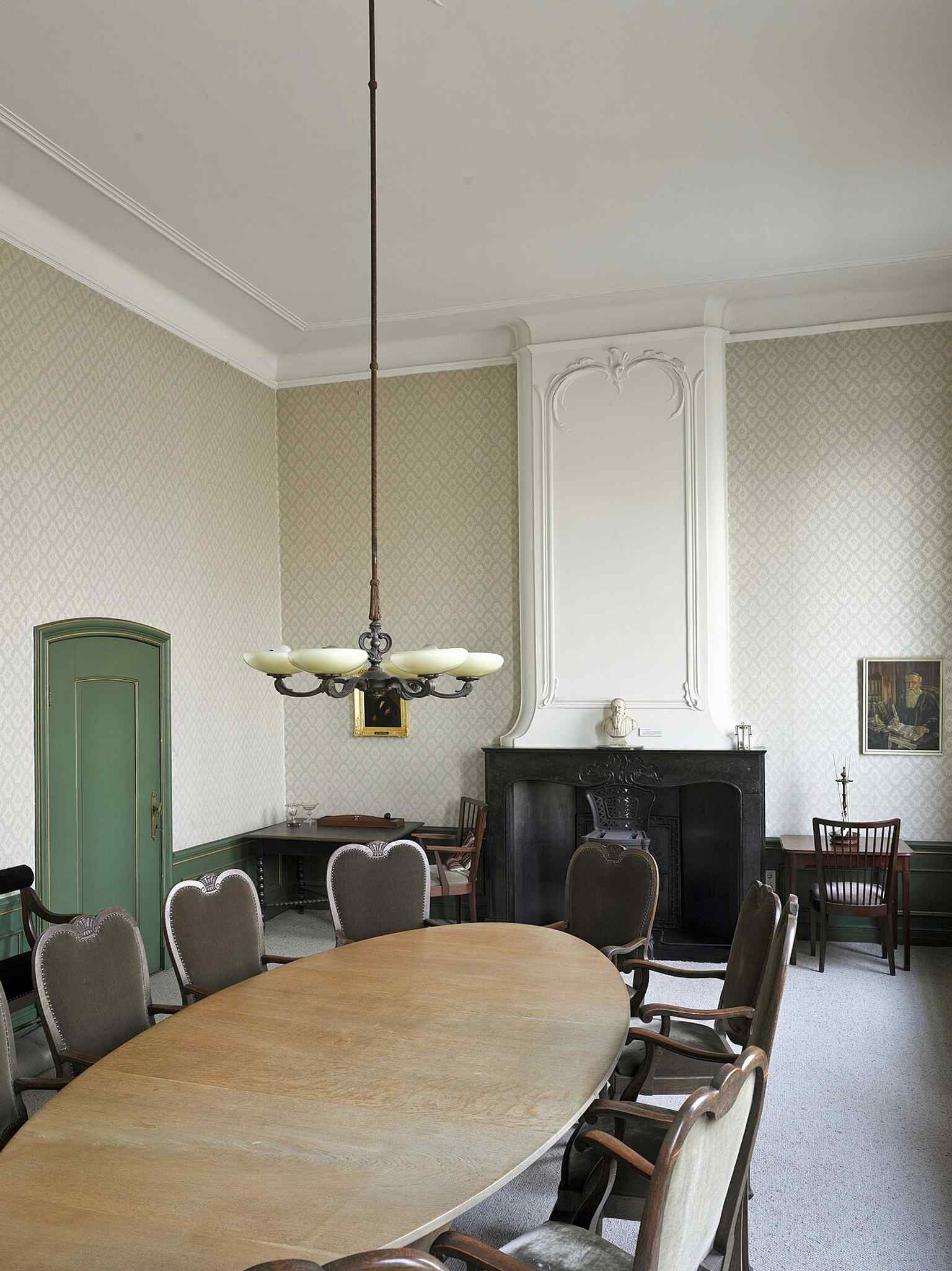
The church council room on the first floor, featuring a fireplace (schouw) and showcasing more of the preserved 18th-century interior design and furniture.Photo: Kris Roderburg / Chris Booms, Wikimedia Commons, CC BY-SA 4.0. Cropped & resized. 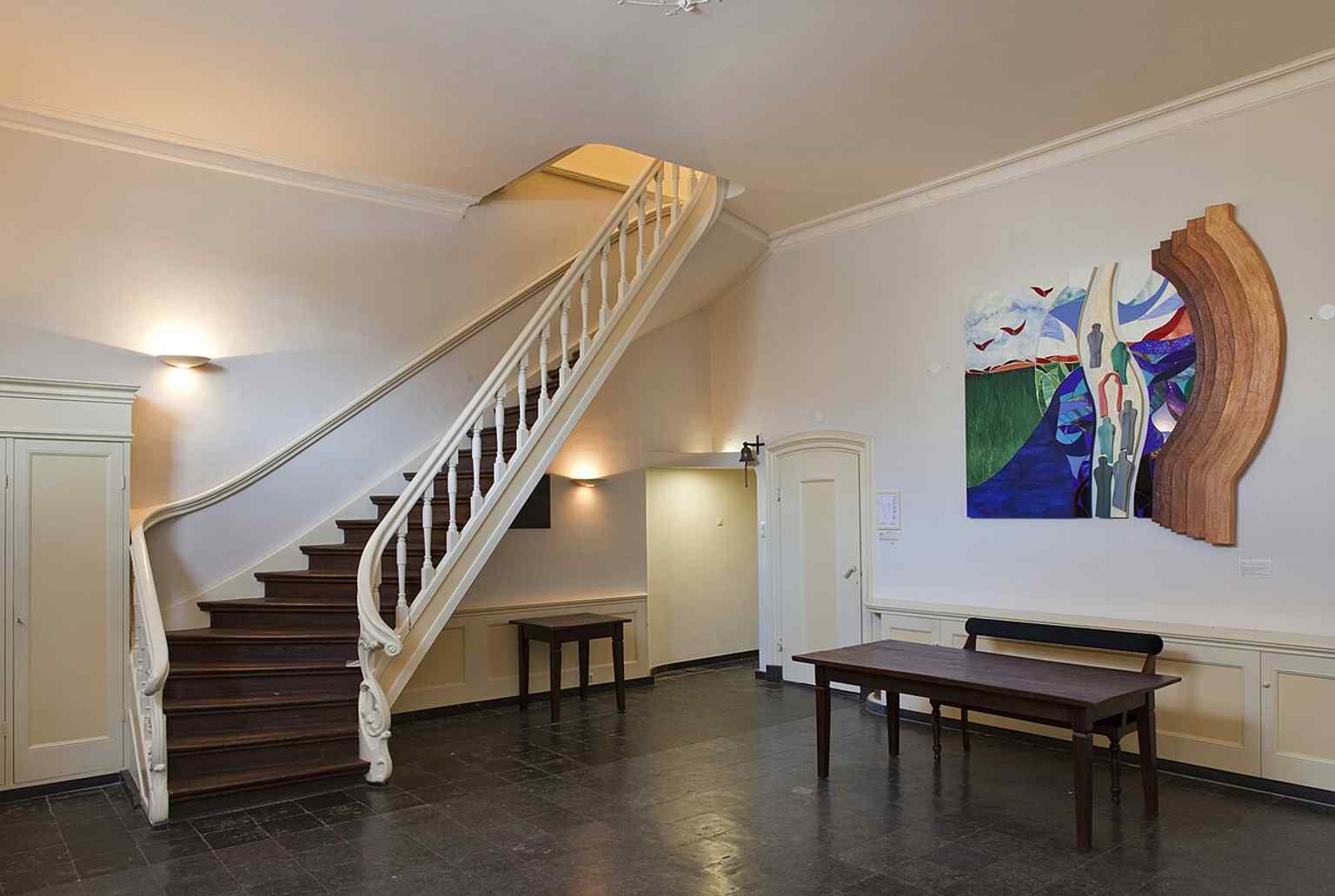
The church's entrance hall on the ground floor with a staircase leading to the first floor, reflecting the building's origin as a converted medieval canal house.Photo: Kris Roderburg / Chris Booms, Wikimedia Commons, CC BY-SA 4.0. Cropped & resized. 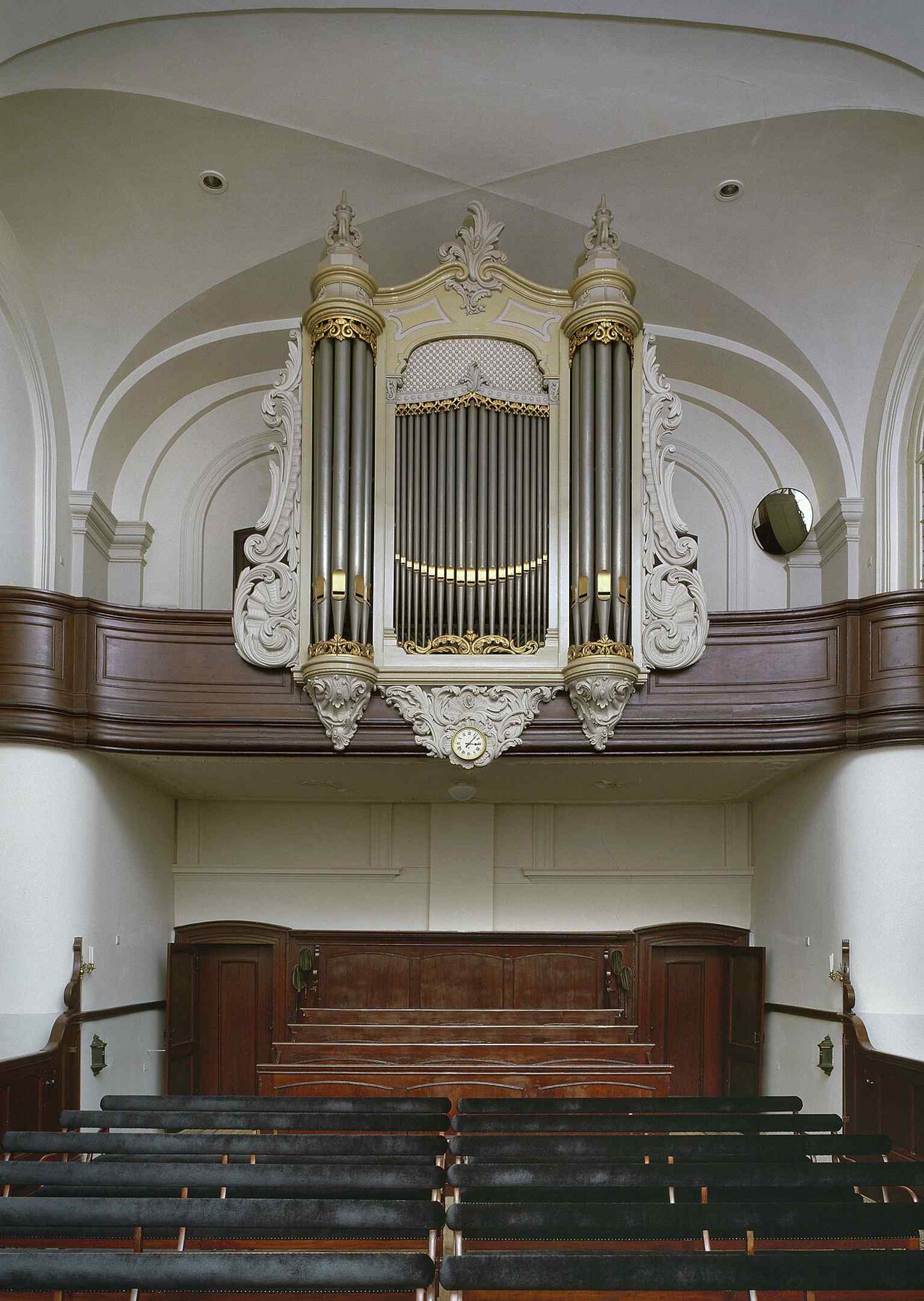
A detailed view of the Bätz organ, built in 1870 with a neo-rococo style casing. Its predecessor is now located in Katwijk aan Zee.Photo: Unknown authorUnknown author, Wikimedia Commons, CC BY-SA 4.0. Cropped & resized. 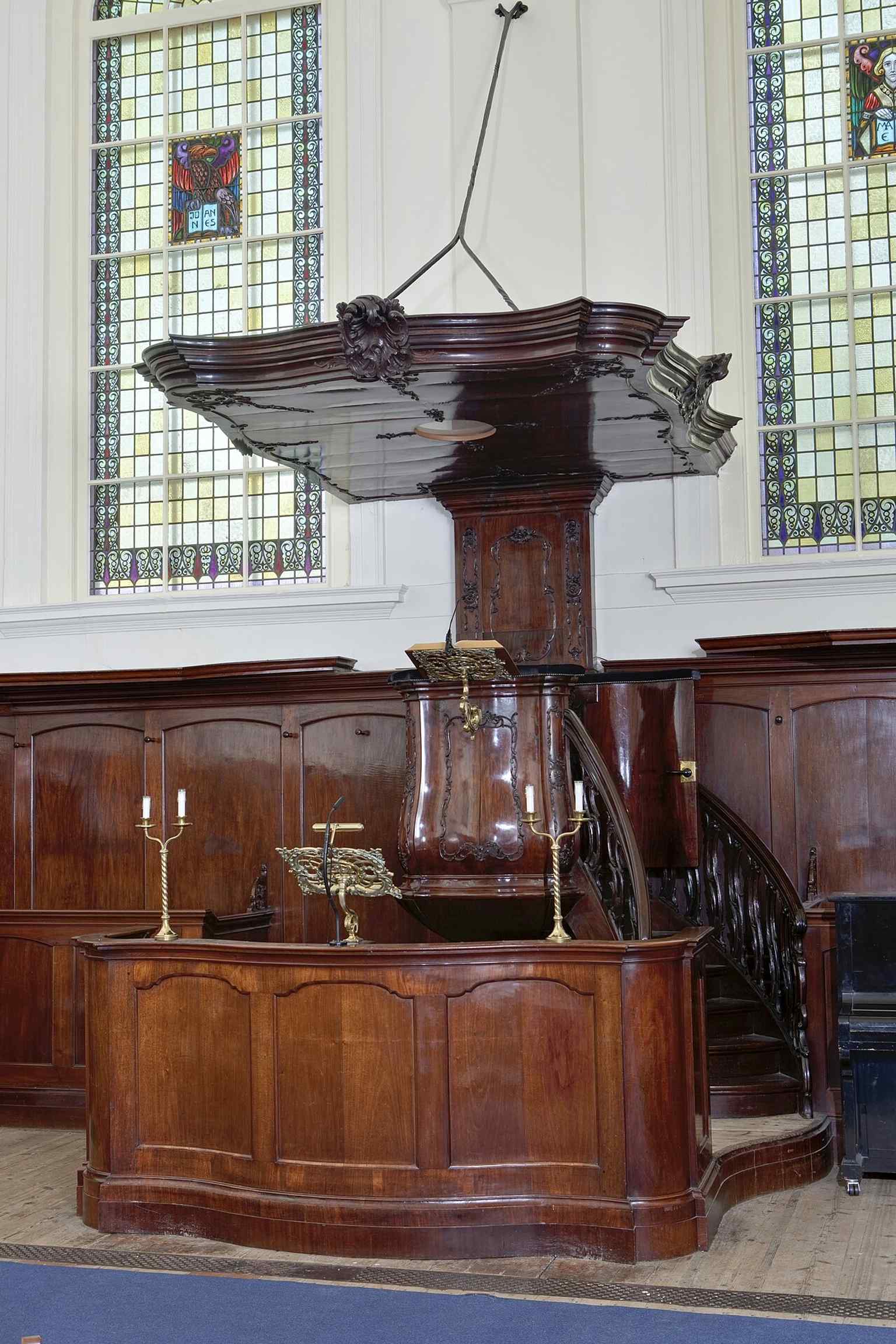
The simple yet elegant pulpit, a key feature of the church's 18th-century interior, executed in the strict Louis XVI style.Photo: Kris Roderburg / Chris Booms, Wikimedia Commons, CC BY-SA 4.0. Cropped & resized. 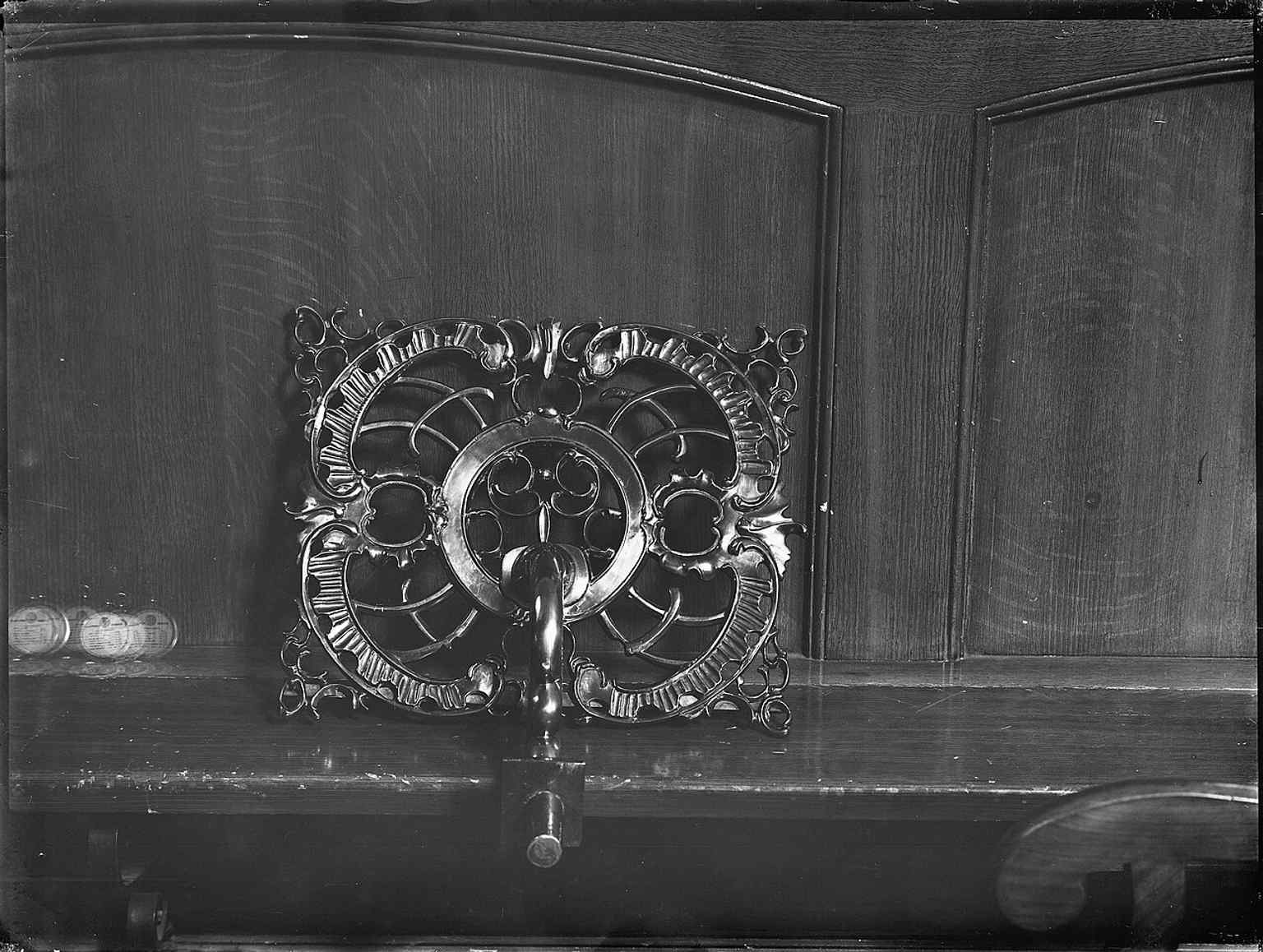
A close-up of the copper lectern at the baptismal fence (doophek), an example of the preserved 18th-century furniture within the church.Photo: Unknown authorUnknown author, Wikimedia Commons, CC BY-SA 4.0. Cropped & resized. Look to your right, and you will see a towering brick facade defined by a sweeping, ornate stepped gable and a slender octagonal tower reaching into the sky. This is Saint…Read moreShow less
Open dedicated page →Look to your right, and you will see a towering brick facade defined by a sweeping, ornate stepped gable and a slender octagonal tower reaching into the sky.
This is Saint Catherine's Cathedral, and its history is a masterclass in architectural survival. In fourteen sixty-eight, an order of Carmelite monks started building a monastery right here. But before they could finish the job, Emperor Charles the Fifth decided he needed a massive castle on the other side of town. He evicted the Knights Hospitaller from their land to build his fortress, and forced them to move here. The Knights took over this half-finished monastery, finally completing the church in fifteen sixty.
They built it as a grand cruciform church, meaning its floor plan is shaped like a cross. It was the very last medieval church constructed in Utrecht, built in a style called Brabantine Gothic, which is famous for tall, round columns and elaborate stone capitals carved to look like curling cabbage leaves.
But the Knights hardly got to enjoy their magnificent new home. Just twenty years later, the Reformation swept through the city. The Catholic church was stripped of its religious status and used for secular purposes, eventually becoming a Protestant church in sixteen thirty-six.
Jumping ahead to eighteen fifteen. In a very rare move, Saint Catherine's became the only medieval church in Utrecht returned to the Catholics. By eighteen fifty-three, it was elevated to a full cathedral. To celebrate its new status, the church brought in an artist named Friedrich Wilhelm Mengelberg to give the interior a dazzling Neo-Gothic makeover, filling the space with elaborate statues and decorations. Around nineteen hundred, an architect named Alfred Tepe extended the nave and added that striking fifty-three-meter tower you see outside today.
But architectural tastes can be brutal. In the nineteen fifties, a new generation of restorers decided they absolutely hated the Neo-Gothic additions. They stripped most of it out, trying to recreate the stark, bare interior captured in a seventeenth-century drawing by the artist Pieter Jansz Saenredam. Check out your screen to see Saenredam's original sketch of the interior, which became the blueprint for erasing decades of design. If you want to see how the nave evolved over those restless decades of restoration, you can pull up the historic comparison in your app to see the view looking east toward the choir in nineteen fifty-nine versus the year two thousand.
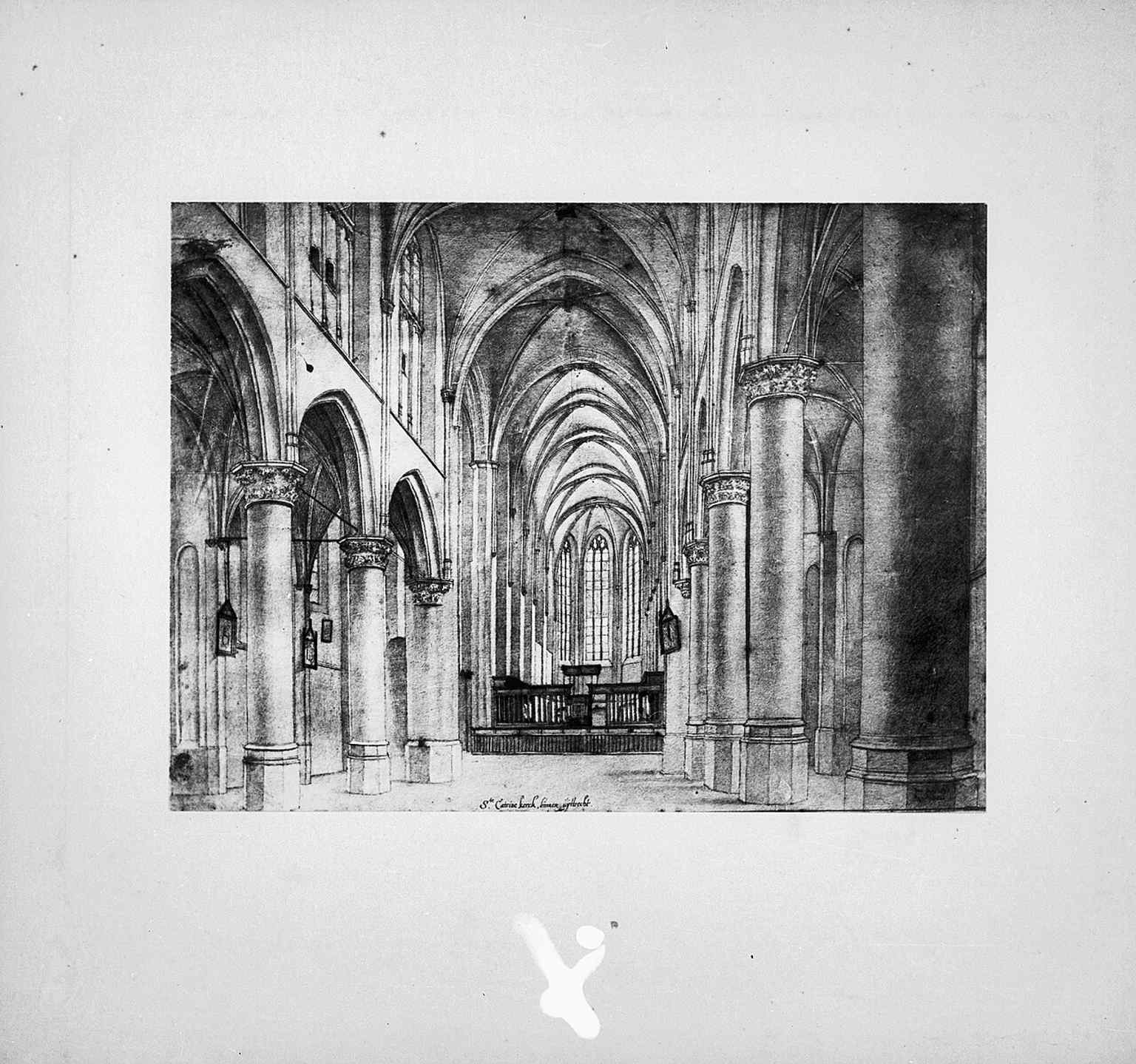
Pieter Jansz Saenredam's interior drawing, a crucial reference for the 1955-1965 restoration efforts to revert the space to its 1636 appearance.Photo: GEMEENTE MUSEUM (Fotograaf), Wikimedia Commons, CC BY-SA 4.0. Cropped & resized. They have since realized their mistake and brought some of the gorgeous Neo-Gothic art back out of storage. And the drama never really stops here. In two thousand eighteen, the diocese announced they would close the cathedral due to budget problems. But the public outcry was so fierce that the Archbishop reversed the decision just a year later.
If you want to explore the interior, the cathedral is open daily starting at noon, though Sunday mornings open at nine fifteen AM and Mondays only offer evening hours. Appreciate this towering landmark. Whenever you're set, we can head to the next stop.
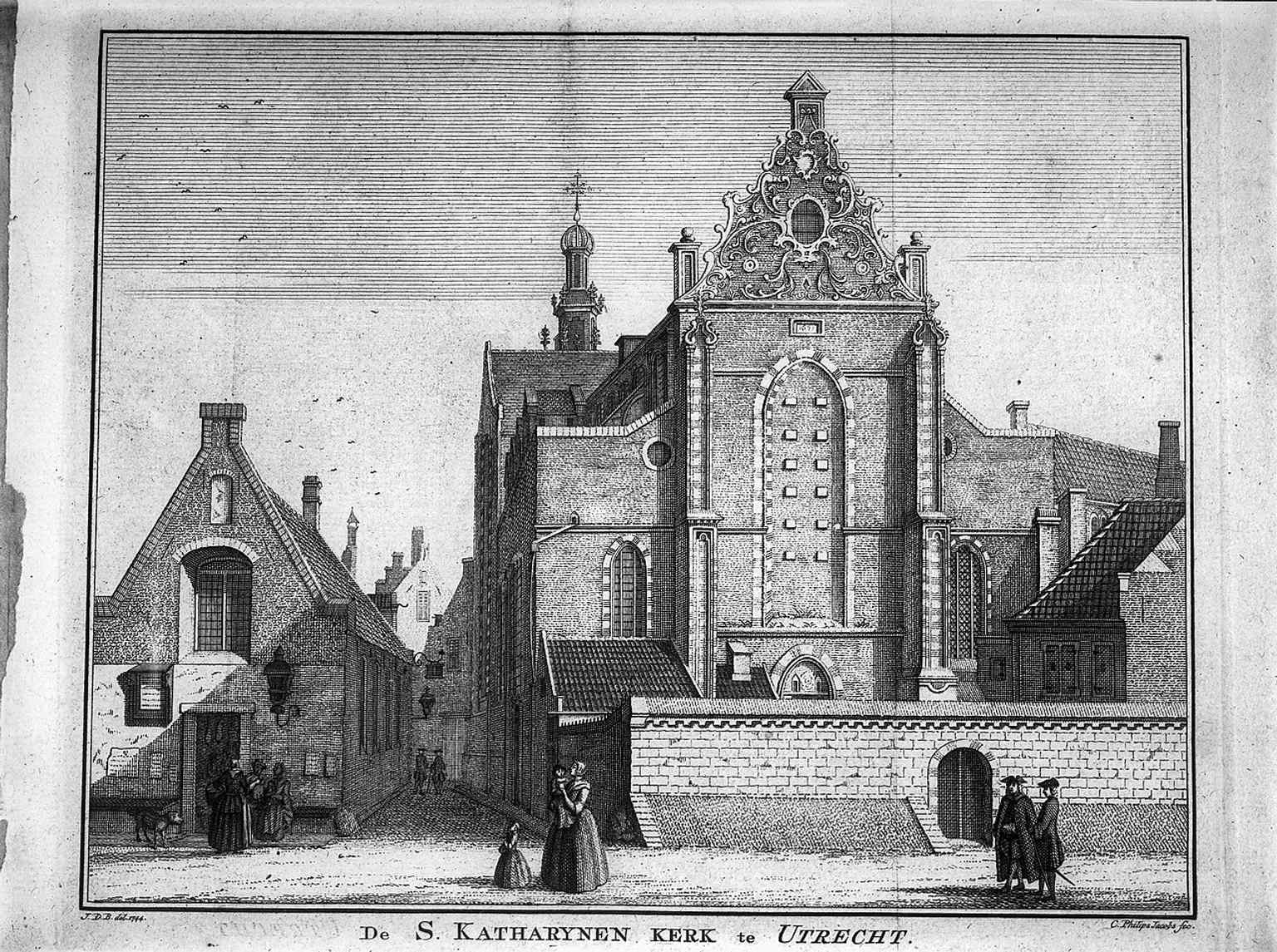
An early engraving of the Catharijnekerk, representing its appearance from 'Tegenwoordige Staat der Verenigde Nederlanden' and offering a glimpse into its long history.Photo: Unknown authorUnknown author, Wikimedia Commons, CC BY-SA 4.0. Cropped & resized. 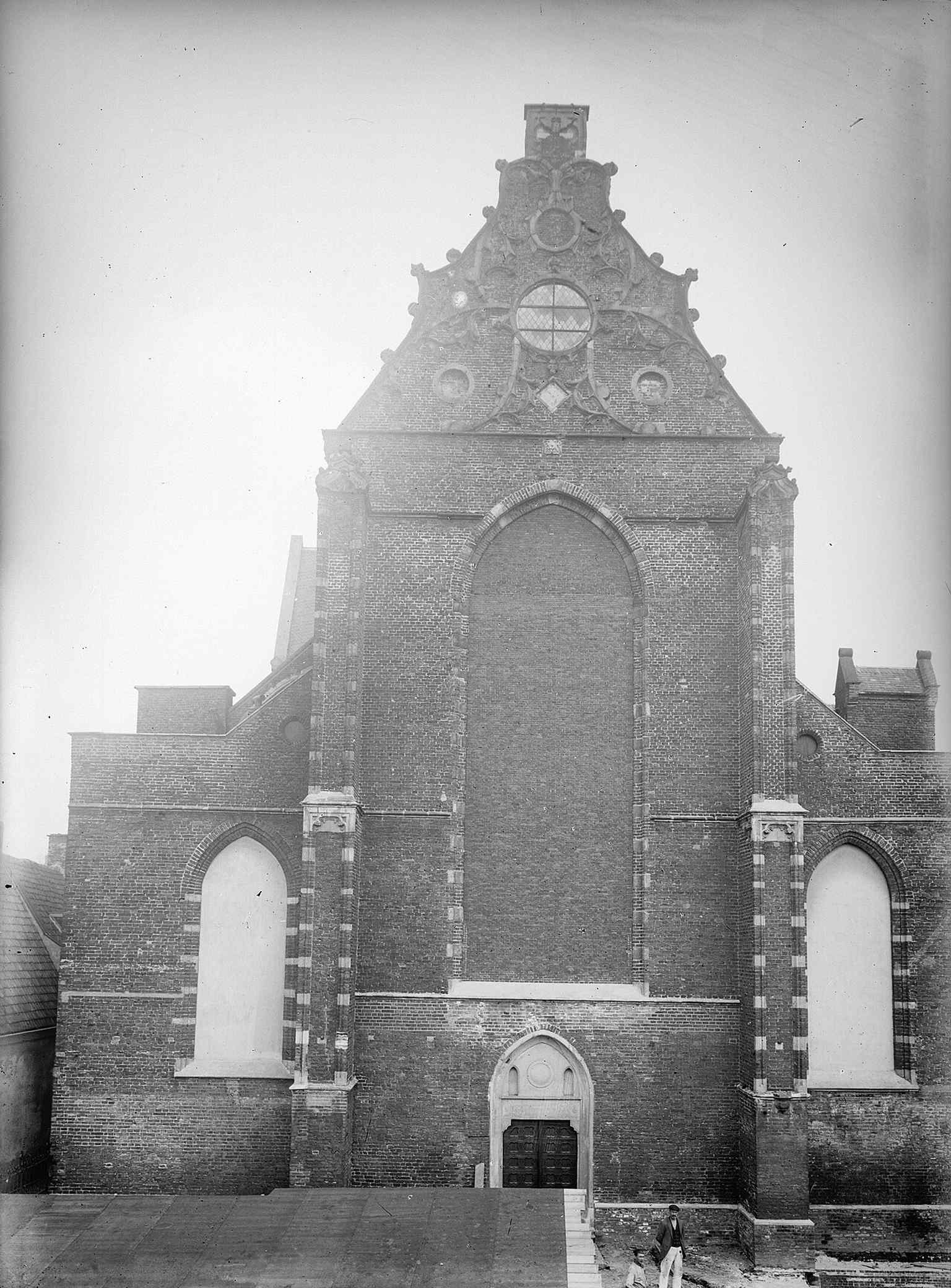
The west facade of the Catharijnekerk around 1899, showcasing its appearance before architect Alfred Tepe extended the nave and added the 53-meter tower.Photo: Unknown authorUnknown author, Wikimedia Commons, CC BY-SA 4.0. Cropped & resized. 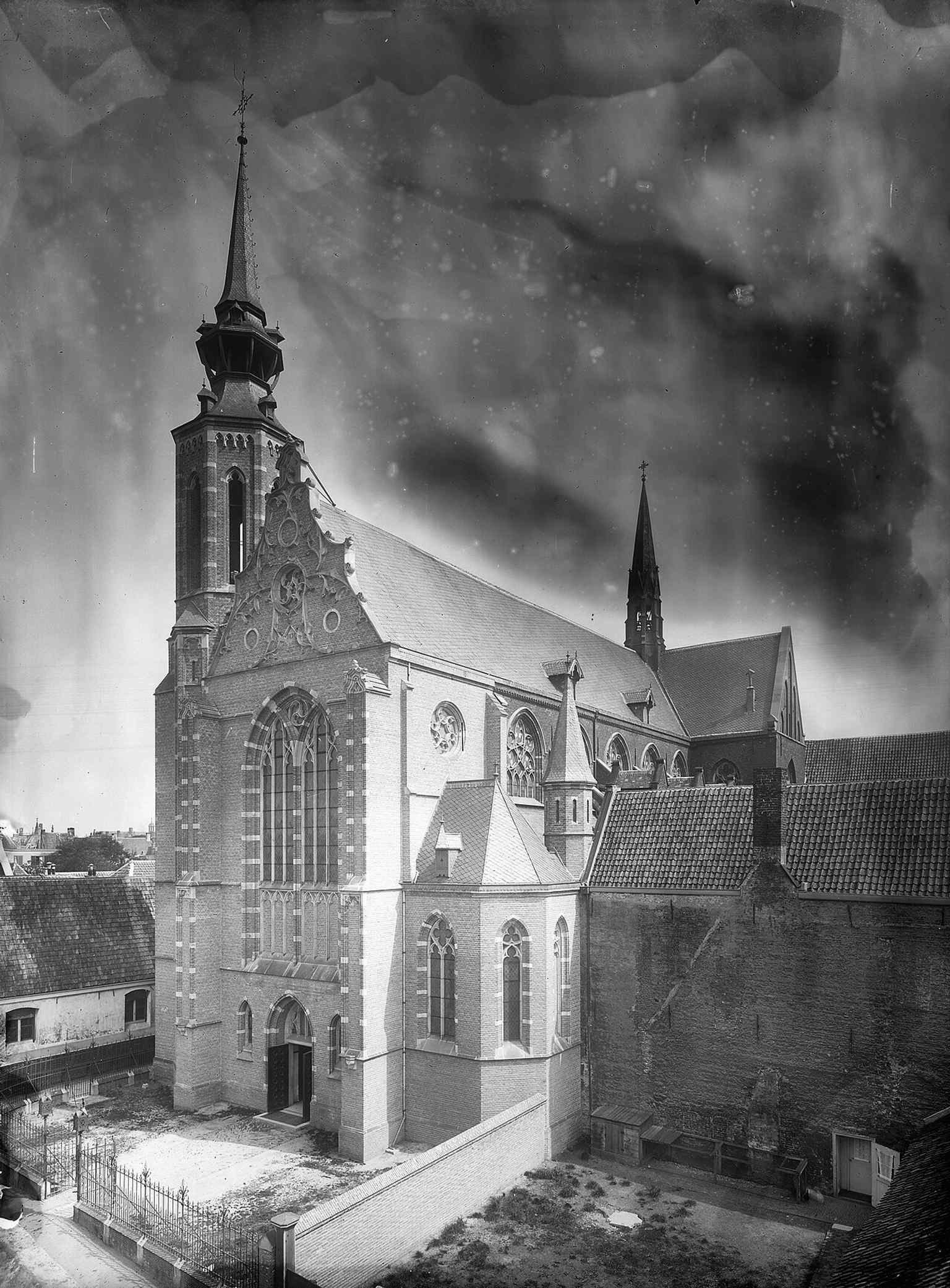
The St. Catherine's Church from the southwest, featuring the distinctive 53-meter tower inspired by Kampen's town hall, added by architect A. Tepe around 1900.Photo: Unknown authorUnknown author, Wikimedia Commons, CC BY-SA 4.0. Cropped & resized. 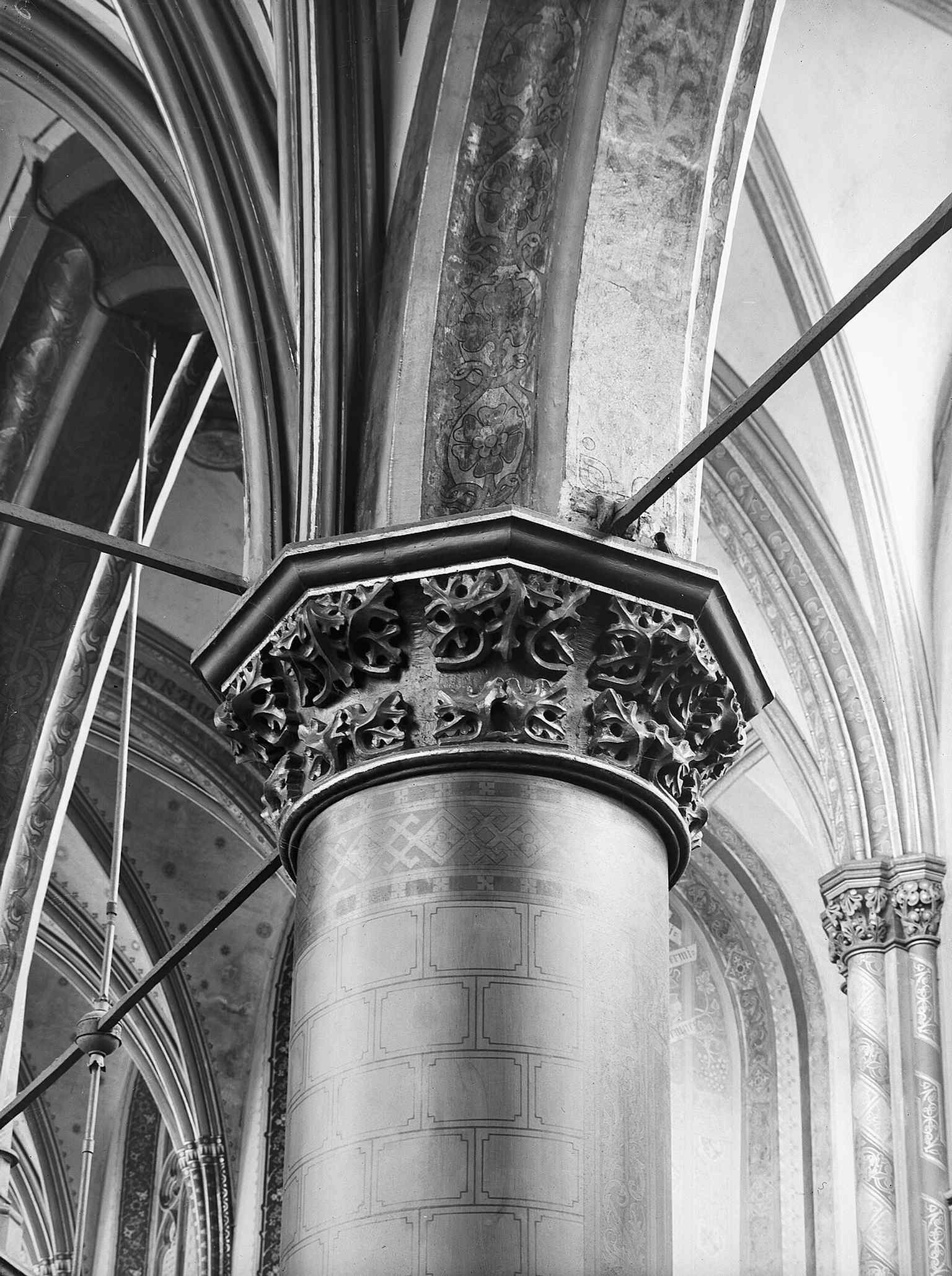
A detail of a 'koolbladkapiteel' (cabbage leaf capital) in the northern side aisle, showcasing the Brabant Gothic influence in the church's 16th-century architecture.Photo: Unknown authorUnknown author, Wikimedia Commons, CC BY-SA 4.0. Cropped & resized. 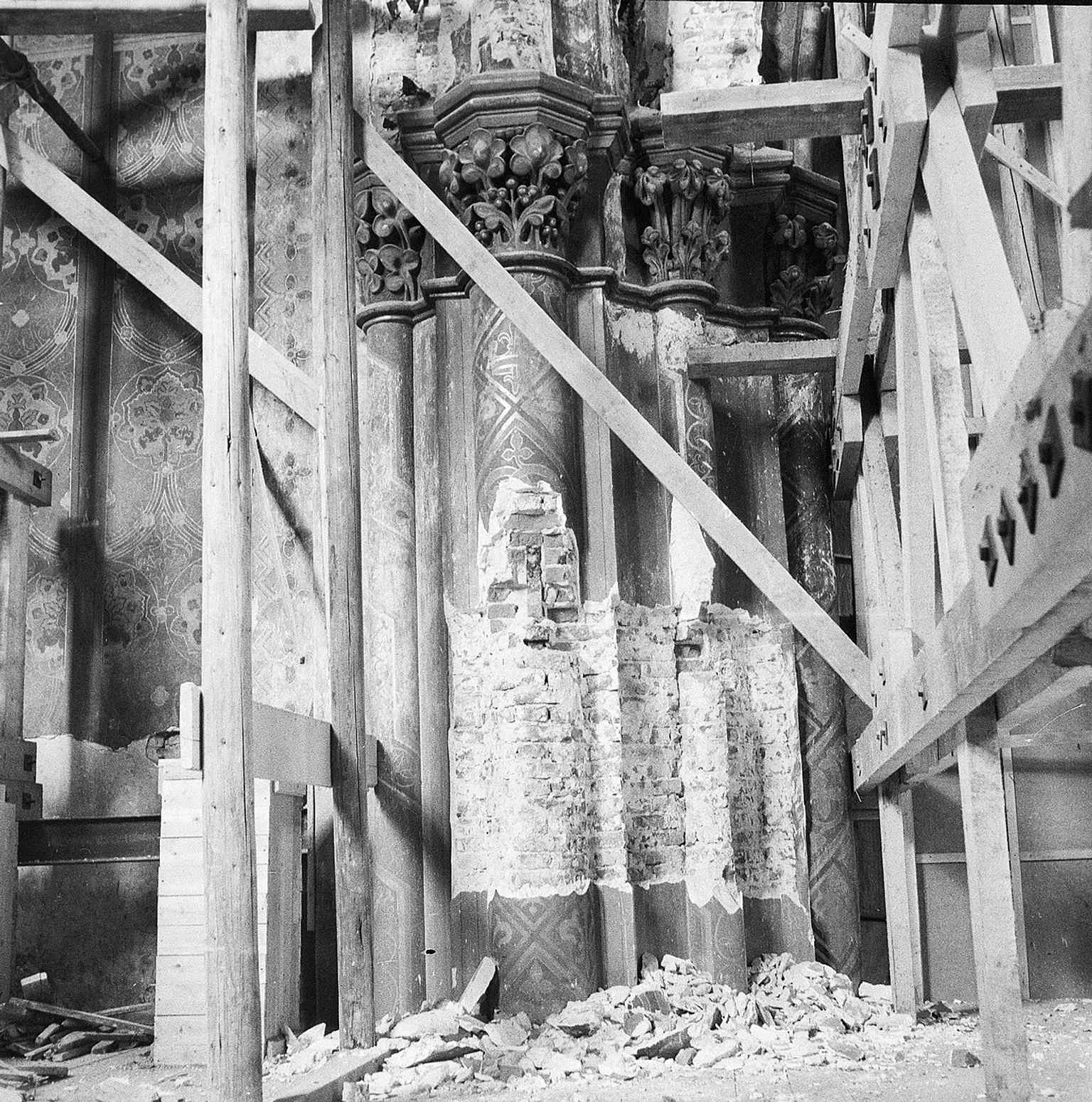
A photo from 1957 illustrating the 'ontgipsing' (plaster removal) process during the major 1955-1965 restoration, which aimed to return the interior to its 1636 state.Photo: G.Th. Delemarre, Wikimedia Commons, CC BY-SA 4.0. Cropped & resized. 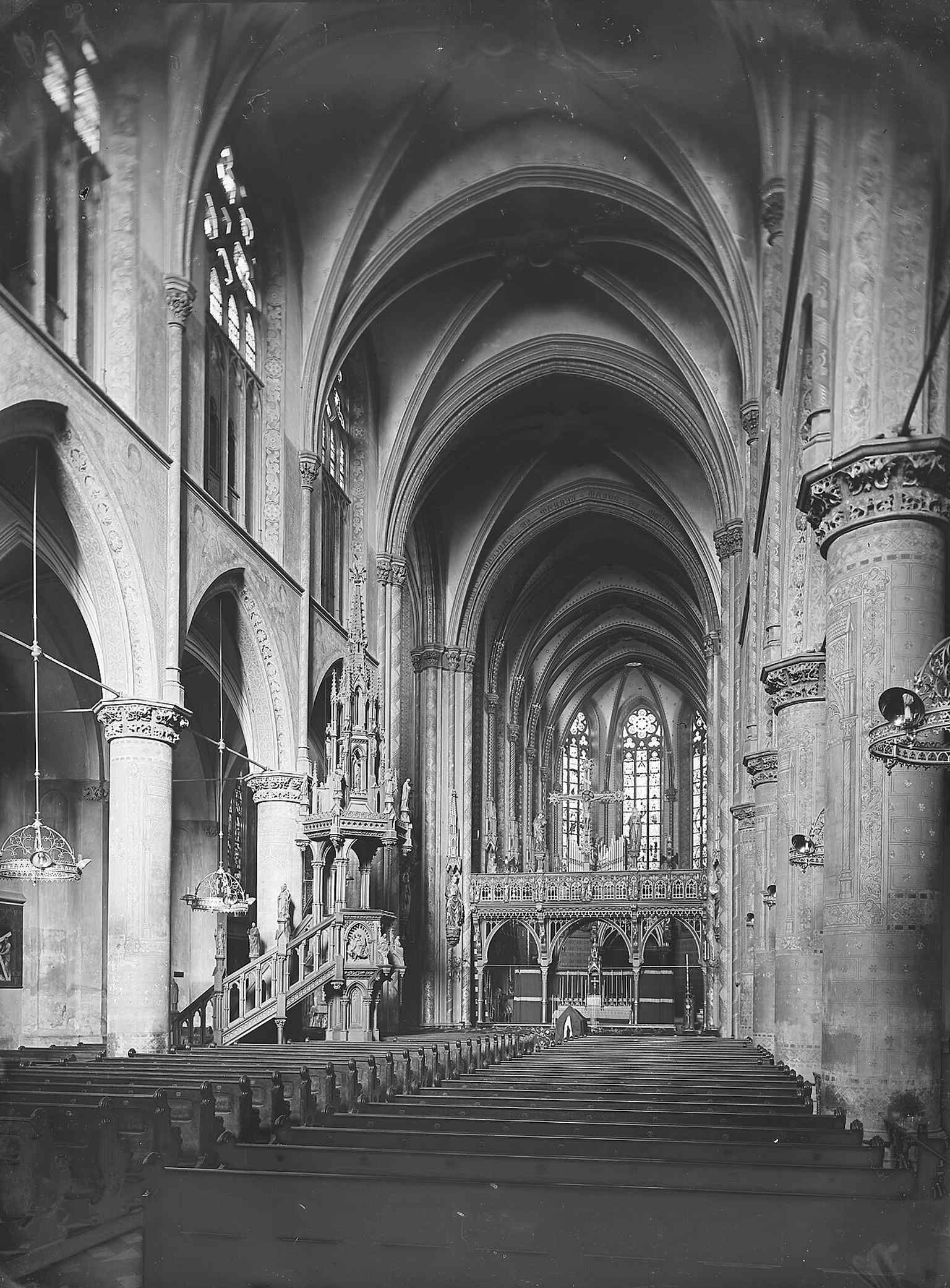
A general interior view looking east, providing a sense of the large Gothic cruciform structure completed in 1560 as the last medieval church in Utrecht.Photo: Unknown authorUnknown author, Wikimedia Commons, CC BY-SA 4.0. Cropped & resized. 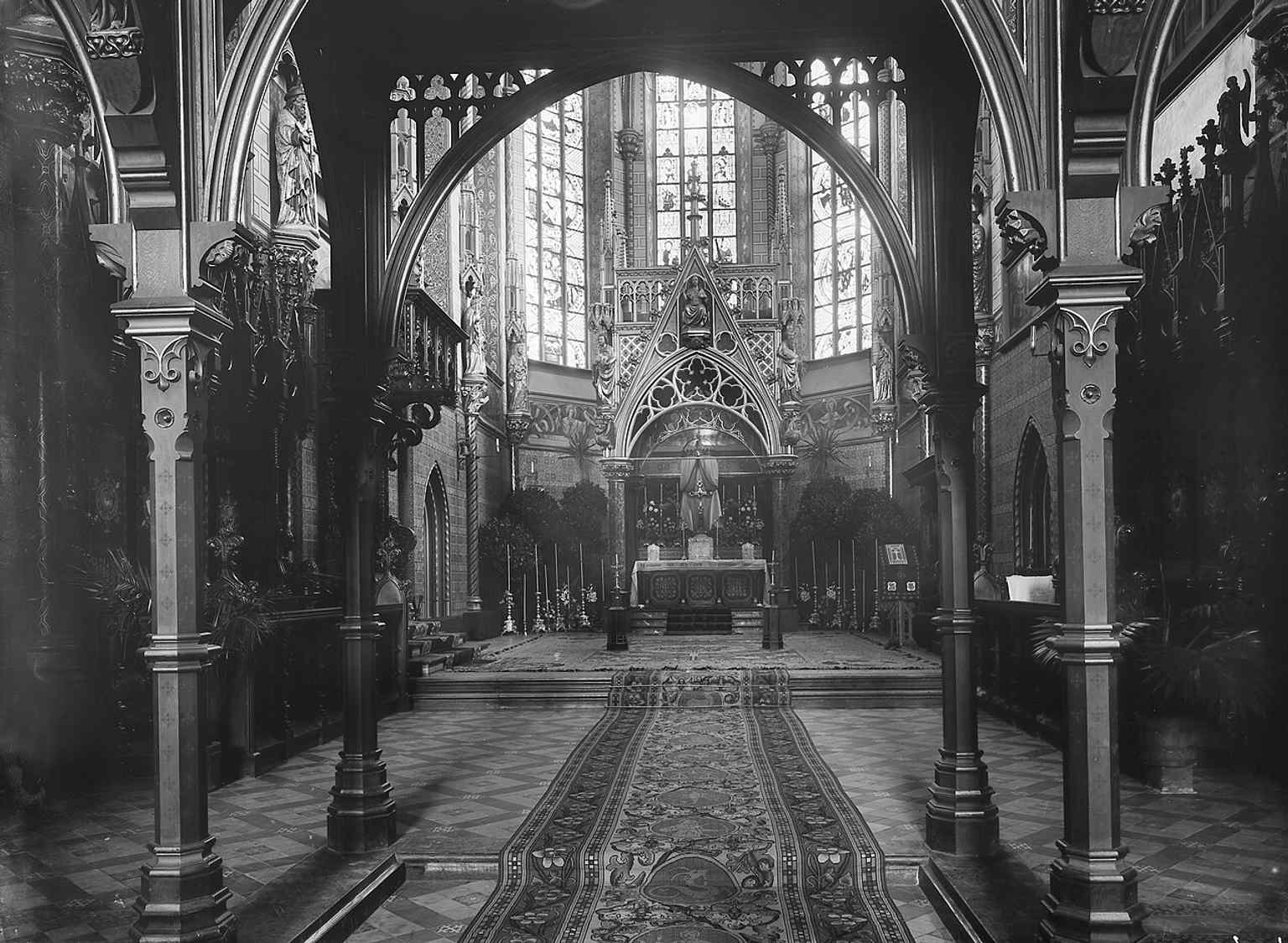
A view of the church's choir, an important area where many Neo-Gothic sculptures by F.W. Mengelberg and the sacrament tower are located.Photo: Unknown authorUnknown author, Wikimedia Commons, CC BY-SA 4.0. Cropped & resized. 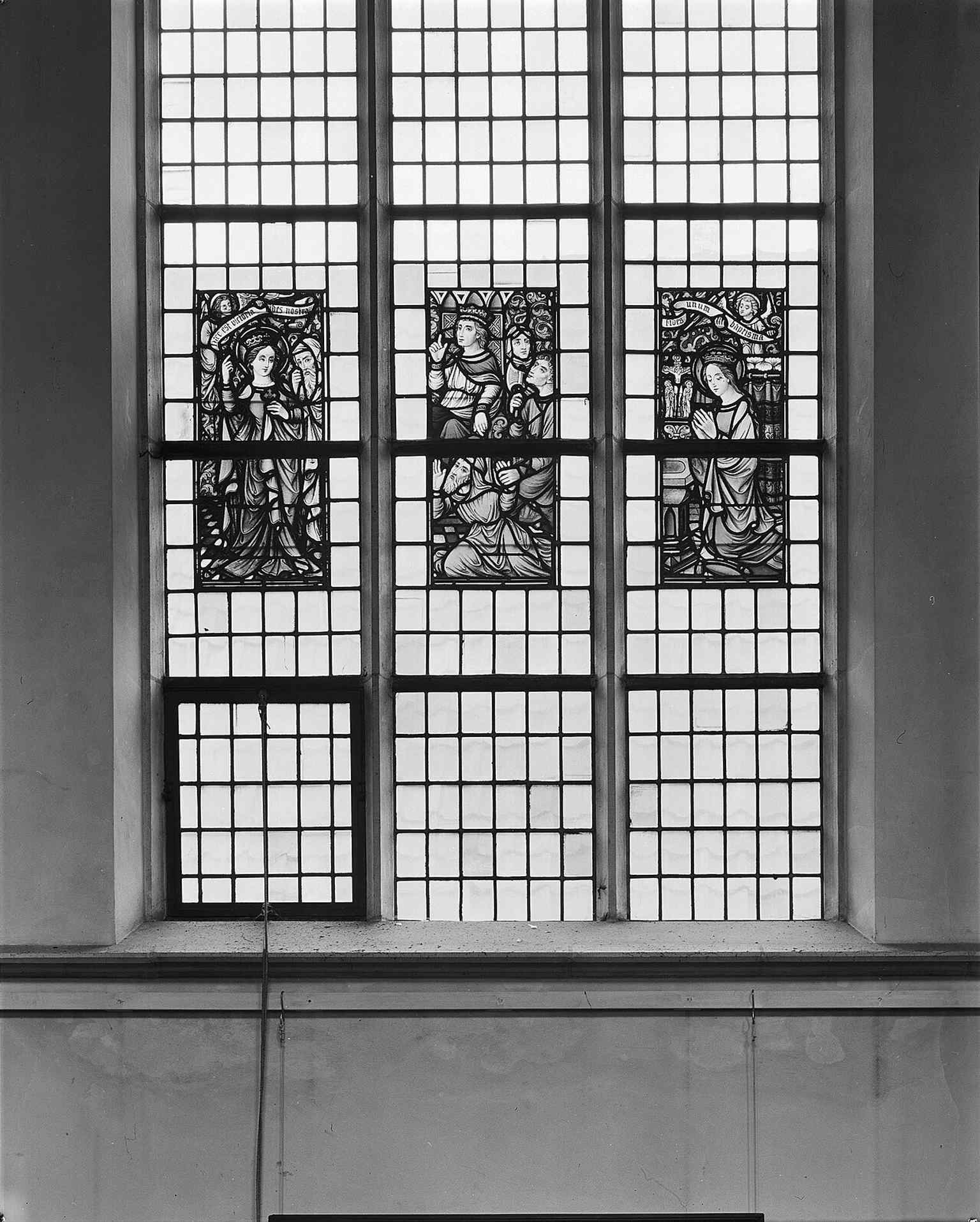
A vibrant stained glass window depicting scenes from the life of Saint Catherine of Alexandria, the revered patron saint to whom the cathedral is dedicated.Photo: Ton Schollen, Wikimedia Commons, CC BY-SA 4.0. Cropped & resized. 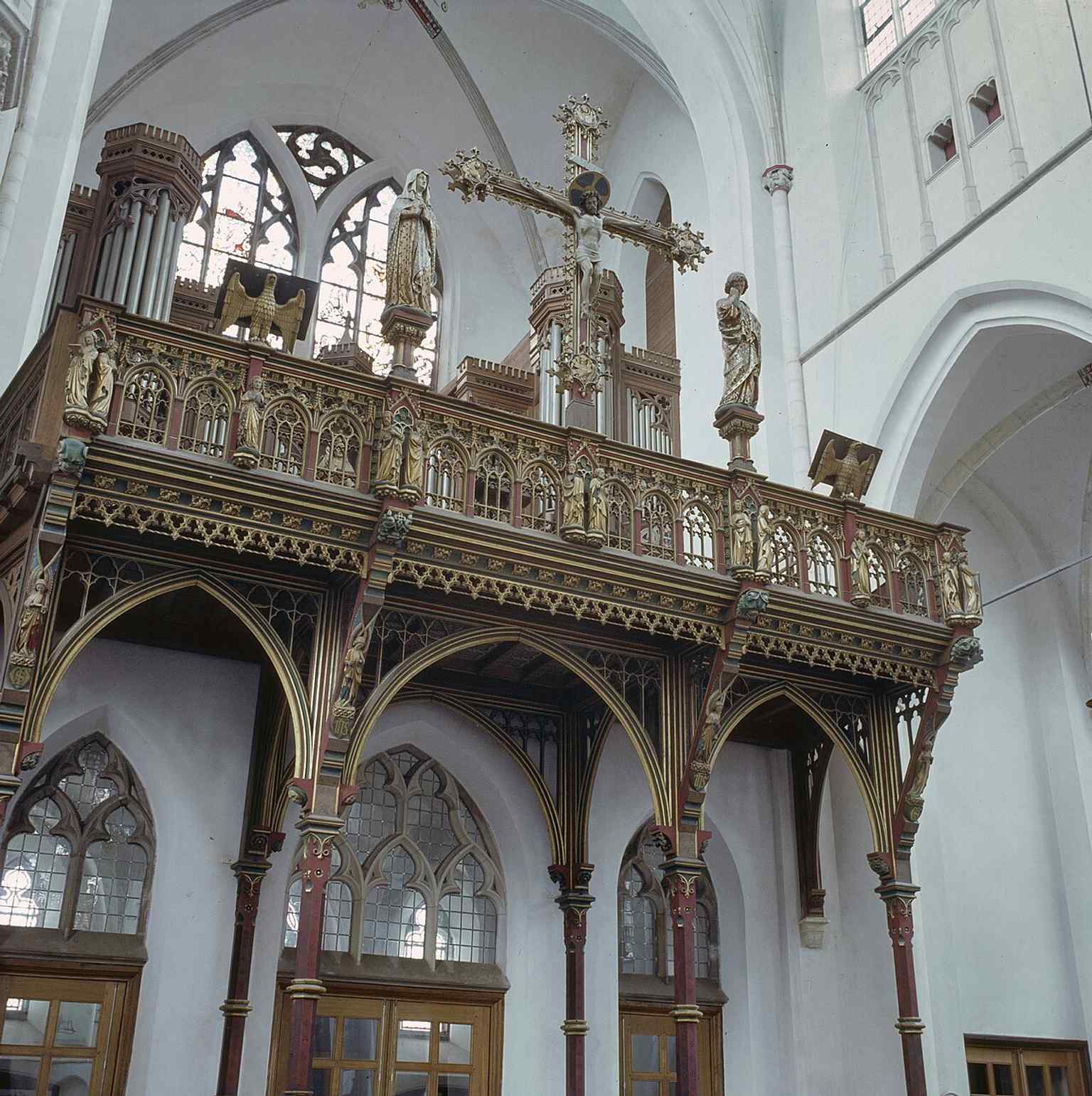
The Neo-Gothic 'doksaal' (rood screen), an important piece crafted by F.W. Mengelberg in 1871 and now positioned at the west side of the church.Photo: Unknown authorUnknown author, Wikimedia Commons, CC BY-SA 4.0. Cropped & resized. 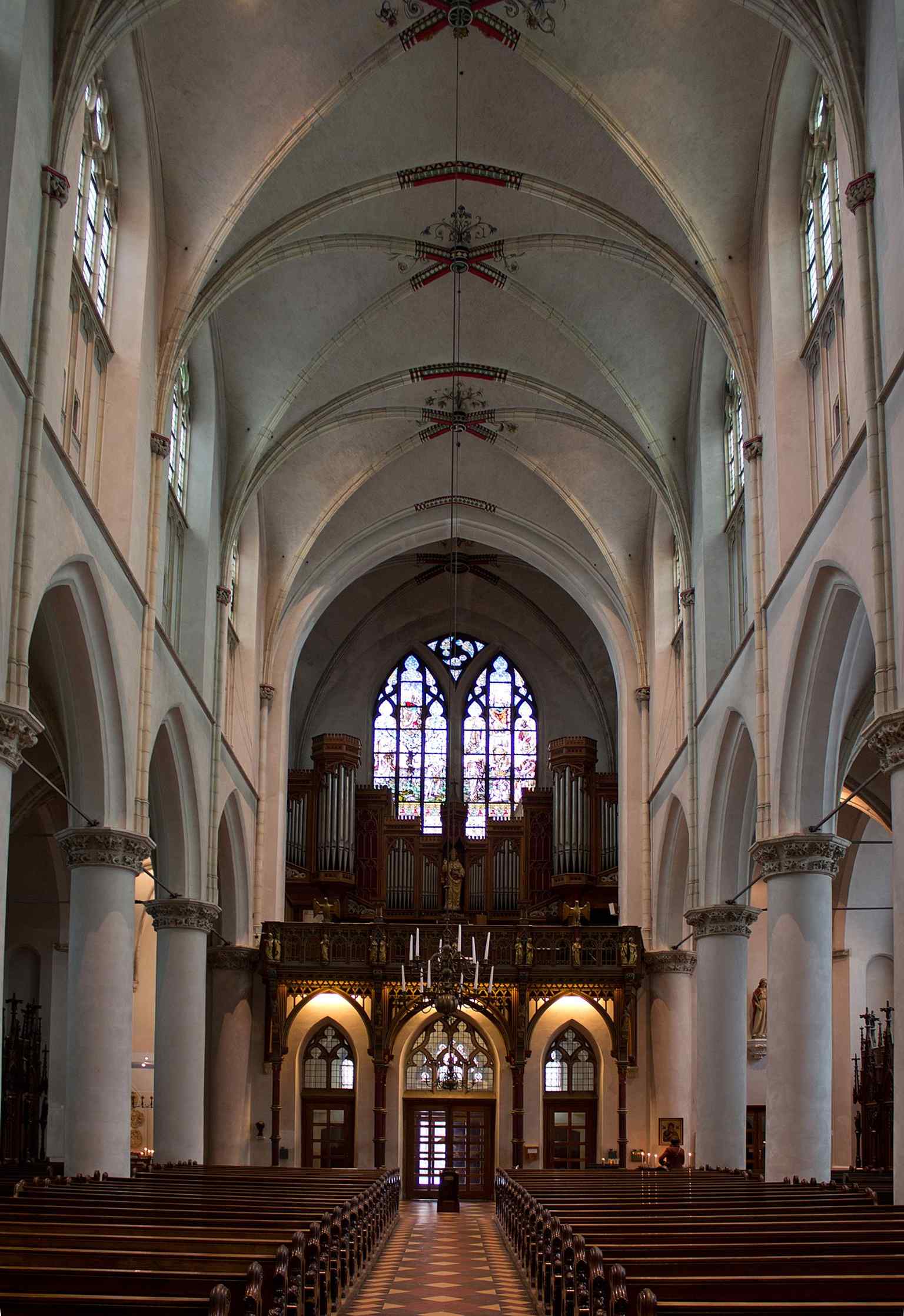
The majestic Maarschalkerweerd organ, built in 1903 and expanded in 1939, dominates the west end of the cathedral, a centerpiece for the church's musical life.Photo: Johan Bakker, Wikimedia Commons, CC BY-SA 3.0 nl. Cropped & resized. Look to your left and you will see a large, multi-story brick building with a dark, sloping slate roof dotted with dormer windows, bordering a green garden space that features a…Read moreShow less
Open dedicated page →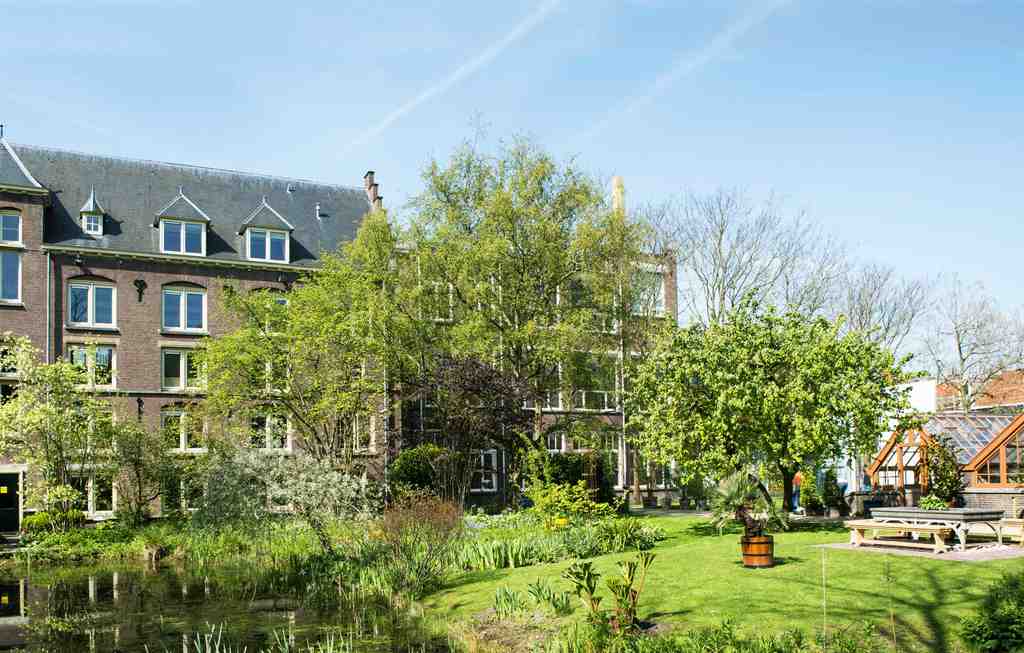
Old HortusPhoto: UMuseumUtrecht, Wikimedia Commons, CC BY-SA 4.0. Cropped & resized. Look to your left and you will see a large, multi-story brick building with a dark, sloping slate roof dotted with dormer windows, bordering a green garden space that features a peaked glass and wood greenhouse in the background.
Welcome to the Old Hortus. You are standing right on the edge of a living timeline of botanical science. For centuries, this was the official botanical garden of Utrecht University.
The story actually starts way back in sixteen thirty-nine. The university was just three years old, and the city bought a plot of land for a hortus medicus, a medical garden. Back then, botany was all about survival. The first director, Henricus Regius, grew herbs specifically to train medical students in healing. He even published a catalog in sixteen fifty documenting six hundred seventy-eight different species!
By seventeen twenty-three, the garden outgrew its original plot and moved right here to this very spot. It became a true hortus botanicus, a garden dedicated to the science of plants itself. The legendary Swedish botanist Carl Linnaeus even visited here in seventeen thirty-five. A local professor, Evert Jacob van Wachendorff, completely redesigned this space to demonstrate his very own system of plant classification, tagging everything with numbers.
If you explore the grounds today, you can still trace this incredible history. You will find an eighteenth-century Ginkgo biloba, widely considered the oldest Japanese nut tree in all of Europe. You will also see two orangeries dating back to seventeen twenty-four and seventeen sixty-eight. These were specialized buildings designed to keep tropical and subtropical plants alive through the cold European winters.
But science never stops moving. Jumping to the early twentieth century, between nineteen zero six and nineteen zero eight. Botanists tore down the old glasshouses to build a highly modern greenhouse complex where they could artificially control different climates. Check out the screen on your device for a look inside one of those incredible warm-climate rooms from the modern era, featuring the massive Victoria Amazonica water lily.
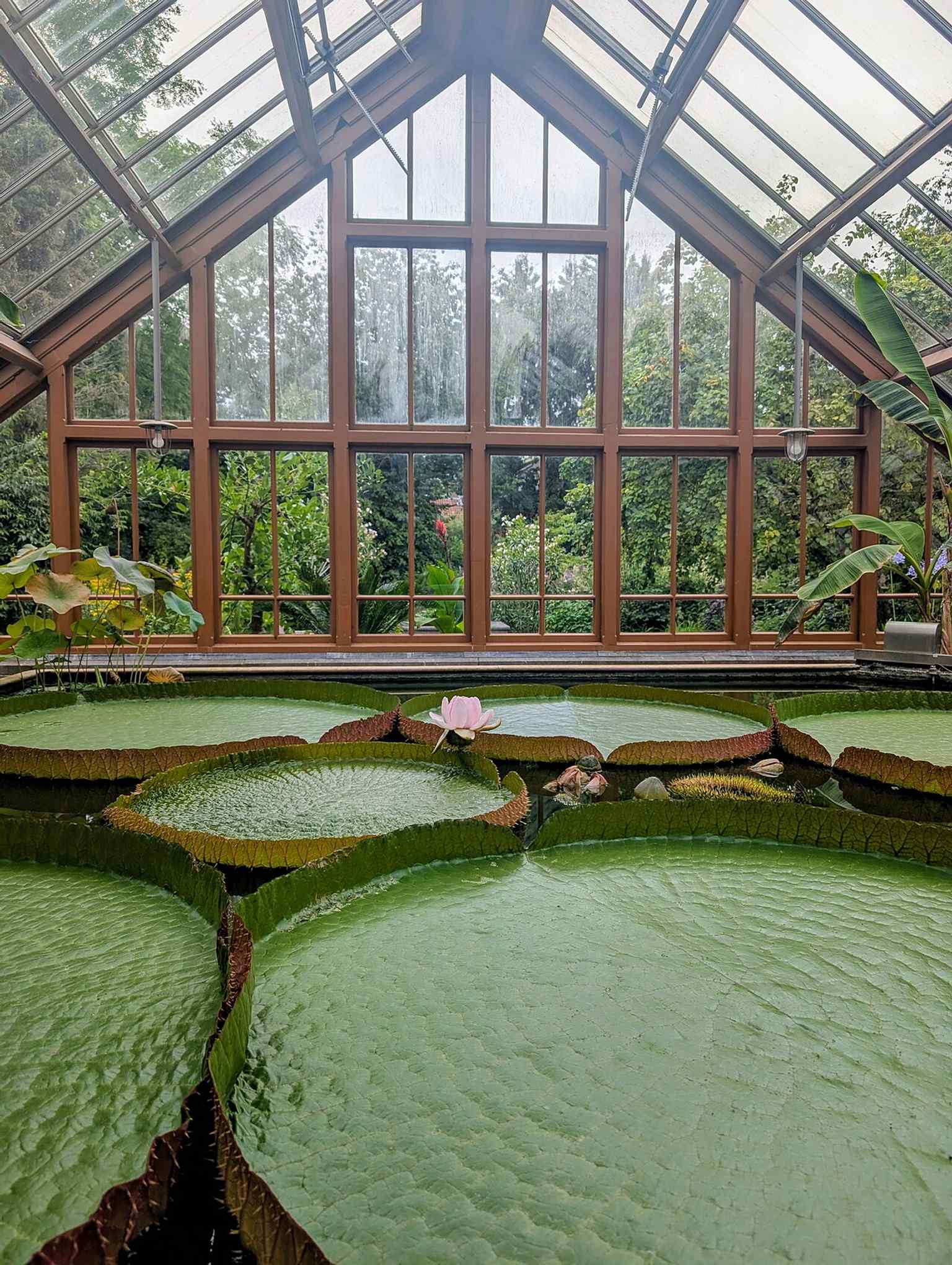
The impressive Victoria Amazonica water lily, as seen in the Oude Hortus's modern greenhouse complex, which was built between 1906 and 1908 to allow for different climates.Photo: Mx Lucy, Wikimedia Commons, CC BY-SA 4.0. Cropped & resized. Eventually, the university outgrew this space too. In nineteen twenty, the main plant collection began moving out to the countryside, and by nineteen ninety-one, developers actually planned to demolish this entire historic complex to build a parking lot. Luckily, locals, rotary clubs, and dedicated volunteers formed a foundation and fought tooth and nail to save it. They won. Today, this space thrives as a museum garden attached to the Utrecht University Museum.
If you want to explore the historic gardens and the museum cafe, just keep in mind they are closed on Mondays, but open Tuesday through Sunday from ten AM to five PM.
This sanctuary survived against all odds, preserving three and a half centuries of scientific discovery in its soil. Enjoy the lush greenery. When you are ready, we will head to the next stop.
Look to your left for the Centraal Museum, easily spotted by its historic brick walls, modern glass additions, and a striking sign featuring a perfectly round, bright yellow…Read moreShow less
Open dedicated page →
Centraal MuseumPhoto: Centraal Museum, Wikimedia Commons, Public domain. Cropped & resized. Look to your left for the Centraal Museum, easily spotted by its historic brick walls, modern glass additions, and a striking sign featuring a perfectly round, bright yellow circle.
This place is an absolute treasure chest! Today, the Centraal Museum holds an astonishing collection of over fifty thousand objects, ranging from ancient archaeological finds to cutting-edge contemporary fashion. But the story of how this massive collection came together is just as fascinating as the artifacts themselves.
Back in eighteen thirty, the city of Utrecht realized it had gathered quite a pile of historical artifacts and nowhere to properly show them off. So, they set up a modest four-room gallery on the top floor of the local city hall. In eighteen thirty-eight, Mayor Van Asch van Wijck officially opened it to the public. For just a quarter - roughly three euros in today's money - locals could spend ninety minutes every Wednesday afternoon wandering through the city's artistic heritage. Visitors were handed a very wordy catalog and left to explore.
But as the city uncovered more artifacts, those four rooms quickly became overcrowded. By eighteen seventy-four, a dedicated archivist named Samuel Muller took charge. He reorganized the chaotic displays into a proper timeline, relentlessly hunted down new artifacts, and eventually moved the whole operation to a larger estate. The crowds exploded. Attendance jumped from two thousand visitors a year to over twenty thousand!
Still, they needed even more space. In nineteen twenty-one, the city decided to merge several private collections into one centralized institution, giving birth to the name Centraal Museum. They moved everything right here to the medieval Agnietenklooster, a former convent. Once serving as a utilitarian military building at the turn of the twentieth century, the historic former monastery was beautifully repurposed to house the expansive art and design collections of the Centraal Museum.
Since then, the building has evolved, most notably with a dramatic nineteen ninety-nine renovation by Flemish architects who added the towering five-story glass entrance you can see today.
What waits inside is incredibly diverse. You will find the Utrecht ship, a massive one-thousand-year-old wooden vessel discovered completely buried in the city in nineteen thirty. You will find over eight thousand pieces of fashion, spanning from eighteenth-century corsets to modern avant-garde creations. You will also find masterpieces by the Utrecht Caravaggists, local seventeenth-century painters who adopted the dramatic, high-contrast lighting techniques of the famous Italian artist Caravaggio. If you glance at your screen, you can see Theo van Doesburg's Portrait of a Woman with a Hat, which perfectly captures the bold modern art you will also discover inside.
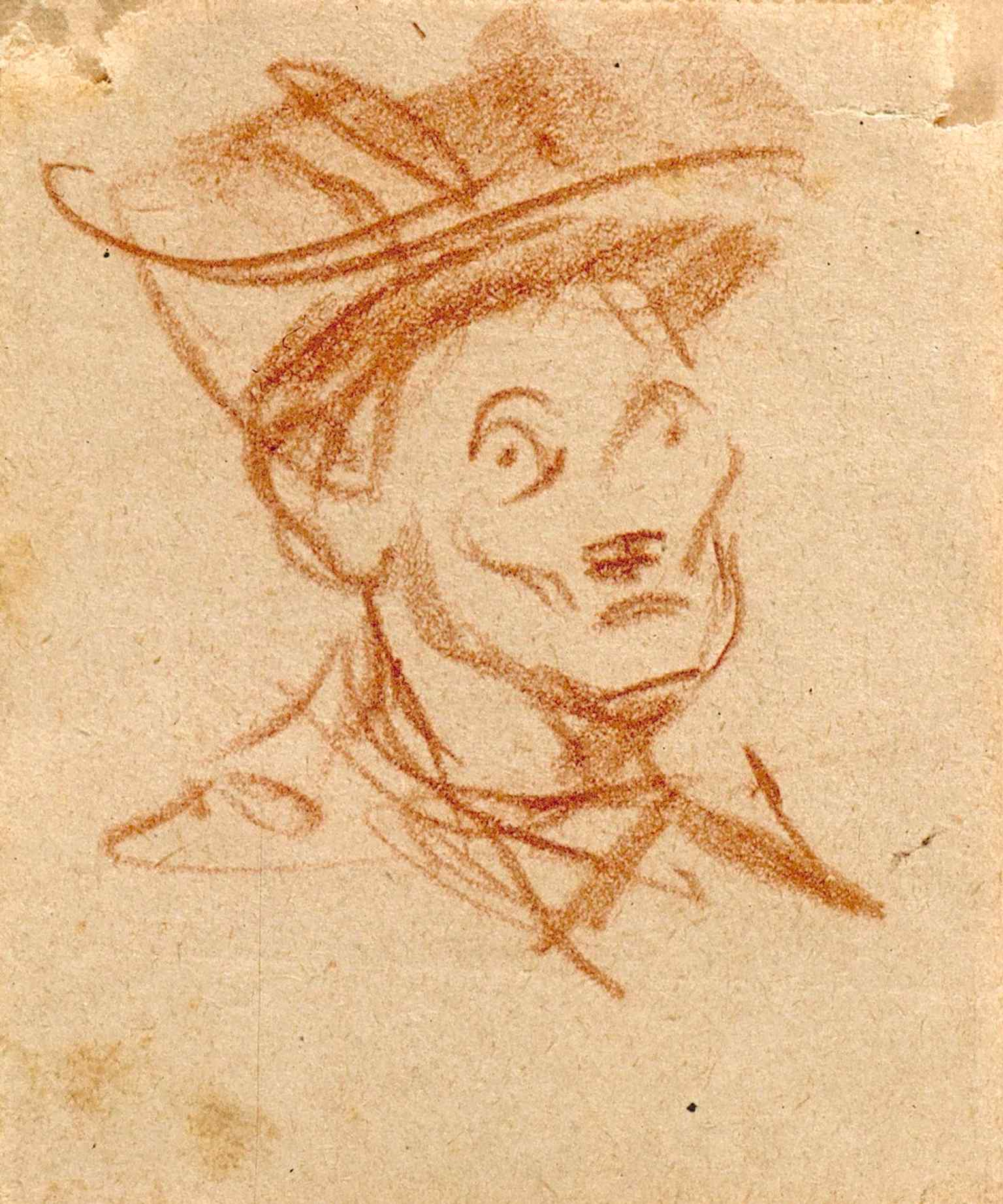
"Portrait of a Woman with a Hat" by Theo van Doesburg, an important Dutch artist whose work, like "Mouvement héroïque," is part of the Centraal Museum's collection.Photo: Theo van Doesburg, Wikimedia Commons, Public domain. Cropped & resized. If you want to explore the galleries, the museum is open Tuesday through Sunday from eleven A-M to five P-M.
There is so much human ingenuity packed into these walls. Think about the endless stories hidden within. When you're ready, let's move on.
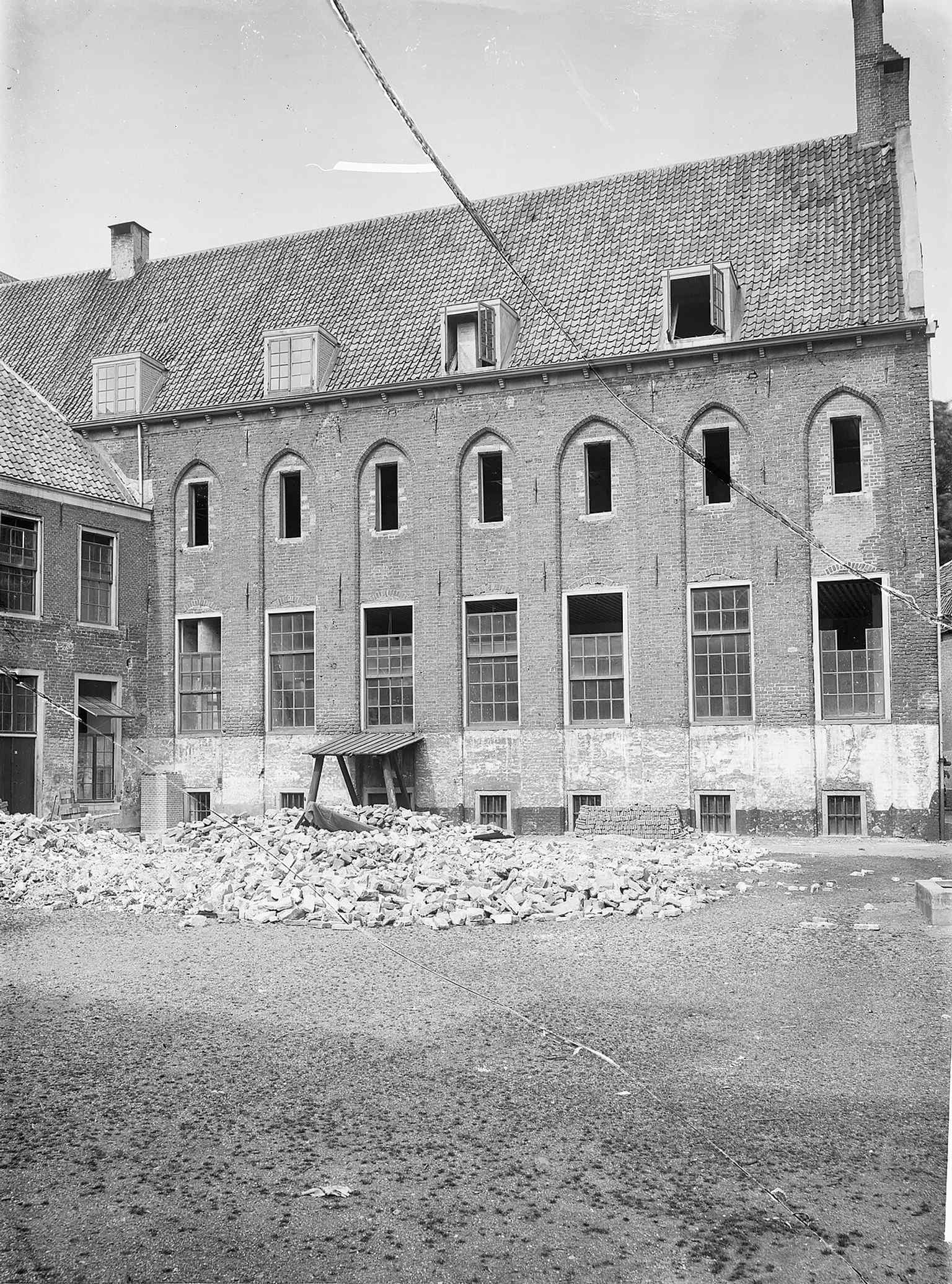
The Agnietenklooster exterior in 1902, almost two decades before it became the Centraal Museum's permanent home.Photo: Unknown authorUnknown author, Wikimedia Commons, CC BY-SA 4.0. Cropped & resized. 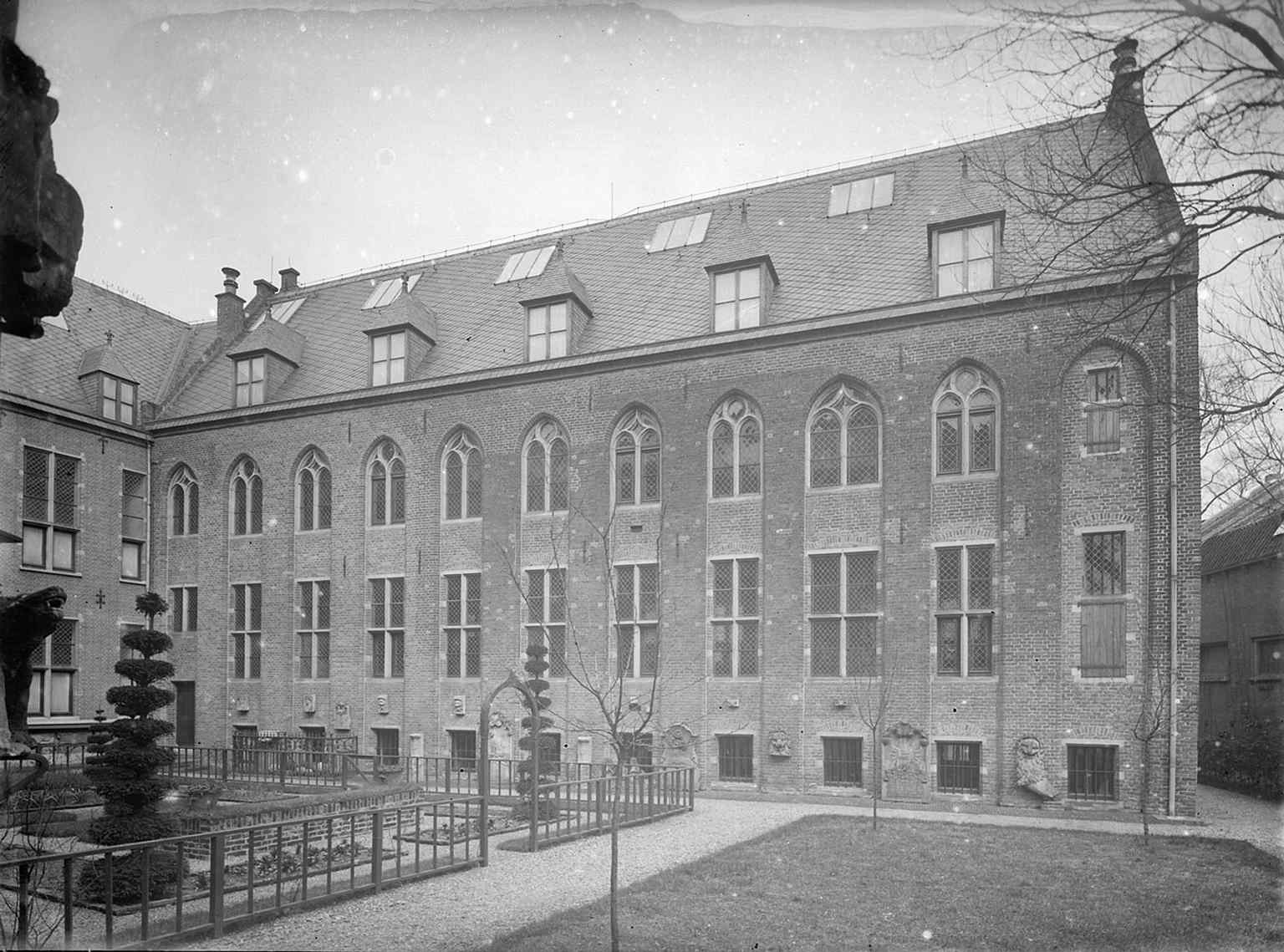
An interior view of the Agnietenklooster's refectory in 1925, shortly after it was repurposed to house the Centraal Museum.Photo: Unknown authorUnknown author, Wikimedia Commons, CC BY-SA 4.0. Cropped & resized. 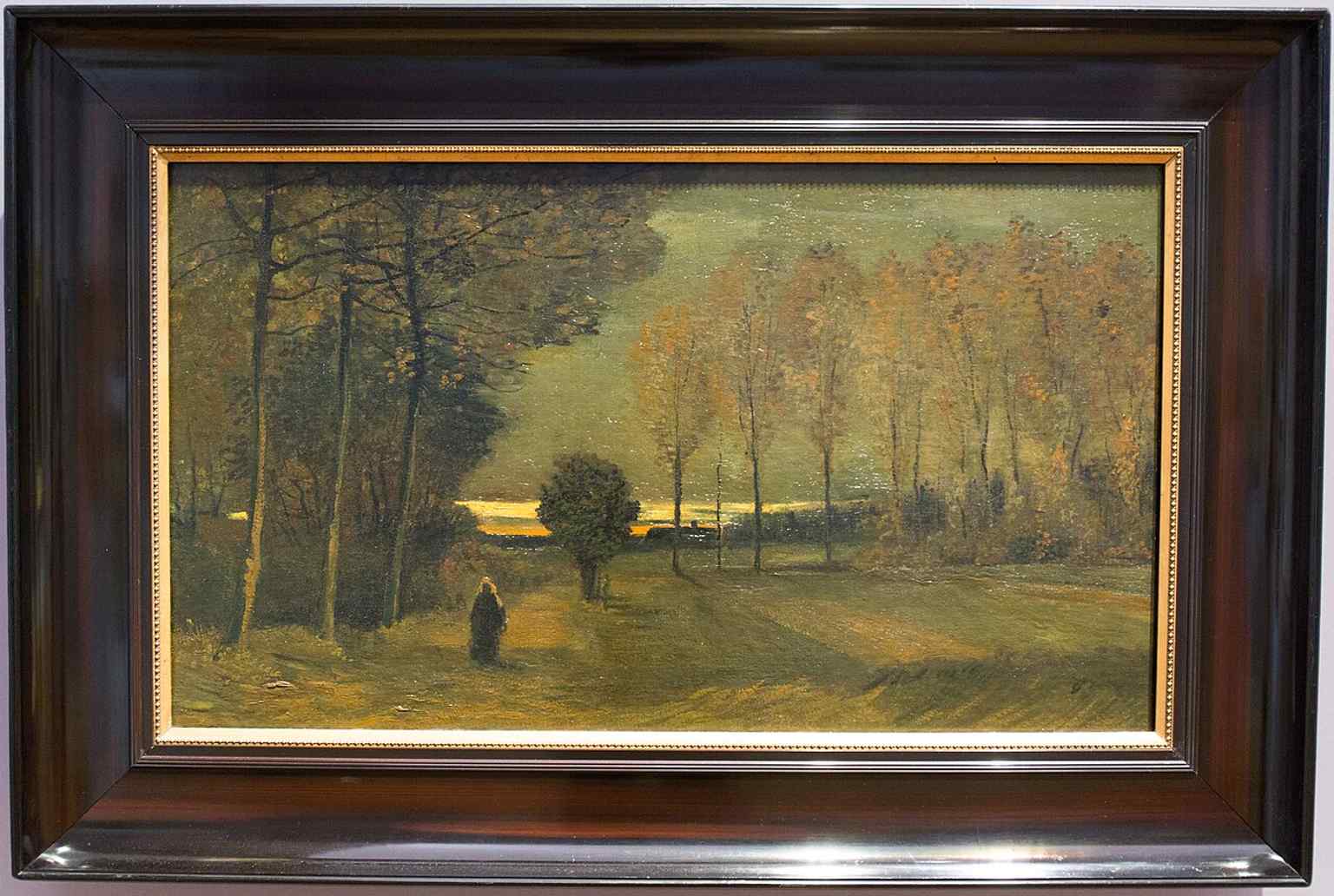
Vincent van Gogh's "Borabend," an example from the Centraal Museum's extensive collection of old and modern art.Photo: GodeNehler, Wikimedia Commons, CC BY-SA 4.0. Cropped & resized. Look ahead to the towering trees with thick, ivy-wrapped trunks stretching their branches over the wide, curving waterway. Welcome to Zocherpark, the final stop on our journey.…Read moreShow less
Open dedicated page →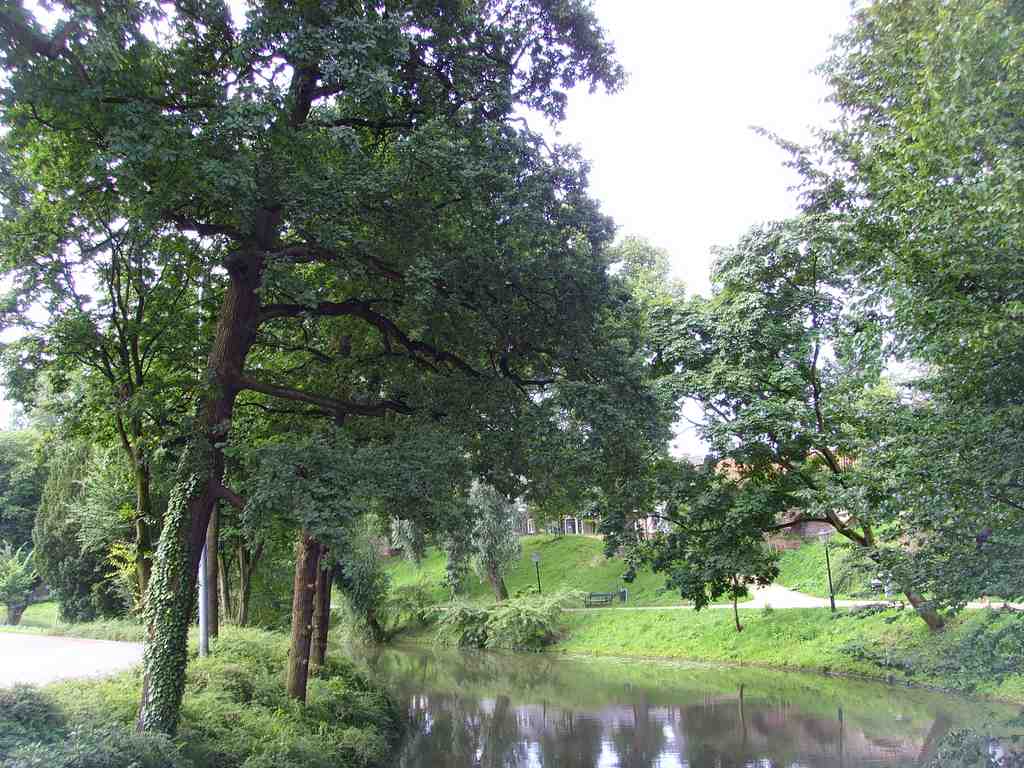
ZocherparkPhoto: Luctor, Wikimedia Commons, Public domain. Cropped & resized. Look ahead to the towering trees with thick, ivy-wrapped trunks stretching their branches over the wide, curving waterway. Welcome to Zocherpark, the final stop on our journey.
Looking at this peaceful scene, you might assume nature just shaped it over thousands of years. But almost everything you see here is entirely engineered by human hands. And even wilder, this tranquil green space used to be a massive, terrifying military fortress.
From the year eleven twenty-two all the way into the sixteenth century, the city of Utrecht was locked inside a massive ring of stone defenses. We are talking high walls, heavy gates, watchtowers, and a deep defensive moat designed to keep heavily armed invaders out. If you pull up the screen on your device, check out this incredible sixteenth-century design drawing of Vredenburg Castle, which illustrates just how robust these fortifications really were.
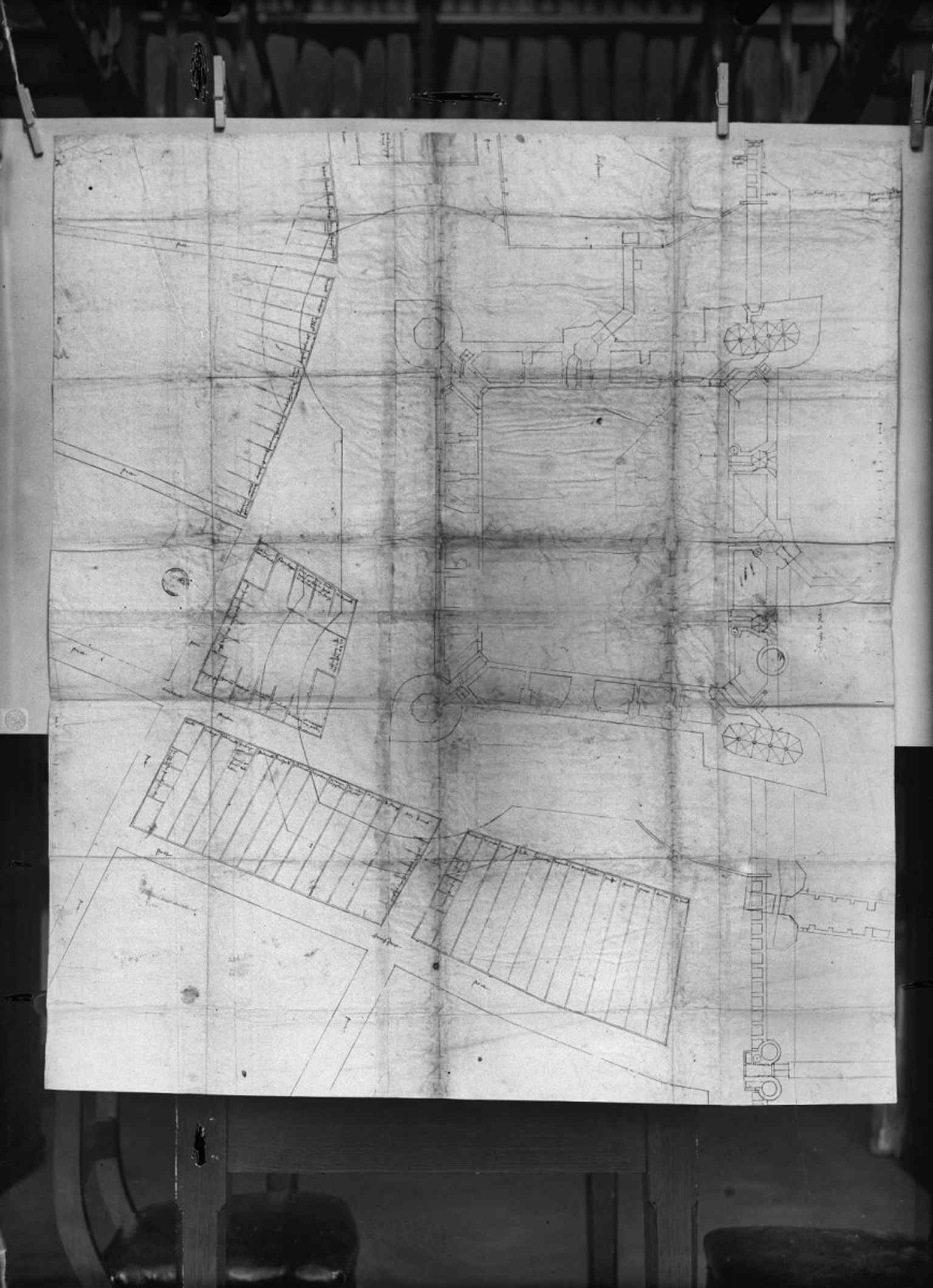
This 16th-century design drawing of Vredenburg Castle illustrates one of the robust city defenses that once stood on the site now occupied by Zocherpark.Photo: Rombout II Keldermans, Wikimedia Commons, Public domain. Cropped & resized. By the eighteen twenties, modern artillery had made those old stone walls completely useless. The city council decided it was time to tear them down. Enter Jan David Zocher junior, a brilliant landscape architect. He pitched an incredibly ambitious idea. Instead of just flattening the rubble and building houses, Zocher proposed transforming the entire defensive ring into a continuous public park. He wanted to use the English landscape style, an approach to garden design meant to look wild, romantic, and completely natural, with sweeping views and rolling hills instead of rigid, straight lines.
And his execution was genius. He did not fill in the old defensive moat. Instead, he softened its harsh military edges, turning it into the gently winding river you see right in front of you. And those grassy slopes and small hills you can walk up and down? Those are actually the buried, smashed-up remains of the old medieval city walls. Zocher just piled earth right on top of the rubble. Take a glance at your app again to see a nineteen seventy-six archaeological excavation of the castle, revealing the massive, complex stone foundations still hiding just below the dirt.
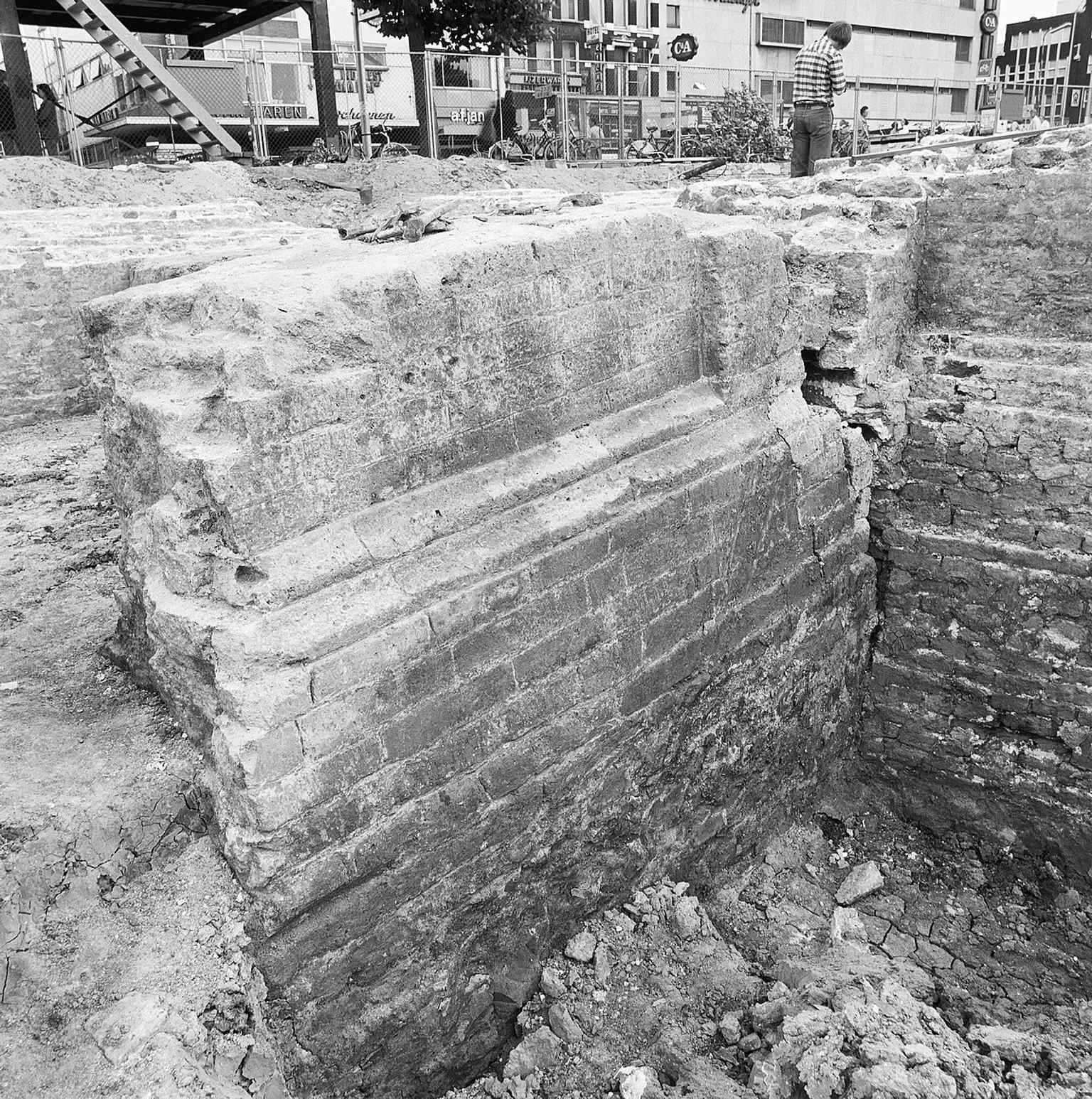
An archaeological excavation of Vredenburg Castle in 1976, revealing the foundations of the former city defenses that were dismantled to make way for Zocherpark.Photo: Ton Schollen, Wikimedia Commons, CC BY-SA 4.0. Cropped & resized. The colossal project of tearing down the walls and planting the park took over forty years. Zocher's son, Louis Paul, eventually joined him to finish the job. Today, Zocherpark is one of the oldest existing public parks in the Netherlands. In fact, about two hundred fifty of the trees standing here today were planted during that original construction in the eighteen thirties. They have been quietly watching the city change for nearly two centuries.
And since this beautiful, historic space never closes, you can stay and explore those winding paths as long as you like.
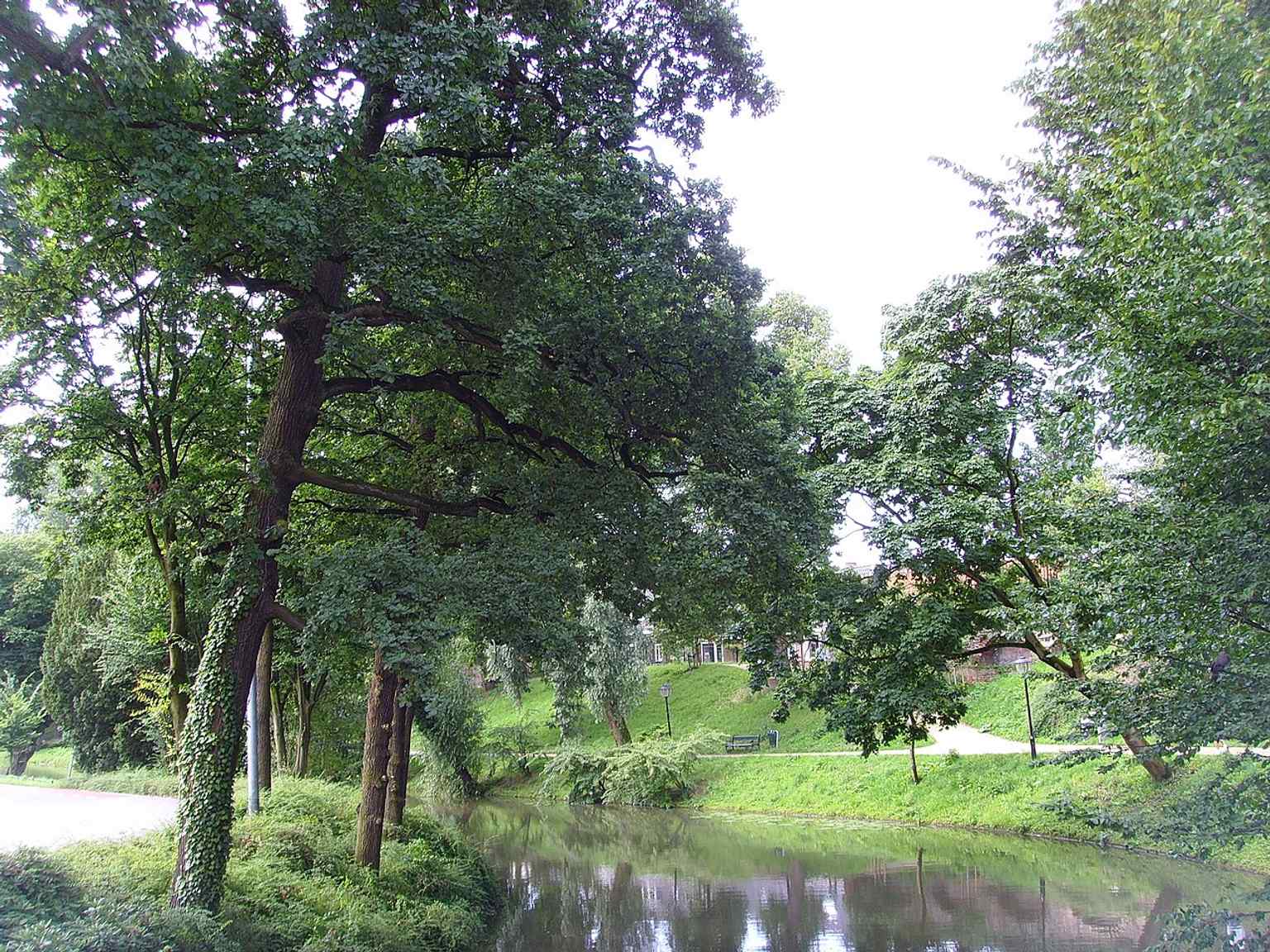
This modern view of the Maliesingel from Lucasbolwerk shows a section of Zocherpark, a city park designed by Jan David Zocher jr. in the 19th century.Photo: Luctor, Wikimedia Commons, Public domain. Cropped & resized. 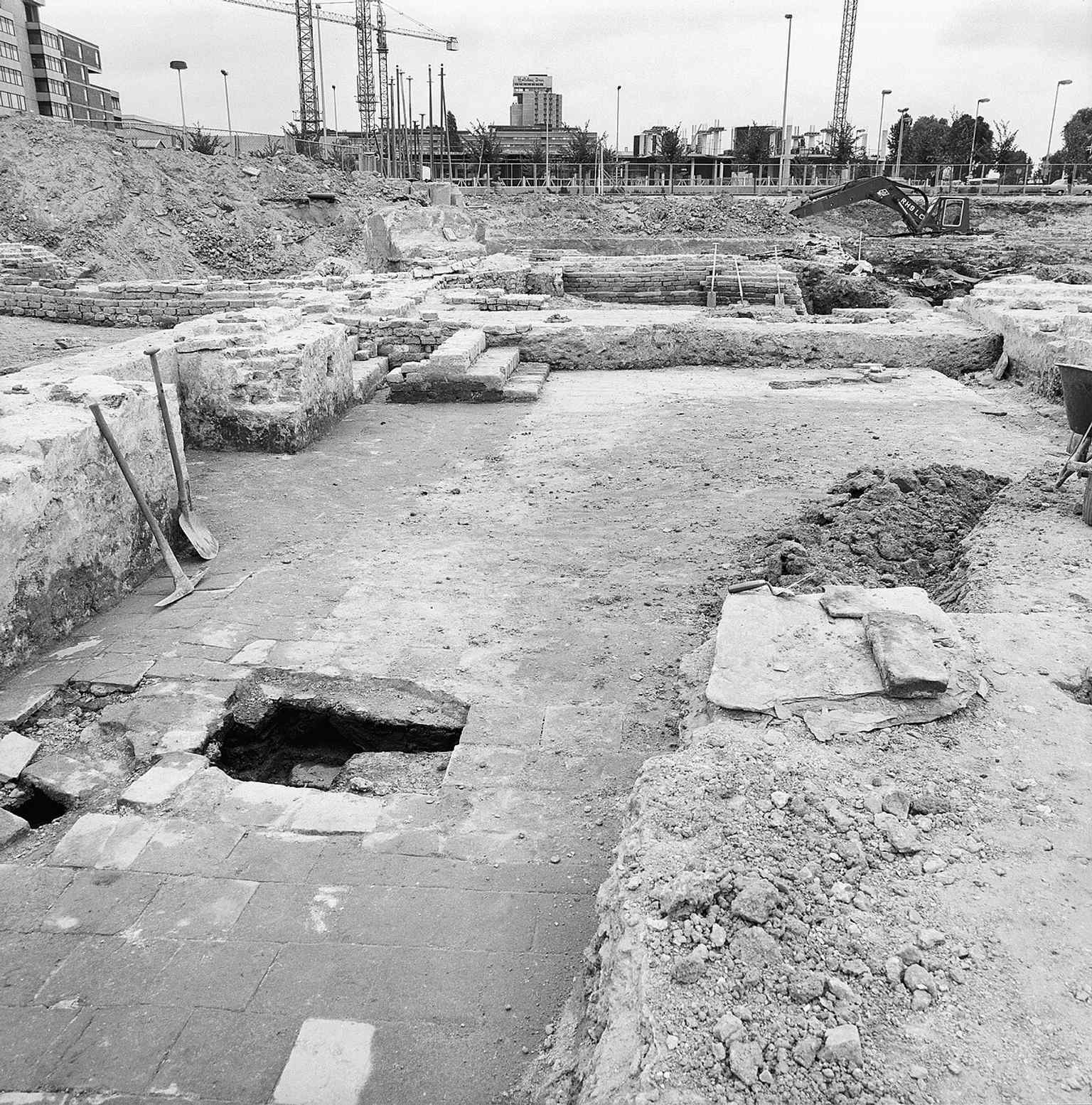
Another view of the 1976 excavation of Vredenburg Castle, demonstrating the complex structures of the old fortifications before their transformation into a public park.Photo: Ton Schollen, Wikimedia Commons, CC BY-SA 4.0. Cropped & resized.


Frequently asked questions
How do I start the tour?
After purchase, download the AudaTours app and enter your redemption code. The tour will be ready to start immediately - just tap play and follow the GPS-guided route.
Do I need internet during the tour?
No! Download the tour before you start and enjoy it fully offline. Only the chat feature requires internet. We recommend downloading on WiFi to save mobile data.
Is this a guided group tour?
No - this is a self-guided audio tour. You explore independently at your own pace, with audio narration playing through your phone. No tour guide, no group, no schedule.
How long does the tour take?
Most tours take 60–90 minutes to complete, but you control the pace entirely. Pause, skip stops, or take breaks whenever you want.
What if I can't finish the tour today?
No problem! Tours have lifetime access. Pause and resume whenever you like - tomorrow, next week, or next year. Your progress is saved.
What languages are available?
All tours are available in 50+ languages. Select your preferred language when redeeming your code. Note: language cannot be changed after tour generation.
Where do I access the tour after purchase?
Download the free AudaTours app from the App Store or Google Play. Enter your redemption code (sent via email) and the tour will appear in your library, ready to download and start.
If you don't enjoy the tour, we'll refund your purchase. Contact us at [email protected]
Checkout securely with 


%20-%20Utrecht%20-%2020233800%20-%20RCE.jpg)


%20noordzijde%20met%20oorspronkelijk%20korbeelstel%20-%20Utrecht%20-%2020233854%20-%20RCE.jpg)


%20-%20Utrecht%20-%2020298812%20-%20RCE.jpg)


