
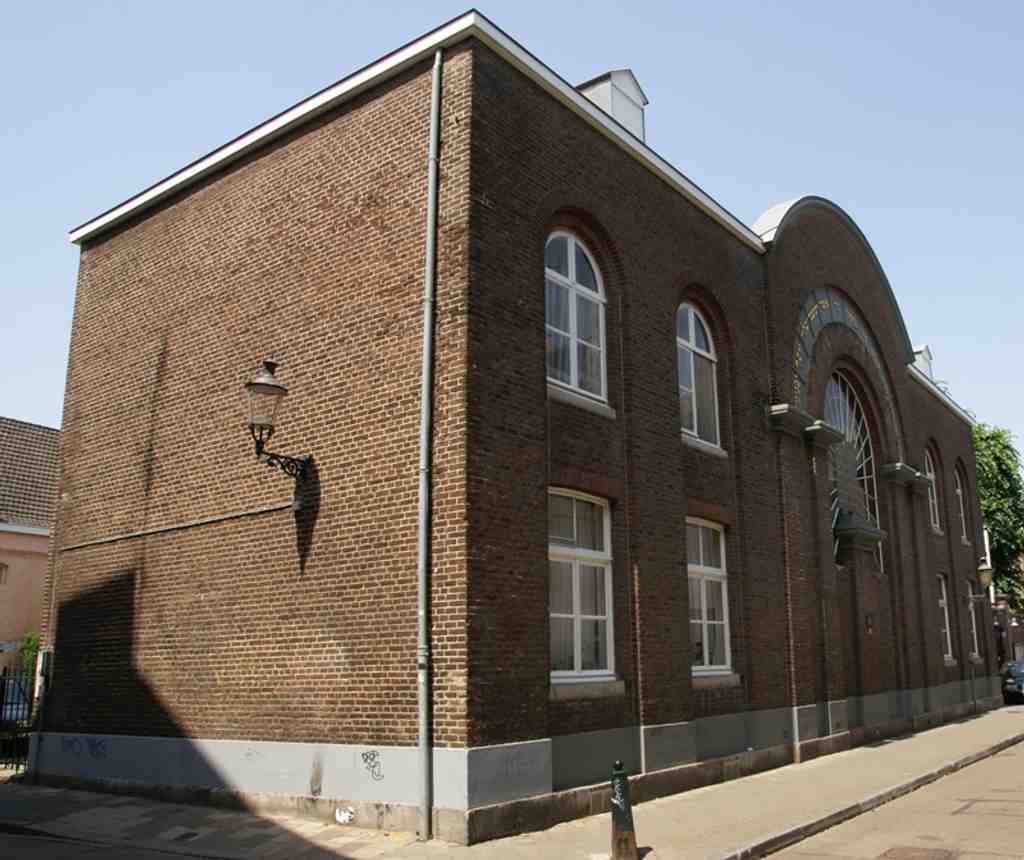
To spot the Synagogue, look for a sturdy brick building on the corner, with tall arched windows and a wide, decorative arch above the entrance facing Bogaardenstraat-it’s solid, a bit austere, and unmistakably monumental.
Now, if you’re standing here, imagine this corner almost two centuries ago-there’s excitement in the air, a throng of people watches a festive parade, and the city’s carillon plays from the Markt for the opening of this very building in 1840. Somewhere nearby, city architect Mathijs Hermans must’ve dusted off his best hat for the big day, proud of his early 19th-century neoclassical design. With its brickwork, rounded arches, and heavy doors, the place gives off the impression you’d need the wisdom of Solomon just to decide which entrance to use!
But let’s not start at the beginning of the story-no, let’s take a jump back to the distant year of 1295. Here in Maastricht, Jewish families lived and worked, their presence marked in medieval records as the city’s Jewish quarter: “platea judaeorum” or what’s today called Jodenstraat. Imagine shouts, laughter, prayers, and the scratch of Hebrew script-a community, growing roots. Of course, as in many cities, those roots got yanked. During the plague years around 1370, Jews were forced out, though records show Maastricht didn’t see the same violence as some places. Still, the first synagogue was abandoned, and Jewish life almost disappeared.
Fast forward to the 18th century, and Jewish people trickled back, squeezed into tiny back rooms and makeshift synagogues-one was even above a carriage entrance, surely a tight fit for a festive gathering. Their efforts to find bigger, safer spaces were rebuffed (apparently, chapels and empty churches were the “hot rentals” of their day). But hope prevailed, and after the Napoleonic era, when all Maastricht’s citizens gained full rights, Jewish families began openly rebuilding their religious life.
The answer to centuries of searching? The very earth beneath your shoes. This used to be the “little Capuchin garden”-part of an old monastery. The city gifted this plot, and here in 1840, the synagogue rose as the new anchor of the Jewish community in Limburg. It came complete with classrooms for the Jewish school-and a lot more elbow room than those attic hideaways!
The story isn’t all celebrations, though. When the Nazis rolled into Maastricht during World War II, this synagogue was seized, used as a warehouse, and stripped of nearly everything sacred. Yet, in a twist worthy of any spy movie, the precious Torah scrolls were hidden just in time; later, unbelievably, American soldiers pitched in after liberation to help restore the chaos left behind. By 1952, services resumed, and the old ark and a pair of dazzling 24-arm chandeliers-sneakily kept safe in the cellar of City Hall-were brought back.
On the outside, you’ll see a mix of memorials: a plaque for the many victims of the Holocaust, another marking 150 years of this community’s resilience. Today, the building is still the main synagogue for Limburg, belonging to the larger congregation in Amsterdam. On the inside, the light that streams from the dome above the bima makes up for the few windows. The walls are washed a brilliant white-no need for fancy frescoes, just the essentials: ancient prayers, hopes, and memories.
Where you stand now, you’re not only facing a house of worship but also a survivor, a testament to centuries of challenge, loss, and astonishing perseverance. And if you see a local walking by, smiling quietly, just think: this corner has known secrets, sorrows, and a few festive parades through the ages-it’s earned a bit of dignity and joy.




