
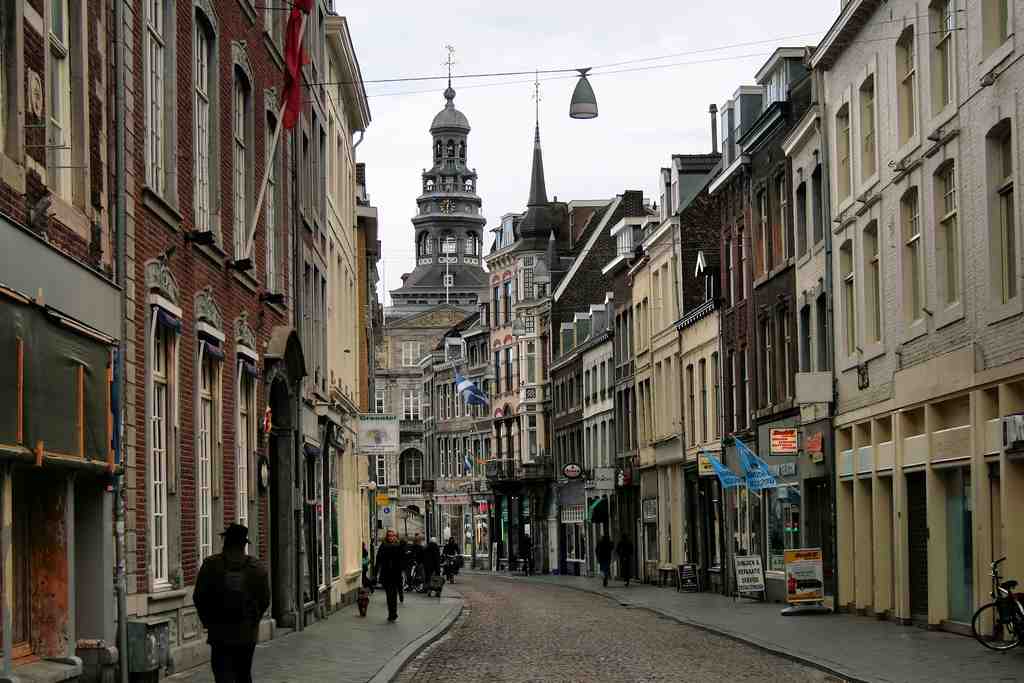
In front of you, the Grote Gracht curves gently uphill with rows of narrow, tall historic houses tightly packed on either side, their brick and stone façades leading your eyes toward the grand tower of the Maastricht town hall straight ahead.
You’re standing in one of Maastricht’s most storied streets, where history is layered like the bricks beneath your feet-each step here is a leap between centuries, commerce, intrigue, and urban legend. Picture this: In the 16th century, where you now see pavements and people hustling by, there was once a broad, dry moat. As part of the city’s earliest defense, the original Grote Gracht (which literally means “Great Ditch”) split Maastricht's old quarters and kept its secrets buried in mud. By the 1500s, the city’s needs changed-a moat was no longer so fashionable-so they filled it in, and a bustling street grew where an old city wall once stood.
If you feel the road slanting beneath your feet, that’s no accident. The street gently climbs from the old prison gate by the Markt to the Two Mountains Gate at the other end-imagine dragging carts and trams up this slope! And trams really did rumble through here at the turn of the last century, first with gas, then with the somewhat less-explosive horsepower of horses. The gas tram-let’s just say it made headlines for the wrong reasons: so many breakdowns, city officials swapped it for a good old-fashioned horse-drawn one in 1903. If your imagination is good, you might hear the clop of hooves joining today’s traffic.
Now, take in the facades around you. Over fifty monumental buildings line the Grote Gracht, each with its own flavor, from the strict geometry of neoclassicism to the playful curves of Rococo. See if you can spot the lavish House Soiron, with its pristine pilasters and central coach gate, or the grand Hof van Tilly, decorated with a cartouche boasting-quite proudly-its founding in 1714. A once-luxurious palace, a school, and even a government guesthouse for visitors inspecting the town on behalf of the Prince-Bishop of Liège, Hof van Tilly later witnessed everything from elegant assemblies to gym classes! It even has a fountain in the courtyard, still adorned with Poseidon carrying off Amphitrite. (Those ancient gods really had a flair for drama.)
And then there’s the famous Wine House Thiessen, built in 1740-yes, centuries-old wine cellars lurk beneath your feet. The façade’s stately brick masks a secret world of rococo swirls and the scent of old casks. If you see a door crowned with a figure of a reclining lion, that’s 't Liewke. Local legend claims the lion isn’t as ancient as it seems-let’s call it Maastricht’s version of anti-aging cream. Locals even named their favorite beer hall after it, long after lions vanished from the street (if there ever were any!).
But life on the Grote Gracht hasn’t always been all nobility, grand windows, and fine wine. For centuries this street has been a patchwork of palaces, shops, cafés, convents, butcheries, and-more recently-a curious selection of smartshops and coffeeshops, earning the cheeky nickname, the “Via Marihuana.” At its height, you could find more than twenty such establishments styled between 17th-century mansions. Meanwhile, the upper floors above shuttered stores are being reimagined as students’ homes-can you picture students of Maastricht University getting inspired under old, stuccoed ceilings?
Mystery and mishaps aren’t strangers here. Take the story of number 56! Once tangled up in tax evasion drama, an abandoned hotel project, and a real estate rescue mission, it now thrives as a hotel after weathering more twists than a Maastricht alleyway.
So, while the Grote Gracht may look peaceful today, its past overflows with bold urban planners, enterprising tradesmen, tram noises, secret lion statues, and the persistent scent of change. Who knows-perhaps around the next corner, a new legend awaits, just ready to join the street’s extraordinary cast!


