
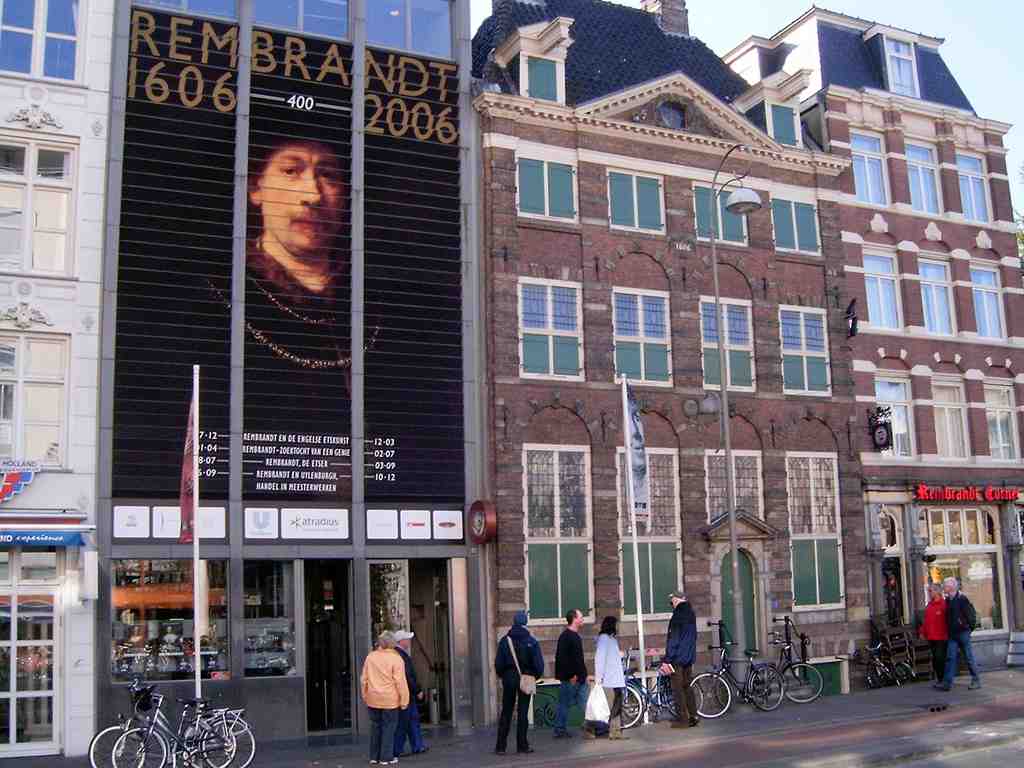
Look to your right for an elegant brick house with an extra floor, green shuttered windows, and a distinct triangular rooftop above the entrance-this is the Rembrandt House Museum, sitting right beside a modern glass-fronted building bearing Rembrandt’s famous self-portrait.
Now, as you stand here, let your imagination wander back almost four hundred years. The air around you would have smelled faintly of paints and linseed oil, and you might just hear laughter, footsteps on old wooden floors, and the scratching of a quill somewhere inside. You're face-to-face with the very home where Rembrandt van Rijn-yes, the superstar of Dutch painting, the man who gave us those unforgettable eyes and stormy, golden-lit canvases-ate, dreamt, worried about bills, and above all, painted like there would never be a tomorrow.
Rembrandt moved into this sturdy house on the Jodenbreestraat in 1639, not long after it got an upgrade: more space, a fancy new facade with that triangular pediment, and an extra floor-just to show off a little, because, well, artists need room for dreams (and for all the canvases and clients). He wasn’t alone: his family, students, and customers bustled in and out. In those years, if you had peeked through the windows, you might have seen works in progress destined for the most powerful people in Europe-or a young apprentice nervously sweeping up potion-like mixtures of ground quartz and clay, Rembrandt’s own secret recipe for preparing his canvases. That odd mixture made his colors sing, and some of the very pots he used were discovered centuries later where only a true detective would look: in the cesspool.
Rembrandt’s house wasn’t just a home-it was a hive. There was a studio alive with the scratch of etching needles (the museum now owns almost every one Rembrandt ever made), and a lively art dealership where the best gossip in Amsterdam swirled between negotiations over masterpieces. Students like Ferdinand Bol and Govert Flinck trained here, learning from the master while probably being told, “No, more shadows! More drama!”-or maybe just, “Fetch more coffee!”
But success has its shadows, even in a house of light. Rembrandt’s spending could be as dramatic as his art, and in 1658, after years of financial troubles, the home was auctioned away for less than he paid. And yet, luck and love followed these old bricks. Over the years the house became many things-a residence, a site for repairs and experiments-until, rather battered, it caught the attention of Amsterdam’s leaders. In 1907, after centuries of history, they rescued the building and transformed it for Rembrandt’s 300th birthday. Even Queen Wilhelmina walked these floors on opening day, perhaps pinching herself at how much history seeped from the walls.
Today, the Rembrandt House Museum takes things full circle. It has been carefully rebuilt to look as it did in Rembrandt’s day. As you walk through, you pass from bustling public rooms to the deep, comforting quiet of a 17th-century living room-furnished to match inventories found during Rembrandt's bankruptcy. You’ll see the art rooms, the bedroom where the artist dreamed up his mythic stories, and the actual etching plates he used, plus paintings by friends and pupils-like the sweet, moody “Shepherdess in a Landscape,” gifted just recently.
But this isn’t a museum frozen in time. Alongside Rembrandt’s etchings and his teacher’s paintings, you’ll also find bold new art by contemporary creators-proof that inspiration is alive and plotting its next great design in the heart of old Amsterdam.
Every year, hundreds of thousands of visitors pass through, looking for a little piece of Rembrandt’s magic. Some find it in the crooked stairs; others, in a glint of morning light falling across the studio floor. So take a deep breath, step inside, and let Rembrandt’s world-full of triumph, tragedy, paint, and laughter-spill around you. Don’t worry, the ghosts here all have fantastic stories to tell.
Want to explore the rembrandt's house, collection or the exhibitions in more depth? Join me in the chat section for a detailed discussion.




