
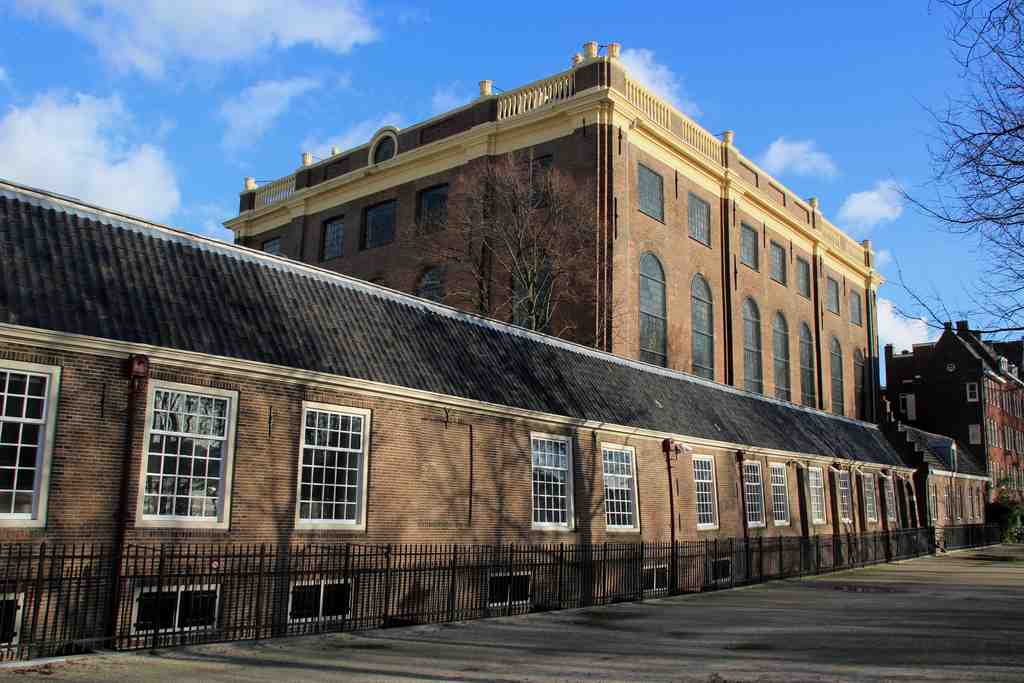
You’re looking for a grand, free-standing building with a tall, pale stone rooftop trim and rows of large arched windows-just peer right behind the long row of brick buildings with white-paned windows, and you’ll spot the majestic Portuguese Synagogue rising above them.
Welcome to the Portuguese Synagogue-or as the locals with a dash of flair call it, the Esnoga! Picture yourself standing right where history shook off its dust: in front of a shining beacon built in 1675, at a time when the world seemed about as friendly to Jewish people as a cat is to a cucumber. Let’s jump back five centuries for a moment. Imagine families whispering in Judeo-Spanish huddled around candlelight, while far away in Spain and Portugal, Jewish communities faced decrees giving them grim choices: convert, flee, or face brutal consequences. Some slipped out under cover of night, making their way to Portugal, and then, when tolerance ran even thinner, scattered again-many heading here, to Amsterdam, their hopes balled in their fists like the world’s least fun souvenir.
Amsterdam in the 1600s! Canals were bustling, the air thick with trade winds and new ideas. Here, in what was one of Europe’s greatest cities, these Sephardic Jews-our globe-trotting ancestors-could finally worship freely. No sneaky secret services peering through keyholes, just the bold sound of prayer and the crackle of candles. Their dream? A truly grand synagogue that could make Christian tourists gasp and Amsterdam’s pigeons feel underdressed! (And let’s face it, with 17th-century Dutch fashion, that’s saying something.)
They called themselves “Portuguese Jews” because, well, Spain was fighting the Dutch Republic and who wants to cheer for the losing team? Their new home-the Esnoga-was more than a place to pray. It became a dazzling display of their resilience, smarts, and, let’s be frank, their taste for gorgeous architecture. Inspired by King Solomon’s Temple, the synagogue sits on wooden piles driven deep into the soft Dutch earth, with canal water slipping quietly beneath. The entrance leads you through a peaceful courtyard lined by buildings that once held the winter synagogue, a library, the homes of learned rabbis, and perhaps a few secret cookie stashes.
Step inside (at least in your mind!) and what do you see? A vast, sunlit hall held up by twelve stone columns-one for each of the legendary Twelve Tribes of Israel. Instead of carpets, the floor glimmers with fine sand, a quirky Dutch touch that muffles footfall and catches city grime, turning the place into what may be the fanciest sandpit in Europe. As you look up, there’s not a trace of wires or bulbs. Instead, during services, over a thousand candles blaze in huge brass chandeliers, making every face glow with ancient light through a dazzling set of 72 windows. And perched proudly at the front? The Torah Ark, carved from a single solid piece of jacaranda wood shipped all the way from Brazil-eat your heart out, IKEA.
Over the centuries, the Esnoga saw joy, tradition, and even some serious close shaves. During World War II, the Nazis eyed this synagogue as a deportation center, but a daring team led by Leo Palache managed to talk them out of it. Instead, ritual treasures were hidden in the ceiling and attic, just waiting to be rediscovered like the world’s best (and most nerve-wracking) surprise party. After the war, the famous Ets Haim library, packed with rare manuscripts, survived, traveled between countries, and was finally recognized by UNESCO as a “Memory of the World”-so, yes, some of the world’s oldest wisdom is just a stone’s throw from where you’re standing.
But oh, the Esnoga keeps making headlines! Even today, debates spark like Hanukkah candles over old bans-as with the recent controversy about Baruch Spinoza, the philosopher still persona non grata here after three centuries. Some things change, some things don’t, right?
Finally, don’t miss the art! Dutch artists of the Golden Age painted this synagogue inside and out. Imagine grand inauguration scenes with men parading Torah scrolls and a choir of candles, while all around, donors’ names glimmer on medallions-a roll call of the community that made miracles happen.
So, as you stand here, take in that grand facade and those rows of ancient windows. The Esnoga isn’t just a building-it’s a symbol of survival, pride, and more than a little architectural swagger. Onward, history explorer! I promise, the next stop might have fewer candles, but just as many stories.
To delve deeper into the architecture, ets haim (tree of life) library or the image gallery, simply drop your query in the chat section and I'll provide more information.




