
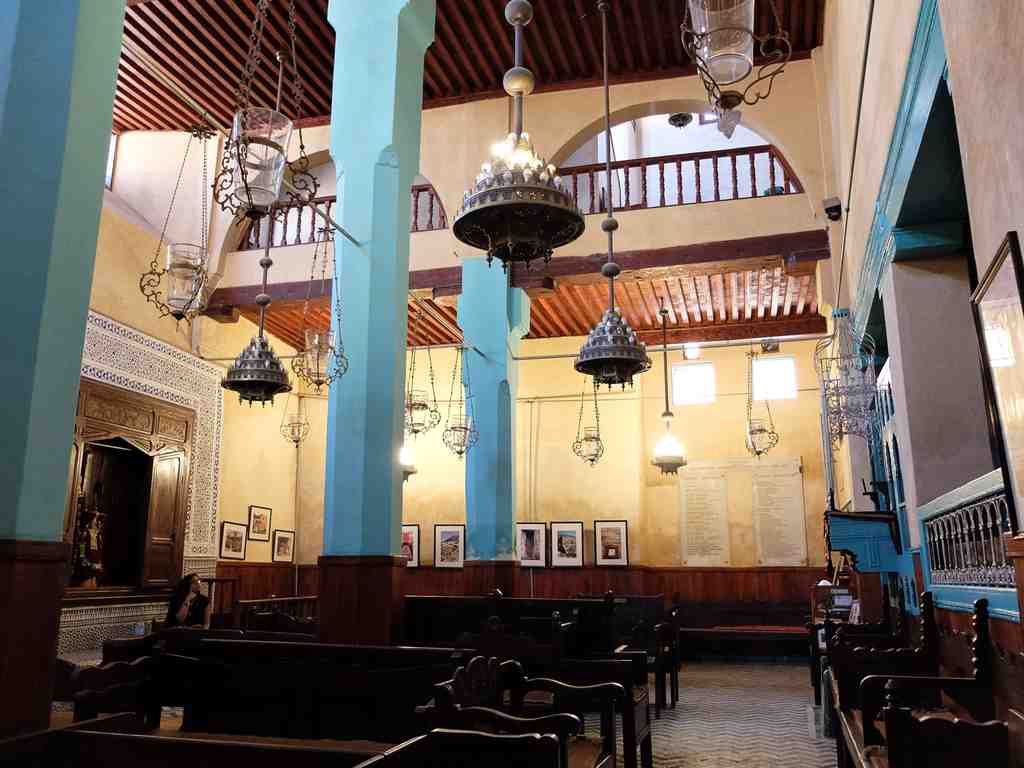
To find the Ibn Danan Synagogue, look for a simple, almost unmarked doorway nestled between houses in the Mellah district - it blends right in, so you’ll want to spot the subtle entry before the bright turquoise pillars inside give it away.
Now that you’re standing outside, let’s take a walk through history-no passport required, just a bit of imagination! Picture the narrow lanes of the Mellah in Fes el-Jdid centuries ago, where merchants shout prices and children weave between stalls. It’s the early 1600s, and a wealthy merchant named Mimon Boussidan decides this community needs a sanctuary-a place to bring people together in prayer and hope. He pours his heart (and a fair bit of his purse) into building this synagogue right here, supported by strong brick walls and lime mortar.
But oh, this place would need more than bricks to survive what comes next! Just decades after opening, the Saadi sultan Muhammad al-Shaykh al-Saghir comes storming through in 1646, bringing destruction in his wake. For a moment, only the memory of prayers echoes through the ruins. Yet, the spirit of the community refuses to fade. By 1701, the doors swing open once more, and the synagogue stands tall again-fresh plaster, new tiles, and a crowd ready to sing and celebrate.
Through the 18th and 19th centuries, life isn’t always peaceful. Turbulence strikes the Jewish community again during persecutions in 1790, damaging this beloved house of worship. But once more, repair and resilience flip the script-nothing keeps this place closed for long, not even time itself. The 1800s see another makeover, while a dynasty of rabbis, all from the Danan family, shape the synagogue’s story for over a hundred and fifty years. That’s dedication! The Danans trace their roots all the way to Granada, Spain, and after wandering, they return here, bringing wisdom from far-off lands.
By the late 20th century, the synagogue’s brushed frescoes and vivid blue tiles have faded, its wooden beams groan under water damage, and plaster peels from the walls. Yet, like a prankster who just won’t quit, the Ibn Danan refuses to be forgotten. In 1996, the World Monuments Fund and allies rally to its rescue. Thanks to crack teams (and a little help from American Express-yes, you heard that right!), the synagogue gets a true facelift, reopening with a flourish in 1999.
And what a place it is! Through that nondescript door, you find yourself in a high, rectangular prayer hall crowned by wooden beams and delicate lamps. Three pillars split the main room as clusters of memorial lamps used to hang from the ceiling, filling the space with a warm, restless glow. The Torah ark-imagine a dramatic, carved wardrobe for scrolls-spans an entire wall, its wooden artistry rivaled only by the blue Moroccan tiles beneath your feet. Opposite, you see an elevated alcove with an ornately carved screen; this was once reserved for the community’s VIPs. The bimah rises from here, a wooden platform topped with an iron canopy that looks almost too regal for its humble origins.
And here’s a twist-during restoration, workers rediscovered a hidden chamber below the main hall. A narrow stair leads down to a secretive cellar and a ritual bath, still clinging to faint memories of busy, everyday life in the old Mellah. So, as you take in the story of the Ibn Danan Synagogue, remember: it’s a survivor, a storyteller, and a little bit of a magician, always finding a way to reappear-restored, renewed, and waiting for its next chapter.




