
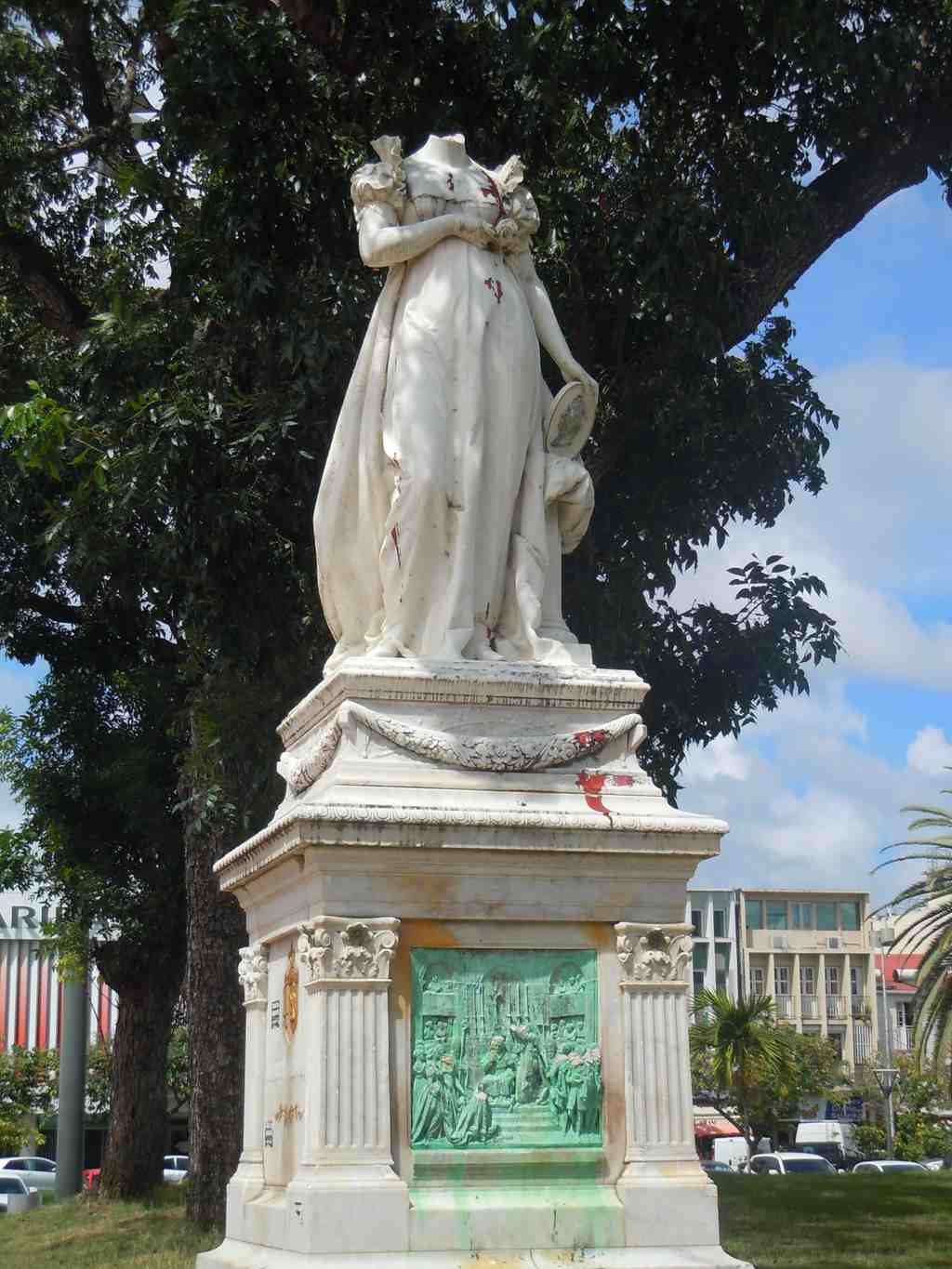
If you’re looking for the statue, just glance ahead toward the edge of the Savane park-once, in the middle of a wide open space and framed by tall royal palms, there stood a white marble figure on a grand pedestal; even now, you’ll notice the empty base where she once was, just beside the Rue de la Liberté.
Alright, adventurous explorer, take a breath - you’re standing exactly where one of Fort-de-France’s most controversial, mysterious, and dramatic tales unfolded! The Statue of Empress Josephine, or, as she was officially called, the Monument to Empress Josephine de Beauharnais, once dominated this very spot. Imagine shining white marble carved from Carrara, Italy, gleaming in the sun. Josephine’s statue was dressed in a grand imperial cloak, holding Napoleon’s medallion-looking every bit the regal empress. The base was ringed by bronze plaques, each commemorating a highlight of her life: her birth in 1763; marriage to Napoleon in 1796; coronation in Paris in 1804; and, of course, the date the statue was finally unveiled in 1859.
Now, picture the scene back in the 1850s. There’s dust and excitement swirling through Fort-de-France as the city prepares for a monument unlike any other. Josephine, born Marie Rose Tascher de la Pagerie right here in Martinique, was already a figure wrapped in both legend and controversy. Generations whispered that, as a young girl strolling the Savane, a cannonball once landed at her feet-don’t worry, she wasn’t practicing for a circus act, she just had an especially dramatic childhood! History and rumor tangled together, setting the stage for what was to come.
When Emperor Napoleon III wanted to honor his illustrious step-grandmother-in-law, he kicked off a public subscription in Martinique. The local bigwigs joined in, and Napoleon III himself offered 12,000 francs (imagine getting a generous gift card from your most powerful relative). Meanwhile, the artist Gabriel Dubray traveled to Tuscany to choose the very best Carrara marble for Josephine’s likeness. The initial plaster model of the statue was even shown at the 1855 Paris World’s Fair, dazzling onlookers on the other side of the Atlantic.
After three years of anticipation, the big day arrived. The statue rose at the very center of the Savane, surrounded by eight perfectly placed royal palms. Candles flickered in ornate candelabra, and a grand wrought-iron fence glittered around the site. The inauguration was the party of the decade: three days of fireworks, banquet tables piled with Creole delicacies, and enough cannon salutes to keep everyone’s ears ringing. Local governors and foreign dignitaries gathered under brightly colored banners, toasting to the Empress and her fabled - if complicated - life.
But, as you might suspect, all that marble and celebration couldn’t smooth over the deeper shadows of Josephine’s history. She was a white Creole whose family owned the “Petite Guinée” plantation-and was suspected of having helped Napoleon reintroduce slavery in 1802. For many in Martinique, the statue began to feel less like a memorial, and more like a reminder of wounds that never truly healed.
The city tried to make peace with the past-literally. In 1974, the influential poet Aimé Césaire ordered the statue moved from the Savane’s center to its quieter western edge and stripped away the grand granite base and the dazzling ironwork, making her a little less visible to the crowds. But Josephine’s gaze - at least, what was left of it - lingered. In September 1991, the story took a head-turning twist: one night, a mysterious commando crept up and decapitated the statue, leaving the Empress forever silent. The city left Josephine headless, a stark and unsettling symbol-though the statue was still protected as a historic monument.
The years rolled by, but anger and debate never truly faded. In July 2020, amid global protests against racism and colonial legacies, activists demanded the city topple Josephine once and for all. When officials hesitated, the collective Rouge-Vert-Noir took action-within hours, the statue was demolished, crashing down in front of a cluster of stunned onlookers. The Prime Minister of France denounced the destruction, but to others, it was the long-overdue removal of a painful reminder.
So as you stand here by the now-empty pedestal, imagine all those decades: the explosion of celebration, the uneasy silences, the moonlit mission that left Josephine headless, and the dramatic final showdown of 2020. History, after all, has a way of sticking around-sometimes on a pedestal, and sometimes only in the stories that get passed down from those who still walk the Savane. Keep your eyes open; here, the past never truly disappears-it just bides its time for the next chapter.


