
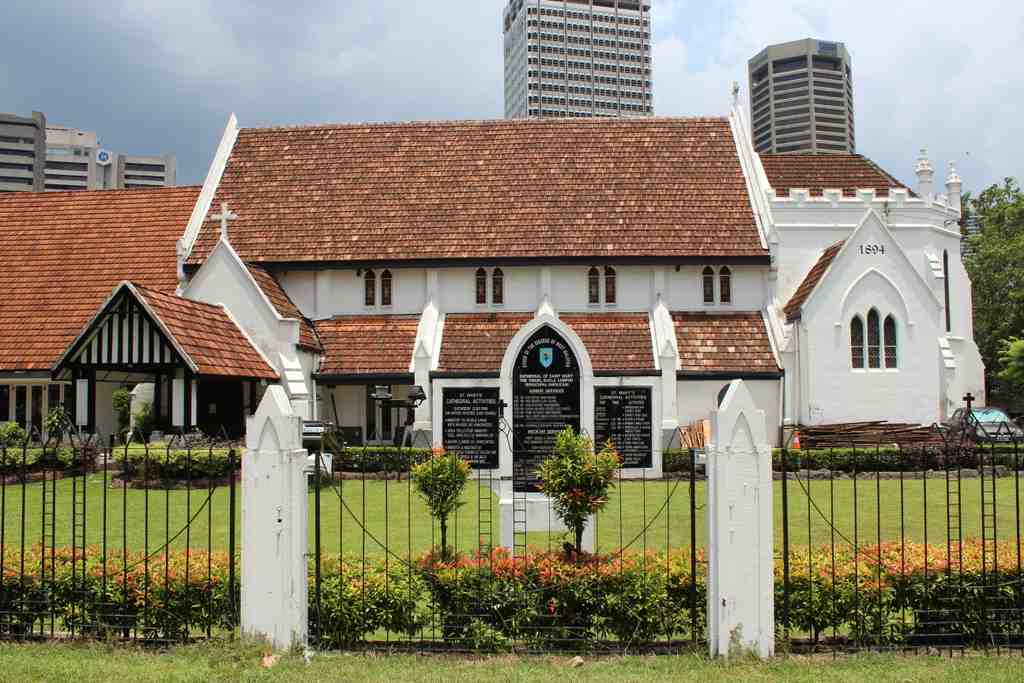
To spot St. Mary’s Cathedral, just look for the charming white building with pointed windows and steep, reddish-brown tiled roofs surrounded by a tidy green lawn and simple black iron fence-it sits right across from Independence Square, standing out against the backdrop of modern towers.
Now, take a breath and let your mind travel back with me to the late 1800s, when Kuala Lumpur was a much sleepier outpost crisscrossed by jungle paths and horse-drawn carriages. Right where you’re standing, imagine a group of Anglican settlers gathering, dusty shoes and all, hoping for a place of worship in this far-off colonial land. Their first church was just a humble timber structure perched atop the hill now called Bukit Aman-where, if you tried building a chapel today, you would have the Royal Malaysian Police as your rather stern neighbors! That first church, consecrated in 1887 by the steely Bishop Hose, was like a tiny spiritual lighthouse for a handful of British colonial officials: no grand stained glass, but certainly no shortage of faith.
As the city bustled and blossomed, so too did the congregation. Soon, their timber chapel was simply too snug for the growing numbers-some of whom were the very top hats of colonial Selangor, folks named Treacher and Swettenham, who’d help pen local history books. It was in 1893 that St. Mary’s got its ticket to move right here, on the edge of the old Padang-nowadays called Independence Square, or Dataran Merdeka, where you’ve seen all those grand parades and celebrations. Construction funds came not just from the British community, but also from local legends like Yap Kwan Seng and K. Thamboosamy Pillay-who, interestingly enough, weren’t Christians themselves, but apparently thought the town could use a bit more heavenly architecture. Maybe they figured helping out might earn them a gold star on someone’s chart upstairs.
Cue the arrival of A.C.A. Norman, the government architect and a true aficionado of Early English Gothic style. He wasn’t the winner of the official church design competition, but he was the only one with a design that got the thumbs up-sometimes being second or third time lucky really does pay off! Imagine the scene in 1894 when Sir W.H. Treacher, top hat gleaming, carefully laid the foundation stone while onlookers fanned themselves in the steamy heat. By February 1895, the first brick church of the Malay Peninsula’s native states was open for business, a place where the soaring nave could fit 180 worshippers…and probably a decent amount of gossip.
Inside, take a moment to imagine warm sunlight flooding through stained glass into the nave-87 feet long, 28 feet wide-while the echoes of the choir drift through the chancel’s octagonal end. See if you can spot where the pipe organ waits. Ah, the organ! It’s a story in itself: crafted by the renowned Henry Willis-yes, the same guy who built the organ at St Paul's in London! This was a secondhand buy from Frederic Duberly, an official with a love for booming chords. After Duberly’s sudden death, the organ made its way here, suffered floods, wartime damage, and was repeatedly rebuilt by the mysterious Mr. Riddell, the local master of pipes who possibly once apprenticed with Willis himself. You could say the organ has survived more dramatic twists than a soap opera-each time, rising again, ready for another Sunday.
Step outside the pages of history, and you’ll find St. Mary’s still very much alive. Every Sunday the building fills with the music of centuries-old hymns during the English liturgical services, the pipes thundering at 7, 9, and 11 AM as the congregation gathers-sometimes high church, sometimes blissfully simple, but always heartfelt. Just next door, you’ve got the buzz of SMACC, the contemporary service, where young professionals, students, and families all pile in for something a little more modern, featuring a touch less incense and a lot more lively chatter. There’s even an Iban service for those from Sarawak, and Bahasa Malaysia services for folks from Sabah and Sarawak, adding extra color and warmth each week.
So as you stand before those whitewashed walls, with traffic rushing behind and skyscrapers peering down, picture the layers of past and present stacked atop each other-colonials and locals coming together, floods, music, Sunday bests, and now you, right in the middle of the story. The past may be set in stone (and brick), but here at St. Mary’s, the spirit is very much alive and ringing, just like its legendary organ. Shall we see what’s next on our journey?
Wondering about the architecture, organ or the sunday services? Feel free to discuss it further in the chat section below.




