
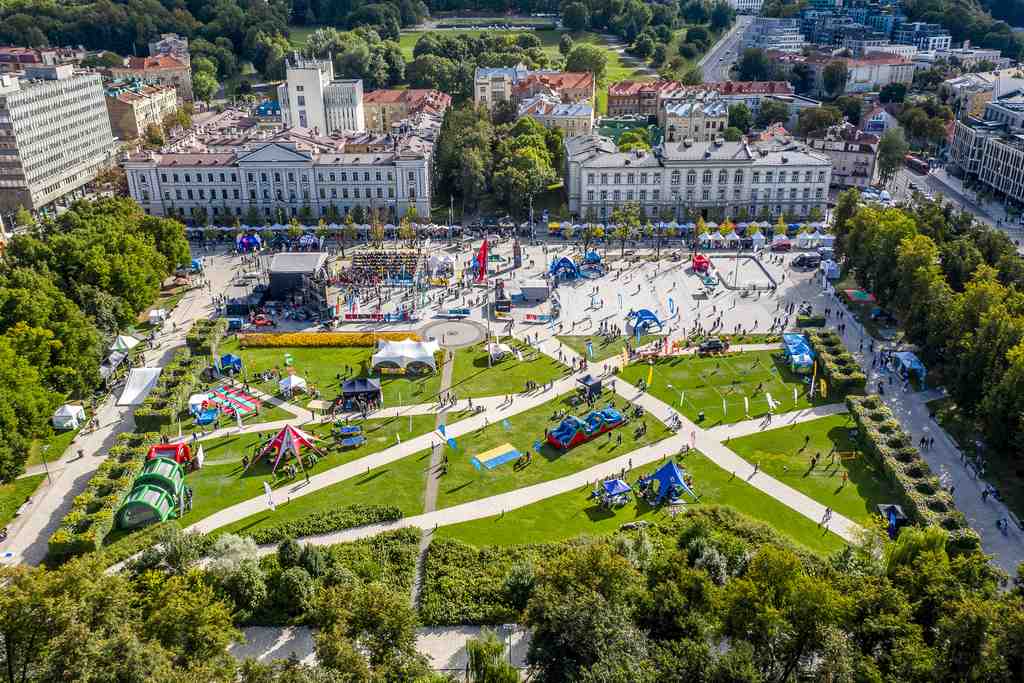
Look straight ahead for a huge, open public square with neat geometric lawns, crisscrossing walkways, and often a scattering of colorful tents or events-Lukiškės Square sits right in front of the elegant state buildings at the city’s heart.
Welcome to Lukiškės Square, the grandest and most spacious square in all of Vilnius! You’re now standing where centuries of history have swirled together-sometimes with celebration and sometimes with the darkest shadows imaginable. Picture it: four whole hectares of city life, with Gediminas Avenue buzzing along one edge, and important buildings-like the Ministry of Finance and Foreign Affairs-watching over you like polite, stone-faced sentries.
A few centuries back, this wasn’t the busy heart of Vilnius but a leafy suburb. The area was known for its wooden mosque belonging to Lithuanian Tatars and a serene graveyard-imagine the gentle smell of grass and the quiet rustling of trees. But the winds of history are not always gentle, and the Soviets sadly bulldozed these landmarks away in the 1960s, forever changing the landscape.
Let your imagination carry you to the mid-19th century. The square is newly planned, crisscrossed by the grand avenue that’s now known as Gediminas. But the air here can seem tense-especially after the failed January Uprising in 1863. You might feel a chill as I tell you: this place was once a stage for public executions. In 1864, when the freedom-seeker Konstanty Kalinowski was led here for his final moments, the crowd was thick with whispers and nervous breath. From then on, the man in charge, Governor General Muravyov, became feared as “The Hangman.” I promise things get lighter-eventually!
Move ahead a few decades to the 20th-century hustle and bustle: imagine the Kaziukas Fair, with market sellers hawking their wares, the sweet smell of pastries, and kids darting between stalls. But shadows returned during Soviet rule. Just steps from where you stand, in the imposing NKVD Palace, countless Lithuanians who dared to oppose the Soviets met a fate much darker than the storm clouds overhead. Between 1944 and 1947, this became a place that seemed to swallow hope.
When the Soviets wanted to send a message, they plunked down a gigantic statue of Lenin right in the middle of the square. Locals joked it was the biggest Lenin head for miles-you just couldn’t escape that trademark sneer! But after independence in 1991? The crowd cheered as the statue came down, its upper half waving an awkward, accidental goodbye as it was hoisted away.
Now, this square is a place for festivals, fairs, and free spirits-you might just stumble upon music or laughter echoing from the green. What a journey for one city square-you can almost hear the stories beneath your feet!




