
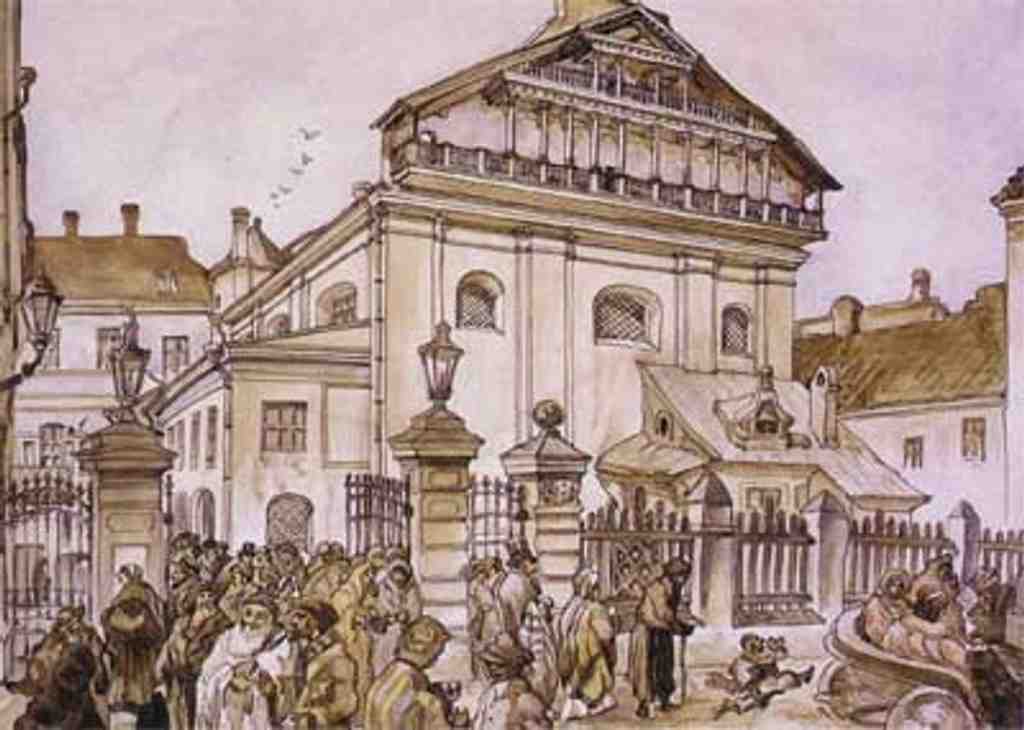
To spot the Great Synagogue of Vilna, look for a large open courtyard where a school building now stands-once, this place was crowned by an imposing stone structure with Renaissance and Baroque style lines, topped with an arched brick facade, but today the only traces are the archaeological remains and a few subtle memorial markers.
Alright, put yourself in a different time for just a moment. Imagine you’re standing right here in the heart of Vilnius’ Old Town, on what used to be Jewish Street. The year is 1633. Instead of the modern schoolyard and gentle city bustle you see and hear now, a stunning stone synagogue stretches up in front of you, its Renaissance and Baroque lines hugging the street. The walls are thick-nearly fortress-like. Now, here’s a funny bit of European history: Back in the day, local rules said synagogues couldn’t be taller than churches. But the clever builders had a solution-why go up, when you can dig down? So, you’d walk past intricate iron gates, gifts from long-gone tailors and psalm reciters, and step down into a space that looked three stories tall from the outside but soared a massive five stories within. Talk about under-the-radar architecture!
Inside was a world of light and grandeur. Imagine the massive stone-floored hall, sunlight streaming through tall windows, catching flashes of gold and silver from hanging chandeliers. In the center, four powerful columns held up the whole immense structure, drawing your eye up to an elaborate three-tiered bimah-basically a raised platform where the Torah was read-so beautifully decorated it looked ready for royalty. Hanging above, a cupola twinkled, supported by eight slim columns. And don’t miss the Holy Ark on the eastern wall, a masterpiece of gilded wood with plants, animals, and a double-headed eagle perched proudly on top. It was guarded by two winding flights of iron-railed stairs, so dramatic you’d half expect to see a rabbi dash down them, Truman Show-style.
But the synagogue wasn’t just about show. It was a refuge, a stronghold for the Jewish community of Vilnius-a place that could shelter hundreds in times of danger. On the holiest days before World War II, up to 5,000 people packed inside, voices rising together until the stone walls almost vibrated. Even visitors like the famous philanthropist Sir Moses Montefiore had to be given special entrance tickets because of the crowds.
If you peeked into the corners, you’d see women’s galleries-balconies with small windows connecting to the main prayer hall, the result of fierce community effort and a bit of financial drama. There was even a “Chair of Elijah” in the northwest corner for special rituals, and a massive seven-branched candelabrum that, in a plot twist worthy of Sherlock Holmes, was whisked away to Moscow just before World War I.
But with the coming of World War II, darkness fell. The Nazis looted, burned, and shattered what was left of this community jewel in 1941. For a while after the war, the ruins stood-a ghostly shell, quietly resisting time. Locals tried to declare it a historic monument, but in the crushing years that followed, the Soviets reduced the remaining fragments to dust. If you’d walked here in the late 1950s, you would have found, not a synagogue, but a playground and a kindergarten-a deliberate attempt to erase history. It’s like sweeping your grandmother’s porcelain tea set under a rug and calling it modern art.
Yet, a few precious pieces survived-the door of the Holy Ark, a reader’s desk, and a carved bas-relief of the Ten Commandments, now kept safe in the Vilna Gaon Jewish Museum. But the heart of the synagogue, its stories and spirit, waited underground for decades.
Then came the archaeologists, armed with curiosity and ground-penetrating radar. In 2015, right under the current school, they traced the old synagogue’s massive walls and even began to excavate its sunken treasures. Would you believe they found parts of the legendary Baroque bimah? In 2019, they uncovered a Hebrew inscription from a Torah reading table that quietly told of the Jewish community’s deep ties with Jerusalem. It mentioned Rabbi Eliezer and Rabbi Shmuel, brothers whose parents left Vilna for the Holy Land centuries ago-and whose gravestones were found, not here, but side by side on the Mount of Olives.
Even today, the city dreams of restoring this sacred space-not as a complete replica, but as a powerful memorial, a space echoing with voices from the past and the promise of the future. So while you stand here, let your imagination fill in the walls, the shimmering chandeliers, and the crowded galleries, and remember a place that shaped Vilna’s soul for nearly 400 years. And who knows? Maybe someday, the prayers that once echoed here will rise again.
Now, take a deep breath and let’s journey to our next destination. But first, don’t forget where you’re standing-sometimes the most powerful monuments are the ones you can’t fully see.
For further insights on the structure, destruction or the plans of restoration, feel free to navigate to the chat section below and inquire.




