
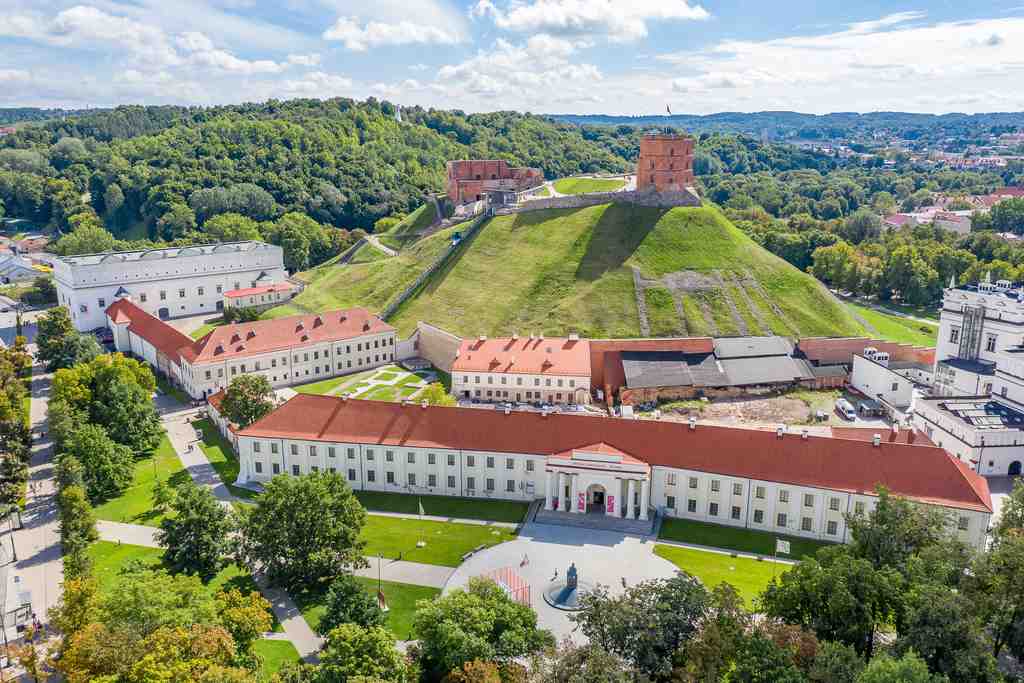
In front of you, you’ll spot a grassy hill crowned by the iconic red-brick Gediminas Tower, rising above elegant palace buildings with orange rooftops-just look up the slope and let that fortress on the hill be your beacon!
Now, take a deep breath and imagine yourself standing here centuries ago, surrounded by the sights and sounds of Vilnius’ greatest stronghold. The Vilnius Castle Complex is not just one castle, but a whole ensemble of mighty fortresses-crowning the left bank of the Neris River, right where it meets the Vilnia River. Picture it: stone walls gleaming in the sun, villagers bustling around the Lower Castle, soldiers sharpening blades atop Gediminas Hill, and, just perhaps, the faint smell of campfires drifting by.
This legendary spot tells the whole epic of Vilnius! Originally, in the 10th century, the first wooden castle stood here, perched on Gediminas Hill. But it wasn’t enough for the ambitious Grand Duke Gediminas. So, in 1323, he expanded and fortified the castle, declaring Vilnius the heart of Lithuania. Over time, the Castle Complex grew to include not one, not two, but three spectacular castles: the Upper Castle you see up on the hill, the grand Lower Castle with its Palace and Cathedral, and the mysterious Crooked Castle, once perched on a nearby hill.
But if you sense a bit of drama in the air, you’re on track! In the 1300s and 1400s, Vilnius Castle was a target for armies from all over Europe, especially the fierce Teutonic Knights, who attacked time and again, year after year. In 1390, their torches finally took down the Crooked Castle, burning it to the ground in a blaze that echoes through legend, never to be rebuilt.
Wars and sieges continued-once even with the future King Henry IV of England amongst the attackers-and the Upper and Lower Castles stood strong through wave after wave of battle. Vilnius was a full-on medieval action movie set, minus the popcorn. There were betrayals, with nobles switching sides, plots between cousins for the Grand Duke’s crown, and all the clashing ambitions of old Lithuania! In 1419, a fire devastated the Upper Castle, but Grand Duke Vytautas managed to rebuild it in Gothic glory, adding glazed green tiles to the roof-fancy for the Middle Ages, right?
The Lower Castle flourished too, its Royal Palace becoming the seat of power for the mighty Grand Dukes. It saw everything from royal coronations to the staging of the very first opera in Lithuania in 1634. Diplomats arrived from across Europe, national treasures sparkled in its halls, and artists and kings alike wandered its corridors. But after a disastrous invasion by Russian armies in 1655, the castle’s glory faded, and much of it was abandoned and later destroyed. Imagine the shattered walls and fallen towers, the echoes of clashing swords and shouts drifting away as the decades passed.
Yet even as the centuries washed over Vilnius, Gediminas Tower remained-a proud stump on the skyline. In more recent years, it’s become Lithuania’s symbol of strength and independence. On every January 1st-Flag Day-the Lithuanian tricolor is raised high above the tower, waving bravely against the sky. The Tower now invites you in with modern comforts too, like a lift that whisks visitors up the steep hillside.
Inside the tower and surrounding buildings, you’ll find glimpses into every century: medieval weapons, ancient coins, and models that recreate the castle’s marvelous past. The air in the museum is thick with stories, from the pagan rituals of old to the struggles for sovereignty and freedom that shaped a nation.
So as you stand here, looking up at Gediminas Tower, listen for the whispers of ancient rulers, the clangor of armies, the music of long-lost banquets, and the laughter of a city that never gave up. The Vilnius Castle Complex is more than stone and earth-it’s the living heart of Lithuania’s history, pride, and resilience. And hey, if you feel the urge to pretend you’re a medieval knight or a grand duke for just a moment, I promise I won’t tell!




