
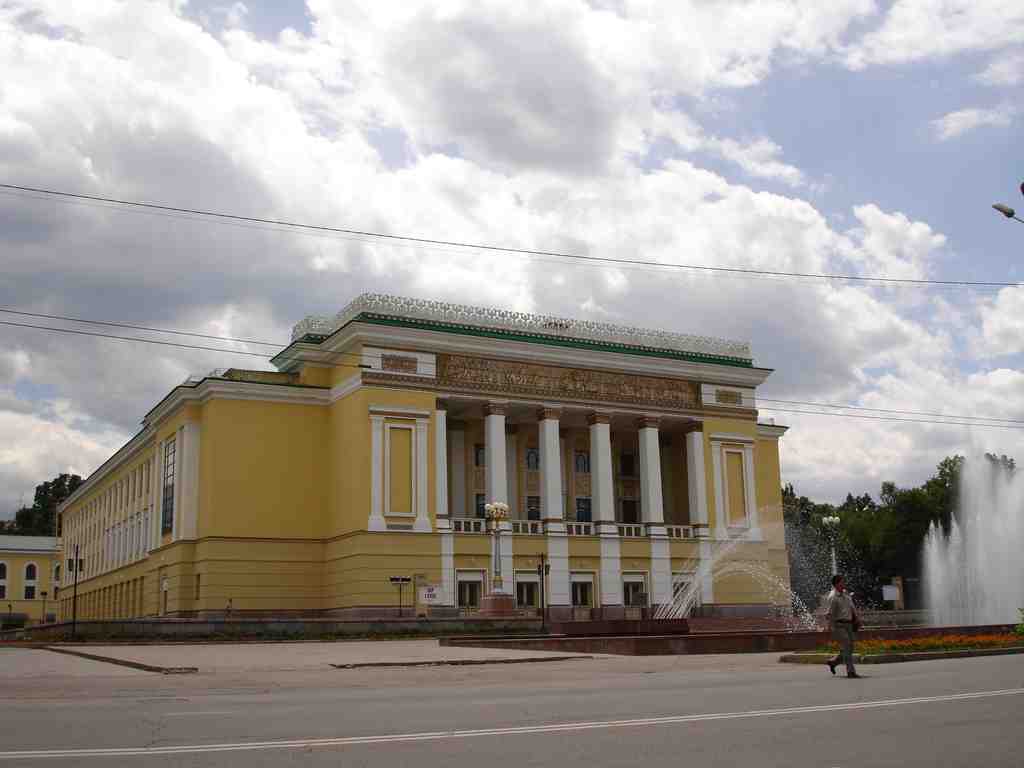
To spot the Abay Opera House, just look for the grand yellow and white building with tall pillars, a large decorative frieze near the roof, and fountains spraying in front-it's right across the broad street and impossible to miss!
Standing here, let’s step back in time and imagine Almaty in the 1930s, bustling with fresh hope, where the seeds of Kazakhstan’s artistic dreams were just being planted. Picture the crisp mountain air mixing with the anticipation of something entirely new: a music studio, born in 1933, trying to find its voice. Imagine hammers, saws, and laughter as the first artists hammer out melodies and rehearse lines, not in an opulent palace but in humble beginnings-where the magic was all in their dreams and not yet in marble and gold.
Now, as you look at this dazzling facade, let your eyes wander up those mighty columns-it feels a bit like ancient Rome, doesn’t it? But keep looking; you’ll spot the bold Soviet touches, too. The architects, Kruglov, Prostakov, and Basenov, wanted to blend power and elegance, so they fused Stalinist strength, Italian flair, and Kazakh patterns into every detail. If you squint, you can almost imagine the builders in 1936 working through day and night, determined to finish before the world changed forever.
The original building took five long years to complete, the final stones settling into place in 1941. By then, Europe was at war, but here, they celebrated something beautiful: the very first performance in this new hall-an opera, of course. “Aiman Sholpan,” performed in 1934 before the building officially opened, was the show that kicked things off for Kazakh musicals. Its music was stitched together from local folk tunes and dreams too big to fit in any ordinary theater.
Fast-forward to 1945, and the entire opera house takes on a new name-the Abay Opera House, honoring the poet, philosopher, and singer Abai Qunanbaiuly, Kazakhstan’s own Renaissance man. If you listen closely-really closely-you might just hear the echoes of some of the company’s greatest voices drifting from the past. Names like Küläş Baiseitova, the “Kazakh nightingale,” or Ermek Serkebaev, who sang here for nearly sixty years. They took the stage with the confidence of folks who knew they were making history, their voices rising toward the gilded ceilings as if to challenge the mountains themselves.
The 1930s and 40s were an explosion of creativity for this place. Legendary Russian operas like “Carmen” and “Aida” found a home here, alongside the very first Kazakh ballets. By 1938, you could catch a performance of “Swan Lake” or the country’s own “Qalqaman and Mamyr,” where dancers spun their stories over polished floors. As the decades rolled forward, the theater kept growing-welcoming Soviet choreographers, world-famous composers, and daring local stars who filled the house with applause and, sometimes, a little backstage mischief (have you ever tried getting a tutu on a stubborn ballerina in a hurry?).
The building itself is a marvel, and not just on the outside. Imagine walking in and seeing grand rusticated walls, massive pylons decorated with arches, and quotations from Lenin about the power of art. Every inch tells a story-in flourishes, in stone, and in the whispered laughter from the loggias high above. Even the side walls are elegant, with pilasters and windows framed by broad platbands set in neat symmetry.
By the 1970s, the theater could boast a repertoire as dramatic as any season of your favorite show. Some of the country’s best-loved operas and ballets premiered here-“Abai,” “Spartak,” and “Swan Lake” among them, the sort of productions where the final curtain falls and the crowd is brought to its feet time after time.
Today, the Abay Opera House holds national status-a fact proudly declared by presidential decree in 2020. It’s watched over generations of artists and listeners, surviving renovations, revolutions, and more than a few wardrobe malfunctions. So as you stand here now, feel the legacy in the air, and let your imagination take a bow. This is more than a building. It’s the heart of Kazakhstan's stage, where every stone and sound tells the ongoing story of art, ambition, and applause.
For a more comprehensive understanding of the construction, management or the the stars of the opera company, engage with me in the chat section below.


