
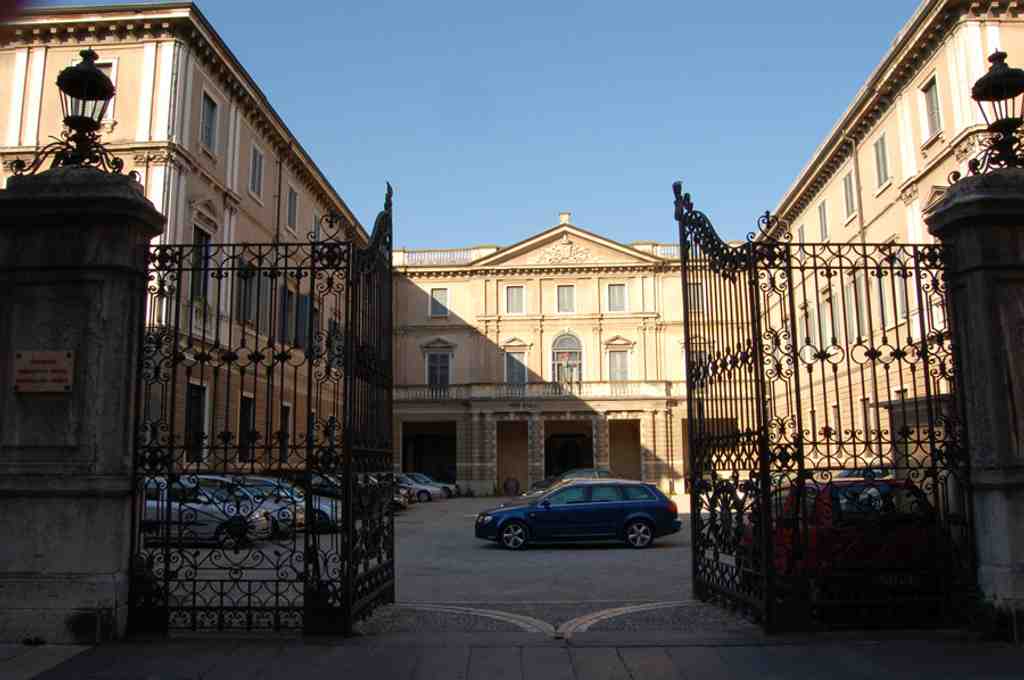
You’re facing a grand neoclassical façade flanked by two symmetrical wings and guarded by ornate iron gates, nestled at the crossroads of Via San Mammaso and Via Giuseppe Garibaldi-if you see a wide courtyard behind imposing railings and a pediment bearing a family crest, you’re in the right place!
Ah, Miniscalchi Erizzo Palace! Doesn’t it look like the sort of place where you’d expect a count to pop out, adjust his ruffled collar, and invite you for a game of chess… or perhaps a duel if you’ve insulted his mustache? But let’s whisk ourselves back to when all of this began, centuries before daily traffic turned its courtyard into a parade of Fiats.
Picture Verona at the end of the 1300s-a city rumbling with medieval merchants, cheeky poets, and rival noble families. Into this scene arrives the Miniscalchi clan from Bergamo, led by Zaninus Mereschalchus-quick on business, and even quicker on the climb to power. In 1409, Verona gave Zaninus the golden ticket: citizenship, which in those days opened more doors than a skeleton key. Flush with new status, the Miniscalchis bought themselves a spot on Via San Mammaso, where beneath the laughter and back-room deals of city life, they began plotting their legacy.
The original home was already old by then, boasting a loggia that had seen plenty of sneaky midnight arrivals. But in the late 1400s, the family decided to give it a true glow-up-out with the old, in with a showstopper. The architect is still a tantalizing mystery, but clues point to Angelo di Giovanni, who left his mark all over Verona, including on the loggia of the Consiglio and the famous church of San Tomaso Cantuariense.
By the time the dust settled, the palace wore a late-Gothic face along Via San Mammaso, with a stroboscopic portal and a rhythm of eighteen windows-three floors of grandeur designed like a stage set, every square inch screaming, “We’ve made it!” The inner courtyard, carefully paved with herringbone bricks, became the heartbeat of the house-a space for duels of wit or, if you were unlucky, swords. If only scandal and romance echoed half as long as those bricks last.
Come the Renaissance, tastes get spicier-everyone wants a bit of fresco’d charm. Michelangelo Aliprandi, star apprentice of Veronese, splashed the façade with the hottest scenes and heroes. You’ve got banquet feasts right over the street, mythological characters striking poses above the windows, and a frisky parade of putti, wild beasts, and river gods. Try not to stare too long, or you’ll be accused of daydreaming about ancient glories yourself!
Fast-forward to 1880 and a new appetite for everything neoclassical. Gustavo Strauss designed the impressive new wing, now facing you on Via Garibaldi, complete with a formal courtyard and iron fences heavy enough to keep out even the nosiest neighbor-or maybe just the local taxman. Their proud stone crest-crowned and inscribed with “Ex concordia fratrum” or “From brotherly harmony”-reminds everyone who really runs the show here.
And you know, amid all that grandeur, some stories sting with a pinch of melancholy. The last Miniscalchi Erizzo, Count Mario, had no children to inherit his treasure chest of fine art and curiosities. Instead of letting it scatter to the wind, he founded a museum in 1955. The city waited until the passing of his widow in 1977; then, the restoration wizards got to work, scrubbing centuries of drama from the walls and unveiling collections-think Renaissance drawings, parade armor, ancient books, oddities from villa Pullé, and even a room recreating Ludovico Moscardo’s “wunderkammer.”
By the late ‘80s, the exhibitions got so much applause that Verona’s sophisticated society nearly sprained a wrist clapping. “Painted Facades” won fans in Rome and even in Nîmes, during the week celebrating Verona’s friendship with its French cousin.
So as you gaze at those solemn stone faces and mythic banquets overhead, imagine the swirl of dancers, the bristle of gossip, and the echoes of ambition that built these walls. Now you’re not just outside a museum-you’re chasing the footsteps of centuries of family drama, triumph, heartbreak, and art, all in one splendid court. Fancy a duel? Just kidding… unless you brought your ruffled collar.




