
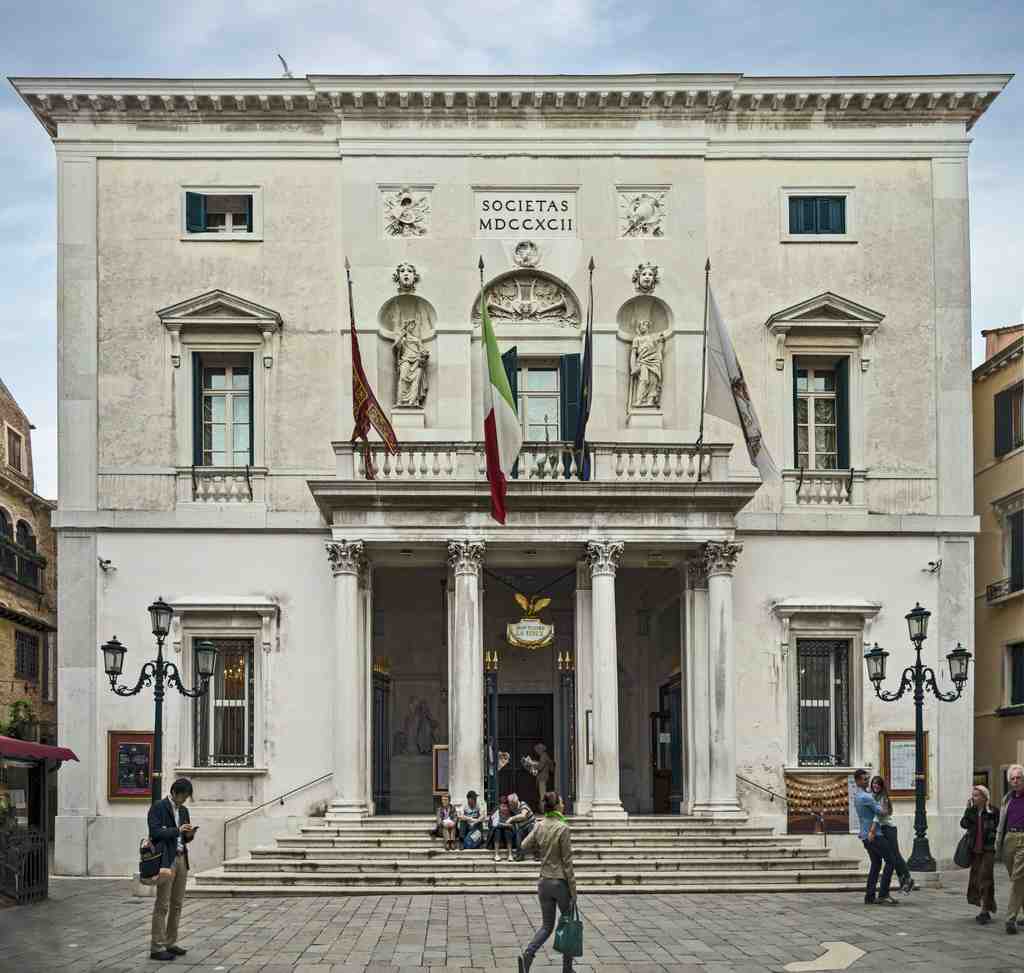
If you’re standing right in front of Gran Teatro La Fenice, take in the scene before you: a neoclassical façade dressed in soft whites and creams, three arched doors at ground level, and above them a small balcony lined with elegant columns. You’ll spot the theatre’s golden phoenix crest perched proudly near the top, glinting above pairs of blue and gold Venetian flags that sway gently. It’s not the biggest building on the street, but it stands out in its own stately, graceful way-so keep an eye out for the theatrical crowd gathering, and listen for a faint echo of music drifting through the bustling campo.
Now, imagine you’re here in the late 1700s. Venice is alive with the sounds of carriages, masked nobles, and the distant clang of church bells bouncing across the canals. At the very spot where you stand, the Grimani family has a plan: to build a magnificent opera house that will outshine them all-a place that would rise, like the legendary phoenix, from any disaster thrown its way. And boy, did it have to keep rising! La Fenice’s name literally means "the Phoenix," and it’s been true to its word, rising from fire not just once, but twice. Picture locals saying, “Will we ever get to see an opera again?" and the phoenix cackling, “But of course!” If only every problem could be solved so dramatically!
You might be surprised to know that, by the end of the 1700s, Venice was overflowing with theatres. Seven, to be exact-enough to keep everyone on their toes (and in elaborate costumes). But this spot was chosen for something entirely “grander.” When the old Teatro San Benedetto was lost to some courthouse squabbles, the dispossessed set their sights on creating a phoenix that could rise again, no matter what. Their challenge? Don’t just build a theatre-build *the* theatre, with five levels of private boxes (“palchetti,” or tiny opera apartments) so families could eat, gossip, play cards, and enjoy a performance all at once. Who wouldn’t want their own fancy box, where singing along was probably tolerated as long as you kept the snacks to yourself?
And let’s not forget how people arrived. Back then, the main entrance wasn’t from a busy street but from the canals-the red carpet was, in fact, water. Guests would glide up in sleek gondolas, dressed to impress, balancing masks and anticipation as they stepped out for a night under the velvet lights.
As you look at La Fenice now, remember the great composers who launched their masterpieces here-Rossini, Bellini, Donizetti, and Verdi. And in more recent times, wild minds like Stravinsky and Britten. This is more than a theatre-it’s a survivor, a rebirth artist, a place where the past and future sing together every night.
So, take a deep breath-can you almost hear a swelling overture or the tap of fancy shoes? Next stop: perhaps you’ll be inspired to hum an aria along the quiet Venetian alleys. But don’t worry-no opera glasses required for our next adventure!
If you're curious about the the first phoenix: from the competition announcement of 1789 to the inauguration of the theater in 1792, the "napoleonic transformation" and subsequent restorations: 1807-1835 or the from the fire of 13 december 1836 to the interventions of 1976, the chat section below is the perfect place to seek clarification.




