
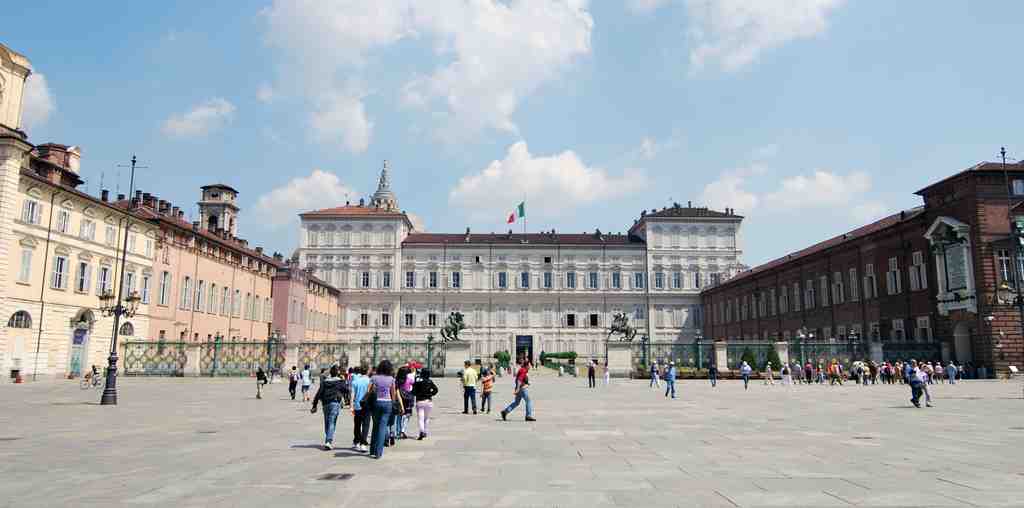
To spot Piazza Castello, look for a huge open square surrounded by elegant buildings and arched porticoes, with the grand white facade of Palazzo Madama standing right at its heart.
Welcome to Piazza Castello-Turin’s living room and quite possibly the best place in the city to lose your sense of direction while admiring the view! Stand here, and you’re standing in the pulsing heart of Torino, where four major roads crisscross like spaghetti: Via Garibaldi, Via Po, Via Roma, and Via Pietro Micca. You might even hear the whirl of bicycle wheels or the happy chatter of fellow explorers all around you.
But oh, the stories these stones could tell! Back in the 1st century AD, this square was nothing more than the eastern entrance to a Roman military camp-Julia Augusta Taurinorum. The Roman gate held steady against wild barbarian raids and the clang of swords during the rule of Lombard dukes, its two massive towers staring down danger like a pair of grumpy old men. By the Middle Ages, the gate got a glow-up, becoming a fortified home for the local bishop, and later, an ever stronger castle-giving the square its name, Castello.
Fast-forward to the drama of the 1500s-when the Savoy Dukes shifted their entire capital here, you could almost feel the city’s chest puff up with pride. The square had everything: festive fairs under the porticoes, fancy palaces, secret ducal passages, and even space for solemn masses. When the Holy Shroud of Turin arrived in 1578, crowds squeezed in here, dazzled, and probably elbowing each other for a better view.
The next few centuries? Architects came in with rulers and lanterns, laying down plans by candlelight. Some, like Ascanio Vitozzi, wanted an elegant square with perfect lines (probably the type who meticulously rearranged their pencils). Others, like Castellamonte and Juvarra, added porticoes for the snow-splattered nobles, a shiny new Royal Palace, and even a pinacoteca full of paintings-though fires and wars didn’t always cooperate.
If you’d strolled here in the 1800s, you might trip on the cobbles-and then get distracted by Napoleonic soldiers, noble ladies, or a few tram horses jostling their way through. King Carlo Alberto added the grand gates you see now, complete with bronze statues of Castor and Pollux to “guard” the Royal Palace. Art lovers flocked to the sparkling Galleria Subalpina, movie buffs caught a flick in its cinema, and even today you can find shoppers and dreamers wandering through.
Wander the square and look for the statues: boldly perched at corners you’ll find symbols of military glory, like the white marble Standard-Bearer dedicated to the Sardinian Army, or the heroic General Aosta, cast from enemy cannons-extra points for recycling, right? Spot the elegant porticoes lining the sides, each with its own stories of carnivals, royal ceremonies, and the wild celebrations of loyal Juventus football fans.
It isn’t just about the past, though! Piazza Castello has a flair for the dramatic-hosting everything from giant bonfires (the Falò di San Giovanni) to wild concerts and glowing drone shows. For centuries, crowds have gathered around the burning wooden pole on the eve of June 24th, eyes fixed on the top where the city’s bull-Torino’s mascot-stands. If the pole falls toward Via Roma, it means good luck for the whole city; if not, well, there’s always next year’s party!
So, whether you’re here to marvel at baroque facades or just pick a prime people-watching spot, Piazza Castello is Torino’s stage. Every era left its mark-ancient Roman gates, medieval fortresses, grand palaces, and modern celebrations. The only thing missing is your own story, drifting into this square’s timeless soundtrack.
Interested in knowing more about the description, i will make of san giovanni or the places of interest


